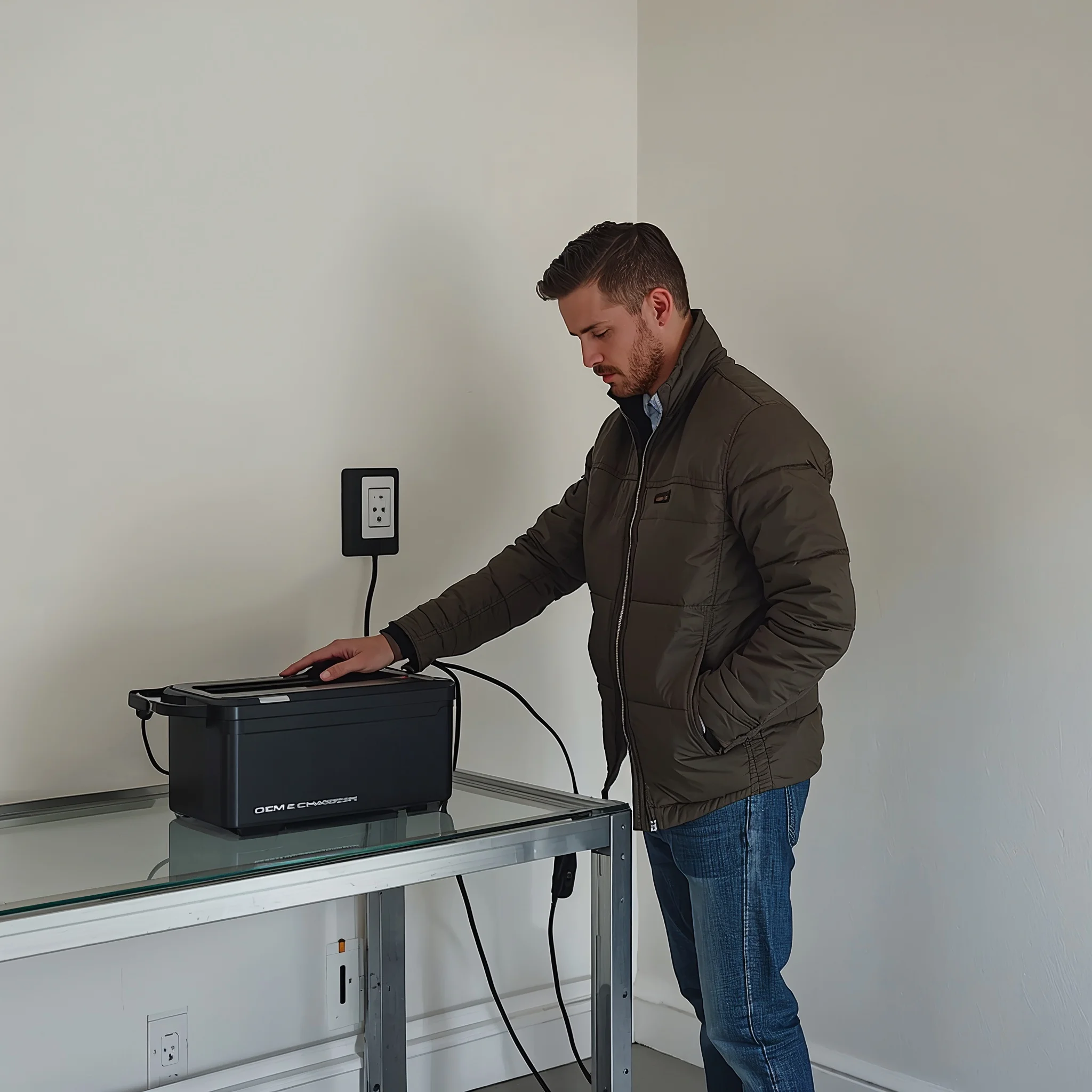
The safest way to charge e-bike battery at home is to use the original manufacturer-approved charger, charge on a clear hard surface, stay nearby, keep the battery away from flammable materials, and unplug it after charging is complete.
That may sound simple, but most unsafe charging situations start with everyday habits: charging on a rug, using a charger that “fits,” leaving the battery plugged in overnight, storing packs near exits, or charging a battery that was dropped but still seems to work.
E-bike batteries are powerful lithium-ion battery packs. When they are correctly made, correctly charged, and undamaged, they can be used safely. When they are damaged, mismatched with the wrong charger, exposed to heat or water, cheaply rebuilt, or left charging in a poor location, the risk changes quickly.
This guide gives you a practical home charging routine, a risk-check table, apartment safety steps, emergency warning signs, U.S. recall guidance, UL certification basics, and safer disposal advice.
The Safest Home Charging Setup for an E-Bike Battery

Use this one-screen setup before every charge:
- Use only the charger approved by the e-bike or battery manufacturer.
- Charge on a hard, flat, nonflammable surface.
- Keep the battery away from beds, sofas, rugs, curtains, paper, clothing, cardboard, heaters, direct sun, and water.
- Stay nearby while charging.
- Do not charge overnight.
- Do not block exits, hallways, stairs, doors, or escape paths.
- Make sure smoke alarms work near the charging area.
- Unplug the charger after the battery is full.
- Stop using the battery if it is swollen, cracked, leaking, unusually hot, noisy, smoking, or smells odd.
A good home charging spot is boring: clear floor or workbench space, ventilation, no clutter, no soft materials, no heat source, and a direct wall outlet that is in good condition.
Use the original manufacturer-approved charger only
The safest charger is the one supplied by the e-bike manufacturer or specifically approved for that exact battery model.
A charger plug that fits does not prove the charger is safe. Voltage, current, connector wiring, charging profile, and battery management system compatibility all matter.
Avoid:
- random marketplace chargers
- “universal” chargers unless the manufacturer confirms compatibility
- chargers borrowed from another e-bike
- chargers with damaged cords, bent pins, heat marks, or buzzing sounds
- cheap replacements that do not list the exact compatible model
If your charger is lost or broken, contact the e-bike brand or battery manufacturer and ask for the correct replacement.
Charge on a hard, nonflammable, ventilated surface
Do not charge on a bed, sofa, rug, carpet, cardboard box, fabric chair, or pile of clothing.
Choose a surface such as:
- concrete floor
- tile floor
- metal workbench
- clear utility-room floor
- garage floor, if temperature and moisture are controlled
- other hard surface with nothing flammable nearby
Ventilation matters because charging creates heat. A battery should not be trapped in a closet, under bedding, inside a bag, or surrounded by stored items.
Keep the battery away from beds, sofas, rugs, paper, curtains, water, heaters, and direct sun
The safest charging area has space around it. Do not place the battery near:
- curtains
- bedding
- laundry
- paper bags
- cardboard
- cleaning chemicals
- gas cans
- paints or solvents
- radiators
- portable heaters
- sunny windows
- sinks, tubs, or wet garage floors
If a charging battery fails, nearby materials can make a small problem spread quickly.
Stay nearby while charging and unplug after full charge
Do not treat e-bike charging like phone charging.
Stay in the home and check the battery during charging. When the charger shows the battery is full, unplug it from the wall and then disconnect it from the battery.
Unplugging after full charge helps reduce unnecessary heat exposure and wear. It also prevents the charger and battery from staying energized for hours after charging is no longer needed.
Never block exits, hallways, stairs, or escape paths
A charging e-bike battery should never sit between people and the way out.
Avoid charging:
- beside the front door
- in a hallway
- on stairs
- near a bedroom door
- beside a fire escape window
- in shared building corridors
- anywhere people would need to pass during an emergency
This is especially important in apartments, dorms, shared houses, and small homes.
Is Your E-Bike Battery Safe to Charge Right Now? Use This Risk Check First

Before you plug in the charger, check whether the battery is safe to charge today.
| Battery condition | What it means | What to do |
|---|---|---|
| Normal shape, no damage, correct charger, normal temperature | Lower-risk charging condition | Charge using the safe setup in this guide |
| Hot after riding | Charging immediately can add heat stress | Let it cool first |
| Very cold from outdoor storage | Charging while too cold may damage the battery | Let it return to normal indoor temperature first |
| Swelling, dents, cracks, leaks, corrosion, odd smell, loose wiring, frayed charger cable | Possible battery or charger damage | Do not charge |
| Dropped, crashed, crushed, or water-exposed battery | Internal damage may not be visible | Do not charge until inspected by the manufacturer or a qualified repair provider |
| Smoke, hissing, popping, burning smell, sparks, flames, rapid heating | Emergency condition | Evacuate and call emergency services |
Safe to charge: normal battery, correct charger, no damage, normal temperature
You can charge the battery when:
- the charger is the correct one
- the battery looks normal
- the charger cable and plug are undamaged
- the battery is dry
- the battery is not unusually hot or cold
- the charging location is clear and safe
- you can stay nearby
Even then, use a safe surface and do not charge overnight.
Wait before charging: battery is hot after riding or exposed to cold/heat
If you just finished a ride, let the battery cool before charging.
If the battery sat in a hot car, direct sun, freezing shed, or cold garage, let it return to a moderate indoor temperature before charging. Follow your manufacturer’s manual for exact charging temperature limits, because safe operating ranges vary by battery.
Do not speed up the process with a heater, hair dryer, freezer, or direct sun.
Do not charge: swelling, dents, cracks, leaks, odor, unusual heat, frayed wires, crash/drop damage
Do not charge a battery if you see or notice:
- swelling
- bulging case
- dents
- cracks
- leaking fluid
- corrosion
- melted plastic
- burning smell
- chemical smell
- unusual heat
- loose charging port
- frayed charger wire
- damaged plug
- hissing, popping, or crackling sounds
Also stop if the battery was dropped, hit in a crash, crushed in transport, or exposed to water. A battery can still power the bike and still be unsafe to charge.
Emergency: smoke, hissing, popping, burning smell, flames, or rapid heating
If the battery is smoking, making noise, heating rapidly, sparking, or burning, treat it as an emergency.
Do not pick it up. Do not open it. Do not puncture it. Do not carry it through the home. Do not try to “finish the charge.”
Leave the area, close the door if you can do so safely, get everyone out, and call emergency services.
Why E-Bike Batteries Can Become a Fire Risk Indoors

Most e-bike batteries use lithium-ion cells. These cells store a lot of energy in a small space. That is why e-bikes can travel useful distances without a huge battery.
The same energy density also means battery problems can become serious. If cells are damaged, overheated, overcharged, poorly made, or paired with the wrong charger, they may enter a failure process often called thermal runaway. In plain English, the battery can begin heating itself faster than the heat can escape.
That is why charging setup matters.
Wrong charger or voltage/current mismatch
Using the wrong charger is one of the most avoidable risks.
A charger can have the same plug shape but still be unsafe for your battery. The voltage may be wrong, the charging current may be too high, or the charger may not communicate correctly with the battery’s management system.
Safer rule: if the charger is not original or officially approved for your exact battery model, do not use it.
Damaged cells, crash damage, water exposure, or internal short circuits
A battery does not need to look destroyed to be unsafe.
Crash impact, drops, crushing, water exposure, or a damaged charging port can create internal problems that are hard to see from the outside. A pack may still turn on the bike but fail later during charging or storage.
If damage is possible, stop using the battery and ask the manufacturer or a qualified service provider what to do next.
Cheap, uncertified, rebuilt, or poorly repaired batteries
Be careful with bargain replacement batteries, rebuilt packs, and marketplace listings that make vague safety claims.
Higher-risk signs include:
- no clear brand or manufacturer
- no exact model compatibility
- no real certification details
- no warranty or support
- unusually low price compared with the original battery
- seller cannot confirm charger compatibility
- battery was rebuilt by an unknown repair shop
A replacement battery should match the e-bike system and charger requirements, not just the frame mount.
Overheating from heat, poor ventilation, or unsafe charging locations
Heat increases stress on a battery.
Do not charge:
- in direct sunlight
- beside a heater
- inside a closed bag
- inside a packed closet
- in a hot garage
- on a soft surface that traps heat
- under blankets or clothing
A safe charging zone gives heat room to escape and keeps flammable materials away.
Can an e-bike battery catch fire when it is not charging?
Yes, a damaged or defective lithium-ion battery can become dangerous even when it is not actively charging.
Charging is a common risk moment because energy is moving into the battery, but storage conditions also matter. That is why you should store batteries away from exits, sleeping areas, heat, water, and flammable materials.
If a battery has warning signs, do not assume it is safe just because it is unplugged.
How to Charge an E-Bike Battery Safely at Home: Step-by-Step Routine

Use the same routine every time. A predictable charging habit reduces mistakes.
Step 1: Read the battery and charger label before plugging in
Check that the charger matches the battery.
Look for:
- brand
- battery voltage
- charger output
- model number
- connector type
- manufacturer guidance
- warning labels
If you are not sure whether the charger belongs to that battery, do not guess. Contact the manufacturer.
Step 2: Inspect the battery, charger, port, cable, and plug
Before charging, inspect:
- battery case
- charging port
- charger cable
- wall plug
- connector pins
- battery mount
- visible wires
- charger brick
Do not use the battery or charger if anything looks melted, cracked, loose, corroded, wet, frayed, or unusually worn.
Step 3: Let the battery cool after riding before charging
After a ride, especially a long ride, hill climb, hot-weather ride, or heavy cargo trip, let the battery cool.
Place it in a safe indoor location away from heat and flammable materials. Once it feels normal and the manual’s charging conditions are met, begin charging.
Step 4: Choose a safe charging surface and clear nearby materials
Choose a hard, open, ventilated place.
Clear at least the nearby area of:
- paper
- boxes
- clothing
- bedding
- curtains
- cleaning products
- fuel containers
- tools with oily rags
- trash
- pet bedding
- children’s toys
If you cannot create a clear charging zone, do not charge until you can.
Step 5: Plug in correctly and avoid damaged extension cords or power strips
Best practice is to plug the charger directly into a wall outlet that is in good condition.
Avoid charging through:
- damaged extension cords
- cheap power strips
- overloaded outlets
- loose wall sockets
- multi-plug adapters
- cords running under rugs
If you must use an extension cord because of layout constraints, check your manufacturer’s guidance and use only a properly rated, undamaged cord. In many home setups, the safer answer is to move the charging location closer to a proper wall outlet.
Step 6: Monitor the battery while charging
Stay nearby and check the battery occasionally.
Stop charging immediately if you notice:
- unusual heat
- smell
- swelling
- charger noise
- battery noise
- flickering charger indicator
- sparks
- smoke
- melting plastic
- sudden change in shape
Do not leave the home while the battery is charging.
Step 7: Unplug after full charge and store safely
When the charger indicates full charge, unplug it.
Then store the battery in a safe place away from heat, water, flammable materials, and exits. If storing for longer than normal daily use, follow the battery manual’s storage charge guidance.
Best and Worst Places to Charge an E-Bike Battery at Home

The best charging place is not always the most convenient place. Choose safety first.
| Charging location | Safer or riskier? | Why |
| Clear concrete garage floor | Usually safer if dry, moderate temperature, and no flammables nearby | Hard surface and space, but watch heat, cold, fuel, and clutter |
| Utility room with tile floor | Often safer if ventilated and not near exits | Hard surface and controlled indoor conditions |
| Metal workbench with clear space | Often safer if stable and away from flammables | Non-soft surface and easy monitoring |
| Bedroom floor | Risky | Sleeping area and possible exit-path issue |
| Bed, sofa, rug, carpet | Unsafe | Soft materials trap heat and can ignite |
| Closet | Unsafe | Poor ventilation and often surrounded by combustibles |
| Hallway, stairs, entry door | Unsafe | Blocks escape route |
| Balcony | Depends | May be exposed to sun, rain, theft, extreme temperatures, and building rules |
| Shed | Depends | Heat, cold, moisture, dust, and flammables can be problems |
Safest indoor charging area: clear, ventilated, hard, nonflammable surface
A safer indoor setup looks like this:
- hard floor or stable bench
- nothing flammable nearby
- direct wall outlet
- no blocked exit
- working smoke alarm nearby
- normal room temperature
- easy to observe while charging
- battery protected from kids and pets
For many homes, a utility room, clear garage space, or tiled corner away from exits works better than a bedroom or living room.
Places to avoid: bedrooms, beds, sofas, rugs, closets, hallways, exits, stairs, and cluttered areas
Avoid charging where people sleep or where they must pass to escape.
The highest-risk home charging places are often chosen for convenience: beside the front door, in a hallway, near a couch, or in a bedroom. These are exactly the places to avoid.
Garage, shed, balcony, or utility room: safer only if conditions are controlled
A garage can be a good charging area only if it is not too hot, too cold, damp, or filled with flammable storage.
Avoid charging near:
- gasoline
- propane
- paint
- solvents
- lawn equipment
- sawdust
- oily rags
- cardboard storage
- space heaters
A balcony may seem safer because it is outside, but rain, direct sun, freezing temperatures, theft risk, and apartment rules may make it unsuitable.
Is it safer to remove the battery or charge it installed on the bike?

It depends on your e-bike design and manufacturer instructions.
Removing the battery may be safer if it lets you charge on a clear, hard, monitored surface away from exits and flammable materials. Charging while installed may be safer if removing the battery risks dropping it, damaging connectors, or exposing contacts.
Use this decision rule:
- If the manual says to remove it, remove it carefully.
- If the manual allows either, choose the setup with the clearest, hardest, least cluttered, best-monitored location.
- If removing the battery is difficult or the latch feels damaged, do not force it.
The goal is not “battery removed” by itself. The goal is a safer charging environment.
Why exit paths and smoke alarms matter

A battery fire can produce heat, smoke, and toxic gases quickly. The charging location should not trap people inside.
Keep the battery away from:
- main doors
- bedroom doors
- stairs
- hallway paths
- fire escape windows
- shared corridors
Smoke alarms should be working near sleeping areas and near the charging zone, based on your home layout and local guidance.
Apartment, Dorm, Workplace, Garage, and Shared-Space Charging Safety

Shared living spaces need stricter habits because one unsafe battery can affect many people.
Apartment renters: check lease, building rules, exits, alarms, and charging location
Before charging in an apartment:
- Check your lease and building rules.
- Do not charge in shared hallways.
- Do not block doors, stairs, elevators, or fire exits.
- Keep the battery away from the front door.
- Charge only where you can stay nearby.
- Keep smoke alarms working.
- Ask building management if there are approved charging areas.
Small apartment example:
A safer setup may be a clear tiled kitchen or utility corner away from the front door, curtains, trash, and appliances that produce heat. A worse setup is charging beside the entrance because “it is near the bike.”
Dorms and workplaces: follow facility rules and avoid unattended shared charging
Dorms, offices, warehouses, and delivery hubs may have their own rules for e-bike charging.
Follow those rules even if your battery seems normal. Do not charge under desks, in storage closets, near paper supplies, in hallways, or in crowded shared areas.
If no rule exists, ask before charging.
Delivery riders and multi-battery homes: separate packs, avoid crowding, label chargers
Delivery riders and multi-bike households may charge several batteries often. That increases the importance of organization.
Use these habits:
- Label each charger with the matching battery model.
- Do not mix chargers.
- Do not stack batteries.
- Keep batteries separated while charging.
- Do not charge multiple packs on one overloaded outlet.
- Retire damaged packs instead of pushing them for “one more shift.”
- Keep spare batteries away from the charging battery.
If you depend on e-bike batteries for work, build charging time into your schedule so you are not tempted to charge overnight or unattended.
Families with kids or pets: keep batteries out of reach and away from living spaces
Children and pets can pull cords, knock batteries over, chew cables, block ventilation, or move flammable items near the charger.
Charge where the battery is:
- visible to an adult
- out of reach
- away from pet beds
- away from toys
- away from food and water bowls
- not in a child’s bedroom or play area
Garage or shed charging: manage heat, cold, moisture, dust, and flammable storage nearby
Garages and sheds can look safer because they are not bedrooms, but they often contain flammable materials.
Before charging in a garage or shed, check:
- Is the floor dry?
- Is the space too hot or too cold?
- Are gasoline, propane, solvents, cardboard, or oily rags nearby?
- Is the outlet in good condition?
- Can you monitor the battery?
- Is the battery protected from dust and moisture?
- Is there a clear exit path?
A cluttered garage is not automatically safer than a clear indoor utility space.
Should You Leave an E-Bike Battery Charging Overnight, Fully Charged, or Unattended?

No. Do not leave an e-bike battery charging overnight or unattended indoors.
Even if your charger is designed to stop charging when the battery is full, you should still unplug it after charging. A smart charger reduces certain risks, but it does not make poor charging habits safe.
Why unattended charging increases risk
If a battery begins to overheat, swell, smoke, smell odd, or make noise, someone needs to notice quickly.
Unattended charging removes that chance. A problem that might have been stopped early can become a fire while no one is nearby.
Why overnight charging is not recommended indoors
Overnight charging usually means:
- people are asleep
- warning signs may go unnoticed
- exits may be harder to reach
- smoke can spread before anyone reacts
- the battery may remain plugged in for hours after it is full
Charge earlier in the day or evening when you can stay awake and nearby.
What to do when the charger says the battery is full
When the charger shows full:
- Turn off the charger if it has a switch.
- Unplug from the wall.
- Disconnect from the battery.
- Let the battery sit in a safe storage location.
- Check that the charger and battery are not unusually warm.
Do not leave the charger connected “just in case.”
Fire safety vs battery lifespan: do not confuse the two
Some advice is about fire safety. Some advice is about long-term battery health.
Fire-safety habits include:
- correct charger
- no damaged battery
- no overnight charging
- safe surface
- clear space
- no blocked exits
- supervision
Battery-lifespan habits include:
- avoiding unnecessary full-charge storage
- avoiding deep discharge
- avoiding heat
- storing partially charged when not used for a long time
Both matter, but they are not the same.
Is the 40–80 rule about safety, battery life, or both?

The 40–80 rule is mainly a battery-life habit. It means some riders try to keep the battery roughly between partial and high charge instead of constantly draining it to empty or storing it full.
It is not a replacement for fire safety. A damaged battery at 60 percent can still be dangerous. A safe battery charged to 100 percent with the correct charger in a safe location is not automatically unsafe just because it is full.
For daily use, follow your manufacturer’s charging guidance. For long-term storage, follow the manual’s recommended storage charge.
Where and How to Store an E-Bike Battery Safely When Not in Use

Safe storage matters because battery problems do not only happen during charging.
Best indoor storage location for safety
Store the battery:
- in a cool, dry, moderate-temperature space
- away from direct sun
- away from heaters
- away from water
- away from flammable items
- away from exits and stairs
- where it cannot be knocked over
- out of reach of children and pets
Do not store an e-bike battery under a bed, in a closet full of clothes, beside a door, or inside a hot car.
Best storage temperature for battery life and fire-risk reduction
Use the manufacturer’s manual for exact storage temperature ranges.
As a general safety habit, avoid storing the battery in:
- freezing sheds
- hot garages
- direct sunlight
- vehicles on warm days
- damp basements
- areas near heaters
A moderate indoor temperature is usually better than extreme heat or cold.
How much charge to leave for daily storage
For daily riding, charge only as much as you reasonably need and unplug after charging.
If you ride every day, you may charge more often. If the bike will sit unused, do not automatically store the battery fully charged for weeks unless your manual recommends it.
How to store an e-bike battery for winter or long-term storage
For winter or long-term storage:
- Read the manual first.
- Clean and dry the battery exterior.
- Inspect it for damage.
- Store it partially charged if the manual recommends that.
- Keep it away from extreme temperatures.
- Check it periodically.
- Do not store it on the charger.
- Do not store it near flammable materials.
If the battery was damaged during the riding season, do not store it and hope it improves. Handle it as a damaged battery.
What not to store near an e-bike battery
Keep batteries away from:
- gasoline
- propane
- paint
- solvents
- oily rags
- paper
- cardboard
- bedding
- curtains
- clothing piles
- trash
- cleaning chemicals
- heat sources
- water sources
Storage safety is about reducing both the chance of failure and the chance that a failure spreads.
Warning Signs You Should Never Ignore — and What to Do Immediately

Stop using an e-bike battery when something changes. Do not wait for a second warning.
Stop using the battery if you see swelling, dents, cracks, leaks, corrosion, or loose wiring
These are stop-use signs:
- swollen battery case
- bulging side panels
- dents from a crash
- cracked plastic
- leaking liquid
- corrosion around contacts
- loose wires
- damaged charging port
- melted areas
- exposed cells
Do not charge, ride, sell, donate, or repair the battery yourself.
Stop charging if you notice unusual heat, odor, smoke, hissing, popping, or sparking
During charging, unplug only if you can do so safely and without touching a dangerous battery.
Stop charging if you notice:
- battery getting unusually hot
- burning smell
- sweet chemical smell
- smoke
- hissing
- popping
- crackling
- sparking
- charger overheating
- rapid swelling
If the situation feels unsafe, leave and call emergency services.
What to do if the battery smokes, smells burnt, or catches fire
Take fast action:
- Alert everyone nearby.
- Leave the area.
- Close the door behind you if safe.
- Call emergency services from outside.
- Tell responders it is a lithium-ion e-bike battery.
- Do not re-enter until firefighters say it is safe.
Do not try to carry a smoking battery through your home.
When to evacuate and call emergency services
Evacuate and call emergency services if you see:
- smoke
- flames
- sparks
- rapid heating
- hissing or popping
- strong burning or chemical smell
- battery case swelling quickly
For U.S. readers, call 911. Outside the U.S., call your local emergency number.
Why you should not move, open, puncture, or repair a dangerous battery yourself
A damaged lithium-ion battery can behave unpredictably.
Do not:
- open the battery case
- puncture cells
- cut wires
- pour water into the pack
- tape over major damage and keep using it
- rebuild it yourself
- mail a damaged battery without approved instructions
- throw it in the trash
A dangerous battery needs proper handling, not a DIY fix.
How to Check E-Bike Battery Recalls, Stop-Use Warnings, and UL Certification in the U.S.

This is one of the most important steps for U.S. e-bike owners, especially if the bike came from an online marketplace or budget brand.
How to find your e-bike battery model number and charger model number
Before checking recalls or certification, collect:
- e-bike brand
- e-bike model
- battery model number
- charger model number
- serial number
- voltage and amp-hour rating
- purchase date
- seller or marketplace
- order receipt
- photos of the battery label and charger label
Do not rely only on the product title from an online listing. Marketplace titles can be incomplete or changed later.
How to search CPSC recalls and product safety warnings
Use the U.S. Consumer Product Safety Commission recall and warning search.
Search by:
- brand
- model number
- battery model number
- charger model number
- marketplace seller name
- “e-bike battery”
- “lithium-ion battery”
If your product appears in a recall or stop-use warning, follow the instructions exactly. Stop-use warnings are not suggestions; they are safety alerts for products that may create serious risk.
For example, CPSC has issued recent stop-use warnings for certain e-bike models and lithium-ion battery packs due to fire hazard concerns. Always check your exact model rather than assuming your bike is safe because it looks similar to another model.
What to do if you bought from Amazon, Walmart, eBay, or another marketplace
If you bought from a marketplace:
- Check your order history.
- Save the product listing if it is still available.
- Take screenshots of the seller name and model details.
- Compare the battery label to the recall listing.
- Contact the brand or seller only after checking official recall instructions.
- Do not keep using a recalled battery while waiting for a reply.
Be especially cautious if the listing is gone, the seller name changed, or the brand does not provide clear battery and charger support.
UL 2849 vs UL 2271: what each one means
| Standard | What it generally covers | Why it matters |
| UL 2849 | E-bike electrical system, including drive train, battery system, and charger system combination | Helps evaluate the complete e-bike electrical system as a system |
| UL 2271 | Battery packs for light electric vehicles | Helps evaluate the battery pack as a component |
| UL 2272 | Personal e-mobility electrical systems, often associated with devices like hoverboards and e-scooters | Useful in micromobility, but not the same as UL 2849 for e-bikes |
A battery claim alone is not the same as a full e-bike electrical-system certification. Look for the exact standard and exact model coverage.
How to verify UL certification and avoid fake safety claims
Do not trust a product page just because it says “UL certified.”
A safer verification workflow:
- Find the exact model number on the product label.
- Look for the certification mark and file number if available.
- Search UL Product iQ or UL certification databases.
- Match the exact brand, model, and standard.
- Confirm whether the listing covers the full e-bike or only the battery.
- Be skeptical of vague claims like “meets UL standards” without a verifiable certification record.
If you cannot verify the certification, treat the claim as unconfirmed.
What to Do With a Damaged, Wet, Recalled, Old, or Replacement E-Bike Battery

When a battery is no longer trustworthy, the safest action is usually to stop using it and handle it properly.
| Situation | Risk concern | Safer action |
| Dropped or crashed | Internal cell or wiring damage | Stop using until inspected |
| Wet or flooded | Short circuit, corrosion, delayed failure | Stop using and contact manufacturer |
| Recalled | Known safety issue | Follow recall or stop-use instructions |
| Old and weak | Higher failure risk if degraded or damaged | Replace with approved battery |
| Replacement needed | Wrong battery or charger mismatch | Buy manufacturer-approved or verifiably certified replacement |
| Swollen or smoking | Emergency risk | Evacuate and call emergency services |
Dropped or crashed battery: when to stop using it
If the battery was dropped hard, crushed, or involved in a crash, do not charge it just because it still powers the bike.
Stop using it if:
- the case is dented
- the mount is damaged
- the charging port feels loose
- the battery rattles
- the bike shows electrical errors
- the battery heats unusually
- the battery was hit directly
Ask the manufacturer or a qualified repair provider for next steps.
Wet or water-exposed battery: why it needs caution
Water exposure can cause corrosion, short circuits, and delayed electrical problems.
Do not charge a wet battery. Do not dry it with heat. Do not open the case.
If the battery was exposed to heavy rain, flooding, submersion, or pressure washing, contact the manufacturer before using or charging it again.
Recalled battery: stop-use and disposal steps
If your battery is recalled or listed in a stop-use warning:
- Stop using it immediately.
- Stop charging it.
- Store it away from living spaces and flammable materials if safe to do so.
- Follow the official recall instructions.
- Do not sell or donate it.
- Do not throw it in the trash.
- Ask your local household hazardous waste program whether it accepts damaged or recalled lithium-ion batteries.
Some recalled or defective lithium-ion batteries need special handling and should not go into regular battery recycling boxes.
Old or weak battery: when replacement is safer than repair
An old battery that has reduced range is not automatically dangerous. But replacement becomes safer than continued use when you see:
- swelling
- overheating
- sudden range loss
- charging errors
- loose connectors
- repeated shutdowns
- water damage
- physical damage
- unknown repair history
Avoid informal rebuilds unless the repair provider is certified, reputable, and approved for that battery type.
How to choose a safer replacement battery and charger
A safer replacement should:
- be approved by the e-bike manufacturer
- match the exact model
- include the correct charger or confirmed charger compatibility
- have clear labeling
- come from a traceable seller
- include warranty and support
- have verifiable certification where claimed
- avoid vague “universal” compatibility claims
Never buy a replacement pack only because the voltage and connector look similar.
Where U.S. users should dispose of damaged lithium-ion e-bike batteries
For damaged, defective, recalled, swollen, or water-exposed batteries, contact your local household hazardous waste program or municipality before transporting the battery.
Do not place damaged lithium-ion e-bike batteries in:
- household trash
- curbside recycling
- regular retail battery drop boxes
- public trash cans
- donation bins
Call ahead and explain that it is a damaged or recalled lithium-ion e-bike battery. Ask what packaging, transport, and drop-off steps they require.
Do Fireproof E-Bike Battery Bags, Boxes, Cabinets, and Extinguishers Actually Help?

Fireproof bags, boxes, cabinets, alarms, and extinguishers may reduce certain risks, but they do not make an unsafe battery safe.
The first line of protection is still:
- correct battery
- correct charger
- no damage
- safe charging location
- supervision
- no overnight charging
- proper storage and disposal
Fireproof battery bags: what they may help with and their limits
A fire-resistant bag may help contain small sparks, heat, or debris in some situations, depending on its design and quality.
But do not assume a bag can fully contain a serious e-bike battery failure. Large lithium-ion packs can release intense heat, smoke, and gases.
Use a bag only as an added layer, not as permission to charge on a bed, overnight, or unattended.
Charging boxes and metal containers: when they may reduce spread but add other risks
A metal box or container may reduce spread to nearby materials, but it can also trap heat or gases if poorly designed.
Do not seal a battery in an airtight container while charging unless the product is specifically designed and rated for that use.
If using a charging box, check:
- ventilation
- cable routing
- heat buildup
- manufacturer instructions
- whether it is intended for e-bike battery charging
- whether it keeps the battery away from flammable materials
Battery cabinets: better for multi-battery or commercial/shared setups
Battery charging cabinets may be more useful for delivery riders, workplaces, bike shops, apartment buildings, or homes with multiple batteries.
A proper cabinet should be selected based on the type and number of batteries, the charging setup, ventilation needs, and local fire-safety guidance.
For a single home battery, a cabinet can be helpful, but it still does not replace safe charging behavior.
Smoke alarms, heat alarms, and fire extinguishers: what role they play
Smoke alarms and heat alarms help with early warning. They do not prevent battery failure.
A fire extinguisher may help with small secondary fires around the battery, but serious lithium-ion battery fires can be difficult to control. Do not stay and fight a battery fire if the battery is smoking, popping, hissing, or rapidly heating.
Your priority is evacuation and calling emergency services.
Why containment is not a substitute for a safe battery, correct charger, and supervision
Containment products can create false confidence.
Do not use a bag, box, or cabinet to justify:
- charging a damaged battery
- using the wrong charger
- charging overnight
- charging beside exits
- charging near flammable materials
- ignoring smoke, smell, heat, or swelling
A safer system starts before the battery is plugged in.
Final Home Charging Fire-Prevention Checklist

Use this checklist before every charge.
Before charging
- Confirm the charger is original or manufacturer-approved.
- Check the battery label and charger label if there is any doubt.
- Inspect the battery for swelling, cracks, dents, leaks, odor, or heat.
- Inspect the charger, cable, plug, and port.
- Let the battery cool after riding.
- Let a cold battery return to normal indoor temperature.
- Choose a hard, clear, ventilated surface.
- Remove flammable materials nearby.
- Keep the battery away from exits, stairs, hallways, and sleeping areas.
- Make sure smoke alarms work.
While charging
- Stay nearby.
- Do not sleep while charging.
- Do not leave the home.
- Do not cover the battery or charger.
- Do not charge on beds, sofas, rugs, or carpets.
- Do not charge in closets or cluttered areas.
- Watch for heat, smell, noise, swelling, smoke, or sparks.
After charging
- Unplug after full charge.
- Disconnect the charger from the battery.
- Let the charger cool in open air.
- Store the battery in a cool, dry, moderate-temperature location.
- Keep the battery away from flammable materials.
- Keep it away from children and pets.
- Do not store it beside exits or doors.
Weekly battery and charger inspection
Once a week, check:
- battery case
- mounting rail
- charging port
- connector pins
- charger cable
- wall plug
- charger brick
- battery behavior during rides
- charging time changes
- unusual heat or smell
Small changes can be early warnings.
When to stop using the battery
Stop using and do not charge the battery if:
- it was damaged in a crash
- it was dropped hard
- it was exposed to water
- it is swollen
- it leaks
- it smells odd
- it gets unusually hot
- it makes hissing or popping sounds
- it smokes
- the charger or cable is damaged
- the battery appears in a recall or stop-use warning
When in doubt, do not charge it.
FAQ

Can we charge an electric bike at home?
Yes, you can charge an electric bike at home if you use the correct charger, choose a safe charging location, stay nearby, and follow the manufacturer’s instructions.
Do not charge on beds, sofas, rugs, or near exits. Do not charge overnight or unattended. If the battery is damaged, wet, swollen, unusually hot, or recalled, do not charge it.
What are the chances of an e-bike battery exploding?
There is no single reliable percentage for every e-bike battery because risk depends on battery quality, charger compatibility, damage history, certification, storage, and charging habits.
The risk is higher when a battery is damaged, uncertified, poorly repaired, exposed to water, overheated, or charged with the wrong charger. Focus on reducing controllable risks instead of relying on a general probability.
Can I use a third-party e-bike charger if the plug fits?
No, not unless the e-bike or battery manufacturer confirms that the charger is compatible with your exact battery model.
A plug that fits does not prove the voltage, current, wiring, or charging behavior is correct. Using the wrong charger can increase overheating and fire risk.
How should I charge an e-bike battery for the first time?
For the first charge, read the manual, use the supplied charger, inspect the battery, place it on a hard clear surface, plug it into a proper wall outlet, stay nearby, and unplug when charging is complete.
Do not use a third-party charger for the first charge. Do not charge overnight just because the battery is new.
What is the 40–80 rule for e-bike batteries?
The 40–80 rule is a battery-life habit where some riders try to keep the battery roughly between partial and high charge instead of always draining it to empty or storing it fully charged.
It is mainly about long-term battery health, not a complete fire-safety rule. A safe charging setup, correct charger, and undamaged battery still matter more for fire prevention.
How do I charge an e-bike battery to 80 percent?
You can charge to about 80 percent by using the bike display, battery indicator, app, smart charger setting, or estimated charging time if your system supports it.
Not every e-bike charger allows an exact 80 percent limit. Do not repeatedly unplug and replug in a way that conflicts with the manual. If your manufacturer provides an 80 percent charging mode, use that.
Is it safer to remove the battery from the bike before charging?
It can be safer to remove the battery if doing so lets you charge it on a clear, hard, monitored surface away from exits and flammable materials.
It may be better to charge it installed if removing it risks dropping the battery or damaging the connector. Follow the manufacturer’s instructions and choose the setup with the safer charging environment.
Where should U.S. users dispose of a damaged lithium-ion e-bike battery?
U.S. users should contact their local household hazardous waste program or municipality for damaged, defective, swollen, wet, or recalled lithium-ion e-bike battery disposal.
Do not put it in household trash, curbside recycling, or regular retail battery recycling boxes unless the official recall or local hazardous waste program specifically says it is accepted there.
Are fireproof e-bike battery bags worth it?
They may be worth using as an added layer of protection, but they are not a guarantee and should not be your main safety strategy.
A fire-resistant bag does not make a damaged battery safe, does not fix a wrong charger, and does not justify overnight or unattended charging.
What is the safest e-bike battery charger to buy?
The safest charger is the original charger or a replacement charger approved by the e-bike or battery manufacturer for your exact battery model.
Before buying, confirm the model number, voltage, output, connector, certification claims, seller reputation, and warranty support. Avoid vague universal chargers unless the manufacturer specifically approves them.
Pingback: Electric Bike Battery Safety: Charging, Warning Signs & UL Checks - electricscootercar.com
Pingback: E-Bike Battery Fire Risk: Causes, Warning Signs & How to Stay Safe - electricscootercar.com
Comments are closed.