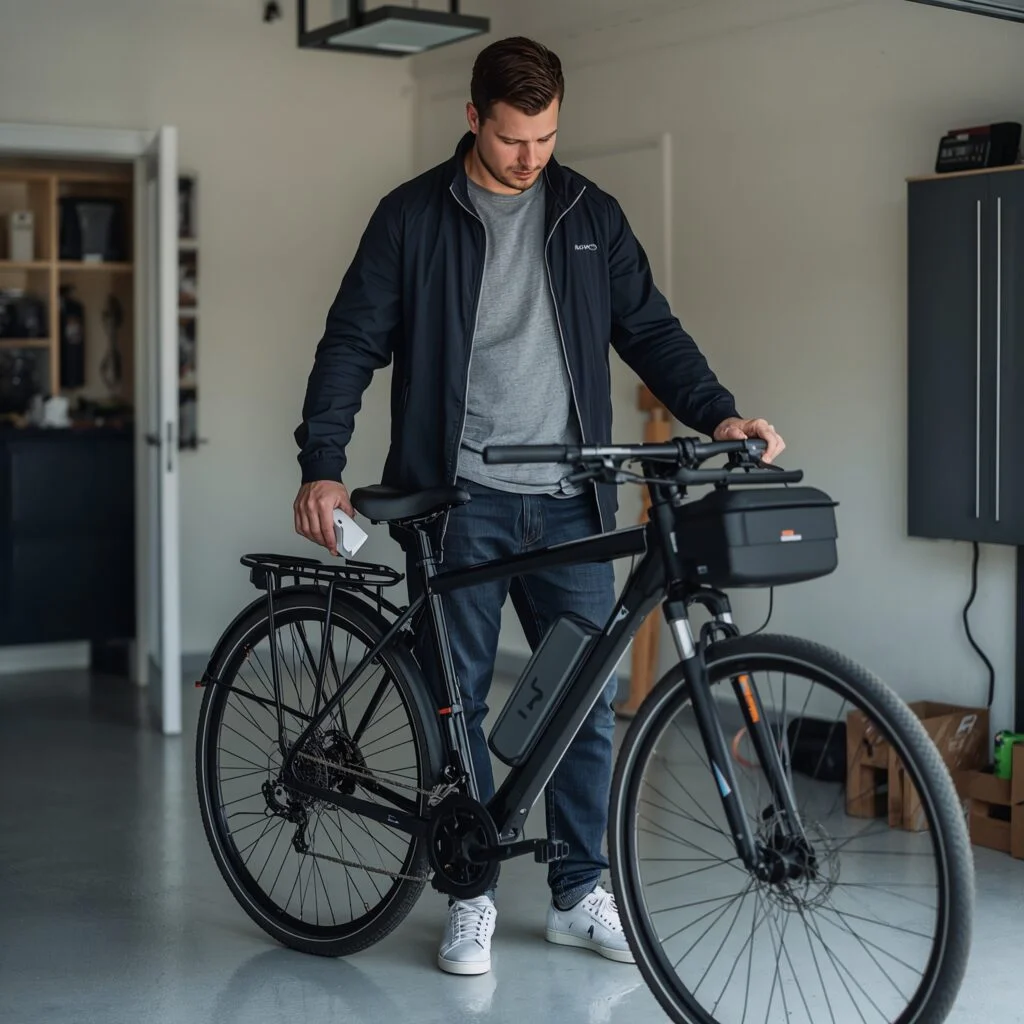
If you searched for “How to Check E-Bike Battery Health Safely,” you probably noticed one of three problems: your range has dropped, the battery shows full but dies quickly, or the bike cuts out under load.
The safest way to check an e-bike battery is not to start with a multimeter. Start with the symptoms. A swollen, hot, leaking, wet, smoking, or burnt-smelling battery should not be tested at home. A normal-looking battery can be checked with visual inspection, voltage testing, range comparison, charger checks, and load behavior.
This guide walks you through a beginner-safe diagnosis so you can decide whether the issue is the battery, charger, BMS, connector, controller, display, or normal aging.
Is Your E-Bike Battery Healthy, Failing, Dead, or Unsafe?

Start here before touching tools. A battery can look “charged” on the display and still fail under load. It can also show low voltage because the charger, connector, or BMS is the real problem.
Start with the symptom, not the tool
Your first question should be: what is the battery doing?
A voltage reading is useful, but it does not tell the whole story. A weak battery may show normal voltage when sitting still, then sag heavily when you accelerate or climb a hill.
Quick battery health diagnosis table
| Symptom | Most likely meaning | What to do next |
|---|---|---|
| Battery is swollen, hot, leaking, smoking, sparking, or smells burnt | Unsafe lithium-ion battery condition | Stop using it. Do not charge or test at home. Move it away from combustibles if safe and contact local guidance, dealer, or fire professionals if there is active danger. |
| Battery charges fully but range is much lower than before | Aging cells, reduced capacity, cold weather, tire/route changes, or high assist use | Compare range under the same route and conditions. Check voltage and load behavior. |
| Display says 100% but bike cuts out under load | Voltage sag, weak cell group, BMS cutoff, connector issue, or display mismatch | Check voltage after full charge and after riding. Inspect connectors. Consider shop testing. |
| Charger light stays green and battery does not charge | Charger mismatch, broken charger, charge-port issue, BMS sleep, or full battery | Check charger label, output, connector fit, and battery voltage. |
| Battery voltage is near zero | BMS protection, deep discharge, internal failure, fuse issue, or no output at discharge port | Do not open the pack. Try manufacturer-approved steps only. Get dealer diagnosis. |
| Battery looks normal and range is stable | Battery may be healthy | Record baseline voltage and range for future comparison. |
When to test yourself vs when to stop immediately
You can usually do basic DIY checks when the battery casing is intact, dry, cool, undamaged, and not recalled.
Stop immediately if the battery has signs of fire risk, water damage, crash damage, melted plastic, chemical smell, swelling, or exposed wiring. In those cases, the goal is not diagnosis. The goal is safe handling.
Safety First: When You Should Not Test an E-Bike Battery at Home

Lithium-ion e-bike batteries store a lot of energy. The wrong test, wrong charger, or damaged pack can create a fire or burn hazard.
Do not test a swollen, hot, leaking, smoking, or burnt-smelling battery
Do not charge, ride, open, or multimeter-test the battery if you notice:
- Swelling or bulging casing
- Melted plastic
- Hissing, smoke, sparks, or popping sounds
- Burnt, sweet, chemical, or solvent-like smell
- Liquid leakage
- Corroded or burnt terminals
- Exposed wires
- Battery that stays hot after charging or riding
- Battery involved in a crash, flood, or fire
- Battery listed in a recall or stop-use warning
Safety note: Do not puncture, squeeze, open, or attempt to “repair” a lithium-ion pack. E-bike battery packs contain multiple cells and a battery management system. Internal damage is not always visible from the outside.
What to do if the battery smells burnt, smokes, sparks, or catches fire
If there is smoke, fire, sparking, or active overheating, treat it as an emergency. Move away, keep others away, and follow local emergency guidance.
For a battery that is not actively burning but looks unsafe, stop using it and contact the manufacturer, dealer, local hazardous waste facility, or local fire department’s non-emergency guidance.
Can an e-bike battery catch fire when it is not charging?
Yes, a damaged or defective lithium-ion battery can become unsafe even when it is not actively charging. Charging is a common risk period, but water intrusion, crash damage, poor-quality cells, internal short circuits, mismatched chargers, and recalled packs can also create hazards.
That is why the first step is always visual safety inspection.
How to handle wet, crashed, recalled, or physically damaged batteries
If the battery was submerged, dropped hard, crushed, or exposed to road debris and water, do not assume it is fine because the bike still powers on.
Do this instead:
- Stop using the battery.
- Do not charge it indoors.
- Check the manufacturer’s recall and safety pages.
- Contact the dealer or battery manufacturer.
- Ask your local household hazardous waste program how to handle damaged lithium-ion batteries.
- Do not put lithium-ion e-bike batteries in household trash or curbside recycling.
What a Healthy E-Bike Battery Should Look Like Before Testing

A healthy e-bike battery should look physically normal, charge predictably, deliver stable power, and provide similar range under similar riding conditions.
Normal charging behavior
A healthy battery usually charges without unusual heat, smell, noise, flickering charger lights, or repeated start-stop behavior.
Normal signs include:
- Charger light changes according to the charger manual
- Battery reaches full charge within a reasonable time
- No burning smell
- No excessive heat at the pack, charger, or charge port
- No loose connection at the charge port
Normal range and power delivery
A healthy battery should deliver power smoothly. Range can change with wind, hills, tire pressure, rider weight, assist level, cold weather, cargo, and speed. But under similar conditions, the battery should not suddenly lose a large amount of range.
Normal heat, appearance, and casing condition
Slight warmth after charging or riding can be normal. Heat that feels excessive, keeps increasing, or appears with smell, swelling, or shutdowns is not normal.
A healthy casing should be:
- Firm and not swollen
- Dry
- Free from cracks
- Free from burnt marks
- Free from corrosion at terminals
- Securely mounted
Why battery percentage alone is not enough
The display percentage is an estimate. It may be based on voltage, system data, or a simple battery gauge. It does not always reveal weak cells, voltage sag, aging capacity, or BMS protection behavior.
That is why a battery can show 100% and still cut out when the motor asks for more current.
Symptoms of a Bad or Failing E-Bike Battery

Battery problems often show up during real riding before they show up on a simple voltage test.
Sudden shutdowns or power cuts
Sudden shutdowns can happen when the battery voltage drops too low under load and the BMS cuts power to protect the pack.
Common triggers include:
- Hill climbs
- Hard acceleration
- High assist level
- Cold weather
- Low state of charge
- Weak or unbalanced cells
Battery shows full but dies quickly
This usually means the battery is no longer holding usable capacity, the display estimate is wrong, or voltage drops sharply under load.
A battery that reaches full voltage but loses range quickly may still be aged or damaged internally.
Fast drain, weak range, or voltage sag under load
Voltage sag means the battery voltage drops when the motor pulls current. Some sag is normal. Heavy sag followed by cutoff is a warning sign.
| Symptom | Possible cause | Next check |
| Good voltage when parked, shuts off on hills | Voltage sag or weak cells | Load behavior and shop capacity test |
| Range dropped sharply | Capacity loss, cold weather, brake drag, tires, route changes | Same-route range test |
| Battery drains fast after full charge | Aging cells or poor calibration | Voltage after charge and after ride |
| Bike weak at high assist | Battery current limit, BMS issue, controller issue | Check error codes and connectors |
Overheating, swelling, corrosion, smell, or casing damage
These are safety signs, not just performance symptoms. Do not continue testing if the battery is swollen, leaking, burnt-smelling, wet inside, or physically damaged.
Inconsistent charging or random charger light behavior
Random charger behavior can point to a charger issue, charge-port issue, loose connector, BMS protection, or battery fault.
Do not keep plugging and unplugging repeatedly if the pack gets hot, smells strange, or sparks.
Before You Test: Know Your Battery Voltage, Chemistry, Charger, and E-Bike System

Before using a multimeter, identify the battery correctly. Generic advice can mislead you if the battery chemistry or system is different.
Find the battery’s rated voltage, Ah, Wh, and charger output
Look for a label on the battery and charger.
Common label details include:
- Nominal voltage: 36V, 48V, 52V, etc.
- Capacity: Ah or Wh
- Chemistry: often Li-ion, sometimes LiFePO4
- Charger output voltage
- Charger current in amps
- Model number
- Certification marks
- Manufacturer name
A 48V battery does not charge with a 48V charger output. Many common 48V lithium-ion packs use a charger around 54.6V. Always match the charger to the battery label and manufacturer manual.
Li-ion vs LiFePO4: why voltage charts are not universal
Most e-bike batteries use lithium-ion chemistry, but not all lithium batteries have the same voltage curve.
Common lithium-ion e-bike packs often use cells that charge to about 4.2V per cell. LiFePO4 cells use a different nominal voltage and full-charge voltage. That means a voltage chart for a typical lithium-ion pack should not be blindly used for LiFePO4.
Practical rule: Use the battery label and manufacturer manual first. Use general voltage charts only as a rough guide.
Why Bosch, Shimano STEPS, Yamaha, Brose, Bafang, Giant, Rad, Aventon, and Lectric systems may show different diagnostics
Some e-bike systems provide app-based or dealer-level diagnostics. Depending on the brand, a shop may be able to check error codes, charge cycles, battery capacity, firmware issues, or system communication faults.
Do not assume all systems behave the same. A smart battery may stop output because of BMS protection or system communication, not because every cell is dead.
Why the wrong charger can create false symptoms or safety risks
- Undercharge the battery
- Overcharge or stress the battery
- Cause the charger light to behave incorrectly
- Trigger BMS protection
- Damage the charge port
- Create fire risk
Use only the charger supplied with or recommended by the manufacturer. Match voltage, connector, polarity, and system compatibility.
How to Test an E-Bike Battery With a Multimeter

A multimeter test can show whether the battery output voltage is normal after charging. It cannot prove full battery health by itself.
Tools you need before testing
You need:
- Digital multimeter
- Battery manual or label
- Clean, dry workspace
- Good lighting
- Insulated probe tips if available
- Notebook or phone to record readings
Do not use metal tools around open battery terminals. Do not bridge the positive and negative terminals.
Set the multimeter to DC voltage
Set the multimeter to DC voltage, usually marked as V⎓ or DCV.
Choose a range higher than your battery voltage if your meter is not auto-ranging. For a 48V or 52V pack, a 200V DC range is commonly used on manual meters.
Fully charge the battery first, if it is safe to do so
Only fully charge the battery if it passes the safety inspection.
Do not charge it if it is swollen, hot, wet, leaking, smoking, recalled, or damaged.
After charging, let the battery rest for a short period so the reading is more stable. Then test at the discharge terminals or manufacturer-approved output point.
Place the red and black probes correctly
Place the red probe on the positive terminal and the black probe on the negative terminal.
Be careful not to let the probes touch each other. A short circuit can damage the battery, meter, connector, or BMS.
If you cannot safely access the terminals, do not force it. Use dealer testing instead.
Record the reading and compare it with the battery rating
Write down:
- Battery label voltage
- Charger output voltage
- Voltage after full charge
- Voltage after a short ride
- Voltage when the bike cuts out, if safely measurable later
- Any display error codes
This helps you compare static voltage with real-world behavior.
Common multimeter mistakes to avoid
Avoid these mistakes:
- Using AC voltage mode instead of DC voltage
- Touching probes together while connected to the battery
- Testing a damaged or wet battery
- Testing the wrong pins
- Assuming voltage alone proves capacity
- Using a generic voltage chart for the wrong chemistry
- Opening the battery case to test internal cells
E-Bike Battery Voltage Chart: What 36V, 48V, and 52V Readings Mean

Voltage tells you the battery’s approximate state of charge, but it does not fully measure health. A battery can show normal voltage and still fail under load.
Fully charged voltage vs nominal voltage
Nominal voltage is the battery’s label category, such as 36V, 48V, or 52V. Fully charged voltage is higher.
For many common lithium-ion e-bike packs:
| Battery label | Common pack setup | Approx. full charge | Notes |
| 36V Li-ion | 10 cells in series | About 42.0V | Common on lighter commuter e-bikes |
| 48V Li-ion | 13 cells in series | About 54.6V | Very common on commuter, cargo, and fat-tire e-bikes |
| 52V Li-ion | 14 cells in series | About 58.8V | Often used on higher-power systems |
These are common lithium-ion assumptions, not universal rules. Check your battery label and manual.
36V e-bike battery voltage readings
A fully charged 36V lithium-ion battery is commonly around 42V. If it is far below that immediately after charging, the charger, battery, BMS, or charge port may be the issue.
A very low reading can mean deep discharge, BMS cutoff, or no output at the port being tested.
48V e-bike battery voltage readings
A fully charged 48V lithium-ion battery is commonly around 54.6V. If your 48V battery reads much lower after a full charge, check the charger output rating and whether the charger is actually completing the charge.
If the battery reads normal but cuts out while riding, move to load and range testing.
52V e-bike battery voltage readings
A fully charged 52V lithium-ion battery is commonly around 58.8V. Because 52V systems are not the same as 48V systems, charger mismatch matters. Do not use a 48V charger on a 52V pack unless the manufacturer specifically approves it.
What low, abnormal, or zero voltage may mean
| Reading pattern | What it may mean | Next action |
| Slightly below full after charge | Normal resting difference, older battery, partial charge | Compare with manual and repeat after full charge |
| Much lower than expected after full charge | Charger issue, aged battery, BMS issue, imbalance | Test charger label/output and get shop diagnosis |
| Zero volts at output | BMS off, sleep mode, fuse issue, wrong terminals, internal failure | Do not open pack. Contact dealer/manufacturer. |
| Normal voltage but bike shuts off | Voltage sag, weak cells, connector, controller, BMS | Test under normal riding conditions and inspect connectors |
Why voltage can look fine but the battery still fails under load
A static voltage test is like checking a water tank level without opening the tap. It may look fine until the motor demands current.
If the voltage drops hard under acceleration, the battery may have high internal resistance, weak cells, imbalance, or BMS protection issues.
How to Check Real Battery Capacity, Range Loss, and Voltage Sag

Capacity and load behavior are better health indicators than one voltage reading.
Compare current range with original range
Use the same route, same rider, same assist level, similar tire pressure, similar cargo, and similar weather.
For example:
- Original range on your commute: 28 miles
- Current range on same commute: 15 miles
- Same assist level and similar weather
That suggests meaningful capacity loss or another efficiency problem. Before blaming the battery, also check tire pressure, brake drag, drivetrain condition, rider cargo, and cold weather.
Use Wh and Ah to understand expected capacity
Battery capacity is often listed in Ah or Wh.
Wh is more useful for comparing battery energy.
Formula:
Volts × Ah = Wh
Example:
A 48V 14Ah battery is roughly:
48 × 14 = 672Wh
This does not mean you will get a fixed number of miles. Riding speed, hills, assist level, temperature, tire pressure, and rider weight change real-world range.
Test battery behavior under normal riding load
A basic DIY load check is observation-based:
- Fully charge the battery if safe.
- Record starting voltage and display percentage.
- Ride a familiar route.
- Use the same assist level.
- Watch for sudden voltage drop, power cuts, or weak acceleration.
- Record remaining voltage and range.
Do not perform aggressive stress tests at home. Normal riding data is safer and often more useful.
Watch for voltage sag, sudden cutoff, and weak acceleration
Some voltage sag is normal. The warning sign is sag that causes the bike to shut off, flash battery errors, or lose power under modest demand.
This often appears as:
- Bike works on flat roads but shuts off on hills
- Display drops from high percentage to low suddenly
- Battery recovers after resting
- Bike restarts, then cuts off again under load
When a capacity tester or shop diagnosis is better than DIY
Use shop testing when:
- The battery is expensive
- The system is proprietary
- The battery has a smart BMS
- You are buying a used e-bike
- The battery passes voltage testing but range is poor
- You see error codes
- You suspect water damage or internal failure
A dealer may be able to read system data that a multimeter cannot show.
Battery, Charger, BMS, Connector, Controller, or Display: How to Find the Real Problem

A weak battery is not the only reason an e-bike stops working. The real issue may be the charger, BMS, connector, display, controller, wiring, or communication between parts.
How to test whether the charger is working
Check the charger label first. It should match the battery type and output voltage required by the manufacturer.
Look for:
- Correct output voltage
- Correct connector
- Correct polarity
- No melted plastic
- No burning smell
- No loose cable
- No overheating
If you know how to safely use a multimeter, you may check charger output at the plug, but only if you can do it without shorting the connector. If the charger plug is too small or awkward to test safely, do not force it.
Loose connectors, dirty terminals, and corrosion
Many “bad battery” problems are actually connection problems.
Check for:
- Loose battery mount
- Dirty terminals
- Green or white corrosion
- Bent pins
- Burnt connector marks
- Water inside the mount
- Battery not locking fully into place
Clean only according to the manufacturer’s guidance. Do not scrape live terminals with metal tools.
BMS sleep mode, cutoff, and protection behavior
The BMS protects the battery from unsafe conditions such as over-discharge, overcurrent, overheating, or cell imbalance.
Sometimes the BMS cuts output even when the cells are not completely dead. This can look like a dead battery from the outside.
Safe BMS wake-up steps vary by brand. Follow the manufacturer’s manual or contact the dealer.
Display says full but bike does not power on
This can happen when the display reading is stale, the battery communicates incorrectly, the connector is loose, the discharge port is off, or the controller/display has a fault.
Try this sequence:
- Remove and reseat the battery.
- Check the battery lock and mount.
- Inspect terminals.
- Confirm the battery power button sequence.
- Check for display error codes.
- Test battery voltage if safe.
- Contact dealer support if the voltage is normal but the system stays off.
When the controller or wiring may be the real issue
Suspect the controller or wiring when:
- Battery voltage is normal
- Charger works
- Battery powers another compatible bike normally
- Display turns on but motor does not assist
- Error codes point to motor/controller communication
- Power cuts happen over bumps
- Connectors near the controller are loose or wet
Common E-Bike Battery Problems and What They Usually Mean

Use this section to match a specific symptom to the next practical step.
E-bike battery not charging but charger light is green
This may mean:
- Battery is already full
- Charger is not detecting the battery
- Charge port is damaged
- Charger is mismatched
- BMS is asleep or in protection mode
- Battery has deep discharge or internal fault
What to try:
- Confirm the charger output matches the battery label.
- Check the charge port for damage.
- Try the manufacturer-approved wake-up process.
- Do not repeatedly force charging if the battery gets warm, smells odd, or sparks.
E-bike battery fully charged but not working
A full charge does not guarantee the battery can deliver current.
Possible causes include:
- Weak cell group
- BMS cutoff
- Loose discharge connector
- Controller fault
- Display communication issue
- Bad battery mount
- Internal fuse or pack fault
If voltage is normal but the bike will not power on, the battery may not be the only suspect.
Battery shows 100% but cuts out under load
This is a classic sign of voltage sag or BMS protection.
Example:
The battery shows 100% at rest. You accelerate uphill. The voltage drops sharply. The BMS cuts power. After a few minutes, the display looks normal again.
That pattern often points to aging cells, imbalance, internal resistance, or a current demand the battery can no longer support.
E-bike battery dying too fast
Fast drain may come from the battery, but check the whole bike:
- Low tire pressure
- Brake rubbing
- Heavy cargo
- High assist level
- Cold weather
- Strong wind
- Steep route
- Old or imbalanced battery
- Controller or motor inefficiency
Use same-route testing before deciding the battery is bad.
Battery voltage abnormal warning
A voltage abnormal warning can mean the system sees voltage outside its expected range.
Common causes include:
- Wrong battery
- Wrong charger
- Over-discharged battery
- BMS fault
- Controller communication fault
- Loose connector
- Battery not seated correctly
Do not ignore repeated voltage warnings.
Battery does not wake up after storage
A battery stored empty for a long time may become deeply discharged. Some batteries enter sleep mode; others may be damaged beyond safe use.
Try only manufacturer-approved wake steps. Do not jump-start the battery with another battery or improvised charger.
What Causes an E-Bike Battery to Fail Early?

Most e-bike batteries degrade gradually, but poor charging, storage, heat, water, and incompatible parts can speed up failure.
Age, charge cycles, and cell degradation
Every rechargeable battery ages. As cells age, usable capacity drops and internal resistance rises. That can reduce range and increase voltage sag.
Poor storage or leaving the battery empty too long
Storing a battery completely empty can push it into deep discharge. Storing it fully charged for long periods can also stress cells.
For seasonal storage, follow the manufacturer’s recommended charge level and check the battery periodically.
Heat, cold weather, water damage, and impact damage
Heat speeds up battery stress. Cold weather can reduce temporary range and increase voltage sag. Water damage can corrode terminals and create internal risk. Impact damage can harm cells or wiring even when the casing looks mostly normal.
Charger mismatch or aftermarket battery risk
A charger that fits physically is not automatically safe. Voltage, current, polarity, connector, communication protocol, and chemistry must match.
Aftermarket batteries can also create compatibility and safety issues, especially with proprietary e-bike systems.
Why unused e-bike batteries can still go bad
A battery can degrade even if the bike is not ridden. Long storage, low charge, high heat, and lack of periodic checking can leave the battery unable to wake or hold capacity.
How Long Should an E-Bike Battery Last Before It Needs Replacement?

Battery life depends on chemistry, pack quality, usage, storage, charging habits, temperature, and how hard the bike is ridden. Do not judge by age alone.
Battery age vs battery health
A newer battery can fail early if abused, damaged, or poorly made. An older battery can still be usable if stored and charged properly.
| Battery condition | What it means |
| Newer battery with poor range | Check charger, system settings, tire pressure, route, and possible defect |
| Older battery with stable range | May still be usable |
| Older battery with major voltage sag | Professional testing or replacement may be needed |
| Any age with swelling, heat, smoke, or damage | Stop using immediately |
Cycle count, mileage, and storage history
Cycle count helps, but it is not the only factor. A delivery rider may put more cycles on a pack in months than a weekend rider does in years.
Storage history matters too. A used battery with unknown storage history should be inspected carefully.
Why old batteries may show full but lose range quickly
As capacity drops, the battery may still reach full voltage, but it cannot store or deliver as much usable energy. That is why the display can show full while the real ride time is much shorter.
When lifespan estimates do not apply
Lifespan estimates do not apply well when the battery has been:
- Flooded
- Crashed
- Recalled
- Opened or repaired by an unqualified person
- Charged with the wrong charger
- Stored empty for a long time
- Exposed to high heat
- Paired with mismatched aftermarket parts
Can You Wake Up or Revive a Dead E-Bike Battery?

Sometimes a “dead” battery is asleep. Sometimes it is deeply discharged or unsafe. The difference matters.
Dead battery vs BMS sleep mode
BMS sleep mode may happen after storage or low charge. Some systems wake up when connected to the correct charger. Others require a brand-specific button sequence or dealer tool.
Do not guess. Use the manufacturer’s instructions.
Deep discharge and charger lockout
If the battery voltage is too low, the charger may refuse to charge it. That can be a safety feature.
Do not bypass this with DIY jump-start methods. Improvised revival can create fire risk.
When a dealer may be able to reset or inspect it
A dealer may be able to:
- Read error codes
- Confirm BMS status
- Check battery communication
- Run a capacity test
- Confirm charger compatibility
- Check whether the battery is recalled
- Recommend replacement or recycling
When revival is unsafe and replacement is smarter
Replacement is safer when the battery is swollen, leaking, burnt-smelling, water-damaged, physically damaged, recalled, or repeatedly shutting down under normal use.
A battery that needs risky revival is not a good candidate for home experimentation.
When to Replace, Professionally Test, Recycle, or Stop Using the Battery
Use the final decision matrix below before spending money.
Signs the battery is still usable
The battery may still be usable if:
- Casing is normal
- No swelling, leaks, smell, or corrosion
- Charging is predictable
- Voltage is near expected range after full charge
- Range is stable for your usage
- No sudden cutoff under normal riding
- No recall or stop-use warning applies
Signs you should get professional testing
Get professional testing if:
- Range has dropped sharply
- Voltage looks normal but the bike cuts out
- The system is Bosch, Shimano STEPS, Yamaha, Brose, Giant, Rad, Aventon, Lectric, or another smart/proprietary setup
- You are buying a used battery
- You see repeated error codes
- The charger behavior is inconsistent
- The battery is expensive and replacement would be costly
Signs you should replace the battery
Replacement may be the best choice when:
- Usable range is no longer enough
- Battery cuts out under normal load
- Voltage drops quickly after charging
- Battery will not charge with the correct charger
- Dealer confirms capacity loss or internal fault
- Battery is old and symptoms match aging
- The pack is incompatible with the bike or charger
What to do with damaged, wet, recalled, or old batteries
Do not throw lithium-ion batteries in household trash or curbside recycling.
For damaged, wet, recalled, or old e-bike batteries:
- Check manufacturer recall instructions.
- Contact the brand or dealer.
- Use a qualified battery recycling or household hazardous waste program.
- Tape terminals only if local guidance says it is safe for that battery condition.
- Do not ship damaged lithium batteries unless you are following proper hazardous materials rules.
How replacement cost affects the decision
Replacement cost depends on the brand, voltage, capacity, battery mount, charger compatibility, certification, and whether the system is proprietary.
For publishing a price range, add a current source from the manufacturer, dealer, or retailer. Without a current source, it is safer to say: compare the cost of replacement against the age of the bike, condition of the motor/controller, availability of OEM batteries, and safety of the current pack.
How to Buy a Safer Replacement E-Bike Battery and Avoid Fake Certification Claims

A bad battery is frustrating. Buying the wrong replacement can be worse.
Buy OEM or manufacturer-approved batteries when possible
The safest replacement path is usually the original manufacturer’s battery or an approved replacement from the bike brand.
This helps ensure:
- Correct voltage
- Correct charger
- Correct BMS behavior
- Correct mounting
- Correct connector
- System communication compatibility
- Warranty and support
Match voltage, connector, charger, mounting style, and BMS compatibility
Before buying, confirm:
- Nominal voltage
- Full charge voltage
- Ah or Wh capacity
- Battery shape and mounting rail
- Connector type
- Charger output
- Polarity
- Controller compatibility
- Display/system compatibility
- Maximum discharge current
- Warranty and support
Do not buy a battery only because it “fits” the frame.
Check for UL 2849, UL 2271, and accredited lab certification claims
For USA buyers, certification context matters.
UL 2849 is used for e-bike electrical system certification, including the drive train, battery, and charger system combination. UL 2271 applies to batteries for light electric vehicle applications.
Look for certification from an accredited testing laboratory, not just a vague “UL compliant” phrase in a product listing.
Watch for fake labels, suspiciously cheap packs, and mismatched chargers
Be cautious with:
- No brand name
- No manufacturer address
- No manual
- No clear warranty
- No certification documentation
- Poor translation and vague specs
- Charger that does not match the battery label
- Battery sold without safety documentation
- Prices far below reputable OEM options
A low-cost battery can become expensive if it damages the bike or creates a safety risk.
Check recalls and stop-use warnings before buying used
Before buying a used e-bike or used battery:
- Search the model number.
- Check CPSC recalls and safety warnings.
- Ask for the original charger.
- Ask for purchase history.
- Inspect the label.
- Check for swelling, cracks, corrosion, and water damage.
- Avoid batteries with unknown history or repair attempts.
Final E-Bike Battery Health Checklist

Use this checklist before deciding what to do next.
Safety check completed
Confirm:
- No swelling
- No smoke
- No burnt smell
- No leaks
- No sparks
- No melted casing
- No major crash or flood exposure
- No recall or stop-use warning
Visual inspection completed
Check:
- Battery casing
- Terminals
- Charge port
- Mounting rail
- Locking mechanism
- Charger cable
- Connector pins
- Corrosion or burn marks
Voltage checked correctly
Confirm:
- Multimeter set to DC voltage
- Battery was safe to charge
- Reading was recorded after full charge
- Reading was compared with battery label and manual
- You did not short the terminals
Capacity and range compared
Record:
- Original range
- Current range
- Route
- Assist level
- Tire pressure
- Weather
- Rider/cargo load
- Voltage before and after ride
Charger, BMS, connectors, and display ruled out
Before replacing the battery, check:
- Charger output and compatibility
- Charge port
- Battery mount
- Discharge connector
- Display errors
- BMS sleep/protection behavior
- Controller or wiring symptoms
Replace, recycle, or professionally test decision made
Choose the safest next step:
| Situation | Best next step |
| Battery looks normal and performs normally | Keep using and record baseline readings |
| Range is lower but battery is safe | Run same-route range test and check charger |
| Voltage normal but cuts out under load | Get professional capacity/load testing |
| Charger or connector seems suspect | Test charger and inspect terminals |
| Battery is damaged, swollen, wet, burnt-smelling, or recalled | Stop using and follow safe disposal/recall guidance |
| Replacement is needed | Buy OEM or manufacturer-approved battery when possible |
FAQs About Checking E-Bike Battery Health

What voltage should a fully charged 36V, 48V, or 52V e-bike battery read?
A fully charged common lithium-ion 36V battery is usually around 42.0V, a 48V battery around 54.6V, and a 52V battery around 58.8V. These values assume typical lithium-ion pack configurations. Check your battery label and manual first, especially if your pack uses LiFePO4 or a proprietary system.
How do you test a 36V e-bike battery with a multimeter?
Set the multimeter to DC voltage, fully charge the battery if it is safe, place the red probe on positive and black probe on negative, then compare the reading with the battery label. A common 36V lithium-ion pack reads around 42V when fully charged, but voltage alone does not prove capacity health.
How do you test a 48V e-bike battery?
Use the same safe multimeter process: DC voltage mode, correct probe placement, and no damaged battery testing. A common 48V lithium-ion pack reads around 54.6V when fully charged. If it reads normally but cuts out while riding, check voltage sag, connectors, BMS behavior, and charger compatibility.
Why does my e-bike display say 100% but the battery cuts out under load?
This usually happens because the display estimate does not show real load performance. The battery may reach full voltage at rest but sag sharply when the motor demands current. Weak cells, aging, imbalance, BMS protection, loose connectors, or controller issues can all cause this.
Is e-bike battery percentage a reliable health indicator?
No, battery percentage alone is not a reliable health indicator. It is only an estimate. Use it with voltage readings, real-world range testing, charger behavior, and load performance.
Can a completely dead e-bike battery be revived?
Sometimes a dead-looking battery is only in BMS sleep mode, but a deeply discharged or damaged battery may be unsafe. Use only manufacturer-approved wake-up steps. Do not jump-start or open the pack at home.
Is it safe to test a swollen, hot, leaking, wet, or damaged e-bike battery?
No. Do not test, charge, ride, or open a swollen, hot, leaking, wet, burnt-smelling, smoking, or damaged e-bike battery. Stop using it and follow manufacturer, dealer, local hazardous waste, or emergency guidance depending on the condition.
Should I search for e-bike battery testing near me or test it myself?
Search for professional e-bike battery testing near you if the battery is expensive, proprietary, damaged, showing error codes, cutting out under load, or has unknown used-bike history. Basic visual checks and voltage readings are reasonable for a normal-looking battery, but capacity and BMS diagnosis are better handled by a qualified shop.
How much does an e-bike battery cost to replace?
It depends on the brand, capacity, voltage, certification, charger compatibility, and whether the battery is OEM or aftermarket. For an article with pricing, add a current source from the manufacturer or dealer because replacement prices change often.
Do fireproof battery bags or battery boxes make e-bike charging safer?
They may reduce some risks when used correctly, but they do not make an unsafe battery safe. A swollen, damaged, recalled, wet, or overheating battery should not be charged in a bag or box. Fix the root problem first: use the correct charger, follow the manual, charge while present, and stop using unsafe batteries.
Pingback: Electric Bike Troubleshooting Guide: Battery, Motor & Display Fixes - electricscootercar.com
Pingback: SEO title: What Is a Volt? 36V, 48V & 52V E-Bike Voltage Explained - electricscootercar.com
Pingback: SEO title: E-Bike Battery Not Charging? Safe Checks Before You Replace Anything - electricscootercar.com
Pingback: SEO Title: E-Bike Charging System Components: How They Work and What Must Match - electricscootercar.com
Pingback: Solid-State E-Bike Batteries in 2026: What’s Real and Should You Wait? - electricscootercar.com
Pingback: What Is a BMS on an E-Bike? How It Works, Protects the Battery, and Troubleshoots Problems - electricscootercar.com
Pingback: SEO title: Why Does My E-Bike Cut Out While Riding? Diagnose It Without Guessing - electricscootercar.com
Pingback: Electric Bike Battery Safety: Charging, Warning Signs & UL Checks - electricscootercar.com
Pingback: Electric Bike Carbon Footprint: CO₂ per Mile, Lifecycle & Savings - electricscootercar.com
Pingback: E-Bike Display Not Working? Diagnose the Fault Before Replacing the Screen - electricscootercar.com
Pingback: What Is an Ampere on an E-Bike? How to Read Amp Ratings - electricscootercar.com
Pingback: Does Rider Weight Affect E-Bike Performance? Range, Speed & Hills ( extenrla pending ) - electricscootercar.com
Pingback: E-Bike Charging Port Not Working? Diagnose the Fault Safely - electricscootercar.com
Pingback: How Weather Affects E-Bike Range—and How to Plan Around It - electricscootercar.com
Pingback: SEO title: E-Bike Battery Draining Fast? Find the Cause Before Replacing It - electricscootercar.com
Pingback: E-Bike Battery Fire Risk: Causes, Warning Signs & How to Stay Safe - electricscootercar.com
Pingback: Battery Recycling Process: How E-Bike & EV Batteries Become New Materials - electricscootercar.com
Comments are closed.