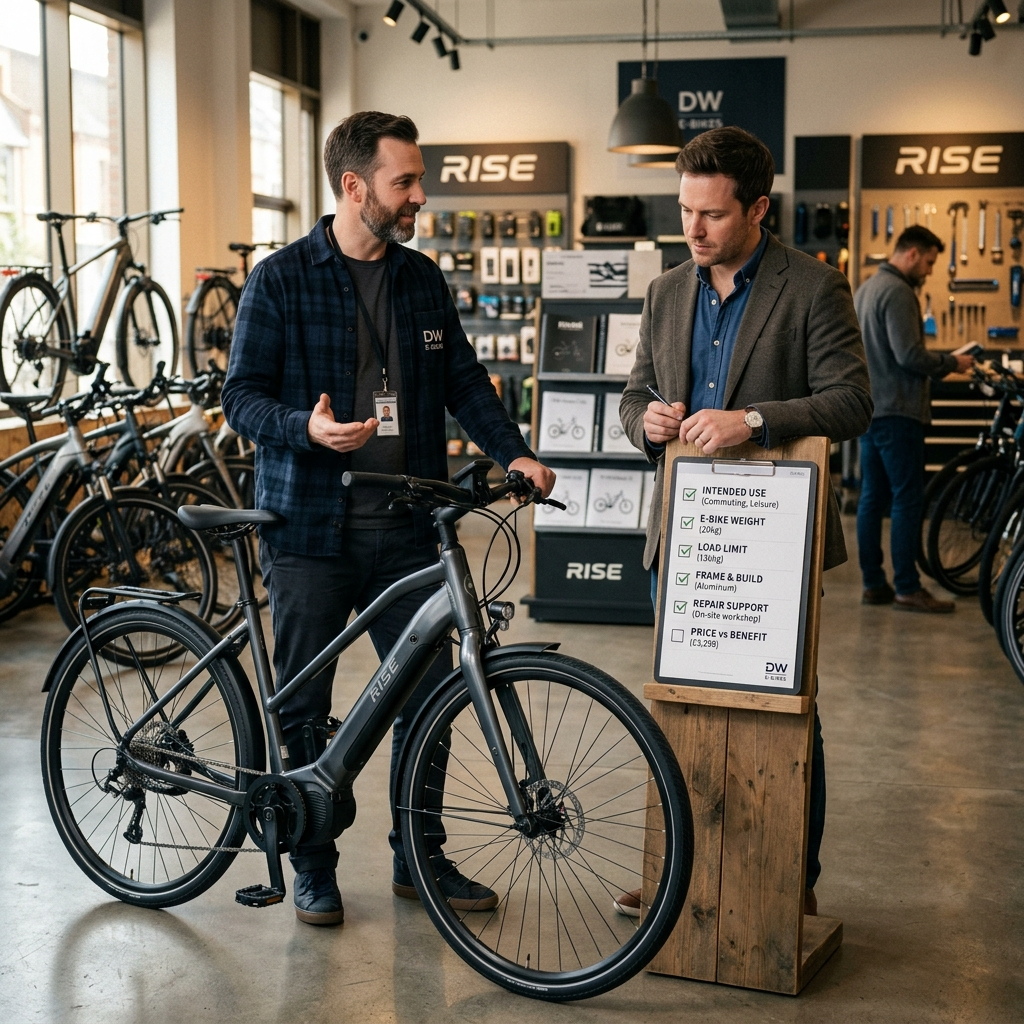
For most riders, aluminum offers the most practical balance of weight, cost and availability. Carbon fiber makes more sense when low weight and highly tailored frame construction justify a higher price and different inspection considerations. Steel favors toughness and established repair pathways, while titanium remains a costly, corrosion-resistant premium option.
But don’t choose an e-bike by frame material alone. The finished bike’s total weight, motor and battery integration, published load limit, structural evidence, repair support and price are more useful buying signals than the material name by itself.
This guide shows you how to compare those factors before you pay extra for a lighter frame.
Method note: This comparison is based on documentary evidence including manufacturer specifications, standards/testing references and independent editorial testing. It does not claim original frame testing. The supplied research likewise identifies the present evidence base as documentary rather than first-hand.
Which E-Bike Frame Material Is Best: Aluminum, Carbon, Steel or Titanium?

There is no universal winner. Each material gives designers different ways to balance weight, stiffness, toughness, manufacturing cost, repairability and packaging.
For buyers, the useful comparison is simpler:
| MaterialUsually makes most sense when…Watch for | ||
|---|---|---|
| Aluminum alloy | You want a practical balance of weight, price and widespread availability | Frame design, weld quality and processing still matter; structural repair can be specialized |
| Carbon fiber | Minimum weight or highly tailored construction is important enough to justify more cost | Impact inspection, repair policy and replacement cost deserve extra attention |
| Steel/chromoly | Toughness, serviceability and long-term repair options matter more than minimum mass | Complete bikes are often heavier when built for comparable use |
| Titanium | You value corrosion resistance, low mass and long-term ownership enough to accept a high price | Fabrication and structural repair require appropriate specialists |
The practical conclusion is not “carbon beats aluminum” or “steel is strongest.” It is:
Choose a material family that suits your priorities, then judge the actual frame as an engineered product.
Why strength-to-weight alone cannot tell you which frame is better
Raw material properties do not tell you how a finished frame will behave.
A metal frame’s performance depends on factors such as tube diameter, wall thickness, joints, reinforcement, welding and processing. A carbon frame can be altered through fiber orientation, layer placement, resin choice and local reinforcement.
Strength, stiffness, toughness, fatigue resistance and impact behavior are also different properties. A frame that performs well in one load case does not automatically perform best in every other one.
So when two bikes use different materials, don’t stop at a density or tensile-strength chart. Compare what the manufacturer actually built, what use it approves and what evidence supports the finished structure.
What Do You Give Up With a Lighter E-Bike?

A lighter frame does not automatically create a dramatically lighter e-bike.
The motor, battery, wheels, tires, suspension, brakes and accessories can account for a substantial share of total mass. A meaningful reduction in frame weight may therefore produce a much smaller percentage reduction in complete-bike weight.
That doesn’t make weight savings pointless. It changes where they matter.
Frame weight vs total e-bike weight
Suppose, purely as a hypothetical example, one e-bike weighs 55 lb and a more expensive version saves 2 lb through its frame and associated components.
The lighter bike weighs 53 lb.
That 2 lb may be very noticeable if you lift the bike into a vehicle every day. It is less meaningful if you assumed the lighter frame would transform a heavy utility bike into an ultralight bicycle.
Always compare the complete-bike weights of the models you are actually considering.
A lighter bike can involve tradeoffs elsewhere
Manufacturers can reduce complete-bike mass in several ways:
- use a smaller battery;
- choose a lighter drive unit;
- fit lighter wheels or tires;
- reduce suspension or component mass;
- use more expensive frame construction;
- remove accessories or utility equipment.
Those choices are not inherently good or bad. They need to match the bike’s job.
A commuter carried upstairs every day may benefit greatly from several pounds of weight reduction. A cargo rider may prefer more battery, stronger wheels and a higher approved load even if the bike becomes heavier.
Does a lighter e-bike automatically have better range?
No.
Lower mass can reduce some energy demand, particularly during acceleration and climbing, but there is no reliable universal percentage by which a lighter frame improves range.
Speed, aerodynamics, terrain, tire losses, rider mass, assist level, motor efficiency and battery capacity can all materially affect the result.
Independent lightweight e-MTB testing also shows why complete-bike performance cannot be reduced to a scale reading alone. Motor behavior, suspension and handling remain part of the system. See Bicycling’s lightweight e-bike comparison.
Where lower weight is most useful
Weight savings have the clearest practical value when you:
- carry the bike up stairs;
- lift it into a car or truck regularly;
- use a vehicle rack with a strict per-bike weight limit;
- want a lighter-feeling, bicycle-like riding experience;
- ride terrain where the complete bike’s mass and weight distribution matter to handling.
Before paying for lightweight construction, ask:
Where in my normal week will I actually use the weight saving?
If you cannot identify a clear answer, another upgrade may provide more value.
Why Motor and Battery Integration Matter as Much as Frame Material

An e-bike frame has to accommodate components and loads that do not exist on a conventional bicycle in the same way.
That makes motor mounting, battery packaging and mass distribution part of the frame-design problem.
Mid-drive motors change the frame around the bottom bracket
A mid-drive occupies the central area where a conventional bicycle normally places its bottom bracket and crank interface.
The frame must be designed around the specific motor package, mounting points and surrounding structure. That can influence tube shapes, reinforcement and available space for the battery or suspension.
Two carbon frames—or two aluminum ones—may therefore require very different engineering even though their headline material is identical.
Hub motors move loads and mass toward the wheel
A hub motor places the drive unit at a wheel instead of near the center of the bike.
That makes the wheel-end interface, including dropout design, relevant to the complete structure.
There is no credible rule that says a certain motor torque automatically requires a particular frame material. What matters is whether the specific frame, fork, wheel interface and drive system were designed to work together.
Integrated batteries affect both structure and handling
An internal battery may require a large downtube cavity, removable cover or access opening. The surrounding structure has to accommodate that packaging.
Battery location also changes where the bike carries its mass.
A slightly heavier frame with well-positioned motor and battery mass can therefore make more sense than choosing a lighter frame solely from a specification sheet.
For a buyer, the useful comparison becomes:
frame construction + motor interface + battery packaging + intended use
rather than material in isolation.
How Much Load Can a Lightweight E-Bike Safely Carry?

Do not estimate safe load from frame material.
A carbon frame does not have one universal payload figure. Neither does aluminum, steel or titanium.
The number that matters is the manufacturer’s published limit for the exact bike.
First, check what the manufacturer’s number means
Manufacturers may publish:
- maximum system weight;
- permissible total weight;
- payload;
- maximum rider weight;
- rack load;
- cargo limit.
Those terms are not always defined the same way.
A system-weight limit, for example, may include the bicycle itself, rider, luggage and accessories. A rack can also have a lower limit than the bike as a whole.
Use the definition in the owner’s manual for the exact model and model year.
A simple load calculation
If the manufacturer defines its limit as total system weight, the calculation is:
permitted system weight − bike weight − counted accessories = remaining rider-and-cargo allowance
Hypothetical example:
- Permitted system weight: 330 lb
- Bike: 55 lb
- Accessories: 10 lb
- Remaining allowance for rider and cargo: 265 lb
That example is only arithmetic. It is not a recommended e-bike load limit.
Use the manufacturer’s actual numbers and definitions for the bike you are evaluating.
CUBE’s support documentation is one example of manufacturer guidance that treats approved load limits as model-specific rather than properties of an entire material category.
Three checks before relying on a load number
- Confirm the exact model and year. Limits can vary between versions.
- Read the manufacturer’s definition. Determine what counts toward payload or system weight.
- Check lower component limits. Racks, wheels, child-seat systems or other accessories may impose tighter restrictions.
If a manufacturer does not publish a clear limit for the exact bike, treat the answer as unknown rather than inferring one from frame material.
How to Tell Whether a Lightweight Frame Has Credible Safety Evidence

A description such as “high strength” tells you little by itself.
The useful question is: what evidence exists for the completed bicycle or frame?
U.S. requirements and mechanical test evidence answer different questions
For U.S. readers, the supplied research identifies 16 CFR Part 1512 as relevant federal bicycle regulatory context for bicycles within its scope, including frame/fork structural provisions. It should not be treated as a premium quality score that tells you one compliant frame is better than another.
For mechanical test-method context, the research identifies ISO 4210-6:2023 as the published ISO document covering frame and fork test methods. Regional requirements still need to be applied correctly. The same research explicitly warns against presenting Europe’s EN 15194 as a universal U.S. requirement.
TÜV SÜD’s bicycle and e-bike testing overview is useful for understanding how ISO bicycle testing and European e-bike requirements fit into a broader test context.
Use an evidence ladder instead of trusting one badge
A useful buyer hierarchy is:
- Marketing claim — “ultralight,” “high strength,” “aerospace grade.”
- Published construction specification — what the frame is actually made from and how it is built.
- Model-specific weight, intended use and load limits.
- Relevant mechanical requirements or test methods.
- Manufacturer test documentation.
- Independent technical evidence where available.
You do not need every bike to reach the final step.
The point is to distinguish a product backed by specific, relevant information from one described mainly with impressive adjectives.
Electrical certification is not the same as frame-strength testing
This is an easy distinction to miss.
UL Solutions describes UL 2849 in the context of safety for e-bike electrical systems.
That is important evidence for the hazards the standard addresses. It should not be treated as proof that one frame is mechanically stronger than another.
When a manufacturer cites testing or certification, ask:
What exactly was evaluated—the electrical system, battery, complete bicycle, frame, fork or another component?
Also distinguish “tested to” from independent certification. If structural evidence is central to your purchase, look for who performed the testing and which model or use category it applies to.
How Durable Are Carbon E-Bike Frames?

A well-designed carbon e-bike frame is not automatically fragile because it is light.
Carbon construction allows designers to vary fiber direction, layer placement, geometry and reinforcement. The important ownership difference is that certain kinds of damage may not be obvious from a casual visual inspection.
Everyday durability and crash damage are different questions
A frame can handle normal riding loads successfully for years and still require careful evaluation after an abnormal impact.
That distinction is more useful than giving carbon one generic “durability score.”
Metal frames also require proper inspection after serious damage. But carbon deserves particular attention because apparently minor surface appearance does not necessarily establish what happened inside the composite structure.
What should you do after a significant carbon-frame impact?
Trek’s 2026 owner guidance warns that carbon damage may be concealed and advises riders who suspect damage to stop riding and obtain appropriate evaluation. See the Trek Bicycle Owner’s Manual.
Safety warning: If a carbon e-bike has experienced a significant crash or impact and structural damage is reasonably suspected, stop using it. Follow the manufacturer’s inspection guidance or obtain qualified professional assessment before riding again.
Do not treat a cosmetic check, improvised “tap test” or other home procedure as definitive proof that a potentially damaged structural frame is safe.
Which Frame Materials Are Easier to Repair?

Repairability is worth considering before you buy an expensive lightweight e-bike, not after the first accident.
Material matters, but so do damage location, construction method, frame alignment, manufacturer policy, specialist availability and replacement-frame cost.
| MaterialTypical repair outlookMain complication | ||
|---|---|---|
| Steel/chromoly | Specialist structural repair may be possible in many cases | Damage severity and alignment still control the decision |
| Aluminum | Some repairs are technically possible | Welding and processing considerations may make replacement more practical |
| Titanium | Specialist repair may be possible | Requires someone experienced with titanium bicycle fabrication |
| Carbon fiber | Professional composite repair can be viable for suitable damage | Inspection, location, manufacturer policy and economics may favor replacement |
This is not a DIY repair guide.
The repair ecosystem can matter more than theoretical repairability
Before buying, find out:
- Does the manufacturer allow or support structural repair?
- Is a qualified specialist available in your region?
- Could third-party repair affect the warranty?
- Can you buy a replacement frame?
- What happens if damage occurs around a motor mount, battery opening or other complex interface?
- How long could the bike realistically be out of service?
A material that can theoretically be repaired is not especially convenient if the nearest suitable specialist is hundreds of miles away.
Will Frame Material Actually Change Ride Quality?

Possibly—but usually not by itself.
Tires, tire pressure, suspension, geometry, fit, wheel construction, frame profiles and total rider-bike mass can all affect what you feel.
That makes ride quality one of the easiest areas in which to over-credit the frame material.
Stiffness is not the same as better ride quality
Different areas of a frame may need high stiffness for steering precision or load transfer, while controlled compliance can be useful elsewhere.
Designers influence that behavior with tube shapes, wall dimensions, layup and geometry as well as the base material.
This is why broad claims such as “steel is always comfortable” or “carbon always absorbs vibration” are poor buying rules.
Before blaming or praising the frame, check these variables
If two bikes feel different, compare:
- tire model, width and pressure;
- suspension travel and setup;
- wheel construction;
- geometry and fit;
- seatpost, saddle and handlebar;
- total system mass;
- frame construction.
If several of those change between bikes, a test ride cannot cleanly isolate “material feel.”
Fatigue is not the same as impact damage
Fatigue comes from repeated loading cycles.
A crash or strike is an impact event.
Corrosion, joint problems and local manufacturing defects are different failure mechanisms again.
Treating all of them as one vague measure of “frame lifespan” creates false certainty. There is no useful universal rule that every frame made from one material outlasts every frame made from another.
Is a Lightweight E-Bike Frame Worth Paying More For?

Only if the complete bike solves a problem that matters to you.
A premium model may differ from a cheaper one in far more than frame material. Wheels, suspension, brakes, motor, battery and drivetrain can all change at the same time.
That makes blanket statements such as “carbon costs X% more” unreliable unless they are based on a dated comparison of genuinely similar bikes.
Paying more makes the most sense when…
A lighter build is easier to justify when:
- you carry the bike frequently;
- stairs are part of normal ownership;
- you regularly lift it into a vehicle;
- your bike rack has a restrictive per-bike weight limit;
- a lighter, more bicycle-like ride is a major goal;
- the lighter model still provides the battery capacity, payload and durability you need.
It may be poor value when…
Think twice when:
- payload is more important than portability;
- you need more battery capacity;
- stronger wheels, tires or suspension matter more;
- the complete-bike weight difference is small;
- repair support for the premium frame is weak;
- the same budget would improve braking, fit, tires or another feature you notice every ride.
A useful mini decision tree is:
Do you regularly carry or transport the bike?
→ Yes: meaningful complete-bike weight savings may be worth paying for.
No. Is lower mass central to the riding experience you want?
→ Yes: compare complete-bike weight and test ride both options.
No. Are you sacrificing battery, payload, robustness or serviceability to get lighter?
→ If yes, the premium is probably harder to justify.
The useful metric is not dollars per gram.
It is useful benefit per dollar.
What Could Replace Today’s E-Bike Frame Materials?

Probably not one single material.
The more credible future is a mix of new composite systems, niche metals and manufacturing processes that let designers change how frames are made, repaired or recovered.
The important distinction is commercial maturity.
Thermoplastic carbon: real technology, broader claims still need evidence
FOCUS currently documents its JAM² NEXT around a thermoplastic-carbon frame concept designed with material recovery in mind.
That establishes a real contemporary application.
It does not by itself establish that thermoplastic carbon is universally more durable, cheaper or environmentally preferable over a complete lifecycle. Those conclusions require broader independent comparison.
A fair description is:
commercially emerging, with promising manufacturing and recovery possibilities that still need wider evidence and adoption.
Magnesium: credible, but still niche
Magnesium has been used in real bicycle and e-bike frames, so it does not belong in the same category as speculative laboratory materials.
Its presence also demonstrates an important point: choosing a comparatively light base material does not guarantee an exceptionally light finished e-bike.
Motor, battery, wheels, components and the amount of material required by the design still matter.
The current evidence supports describing magnesium as a commercial but non-mainstream alternative, not the inevitable replacement for aluminum.
Recyclable and recoverable polymer approaches
Some current projects are trying to make frame materials easier to recover, recycle or reuse.
Those efforts are relevant, but words such as “recyclable” need context. A theoretically recoverable material is not the same thing as a complete, widely available collection and recycling system.
When evaluating sustainability claims, look for:
- what part of the frame can actually be recovered;
- whether recovery occurs at useful scale;
- what happens to recovered material;
- whether durability or repair pathways change;
- whether claims come from independent lifecycle evidence or the manufacturer itself.
3D-printed titanium is a manufacturing development, not a new material
Sika’s documented e-bike project uses 3D-printed titanium lugs with thin-wall titanium tubes and bonded assembly.
That makes additive manufacturing a legitimate current development rather than speculative filler.
Its appeal is the ability to create complex connection geometries and place material strategically. The unanswered questions are more practical: cost, production scale, repeatability, validation and repair.
For buyers, that places it in the emerging/niche manufacturing category rather than the mainstream.
The broader rule for future-frame claims is simple:
Real prototype or product? Good first step. Independent evidence, scalable production and practical ownership support? Much stronger evidence.
A 6-Point Check Before You Buy a Lightweight E-Bike
You do not need to become a materials engineer to make a good decision.
For each bike on your shortlist, check six things:
- Intended use
Is the model designed for the riding, terrain and cargo you expect? - Complete-bike weight
How much lighter is the entire bike—not just its frame? - Published load limit
Can the exact model accommodate you, your cargo and your accessories under the manufacturer’s definition? - Relevant structural evidence
What specifications, mechanical requirements or test information support the completed frame? - Damage and repair support
What happens after a crash, structural problem or warranty claim? - Price versus useful benefit
Will you actually notice what the more expensive bike gives you?
If one bike wins only because its material sounds more advanced, keep comparing.
If it is lighter at the complete-bike level, meets your load and use requirements, has credible structural documentation, gives you workable repair/support options and improves something you genuinely care about, the premium becomes much easier to justify.
Next step: put two or three shortlisted e-bikes through those six checks using their official specifications and manuals. If motor layout is still part of the decision, continue with the site’s motor-types guide rather than trying to infer drive-system suitability from frame material alone.
Pingback: Electric Bike Frame Design: Fit, Strength & Compatibility - electricscootercar.com
Pingback: SEO title: Future of Electric Bikes: What’s Real, Emerging & Worth Waiting For *** - electricscootercar.com
Comments are closed.