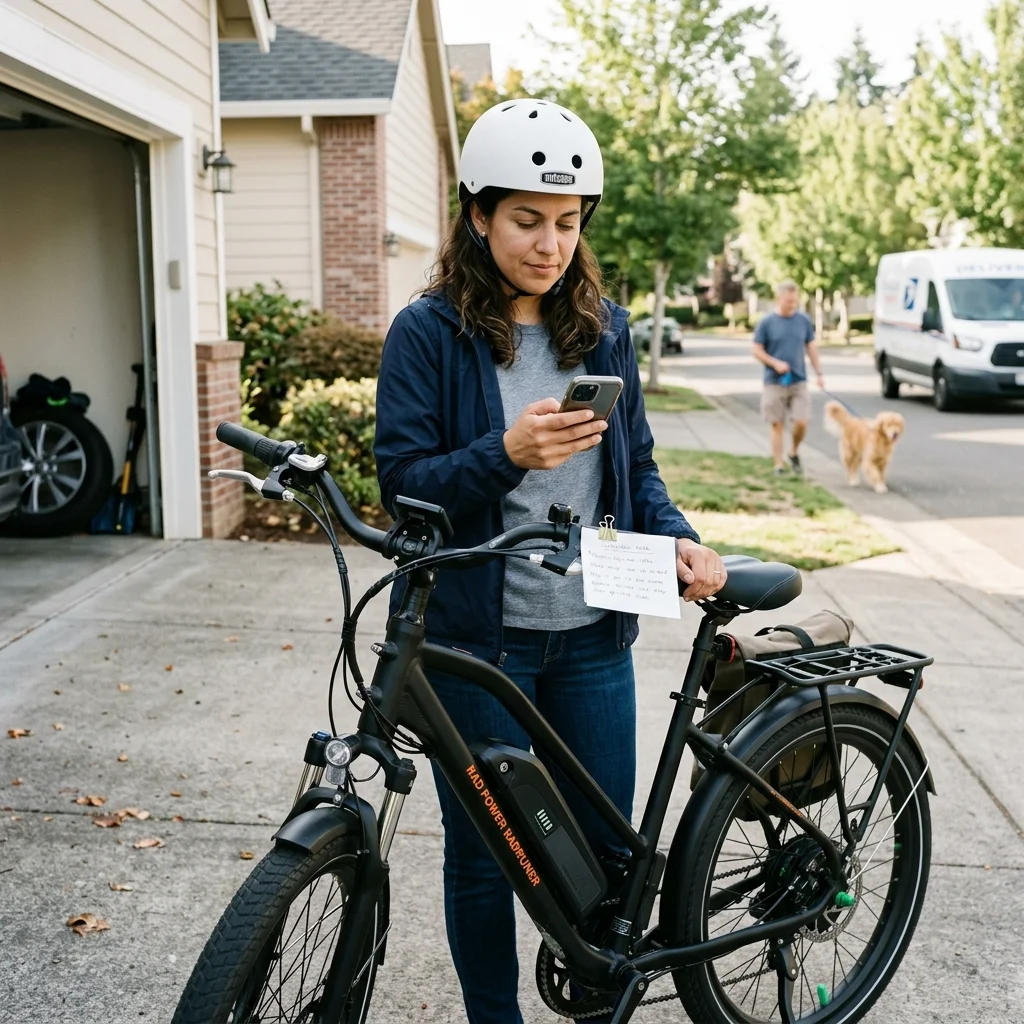
If you are asking, “Why is my e-bike losing power?”, the answer usually comes down to one of five areas: battery condition, voltage sag under load, loose connections, sensor/controller faults, or mechanical drag.
The key is to diagnose the symptom before replacing parts.
A bike that slowly feels weaker as the battery drops is very different from one that shuts off on hills, cuts out over bumps, or loses motor assist while the display stays on. Some causes are simple, such as low tire pressure or a loose battery mount. Others, especially battery swelling, overheating, smoke, burning smells, or repeated shutdowns, need immediate stop-use action.
Use this guide to match your symptom, run safe checks, and decide when the issue is DIY, shop-level, or manufacturer-level.
Start Here: Match Your E-Bike Power Loss Symptom to the Likely Cause
Start with what the bike is doing. Do not buy a new battery, controller, or display until you have narrowed down the pattern.
| Symptom | Most Likely Causes | First Safe Checks |
|---|---|---|
| Bike feels weaker as the battery gets low | Normal voltage drop, low charge, aging battery, high load | Fully charge the battery, test on flat ground, compare assist levels |
| Power cuts out only under load | Voltage sag, weak cell group, BMS cutoff, controller current limit | Test on a hill or acceleration run, check if the display turns off |
| Display stays on but motor stops | Brake cutoff sensor, PAS/throttle issue, controller fault, motor connector issue | Check error codes, brake levers, throttle, PAS sensor, motor plug |
| Whole bike turns off | Battery BMS trip, loose battery contacts, bad battery mount, internal battery fault | Reseat battery, inspect pins, stop riding if shutdown repeats |
| Problem happens after rain, washing, bumps, or cold weather | Water in connectors, corroded pins, loose harness, cold battery voltage sag | Dry the bike safely, inspect plugs, avoid riding with a wet or suspect battery |
If the bike feels slower as the battery drops
Some power loss is normal. As the battery charge falls, the voltage available to the motor also drops. You may notice weaker acceleration, less hill-climbing power, and lower assist strength near the end of a ride.
That does not automatically mean the battery is bad.
It becomes suspicious when the bike feels weak soon after a full charge, drops power suddenly, shuts off under load, or loses range much faster than before.
If power cuts out only under load
Power loss under load usually appears when you accelerate hard, climb a hill, carry cargo, ride into wind, or use full throttle.
That load asks the battery for more current. If the battery voltage sags too far, the battery management system may cut power to protect the pack. A weak battery, loose connection, overheated controller, or damaged wire can create the same symptom.
If the display stays on but the motor stops
This usually points away from a total battery shutdown.
Possible causes include a brake cutoff sensor, pedal assist sensor, throttle signal problem, controller fault, motor connector issue, speed sensor fault, or display/controller communication issue.
Check whether the display shows an error code. Also check whether a brake lever is slightly stuck or the brake cutoff sensor is misaligned.
If the whole bike turns off
If the display and motor both shut off, focus first on the battery, battery mount, main power contacts, fuse, BMS protection, or wiring between the battery and controller.
A one-time shutdown on a nearly empty battery may be normal low-voltage protection. Repeated shutdowns after charging are not normal.
If the problem happens after rain, bumps, or cold weather
Cutouts after bumps often point to a loose battery mount, worn contacts, or a connector that briefly disconnects.
Cutouts after rain or washing may involve water inside plugs, the controller area, display connector, motor connector, or battery cradle. Cold weather can also make a battery feel weaker because voltage sag becomes more noticeable.
Expert tip: do not replace parts yet. A loose battery rail, dirty contact, brake sensor issue, or underinflated tire can imitate a failing battery.
Stop Riding Immediately If You Notice These Battery or Electrical Warning Signs

Most e-bike power loss is not an emergency. But some symptoms can mean the battery or electrical system is unsafe.
Stop riding and move the bike away from buildings, vehicles, and flammable materials if you notice:
- Battery swelling or deformation
- Smoke, hissing, leaking, or strange chemical smell
- Burning smell from the battery, controller, motor, or wiring
- Battery or charger getting unusually hot
- Melted plastic, blackened connectors, or burnt pins
- Power loss after a crash, drop, flood, or heavy water exposure
- Repeated shutdowns even after a full charge
- A recall, stop-use notice, or manufacturer safety warning for your model
Battery swelling, smoke, heat, or burnt smell
A swollen, smoking, leaking, or overheating lithium-ion battery is not a DIY repair job. Do not open the pack. Do not keep charging it to “test again.” Do not store it indoors while you decide what to do.
Contact the bike manufacturer, battery manufacturer, or a qualified battery specialist for safe next steps.
Power loss after water exposure or a crash
Water and impact damage can create delayed electrical problems. A bike may turn on after rain or a crash and still have moisture inside a connector, battery cradle, controller housing, or wiring harness.
If power loss starts after water exposure, avoid charging until the system has been inspected. Charging a compromised battery or wet electrical system can increase risk.
Repeated shutdowns even after charging
A single low-battery cutoff near the end of a ride is one thing. Repeated shutdowns after a full charge suggest a real fault.
Possible causes include a weak cell group, failing BMS, damaged connector, overheated controller, or internal battery issue.
When to check recalls or contact the manufacturer
If the battery gets hot, cuts out repeatedly, smells unusual, or appears damaged, check the manufacturer’s website and the CPSC recall database before riding again.
For U.S. riders, this matters because some e-bike battery warnings include stop-use and special disposal instructions. A recalled or defective lithium-ion battery should not be treated like normal household trash.
Safety note: UL 2849 relates to e-bike electrical systems, including the drive train, battery, and charger system combination. UL 2271 relates to batteries used in light electric vehicle applications. Certification does not make damage impossible, but it is a useful safety signal when buying or replacing parts.
Why E-Bikes Lose Power: Normal Battery Behavior vs a Real Fault

E-bikes lose power when the motor cannot get steady, sufficient electrical power or when the system intentionally limits power to protect itself.
That can be normal. It can also be a fault.
| Situation | Usually Normal? | What It Means |
| Bike feels weaker near very low battery | Yes | Battery voltage is low, so power output drops |
| Acceleration is slightly softer in cold weather | Often | Cold increases voltage sag and reduces available power |
| Bike shuts off on hills but shows charge | No | Battery sag, BMS cutoff, weak cells, or controller issue |
| Display stays on but motor stops | No | Sensor, controller, motor connector, or signal issue |
| Whole bike powers off over bumps | No | Loose battery mount, worn contacts, or main power interruption |
| Power drops after rain or washing | No | Possible water intrusion or corroded connector |
| Burning smell, swelling, smoke, or heat | Unsafe | Stop using the bike and battery immediately |
Normal power drop as charge gets low
Most e-bikes feel strongest when the battery is full and weaker when the charge is low. The difference is usually more noticeable during hills, headwinds, heavy cargo, or full-throttle starts.
A normal low-battery power drop should be gradual and predictable.
Abnormal power loss while the battery still shows charge
A battery display is not a perfect measurement of usable power. Some displays estimate charge based on voltage, and voltage can rebound when the bike is resting.
That means the screen may show bars or a percentage while the battery still sags badly under load.
Abnormal signs include sudden shutdowns, cutouts at high assist, loss of power right after charging, or large range drops compared with your normal ride.
Common causes: battery sag, BMS cutoff, controller limits, heat, loose connections, and mechanical drag
The most common causes are:
- Low charge or normal voltage drop
- Battery voltage sag under acceleration
- Aging cells or high internal resistance
- BMS low-voltage cutoff
- Loose battery contacts or corroded plugs
- Controller overheating or current limiting
- Motor connector, phase wire, or hall sensor issues
- Brake cutoff, PAS, throttle, or speed sensor problems
- Tire pressure, brake rub, drivetrain drag, hills, wind, and rider/cargo weight
The fastest way to diagnose the issue is to test the bike in the same condition where the power loss happens.
Low Battery, Weak Battery, and Voltage Sag Explained Simply

The battery is the heart of the e-bike’s power system. Even when the motor, controller, and display are working, a weak or sagging battery can make the bike feel slow, tired, or unreliable.
Why speed and acceleration drop as battery charge falls
An e-bike motor depends on voltage and current. As charge drops, available voltage drops too. That can reduce acceleration, hill-climbing strength, and sometimes top speed.
You may notice:
- Less punch when starting from a stop
- Slower climbing on the same hill
- More effort needed from your legs
- Lower top speed near the end of the ride
- Power cutting out when the battery is very low
This is more noticeable on heavier e-bikes, cargo bikes, fat-tire bikes, and throttle-heavy riding.
Why voltage drops when you accelerate
When you accelerate, the motor asks for a quick burst of current. Under that demand, battery voltage temporarily drops. This is voltage sag.
A healthy battery sags a little and recovers.
A weak or aging battery can sag enough to trigger the BMS low-voltage cutoff. The bike may shut down even though the display showed charge a few seconds earlier.
Example:
You ride on flat ground and everything feels fine. Then you hit a hill, use high assist, and the bike cuts out. After stopping, the display turns back on and shows some battery left.
That pattern often points to voltage sag under load.
How aging cells and internal resistance make sag worse
As lithium-ion batteries age, they lose capacity and develop higher internal resistance. That means the battery struggles more when the motor asks for high current.
Signs include:
- Range keeps getting shorter
- Battery bars drop quickly under load
- Bike shuts off on hills
- Battery feels weaker in cold weather
- Full charge does not last like it used to
- Power returns after resting, then cuts out again
Aging is normal, but sudden severe power loss is not something to ignore.
Why cold weather can make the battery feel weaker
Cold batteries usually deliver less power. The bike may feel sluggish, and voltage sag may become worse during acceleration or hills.
If the same bike works better in mild weather, cold-related sag may be part of the problem. Still, repeated shutdowns, overheating, swelling, smell, or charging problems should be treated as faults, not normal winter behavior.
Expert note: a percentage display is not the same as usable power under load. A battery can show charge while still failing under acceleration.
Why Your E-Bike Loses Power When Accelerating, Climbing Hills, or Using Full Throttle

Acceleration, hills, and full throttle all create high current demand. That is why power loss often appears only when the motor has to work hard.
Why acceleration exposes weak batteries
Starting from a stop requires more current than cruising at steady speed. If the battery is weak, cold, low, or aging, acceleration may expose the problem first.
You may feel hesitation, stuttering, sudden assist loss, or a complete shutdown.
Why hills make power loss more noticeable
Climbing increases motor load. Add rider weight, cargo, low tire pressure, headwind, or a soft surface, and the battery/controller system has to work harder.
A bike that cruises fine on flat pavement can still cut out uphill if the battery sags or the controller overheats.
Why full throttle can trigger BMS or controller protection
Full throttle asks for maximum power quickly. If the system detects low voltage, excess current, heat, or an unsafe condition, it may reduce power or shut down.
Possible causes include:
- Battery voltage sag
- BMS low-voltage cutoff
- Controller current limit
- Controller thermal protection
- Loose main power connection
- Motor phase or hall sensor wiring issue
- Poor battery-to-cradle contact
A repeated full-throttle cutout is a diagnostic signal. It is not something to keep forcing.
Why the bike may work on a stand but cut out on the road
A wheel-in-air test does not prove the bike is healthy.
With the wheel lifted, there is almost no rider load. The motor can spin with very little current. On the road, the same system must move rider weight, tire friction, wind resistance, and terrain.
If the bike works on a stand but cuts out on the road, suspect a load-related problem such as voltage sag, weak battery, controller current limit, overheating, or a bad connection that fails under vibration.
Quick tip: reproduce the symptom safely at low speed in a controlled area. Note whether the display turns off, whether an error code appears, and whether the issue happens only in high assist or throttle.
Display On, Motor Off? How to Diagnose Cutouts by What Stays Powered

One of the best diagnostic clues is what stays powered when the problem happens.
| What Happens | Likely Area | What to Check First |
| Display stays on, motor stops | Sensor, controller, motor connector, throttle/PAS | Error code, brake cutoff, PAS magnet, throttle, motor plug |
| Whole bike turns off | Battery, BMS, main contacts, battery mount | Battery seating, pins, fuse, charge level, repeated shutdowns |
| Cutout over bumps | Loose battery or harness connection | Battery rail, contact pins, motor/controller/display plugs |
| Cutout after rain/washing | Water intrusion, corrosion, wet connector | Dry inspection, plug corrosion, controller area, battery cradle |
| Cutout only in cold | Battery sag, low temperature performance drop | Warm storage, lower assist, test in mild conditions |
Display stays on but motor stops
If the display stays on, the main battery output may still be powering the bike. The issue may be in the motor control path rather than total battery failure.
Check:
- Brake cutoff sensors
- Throttle response
- Pedal assist sensor alignment
- Speed sensor magnet position
- Motor connector seating
- Controller/display error codes
- Loose or damaged wiring near the handlebars and rear axle
A brake cutoff sensor is easy to overlook. If the system thinks you are braking, it may cut motor power even though the display looks normal.
Whole bike powers off while riding
If the entire system shuts down, focus on main power delivery.
Common causes include:
- Battery not fully latched into the mount
- Dirty, loose, bent, or burnt battery contacts
- Battery BMS cutoff
- Weak battery cell group
- Fuse or main power wiring issue
- Controller short or electrical fault
If the bike powers back on after resting, that can point to a protection event. Repeated events need proper diagnosis.
Power cuts out over bumps or vibration
Bump-triggered power loss often comes from physical movement.
Inspect:
- Battery lock and rail
- Battery cradle contacts
- Main harness plugs
- Motor connector near the axle
- Display cable at the handlebar
- Controller wiring
- Any plug that looks loose, green, burnt, wet, or stretched
Do not ride aggressively to “test” a loose electrical connection. A loose high-current contact can arc, heat up, and damage the connector.
Power cuts out after rain or washing
Water can cause corrosion, signal faults, intermittent shorts, and controller problems.
After rain or washing, check for:
- Moisture in plugs
- Green or white corrosion on pins
- Water inside display or controller areas
- Battery cradle moisture
- Damaged seals or exposed wires
Avoid pressure washing e-bikes. Water forced into connectors can create problems days later.
Power cuts out only in cold weather
Cold weather can make voltage sag worse. Use lower assist, avoid hard full-throttle starts, and store the battery at room temperature before riding if your manufacturer allows it.
Do not charge a battery below the safe temperature range listed by the manufacturer.
If cold weather only slightly reduces performance, that may be normal. If the bike repeatedly shuts down, treat it as a fault.
Why Your E-Bike Feels Slow, Sluggish, or Does Not Reach Top Speed

Not every power-loss problem is a battery failure. Sometimes the bike feels slow because the system is limiting power normally, the display settings changed, or the mechanical bike needs maintenance.
Low voltage and battery sag
A low or weak battery can reduce acceleration and top speed. This usually appears more clearly at higher assist levels, under throttle, or near the end of a ride.
If the bike feels normal after a full charge but weak at low charge, that may be expected. If it feels weak right after charging, keep troubleshooting.
Assist level, eco mode, display settings, or speed-class limits
Before assuming a part failed, check the simple settings:
- Is the bike in Eco mode?
- Did the assist level reset?
- Is walk mode accidentally active?
- Is the display showing an error code?
- Did a speed limit setting change after service or reset?
- Is the bike reaching its normal class-limited assist speed?
Do not frame this as a limiter-removal issue. If the bike is operating within its legal class and manufacturer settings, reduced assist above a certain speed may be normal.
Tire pressure, brake rub, drivetrain drag, wind, rider weight, and terrain
Mechanical drag can feel like electrical power loss.
Check:
- Low tire pressure
- Brake pads rubbing the rotor or rim
- Bent rotor
- Dirty or dry chain
- Tight wheel bearings
- Misaligned wheel
- Heavy cargo
- Soft ground, hills, or headwind
Common mistake: replacing the battery before checking brake rub. A dragging brake can make a healthy e-bike feel weak and drain the battery faster.
Why a bigger battery usually improves range more than speed
A higher Ah battery usually means more capacity, not automatically more speed. Voltage has more direct influence on motor speed potential, while Ah affects how much energy the battery can store.
A larger compatible battery may reduce sag and improve range, but it should match the bike manufacturer’s electrical specifications. Installing an incompatible battery can damage components or create safety risk.
Quick DIY Checks Before You Replace the Battery

Use this checklist before buying parts. Stop if you see swelling, smoke, burning smell, melted connectors, exposed wires, or water damage.
Tools that may help:
- Correct charger
- Tire gauge
- Clean dry cloth
- Flashlight
- Small brush for dry debris
- Multimeter, only if you know how to use it safely
- Manufacturer manual or app
Check charge level, assist mode, and display error codes
Start simple:
- Fully charge the battery using the correct charger.
- Confirm the charger indicator behaves normally.
- Check assist level and ride mode.
- Look for display error codes.
- Restart the bike using the manufacturer’s normal process.
- Test on flat ground first, then under moderate load.
If an error code appears, use the manual or manufacturer support page. Error codes can save a lot of guessing.
Reseat the battery and inspect contacts
Remove and reinstall the battery. Make sure it locks firmly.
Inspect the battery and cradle contacts for:
- Dirt
- Corrosion
- Bent pins
- Burn marks
- Melted plastic
- Loose contact plates
- Movement in the battery mount
Clean only as recommended by the manufacturer. Do not scrape or bend contacts aggressively.
Check motor, controller, display, and throttle/PAS connectors
Look for loose, wet, damaged, or corroded plugs.
Pay close attention to:
- Rear hub motor connector
- Mid-drive wiring harness
- Controller plugs
- Display connector
- Throttle connector
- Brake cutoff wiring
- Pedal assist sensor wiring
- Speed sensor wire and magnet
Match arrows or alignment marks when reconnecting waterproof plugs. Forcing them can bend pins.
Check brake cutoff sensors, tire pressure, brake rub, and drivetrain drag
A bike can lose assist if a brake sensor is activated. It can also feel weak if the mechanical system is dragging.
Check:
- Brake lever returns fully
- Brake sensor magnet is aligned
- Throttle is not sticky
- PAS magnet ring is secure
- Tires are inflated to the recommended range
- Wheels spin freely
- Brakes are not rubbing
- Chain is clean and lubricated
Test whether the issue repeats under the same load
Try to repeat the symptom safely:
- Does it happen only on hills?
- Only at full throttle?
- Only with low battery?
- Only after bumps?
- Only after rain?
- Only in cold weather?
- Does the display stay on or turn off?
Write down the pattern before contacting a shop or manufacturer. Clear symptom notes reduce guesswork and unnecessary parts replacement.
Warning: avoid opening sealed lithium-ion battery packs. Internal battery repair is not a normal DIY e-bike task.
Battery, BMS, Controller, Motor, or Sensor: How to Narrow Down the Fault

Several faults can feel similar. Use the pattern to narrow the likely component.
| Suspected Area | Common Signs | What It Feels Like | Next Step |
| Battery or BMS | Whole bike shuts off, cuts out under load, range drops, charge display rebounds after rest | Bike dies on hills or full throttle | Stop if unsafe signs appear; test with manufacturer/shop support |
| Controller | Power reduces after heat, burnt smell, error codes, works again after cooling | Assist fades or cuts during hard use | Inspect for heat/water damage; contact shop if repeated |
| Motor or phase/hall wiring | Jerking, stuttering, grinding, motor error, cutout under load | Motor feels rough or inconsistent | Inspect motor plug and axle wire; avoid riding if damaged |
| Brake sensor | Display on, no assist, motor cuts when lever moves | Bike acts like brakes are applied | Check lever return and sensor alignment |
| PAS/throttle | Assist inconsistent, throttle dead, pedal assist delayed | Motor does not respond normally to input | Check connectors, magnets, throttle movement |
| Speed sensor | Assist cuts oddly, speed reads wrong | Display speed jumps or shows zero | Align magnet and sensor, inspect cable |
Signs the battery or BMS is the likely cause
Suspect battery or BMS involvement when:
- The whole bike turns off
- Shutdown happens under acceleration or hills
- Battery bars drop suddenly under load
- Power returns after the bike rests
- Range has dropped significantly
- Battery gets unusually hot
- Charging behavior is inconsistent
The BMS may be protecting the battery from low voltage, overcurrent, heat, or another detected fault.
Signs the controller may be overheating or limiting current
A controller may reduce or cut power when it overheats or detects electrical stress.
Signs include:
- Power fades during long climbs
- Cutout happens after hard riding
- Bike works again after cooling
- Controller area smells burnt
- Error code points to controller or overcurrent
- Problem began after water exposure
Repeated controller shutdowns should be inspected. A controller fault can damage other parts if ignored.
Signs the motor or phase/hall wiring may be involved
Motor-related issues often feel rougher than simple battery sag.
Look for:
- Jerking or stuttering
- Grinding or unusual motor noise
- Motor error code
- Damaged axle wire
- Loose hub motor connector
- Power loss that appears with vibration or wheel movement
If the motor connector is loose or the axle wire is damaged, avoid riding until inspected.
Signs the throttle, PAS, brake sensor, or speed sensor may be the issue
Input sensor faults often leave the display powered but stop motor assist.
Check the simple items first:
- Brake lever not fully returning
- Brake cutoff sensor misaligned
- PAS magnet ring loose or dirty
- Throttle sticking or unplugged
- Speed sensor magnet out of position
- Display speed reading incorrectly
A sensor fault can feel like a major electrical failure, but it may be much cheaper and easier to fix.
When Power Loss Means the Battery May Need Replacement

A battery does not need replacement just because the bike lost power once. But certain patterns suggest the battery is reaching the end of its useful life or has an internal fault.
Reduced range that keeps getting worse
Gradual range loss is normal as a battery ages. Replacement becomes more likely when the range drop is large, consistent, and not explained by weather, tire pressure, hills, cargo, or riding style.
Sudden voltage drops under load
If the bike shuts down during acceleration or hills even after charging, the battery may be sagging too much under load.
This can happen because of aging cells, a weak cell group, high internal resistance, or BMS protection.
Shutdowns on hills or full throttle
Repeated hill or full-throttle shutdowns are a common sign of battery weakness, BMS cutoff, controller current limit, or poor battery contacts.
Check contacts and load conditions first. If the same symptom continues with a properly seated, fully charged battery, contact the manufacturer or a qualified technician.
Battery overheating, swelling, or inconsistent charging
Stop using the battery if it swells, overheats, smells strange, smokes, leaks, or charges inconsistently.
Do not keep testing it. Do not open it. Do not use a different charger to force it to charge.
Age, cycle count, warranty, and replacement cost factors
Before buying a replacement battery, check:
- Battery age
- Approximate charge cycles
- Warranty status
- Manufacturer support
- Recall status
- Availability of genuine replacement parts
- Compatibility with your exact bike model
- Charger compatibility
- Certification and safety documentation
Safe buying note: use manufacturer-approved replacement batteries and chargers. Avoid random packs that only “look compatible.”
How to Prevent E-Bike Power Loss and Battery Stress

Once the current issue is solved, prevention helps the battery, controller, connectors, and drivetrain work with less stress.
Avoid deep discharges and repeated full-throttle use at low battery
Try not to repeatedly run the battery to empty. Low charge plus full throttle or steep hills can create heavy sag and stress.
Use lower assist when the battery is low, especially on climbs.
Store and charge the battery correctly
Follow the manufacturer’s charging and storage instructions.
- Use the correct charger
- Charge in a dry, safe area
- Avoid charging a damaged battery
- Avoid extreme heat
- Avoid charging below the manufacturer’s safe temperature range
- Unplug when charging is complete if your manual recommends it
- Store at the recommended charge level for longer breaks
Keep connectors clean and dry
Loose or corroded connectors create resistance, heat, and intermittent cutouts.
Check battery contacts, motor plugs, display connectors, and controller harnesses regularly, especially after rain, washing, transport, or winter storage.
Maintain tire pressure, brakes, and drivetrain
Mechanical drag makes the motor work harder and drains the battery faster.
Maintain:
- Tire pressure
- Brake alignment
- Chain lubrication
- Wheel alignment
- Bearing condition
- Clean drivetrain
- Correct cargo loading
A well-maintained mechanical bike puts less stress on the electrical system.
Use the correct charger and approved replacement parts
Wrong chargers and mismatched replacement batteries can damage components and create safety risk.
Use parts approved by the bike or battery manufacturer whenever possible. If you are unsure, contact the manufacturer before buying.
When to Contact a Bike Shop, Battery Specialist, or Manufacturer

Some e-bike power loss is safe to troubleshoot at home. Some is not.
When a shop visit is enough
A bike shop may be the right next step if:
- Brakes are rubbing
- Tire or drivetrain drag is suspected
- PAS or speed sensor needs adjustment
- Motor connector is loose
- Display shows a serviceable error code
- The issue appears mechanical rather than battery-internal
Call first. Not every shop services every e-bike brand or electrical system.
When to contact the battery or bike manufacturer
Contact the manufacturer when:
- The bike is under warranty
- The battery shuts down after full charging
- The charger behaves strangely
- Error codes point to battery, BMS, controller, or motor
- You need a replacement battery
- You suspect a recall or safety notice
- The bike uses proprietary parts
Manufacturer support is especially important for battery, charger, BMS, and controller issues.
When to stop using the battery and check recalls
Stop using the battery and check recall information if you notice:
- Swelling
- Smoke
- Burnt smell
- Overheating
- Melted connectors
- Fire, sparking, or popping sounds
- Power loss after crash or water damage
- A product safety warning for your model
Follow the recall or manufacturer instructions exactly.
Why some shops may refuse unsafe or uncertified batteries
Some shops may decline to work on uncertified, modified, water-damaged, recalled, or unsupported e-bike electrical systems. This is usually about safety, liability, parts availability, and fire risk.
If a shop refuses the battery or bike, ask whether they can recommend the manufacturer, a certified service center, or a battery recycling/hazardous waste route.
Do not put a defective lithium-ion e-bike battery in household trash or curbside recycling. Follow local hazardous waste or recall-specific disposal instructions.
FAQ
How do you reset an e-bike battery?
You can often reset an e-bike battery by turning the bike off, removing the battery, waiting a few minutes, reinstalling it securely, and powering the bike back on.
Some systems also have a battery button, display reset, or app-based reset. Follow your manufacturer’s manual.
A reset may clear a temporary BMS protection event, but it will not fix weak cells, water damage, swelling, overheating, burnt connectors, or repeated voltage sag. If shutdowns continue, stop guessing and get the system checked.
Why is my e-bike battery fully charged but giving no power?
A fully charged battery may give no power because of a BMS protection state, blown fuse, loose battery contacts, bad charger reading, failed cell group, faulty battery mount, display/controller issue, or internal battery fault.
First, check that the battery is seated correctly, the contacts are clean, and the display shows no error code. If the battery smells, swells, overheats, or repeatedly shuts down, stop using it and contact the manufacturer.
Can an e-bike battery show full charge but still be bad?
Yes, an e-bike battery can show full charge and still be bad under load.
The display may show surface voltage or an estimate, not the battery’s true ability to deliver current. A weak battery can look full at rest, then sag badly when you accelerate or climb.
A common sign is the bike cutting out on hills and then showing charge again after resting.
Can I keep riding if my e-bike loses power intermittently?
No, not until you understand the cause.
If the issue is low tire pressure or an assist setting, it may be simple. But intermittent electrical power loss can also come from loose high-current contacts, battery sag, BMS trips, water intrusion, or controller faults.
Stop riding immediately if there is heat, smell, smoke, swelling, melted plastic, water damage, crash damage, or repeated shutdowns after charging.
How do I tell battery voltage sag from a bad controller?
Voltage sag usually appears under load, such as acceleration, hills, cargo, or full throttle. The bike may shut down or feel weak, then recover after resting.
A controller issue may appear after heat builds up, after water exposure, with controller-related error codes, or with a burnt smell near the controller area.
They can feel similar. The safest approach is to record when the issue happens, whether the display turns off, whether an error code appears, and whether the system recovers after rest or cooling.
Why does my e-bike cut out under load but work when the wheel is lifted?
Because a wheel-in-air test puts very little load on the motor.
On the road, the motor must move rider weight, tire friction, wind resistance, hills, and cargo. That requires much more current from the battery.
If the bike works on a stand but cuts out on the road, suspect voltage sag, weak battery, BMS cutoff, controller current limiting, overheating, or a loose connection that fails under vibration.
Does a low battery reduce e-bike acceleration?
Yes, a low battery can reduce e-bike acceleration.
As the battery charge drops, voltage drops too. Under acceleration, voltage can sag further. The result may be softer starts, weaker hill climbing, and less punch in higher assist levels.
Does lower Ah mean less speed on an e-bike?
Not directly. Ah mainly describes battery capacity, which affects range more than speed.
Voltage has more direct influence on speed potential, while Ah affects how much energy the battery can store. A lower Ah battery may sag more under load if it cannot comfortably deliver the required current, but it does not automatically make the bike slower by itself.
Will a bigger battery make my e-bike faster?
Usually no. A bigger compatible battery may improve range and reduce voltage sag, but it usually will not make the bike faster if the voltage, controller, motor, and speed-class limits stay the same.
Use only batteries approved for your bike. An incompatible battery can damage the system or create safety risk.
What is the 80/20 rule for e-bike batteries?
The 80/20 rule usually means avoiding constant charging to 100% and avoiding deep discharging to 0% when practical.
For everyday battery care, many riders try to stay roughly between 20% and 80% for routine use, while still charging fully when they need maximum range. Always follow your manufacturer’s instructions first, especially for storage and charging temperature.
Pingback: How Fast Do Electric Bikes Go? 20 vs 28 MPH - electricscootercar.com
Pingback: SEO Title: Electric Bike Wiring System: Diagram, Connections & Safe Troubleshooting - electricscootercar.com
Pingback: SEO title: Electric Bike Overheating? Diagnose the Cause Before Replacing Parts - electricscootercar.com
Pingback: SEO title: Why Is My Electric Bike Slow? Diagnose It by Symptom - electricscootercar.com
Pingback: SEO title: Why Is My Electric Bike Slow? Diagnose It by Symptom - electricscootercar.com
Pingback: SEO title: E-Bike Turns On but Motor Not Working? Diagnose It Before Replacing Parts - electricscootercar.com
Pingback: SEO title: Why Does My E-Bike Cut Out While Riding? Diagnose It Without Guessing - electricscootercar.com
Pingback: SEO title: Electric Bike Overheating? Diagnose the Cause Before Replacing Parts - electricscootercar.com
Pingback: SEO Title: E-Bike Battery Degradation: Causes, Signs & What’s Normal - electricscootercar.com
Pingback: SEO title: E-Bike Battery Not Charging? Safe Checks Before You Replace Anything - electricscootercar.com
Pingback: E-Bike Throttle Not Working? Diagnose It Before You Replace It - electricscootercar.com
Pingback: SEO title: E-Bike Motor Noise: Diagnose Grinding, Clicking & Buzzing - electricscootercar.com
Comments are closed.