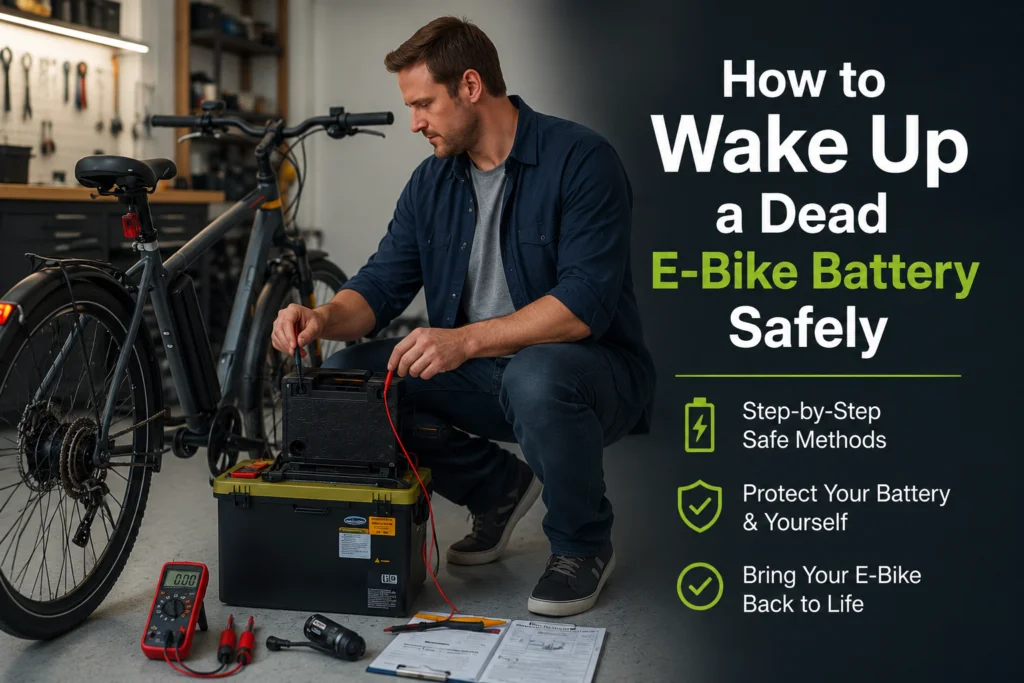
If you are searching for How to Wake Up a Dead E-Bike Battery Safely the safest answer is not “force it to charge.” The right answer is to diagnose why the battery looks dead first.
A dead-looking e-bike battery may be fully drained, locked by the battery management system, disconnected at the charger port, blocked by a bad fuse, or damaged beyond safe recovery. Some batteries can be woken up with the correct charger and reset sequence. Others should not be charged again, especially if they show heat, swelling, odor, water damage, crash damage, or repeated shutdowns.
Most modern e-bike batteries use lithium-ion cells. That means advice meant for old lead-acid batteries, such as desulfation or improvised jump-start methods, does not belong here. Lithium-ion battery systems need careful voltage control, compatible chargers, and working protection circuits. Battery University explains that lithium-ion packs can enter a sleep state when over-discharged and protected by their internal circuit, but unsafe low-voltage conditions should not be treated casually.
This guide gives you a safe diagnostic order: inspect danger signs, check the charger and contacts, understand 0V readings, try normal wake-up steps, decide whether a BMS reset makes sense, and know when replacement is the safer choice.
Can You Wake Up a Dead E-Bike Battery?

Yes, you may be able to wake up a dead e-bike battery if the battery is actually in BMS sleep mode, low-voltage protection, or a charger-detection state. You should not try to wake it if the battery is physically damaged, hot, swollen, leaking, smoking, water-damaged, or repeatedly shutting down.
When a dead battery may be recoverable
A battery may be recoverable when:
- It was stored for weeks or months and now will not power on.
- The display does not turn on, but the battery case looks normal.
- The charger stays green, but there are no signs of heat, odor, swelling, or damage.
- The battery LEDs do not respond after long storage.
- The discharge port reads 0V, but the BMS may be blocking output.
- The original charger and battery are both matched to the same e-bike system.
In these cases, “dead” may mean the BMS has turned off output to protect the cells.
When you should stop and replace or call a technician
Stop immediately if you notice:
- Swelling or a bulging battery case
- Burnt smell, chemical odor, smoke, or hissing
- Heat while the battery is not being used
- Leaking fluid
- Melted plastic, burnt terminals, or blackened connectors
- Water inside the case or charge port
- Crash damage or a cracked shell
- Repeated charger cutoffs
- Battery warming quickly during a wake-up attempt
Lithium-ion batteries can catch fire or explode when damaged or misused, and fire-safety organizations warn that damaged batteries should be handled with caution.
What “waking up” actually means
Waking up an e-bike battery usually means reactivating the battery management system so the battery can accept charge or provide output again.
It does not mean repairing damaged lithium cells. It also does not mean bypassing the BMS, forcing voltage into the pack, or opening the battery case.
Safe DIY: charger check, contact cleaning, normal reset sequence, manufacturer-approved charger.
Technician: voltage testing, charge-port diagnosis, BMS diagnosis, internal inspection.
Replace now: swollen, burnt, wet, crashed, recalled, or unstable battery.
Before You Try Anything: Check These Battery Danger Signs

A dead e-bike battery should be treated as a safety issue before it becomes a repair issue.
Stop immediately if the battery is swollen, hot, leaking, hissing, or smells burnt
Do not plug in the charger if the battery is swollen, hot, leaking, hissing, smoking, or giving off a sharp chemical or burnt smell.
Move it away from anything flammable only if you can do so safely. Do not carry a smoking or actively failing battery through a home, apartment hallway, elevator, or vehicle unless emergency responders tell you to do so.
Do not charge a battery after water damage, crash damage, or melted casing
Water and impact damage can affect internal cells, wiring, insulation, or the BMS. Even if the battery looks normal from the outside, water intrusion or crushed cells can create risk later.
Do not try to revive a battery if:
- It was submerged.
- Rainwater entered the charge port.
- The bike crashed hard.
- The battery case cracked.
- The lock area or mount is bent.
- The charging port sparked.
- The casing looks melted or deformed.
CPSC warnings for specific e-bike batteries have included stop-use instructions where batteries posed fire hazards, including disposal through local hazardous-waste procedures rather than regular trash or ordinary recycling boxes.
What to do if the battery smokes, sparks, or catches fire
If the battery smokes, sparks, pops, catches fire, or releases vapor:
- Get away from the battery.
- Warn others nearby.
- Call emergency services.
- Do not inhale smoke or vapor.
- Do not try to reuse, recharge, or transport the battery afterward.
- Follow local fire department or hazardous-waste guidance for disposal.
FDNY and NFPA both warn that lithium-ion batteries used in e-bikes and similar devices can overheat, catch fire, or explode if defective, damaged, or handled improperly.
Dead, Deeply Discharged, or in Sleep Mode: What’s the Difference?

People often call any non-working battery “dead,” but the cause matters.
A battery that is simply low may charge normally. A battery in BMS sleep mode may need a normal wake-up sequence. A deeply discharged battery may need professional evaluation. A damaged pack should not be revived.
| Battery condition | What it means | Common symptom | Safe next step |
|---|---|---|---|
| Fully drained | Battery is low but still within a normal charging range | Charger turns red and starts charging | Charge with the original charger |
| BMS sleep/protection mode | Battery management system has shut off output | Charger may stay green; bike will not power on | Try approved wake-up or reset steps |
| Deep discharge | Cells may have dropped below healthy voltage | Charger may not recognize the pack | Call a technician if basic steps fail |
| True cell failure or damage | Cells, wiring, or BMS may be unsafe | Heat, swelling, odor, shutdowns, very low voltage | Stop using and replace or recycle safely |
Fully drained battery vs deeply discharged battery
A fully drained battery is not always dangerous. It may simply need a normal charge.
A deeply discharged lithium-ion battery is different. If it has been left empty for a long time, internal cell voltage may fall too low. Battery University notes that storing lithium-ion batteries in a discharged state can allow self-discharge to push the pack into sleep mode.
BMS sleep mode or protection mode
The BMS protects the battery from unsafe conditions such as low voltage, overcurrent, short circuit, overheating, or charging problems.
When the BMS shuts down, the battery may appear completely dead even though the cells still have some charge. That is why a battery can show no output at the discharge port while still having internal voltage.
True cell failure or unsafe battery damage
A BMS reset cannot repair damaged cells.
If a lithium-ion cell has been pushed too far below its safe voltage range, physically damaged, overheated, or contaminated by water, it may become unsafe. Do not use lead-acid battery recovery logic, desulfation advice, Epsom-salt advice, or car-battery jump-start thinking on a lithium e-bike battery.
How to Tell If Your E-Bike Battery Is in Sleep Mode

Sleep mode is one of the more recoverable reasons an e-bike battery looks dead.
A common example: the bike was stored over winter with a low battery. Months later, the display will not turn on, the battery LEDs do nothing, and the charger stays green instead of charging.
No output at the discharge port
If a multimeter reads 0V at the discharge terminals, that may mean the BMS has turned off the output. It does not always prove every cell is at 0V.
Do not probe random pins, communication contacts, or proprietary terminals. If you do not know the correct terminals, skip voltage testing and contact the manufacturer or a qualified e-bike technician.
Charger stays green or does not start charging
A green charger light often means “charged” or “not charging,” depending on the charger. If the battery is actually empty but the charger stays green, possible causes include:
- BMS sleep mode
- Charger mismatch
- Bad charger
- Dirty or damaged charge port
- Blown charge fuse
- Battery too cold
- Pack voltage too low for the charger to detect safely
Display does not power on after long storage
Long storage at low charge is a common sleep-mode trigger. The BMS and internal electronics can slowly consume small amounts of energy over time.
That is why storage matters. A lithium e-bike battery should not be stored empty for months.
Battery LEDs do not respond or show unusual behavior
Battery LEDs may fail to light, blink strangely, or show a false full/empty state when the BMS is locked, the pack is deeply discharged, or the battery electronics are not communicating properly.
Check the owner’s manual before assuming your LED pattern means failure. Brands handle sleep mode differently.
Why Your E-Bike Battery Shows 0 Volts

A 0V reading is serious, but it needs context.
Where you measure matters. A 0V reading at the discharge port may mean BMS output lockout. A 0V reading at internal cell groups would be much more concerning, but opening the pack to check that is not beginner-safe.
0V at the discharge port may mean BMS output lockout
Many e-bike batteries do not expose cell voltage directly at the discharge terminals when the BMS is off. The pack may look like 0V from the outside because the BMS is blocking output.
That is one reason a battery can appear dead even when it has not reached true zero internally.
Charge-port voltage may be different from discharge-port voltage
Some battery designs route charge and discharge through different circuits. A battery may show no voltage at the discharge port but behave differently at the charge port.
Do not assume both ports are the same. Do not insert multimeter probes into unknown pins. Proprietary batteries may include communication terminals that are not meant for basic voltage testing.
When 0V may mean serious cell damage
A true 0V lithium-ion pack is not a DIY recovery candidate.
If a technician confirms the actual cells or cell groups are extremely low, damaged, imbalanced, or unstable, the safest answer is usually replacement or professional recycling. Battery University describes the protection circuit as a safeguard that can turn the battery off when over-discharged; forcing recovery without knowing the pack condition can defeat the purpose of that safeguard.
Why a multimeter reading should not be treated as the only diagnosis
A multimeter reading is useful, but it does not show:
- Cell balance
- Internal resistance
- BMS fault codes
- Water contamination
- Heat history
- Connector damage
- Capacity loss
- Voltage sag under load
Use voltage as one clue, not the whole diagnosis.
| Reading situation | What it may mean | Best next step |
|---|---|---|
| 0V at discharge port only | BMS output lockout or no exposed output | Try approved charger/reset sequence |
| 0V at all accessible terminals | Possible severe fault or full lockout | Stop DIY testing; call technician |
| Low voltage but not 0V | Deep discharge or low pack state | Use original charger only; monitor closely |
| Normal voltage but bike dead | Bike-side issue, fuse, cradle, controller, display | Test connections and bike electronics |
Check the Simple Stuff First: Charger, Port, Fuse, Contacts, and Connections

Many dead-battery problems are not battery-cell problems. Check the simple external causes before trying a reset.
Confirm the charger is the correct voltage and connector type
Use the original charger or a manufacturer-approved replacement.
Do not use a random charger just because the plug fits. A matching connector does not guarantee the correct voltage, polarity, current limit, communication protocol, or charging profile.
Check the charger label for:
- Output voltage
- Output current
- Connector type
- Brand/model compatibility
- Safety certification markings
- Physical damage
A charger mismatch can damage the battery or prevent the BMS from allowing charge.
Check whether the charger light stays green, red, blinking, or off
Charger lights vary by brand, but this table helps you think through the symptom.
| Charger light | Possible meaning | Safe next action |
|---|---|---|
| Red | Charging has started | Monitor battery temperature |
| Green immediately | Battery full, not detected, BMS asleep, bad port, bad charger | Check contacts, port, and manual |
| Blinking | Fault, communication issue, temperature issue, or charger state | Check manual before continuing |
| No light | Bad outlet, bad charger, blown charger fuse, damaged cord | Try another outlet; replace charger if needed |
| Red then green too fast | Weak battery, BMS cutoff, charger issue, or capacity loss | Monitor and test further |
Inspect the charge port, fuse, pins, cradle, and battery mount contacts
Look for:
- Bent pins
- Corrosion
- Dirt or grit
- Burn marks
- Melted plastic
- Loose connector
- Broken charge-port cover
- Damaged cradle contacts
- Blown accessible fuse, if your battery uses one
Clean only external contacts with the battery removed and the charger unplugged. Use a dry cloth or manufacturer-recommended contact cleaner. Do not spray liquid into the battery case.
Try the battery on the bike and off the bike if the design allows it
Some removable batteries can charge on or off the bike. If your design allows both, try both normal charging positions.
If the battery charges off the bike but not on the bike, the issue may be the cradle, wiring, controller, lock, or charge path.
If it does not charge in either position, the issue may be the charger, charge port, battery fuse, BMS, or cells.
Step-by-Step Diagnosis: What to Try Before a BMS Reset

Use the least-invasive process first. Do not jump straight to opening the pack, bypassing protection circuits, or forcing voltage into the battery.
Step 1: Inspect the battery for damage
Before plugging anything in, check:
- Case shape
- Smell
- Temperature
- Charge port
- Discharge contacts
- Mounting rail
- Lock area
- Signs of water
- Burn marks or melted plastic
Any danger sign means stop.
Step 2: Confirm charger compatibility and outlet power
Plug the charger into a known working outlet first. Check the charger indicator before connecting it to the battery.
Then confirm the charger voltage matches your battery system. A 48V lithium-ion e-bike battery commonly uses a 54.6V charger, while a 52V battery commonly uses a 58.8V charger. Chemistry and brand design can vary, so always follow the battery label or manual.
Step 3: Clean and inspect contacts safely
Remove the battery from the bike if possible. Unplug the charger. Wipe external contacts gently.
Do not scrape terminals aggressively. Do not bridge terminals with metal tools. Do not insert objects into unknown ports.
Step 4: Let a cold battery warm to room temperature
If the battery has been stored in freezing conditions, bring it indoors to a safe, dry, room-temperature area before charging.
Do not heat it with a heater, hair dryer, heat gun, or direct sunlight. Let it warm naturally.
Step 5: Try the manufacturer’s normal wake-up sequence
Common normal wake-up actions include:
- Pressing the battery power button once
- Holding the battery power button for several seconds
- Turning the key switch on and off
- Connecting the charger in the manual’s recommended order
- Leaving the original charger connected briefly while monitoring temperature
Use your brand’s manual first because reset behavior varies.
Step 6: Measure voltage only if you know the correct terminals
Use a multimeter only if you know the correct external terminals and can test without shorting pins.
Do not open sealed packs for internal voltage checks unless you are qualified to work on lithium battery systems. A battery pack can contain high energy even when it looks dead.
How to Get an E-Bike Battery Out of Sleep Mode Safely

If the battery passes the safety inspection and you suspect BMS sleep mode, try only low-risk wake-up steps first.
Use the original or manufacturer-approved charger
Start with the correct charger. A BMS may refuse to wake if the charger is incompatible, underpowered, overvoltage, wrong polarity, or missing required communication.
UL Solutions describes UL 2849 as evaluating the e-bike electrical drive train, battery system, and charger system together, which is why mixing random chargers and packs is not a safe shortcut.
Connect charger and battery in the recommended sequence
Some systems prefer charger-to-wall first, then charger-to-battery. Others may specify a different order.
A basic safe sequence is:
- Place the battery on a nonflammable surface away from combustibles.
- Plug the charger into the wall outlet.
- Confirm the charger powers on.
- Connect the charger to the battery.
- Watch the charger light and battery temperature.
- Disconnect if anything smells, heats, sparks, or behaves abnormally.
Follow the manufacturer’s sequence if it differs.
Hold the power button or reset button if your model supports it
Some batteries wake after holding the power button for 5–15 seconds. Some have a reset button. Some use a key switch. Some wake only when connected to the charger.
Do not guess with hidden buttons, pinholes, or ports unless the manual confirms their purpose.
Let the charger sit briefly only if the battery remains cool and stable
If the battery is cool, undamaged, and using the correct charger, you may let it sit briefly to see whether the BMS wakes and charging begins.
Stay nearby. Do not charge overnight. Do not charge near a bed, exit path, curtains, furniture, cardboard, or other combustibles. USFA advises consumers to be aware of lithium-ion battery fire risks and follow safe charging practices.
Stop if the battery heats up, smells, swells, or repeatedly shuts off
Repeated shutdown is not a normal “wake-up” success.
Stop if the battery:
- Gets warm quickly
- Trips the charger again and again
- Shows a fault light
- Smells odd
- Makes noise
- Cuts off immediately after charging
- Powers the bike for only a few seconds
Those symptoms need professional diagnosis.
How to Reset the BMS on an E-Bike Battery

A BMS reset can help when the protection circuit has latched off after low voltage, overcurrent, storage, charger detection failure, or a temporary fault. It cannot repair damaged cells.
What a BMS reset can and cannot fix
A BMS reset may:
- Restore discharge output
- Allow the charger to detect the battery
- Clear a temporary protection state
- Wake a pack after storage
- Restore battery LED response
A BMS reset cannot:
- Restore lost capacity
- Repair swollen cells
- Reverse water damage
- Fix burnt wiring
- Make unsafe cells safe
- Override a recalled-battery warning
- Solve a controller or display fault
Common reset methods: charger sequence, power button, key switch, reset button
| Reset method | When it may apply | Risk level |
|---|---|---|
| Original charger connection | BMS sleep or low-voltage protection | Low, if battery is undamaged |
| Hold power button | Battery has electronic power switch | Low |
| Key switch off/on | Battery uses keyed circuit control | Low |
| Reset button | Manual confirms reset function | Low to medium |
| Disconnect/reconnect removable battery | Contact or cradle issue | Low |
| Open pack and unplug BMS | Internal repair only | High; not beginner DIY |
| Bypass BMS | Unsafe | Do not do this |
Why BMS reset steps vary by battery brand
E-bike battery systems vary widely. Some are simple two-wire packs. Others use communication with the controller, display, charger, or brand-specific electronics.
That is why the correct reset method depends on the model. Look for your exact battery manual, not just a general video.
When a reset does not work
A reset may fail if:
- The charger is wrong or dead.
- The charge port is damaged.
- The fuse is blown.
- Cells are too low or imbalanced.
- The BMS detected a hard fault.
- The battery has water damage.
- The battery is locked by brand electronics.
- The controller/display issue is not in the battery.
If a normal reset fails, stop escalating the DIY risk. Move to professional testing or replacement.
How to Recover a Deeply Discharged E-Bike Battery Without Taking Unsafe Risks

Deep discharge recovery is where many guides become unsafe. The goal is not to “shock” the battery back. The goal is to decide whether it can be safely evaluated and charged under controlled conditions.
Why the original charger may not start
Many lithium-ion chargers will not charge a pack if voltage is too low or the BMS blocks the charge path. That is intentional protection.
A charger that stays green may be saying, “I do not see a chargeable battery,” not “the battery is healthy.”
Why slow recovery should be handled carefully
Professional battery technicians may use controlled equipment to evaluate cell voltage, balance, resistance, and temperature before attempting recovery.
That is different from a beginner connecting random power sources to battery terminals. Controlled lithium recovery requires current limits, chemistry knowledge, voltage monitoring, thermal monitoring, and pack-level judgment.
Why you should not jump-start with a car battery or random battery pack
Do not jump-start an e-bike battery with:
- A car battery
- Another e-bike battery
- A power-tool battery
- Loose wires
- Alligator clips
- A higher-voltage charger
- A random bench supply without proper expertise
- A charger chosen only because the plug fits
These methods can bypass the BMS, overheat cells, short terminals, cause arcing, or push current into a damaged pack. Lithium battery fires can be fast and severe, and damaged or misused lithium-ion batteries are a known fire risk.
When a technician can test or recover the pack safely
Call a qualified e-bike shop, battery rebuilder, or manufacturer service center when:
- The battery shows very low voltage.
- The charger refuses to start.
- The BMS reset fails.
- The battery was stored empty for months.
- The pack wakes but shuts off under load.
- The battery is expensive and still under warranty.
- You do not know which terminals to test.
- The pack uses proprietary electronics.
Ask whether they can test cell balance, BMS function, charge path, discharge path, internal resistance, and water damage.
What Voltage Means Your 36V, 48V, or 52V E-Bike Battery May Be Recoverable?

Voltage helps diagnosis, but it is not a universal pass/fail answer. Pack design, chemistry, BMS settings, cell count, and manufacturer limits matter.
Why nominal voltage is different from full-charge voltage
A 36V, 48V, or 52V label is usually nominal voltage, not full-charge voltage.
Common lithium-ion e-bike pack examples:
| Pack label | Typical series cell count | Typical full charge | Approx. nominal voltage |
|---|---|---|---|
| 36V | 10s | 42.0V | 36V / 37V |
| 48V | 13s | 54.6V | 46.8V / 48V |
| 52V | 14s | 58.8V | 50.4V / 52V |
These are common lithium-ion examples, not a replacement for your battery label.
Why low-voltage cutoff varies by pack design and BMS
Many lithium-ion systems protect cells by cutting off discharge before the cells become dangerously low. The exact cutoff depends on the cell chemistry, BMS design, load, temperature, and manufacturer settings.
Battery University notes that lithium-ion protection circuits are designed to turn the battery off when over-discharged.
How to interpret “very low,” “BMS locked,” and “unsafe to recover” readings
Use this table as conservative troubleshooting logic, not as a forced-charging guide.
| Battery label | Normal full charge | Very low external pack reading | What it may mean |
|---|---|---|---|
| 36V | About 42V | Around 30V or lower | Near or below many common cutoff regions |
| 48V | About 54.6V | Around 39V or lower | Near or below many common cutoff regions |
| 52V | About 58.8V | Around 42V or lower | Near or below many common cutoff regions |
| Any pack | 0V at discharge port | 0V external output | May be BMS lockout or serious fault |
| Any pack | Extremely low confirmed cell-group voltage | Varies | Technician/replacement decision |
Do not use this chart to force-charge a low pack. Use it to decide whether you are still in safe DIY territory.
Why manufacturer specifications matter more than generic charts
Generic voltage charts cannot account for:
- Li-ion vs LiFePO₄ chemistry
- 10s, 13s, 14s, or other cell counts
- Smart BMS behavior
- Proprietary communication
- Temperature limits
- Cell age and imbalance
- Brand-specific cutoff settings
Your battery label, charger label, and manufacturer manual matter more than a generic internet chart.
Battery Wakes Up but Still Dies Quickly, Cuts Out, or Gets Warm

A battery that wakes up is not automatically healthy.
Post-revival testing matters because a weak or unsafe pack may power on briefly, then fail under real load.
Battery shuts off under load
If the bike turns on but cuts out when you accelerate, climb a hill, or use higher assist, possible causes include:
- Weak cells
- High internal resistance
- Cell imbalance
- BMS overcurrent protection
- Voltage sag
- Bad discharge connector
- Controller pulling too much current
- Battery near end of life
Try a short, low-assist test ride only if the battery charged normally, stayed cool, and showed no danger signs.
Battery gets warm during charging or first ride
Slight warmth can happen during normal charging or riding, but noticeable heating during a recovery attempt is a warning sign.
Stop using the battery if it gets hot, smells odd, or warms quickly while doing light work.
Range is much lower than before
A revived battery may have lost capacity. If your usual range drops sharply, the cells may be aged, imbalanced, or damaged from deep discharge.
Do not assume one successful charge means the battery is reliable.
Voltage drops quickly after charging
If voltage falls quickly after the charger turns green, the pack may have weak cell groups or poor balance.
A technician can load-test the battery and check whether the voltage sag is normal or excessive.
Charger finishes too fast or never finishes
Both symptoms matter.
- Finishes too fast: possible low capacity, BMS cutoff, weak cells, or bad charger detection.
- Never finishes: possible imbalance, charger issue, heat issue, or BMS fault.
Post-revival checklist:
- Charge in a safe, visible location.
- Keep the battery away from combustibles.
- Check for heat every few minutes during early charging.
- Let the pack rest after charging.
- Take a short first ride near home.
- Use low assist first.
- Stop if the battery cuts out, heats, smells, or loses power quickly.
Fully Charged E-Bike Battery Not Working: When the Battery Isn’t the Only Suspect

Sometimes the battery is not dead at all. The bike-side system may be the problem.
Battery charges but has no discharge output
A battery can accept charge but fail to provide output if:
- The discharge fuse is blown.
- The BMS discharge path is locked.
- The key switch is faulty.
- The discharge port is damaged.
- The connector is burnt or loose.
- The battery is not seating correctly in the cradle.
Bad discharge port, fuse, cradle, or key switch
Inspect the physical connection between the battery and bike.
Look for:
- Loose battery fit
- Damaged locking rail
- Bent cradle pins
- Burnt mount contacts
- Corrosion
- Loose wiring near the controller
- Key switch that feels loose or inconsistent
A fully charged battery cannot power the bike if the discharge path is broken.
Display, controller, wiring, or communication fault
If the battery has normal voltage but the bike will not turn on, the fault may be outside the battery.
Possible bike-side issues include:
- Failed display
- Controller fault
- Main wiring harness issue
- Brake cutoff sensor fault
- Communication error
- Loose connector
- Water-damaged controller
How to separate battery failure from bike-side failure
| Symptom | Likely area | Safe next action |
|---|---|---|
| Battery charges and LEDs work, but bike dead | Bike wiring, cradle, display, controller | Inspect mount and connectors |
| Battery works on another compatible bike | Bike-side fault | Service bike electronics |
| Known-good battery works on your bike | Original battery fault | Test battery professionally |
| Battery dead on and off bike | Charger, battery, BMS, port, fuse | Continue battery diagnosis |
| Charger works on another same-model battery | Battery-side issue | Call technician or manufacturer |
Do not test with incompatible batteries just because the voltage seems similar. Connector shape and communication requirements can differ.
Repair, Recovery, or Replacement: What Makes the Most Sense?

The right decision depends on the symptom, safety condition, warranty, battery age, and repair access.
When a charger, fuse, port, or contact repair may solve it
Simple external repairs may make sense when:
- The charger is dead.
- The charger cord is damaged.
- A replaceable fuse is blown.
- The charge port is loose.
- Contacts are dirty or corroded.
- The battery mount is misaligned.
- The key switch or cradle is faulty.
These are better outcomes than cell recovery because they do not require opening the lithium pack.
When BMS repair or cell diagnosis requires a professional
Professional help is the safer path when:
- The BMS does not reset.
- The battery reads very low voltage.
- The battery wakes then shuts down.
- The pack has severe voltage sag.
- The charger refuses to recognize it.
- The battery uses proprietary electronics.
- The pack is expensive or under warranty.
Opening a sealed pack can expose high-energy conductors, fragile balance wires, and cells that can short if mishandled.
When replacement is safer than recovery
Replace the battery if:
- It is swollen.
- It smells burnt.
- It was submerged.
- It was damaged in a crash.
- It heats during charging.
- It repeatedly cuts out after recovery.
- It is recalled or under a stop-use warning.
- A technician confirms severe imbalance or cell failure.
- The manufacturer says the pack is not serviceable.
CPSC stop-use warnings for certain e-bike batteries have specifically told consumers not to sell or give away hazardous batteries and to follow hazardous-waste disposal procedures.
Warranty, proprietary batteries, and brand lockouts
Check warranty before opening, modifying, or replacing anything. Opening the battery case may void coverage.
Some e-bike systems use proprietary batteries, smart BMS communication, coded chargers, or brand-specific lockouts. In those cases, a generic replacement may not work even if voltage and connector shape look similar.
| Issue | Possible fix | DIY, technician, or replace? |
|---|---|---|
| Dirty contacts | Clean external contacts | DIY |
| Bad outlet or charger | Replace with approved charger | DIY / retailer |
| Blown external fuse | Replace if manual allows | DIY / technician |
| Bad charge port | Repair or replace port | Technician |
| BMS sleep | Approved wake/reset sequence | DIY first |
| BMS hard fault | Diagnose BMS and cells | Technician |
| Cell imbalance | Controlled testing/rebuild | Specialist |
| Swelling, heat, odor, water damage | Do not revive | Replace/recycle |
How to Choose a Safer Replacement Battery in the USA

If recovery is unsafe or unsuccessful, buy the safest compatible replacement you can.
Match voltage, connector, mount, communication system, and charger requirements
Before buying, match:
- Battery voltage
- Capacity range supported by the bike
- Mount style
- Physical size
- Discharge connector
- Charge connector
- Polarity
- BMS current rating
- Communication system
- Charger voltage and type
- Brand compatibility
Do not rely on product photos alone. Ask the manufacturer or qualified dealer if you are unsure.
Look for reputable brands and certified battery systems
Choose batteries from the original e-bike brand, a reputable dealer, or a known battery specialist.
Avoid no-name packs with vague labels, missing specifications, unclear cell chemistry, no warranty support, or suspiciously low prices.
CPSC has urged manufacturers of micromobility products to comply with applicable safety standards and demonstrate compliance through certification from an accredited testing laboratory.
Understand UL 2849, UL 2271, and misleading certification claims
UL 2849 evaluates the electrical system of e-bikes, including the drive train, battery system, and charger system combination.
UL 2271 is commonly associated with batteries for light electric vehicle applications. A battery label or listing should be specific and verifiable, not just a vague “UL” logo with no standard number or lab traceability.
Avoid unknown chargers, fake labels, and suspiciously cheap packs
A safer replacement checklist:
- Buy from the bike brand, authorized dealer, or reputable battery supplier.
- Verify voltage and charger compatibility.
- Confirm the mount and communication requirements.
- Look for clear certification details.
- Avoid used batteries with unknown history.
- Avoid packs with damaged cases or missing labels.
- Avoid chargers with no brand, no output specs, or poor build quality.
- Keep the receipt and warranty information.
What to Do With a Damaged, Recalled, or Old E-Bike Battery

A failed lithium e-bike battery should not go into household trash.
Check for recalls and stop-use warnings
Search your battery brand, bike model, and battery model number on the manufacturer site and CPSC recall/warning pages.
If your battery appears in a recall or stop-use warning, follow the official instructions. Do not keep riding it because it “still works.”
Do not throw lithium e-bike batteries in regular trash
CPSC recall and warning notices for lithium e-bike batteries commonly state that recalled or defective lithium-ion batteries should not be thrown in the trash, ordinary recycling stream, or standard used-battery recycling boxes.
Use approved recycling or drop-off programs
For normal end-of-life e-bike batteries, use an approved recycling or drop-off program.
The Battery Network provides e-bike battery recycling resources and drop-off information, while noting that damaged, defective, or recalled batteries require special handling and should not be placed in regular collection boxes.
Handle damaged or swollen batteries differently from normal used batteries
If the battery is swollen, burnt, leaking, wet, recalled, or damaged:
- Do not charge it.
- Do not ship it casually.
- Do not drop it into a normal recycling bin.
- Do not store it near combustibles.
- Contact the manufacturer, local household hazardous waste program, fire department guidance line, or approved battery recycling program.
Damaged lithium batteries require special handling because they present higher fire risk.
How to Prevent E-Bike Battery Deep Discharge in the Future

Most deep-discharge problems are preventable.
Store the battery partially charged, not empty
Do not store an e-bike battery at 0%.
For many lithium-ion e-bike batteries, partial charge storage is healthier than empty storage. Follow your manufacturer’s storage recommendation because ideal storage levels vary by brand and chemistry.
Check charge periodically during long storage
During winter or long breaks:
- Check the battery every 4–8 weeks.
- Recharge if it drops too low.
- Do not leave it connected to the bike if the manual warns against parasitic drain.
- Do not forget it in a garage, shed, or storage unit for months.
Avoid extreme heat, freezing temperatures, and moisture
Store the battery in a cool, dry location away from:
- Direct sunlight
- Heaters
- Cars in summer
- Freezing garages
- Damp sheds
- Rain exposure
- Flammable clutter
Temperature abuse can shorten battery life and increase safety risk.
Use the correct charger only
Keep the original charger labeled and separate from other chargers.
Do not mix chargers between e-bikes unless the manufacturer confirms compatibility.
Inspect battery health before winter storage or long trips
Before storage or a long ride, check:
- Case condition
- Mount fit
- Charger behavior
- Range changes
- Charging time
- Heat during charging
- Error codes
- Contact corrosion
A small issue caught early is easier to fix than a battery that has been left empty for months.
FAQs About Waking Up a Dead E-Bike Battery

Do e-bike batteries have a reset button?
Some e-bike batteries have a reset button, but many do not. Reset methods vary by brand, battery design, BMS type, and charger system.
Check your exact manual before pressing hidden buttons or inserting anything into a pinhole. Some batteries reset through the charger sequence, power button, key switch, or display system instead.
What does resetting the battery management system do?
Resetting the BMS may clear a temporary protection state so the battery can charge or provide output again. It does not repair damaged cells.
For example, a battery stored too low may shut off its discharge output. A reset may wake the BMS if the pack is still safe, but it will not fix swelling, water damage, cell imbalance, or severe deep discharge.
Can you wake an e-bike battery that reads 0 volts?
Sometimes, but only if the 0V reading is from the external discharge port and the BMS is blocking output. If the actual cells are truly at or near zero, the battery is not a safe DIY recovery candidate.
Do not open the pack to find out unless you are qualified. Use the original charger and normal reset steps only if the battery has no danger signs.
What is the low-voltage cutoff for a 48V e-bike battery?
There is no single universal cutoff for every 48V e-bike battery. Many 48V lithium-ion packs are 13-cell-series systems with a full charge around 54.6V, but the BMS cutoff depends on the manufacturer, cell chemistry, load, and pack design.
Use the battery manual or manufacturer specification instead of forcing a generic number.
Can you recharge a completely dead lithium e-bike battery?
You can recharge some dead-looking lithium e-bike batteries if they are only in BMS sleep mode or low-voltage protection and show no physical danger signs. You should not recharge a battery that is swollen, hot, leaking, burnt, wet, crashed, recalled, or repeatedly shutting off.
If the original charger will not start and basic reset steps fail, call a technician.
Should I open the battery, bypass the BMS, or jump-start it with another battery?
No. Do not open the battery, bypass the BMS, or jump-start it with another battery as a beginner DIY fix.
Those actions can defeat safety protections, short the pack, cause arcing, damage cells, or start a fire. A BMS exists to stop charging or discharging when the pack may be unsafe.
Why is my e-bike charger green but the battery is not charging?
A green charger light may mean the battery is full, but it can also mean the charger does not detect the battery.
Likely causes include:
- BMS sleep mode
- Battery too low for charger detection
- Bad charger
- Wrong charger
- Dirty contacts
- Damaged charge port
- Blown fuse
- Battery too cold
- Internal BMS fault
Start with charger compatibility, outlet power, contacts, and manual-approved reset steps.
What are the symptoms of a completely dead e-bike battery?
Common symptoms include:
- Bike display will not turn on
- Battery LEDs do not respond
- Charger stays green or shows fault
- Battery reads 0V at external discharge port
- Battery will not charge on or off the bike
- Battery wakes briefly then shuts down
- Range drops sharply after charging
Danger symptoms include swelling, heat, odor, leaking, smoke, hissing, or melted connectors.
Can storage put an e-bike battery into deep discharge?
Yes. Long storage at low charge can allow the battery to self-discharge until the BMS shuts it down or the cells drop too low.
Store the battery partially charged, check it periodically, and follow the manufacturer’s storage instructions.
Can a dead or damaged e-bike battery catch fire even when it is not charging?
Yes, a damaged or defective lithium-ion battery can present fire risk even when it is not charging. CPSC has reported incidents involving certain e-bike batteries where fires occurred while the battery was not charging, not in use, or in storage.
If a battery is damaged, recalled, swollen, wet, hot, or smells burnt, do not keep it inside your home as if it were normal. Follow local hazardous-waste or manufacturer instructions.
Pingback: SEO title: E-Bike Battery Not Charging? Safe Checks Before You Replace Anything - electricscootercar.com
Pingback: SEO Title: E-Bike Charging System Components: How They Work and What Must Match - electricscootercar.com
Pingback: What Is a BMS on an E-Bike? How It Works, Protects the Battery, and Troubleshoots Problems - electricscootercar.com
Comments are closed.