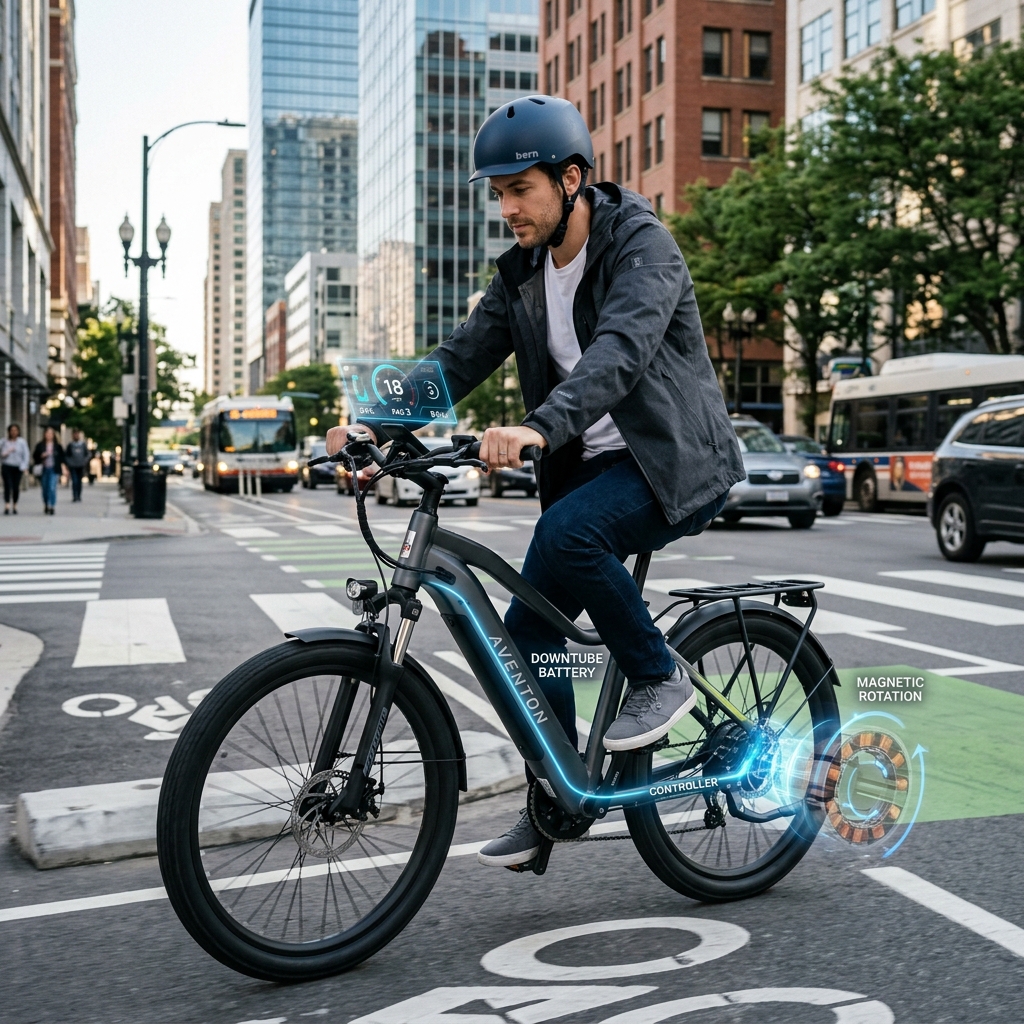
An electric bike motor works by turning battery power into controlled movement. When you pedal or use the throttle, sensors send a signal to the controller. The controller then sends the right amount of power from the battery to the motor. Inside the motor, magnetic force creates torque, which helps spin the wheel directly in a hub motor or helps turn the drivetrain in a mid-drive motor.
In simple words:
Battery → Controller → Sensor Signal → Motor → Wheel or Drivetrain → Bike Moves Forward
Geared Hub Motor vs Gearless Hub Motor
Not all hub motors work the same way. Most riders will see two common types: geared hub motors and gearless, also called direct-drive, hub motors.
| Hub Motor Type | How It Works | Best For | Main Limit |
|---|---|---|---|
| Geared hub motor | Uses internal gears to increase low-speed pulling force. | City riding, starts from traffic lights, moderate hills, lighter e-bikes. | Internal gears can wear over time and may make more noise. |
| Gearless hub motor | Uses direct magnetic force without internal reduction gears. | Flat roads, quiet cruising, simple riding, heavier-duty designs. | Can feel weaker at low speed and may be less efficient on steep hills. |
If your route is mostly flat, either type can work well. If you often start from stops or climb moderate hills, a geared hub motor may feel stronger at lower speeds.
Monthly Motor Care Checklist
Use this simple checklist once a month, especially if you ride daily.
- Check that the motor cable is not loose, pinched or damaged.
- Keep the motor area clean, but do not pressure-wash it.
- Listen for new grinding, clicking or rubbing sounds.
- Keep tyres properly inflated so the motor does not work harder than needed.
- On a mid-drive e-bike, check chain wear because motor power also travels through the drivetrain.
- Stop riding if the motor becomes unusually hot or the bike suddenly loses power.
- Use only the charger recommended by the manufacturer.
- Do not modify the controller to force more speed or power.
Types of Electric Bike Motors

Most electric bikes use one of two motor layouts:
- Hub motor
- Mid-drive motor
Both follow the same basic electric bike motor working principle, but they deliver power differently.
Hub Motors

A hub motor is built into the center of the front or rear wheel. Instead of sending power through the chain, the motor spins the wheel directly.
Rear hub motors are very common on commuter and budget-friendly e-bikes because they give the bike a simple “pushed from behind” feeling. Front hub motors also exist, but they are less common on performance-focused e-bikes.
How Does a Hub Motor Work?
A hub motor uses two main parts:
- Stator: The fixed part with copper windings
- Rotor: The rotating part connected to the wheel, usually with magnets
When the controller sends current into the windings, the stator creates a magnetic field. That field interacts with the rotor magnets, creating torque. Torque is the turning force that spins the wheel.
In many e-bike hub motors, the axle and stator stay fixed while the outer motor shell rotates with the wheel. This lets the motor move the bike without using the chain or gears.
Hub Motor Pros
Hub motors are popular because they are:
- Simple
- Usually more affordable
- Low maintenance
- Good for flat roads
- Good for everyday city commuting
Hub Motor Limits
A hub motor may not feel as efficient on long or steep hills because it does not use the bike’s gears the same way a mid-drive motor does.
For example, a rear hub motor may work well for a flat 5-mile commute. But if your route includes steep hills, heavy cargo, or frequent stop-and-go riding, the motor may drain the battery faster or heat up more easily.
Mid-Drive Motors

A mid-drive motor is mounted near the pedals, usually around the bottom bracket area of the bike. Instead of spinning the wheel directly, it sends power through the crank, chain, gears, and rear wheel.
Bosch describes mid-drive motors as being mounted in the center of the bottom bracket area, which helps with balanced weight distribution and a natural riding feel.
Why Mid-Drive Motors Feel Different
A mid-drive motor works with your pedaling. When you shift gears correctly, the motor can stay in a more efficient range.
This is why mid-drive motors are often better for:
- Steep hills
- Cargo e-bikes
- Electric mountain bikes
- Longer rides
- Riders who want a natural cycling feel
Mid-Drive Pros
Mid-drive motors usually offer:
- Better climbing ability
- More efficient use of gears
- Balanced bike weight
- Stronger performance under load
- More natural pedal-assist response
Mid-Drive Limits
Mid-drive systems often cost more. They can also add more wear to the chain, cassette, and drivetrain because the motor power travels through the same parts you use when pedaling.
A hub motor is often enough for relaxed city riding. A mid-drive motor is usually better if your rides include hills, cargo, longer distances, or rougher terrain.
Core Working Principles of an Electric Bike Motor

The electric bike motor working principle is based on electromagnetism.
When electric current flows through copper windings inside the motor, it creates magnetic fields. These magnetic fields interact with permanent magnets inside the motor. That interaction creates rotation.
That rotation is what helps move the bike forward.
Most modern e-bike motors use brushless DC motor technology. In a brushless DC motor, the controller switches current through the motor windings in a timed sequence. This keeps the rotor spinning smoothly without the older brush-style design used in some traditional motors.
Key Parts Inside an E-Bike Motor

Stator
The stator is the stationary part of the motor. It contains copper windings that become electromagnets when current flows through them.
Rotor
The rotor is the moving part of the motor. It usually contains permanent magnets and turns when it reacts to the stator’s magnetic field.
Magnets
The magnets help create the push-and-pull force that produces rotation.
Windings
Windings are coils of copper wire. The controller energizes them in the correct order to keep the motor spinning.
Sensors
Many e-bike motors use Hall sensors or similar feedback systems. These help the controller understand rotor position, so it knows when to send power to each motor phase.
Role of the Controller

The controller is the power manager of the e-bike.
The battery does not send full power to the motor all the time. That would be inefficient and unsafe. Instead, the controller decides how much current the motor should receive.
The electric bike motor and controller work together every time you ride.
The controller helps manage:
- Motor speed
- Torque
- Acceleration
- Pedal-assist level
- Throttle response, if the bike has a throttle
- Overcurrent protection
- Low-voltage battery protection
- Heat-related power reduction on some systems
For example, when you start from a stop, the controller may send more current for stronger acceleration. When you cruise on a flat bike lane, it may reduce current to save battery.
This is why two e-bikes with similar motor wattage can feel very different. Controller tuning, battery quality, sensor type, and motor design all affect real-world performance.
How the Motor Knows When to Assist

The motor does not guess when to help. It responds to rider input.
Most e-bikes use one or more of these systems:
Cadence Sensor
A cadence sensor detects whether the pedals are turning.
It is common on affordable commuter e-bikes. It usually feels like the motor turns on after you start pedaling and turns off when you stop.
Torque Sensor
A torque sensor measures how hard you press on the pedals.
This usually feels smoother and more natural because the motor gives more help when you pedal harder.
Throttle
Some Class 2 e-bikes include a throttle. This lets the rider activate motor power without pedaling, usually up to 20 mph under the common Class 2 system.
A throttle can help when starting from a stop, riding in traffic, or carrying cargo. But frequent throttle use can drain the battery faster.
How the Battery Powers the Motor

The battery is the energy source of the e-bike.
Most modern e-bikes use lithium-ion batteries because they store a useful amount of energy in a relatively compact package. The battery sends DC power to the controller. The controller then manages and switches that power to operate the motor.
Here is the simple version of how battery powers electric bike motor:
- The battery stores electrical energy.
- The rider pedals or uses the throttle.
- The sensor or throttle sends a signal.
- The controller draws power from the battery.
- The controller sends controlled current to the motor.
- The motor creates rotation.
- The wheel or drivetrain moves the bike forward.
Voltage, Current, Watts, and Watt-Hours
You do not need to be an engineer to understand the basics.
- Voltage: Electrical pressure
- Current: Electrical flow
- Watts: Power being used
- Watt-hours: Stored battery energy
Battery capacity is usually measured in watt-hours, or Wh. A higher Wh number generally means more stored energy, but range also depends on motor power, assist level, rider weight, terrain, wind, tire pressure, temperature, and speed. REI notes that battery capacity and motor power both matter because a higher-powered motor can drain the same battery faster under heavy use.
Real-World Range Example
Advertised range is usually based on ideal conditions. Real rides are rarely ideal.
A rider using low assist on flat streets may get much more range than someone using high assist on hills.
For example:
- A flat 6-mile city commute may use very little battery.
- A 15-mile hilly ride on high assist may use much more.
- Carrying groceries, a child seat, or cargo can reduce range.
- Cold weather can temporarily reduce battery performance.
- Underinflated tires can make the motor work harder.
A practical rule: do not judge an e-bike only by its advertised range. Look at battery Wh, motor type, terrain, rider weight, and how much assist you expect to use.
Do Electric Bikes Use AC or DC Motors?

Most e-bikes use battery systems that supply DC power.
Most modern e-bike motors are brushless DC motor systems. The confusing part is that the controller electronically switches current through different motor phases to create a rotating magnetic field.
So the beginner-friendly answer is:
Most e-bikes use DC battery power and brushless DC motor systems, with the controller handling the electronic switching needed to make the motor spin smoothly.
You do not need to choose AC or DC settings as a rider. The e-bike system handles that automatically.
Electric Bike Motor Working Diagram

A simple electric bike motor working diagram makes the power flow easier to understand.
Hub Motor Power Flow
Inside a Hub Motor
Battery
↓
Controller
↓
Rear or Front Hub Motor
↓
Wheel Spins
↓
Bike Moves Forward
Hub Motor in Wheel
[ Fixed Axle ]
↓
[ Stator + Copper Windings ]
↓ magnetic force
[ Rotor + Permanent Magnets ]
↓
[ Outer Shell Spins with Wheel ]
In a hub motor, the motor helps rotate the wheel directly.
Mid-Drive Motor Working Diagram

Battery
↓
Controller
↓
Mid-Drive Motor
↓
Crank / Chainring
↓
Chain + Gears
↓
Rear Wheel
↓
Bike Moves Forward
A mid-drive motor sends power through the drivetrain.
That is why shifting gears matters. On a hill, using an easier gear helps the motor work more efficiently. Using too hard of a gear can make the system feel strained and may use more battery.
Hub Motor vs. Mid-Drive Motor: Which Feels Better?

The better motor depends on your riding style.
Choose a Hub Motor If You Want:
- A simpler system
- Lower maintenance
- A more affordable e-bike
- Flat-road commuting
- Casual neighborhood rides
- Basic city transportation
Choose a Mid-Drive Motor If You Want:
- Better hill climbing
- A more natural pedaling feel
- Better balance
- Stronger cargo performance
- More efficient use of gears
- Better performance on longer or steeper rides
Bosch also notes that mid-drive systems work with the bike’s gears, which can improve efficiency and range during real riding, especially when the rider shifts properly.
For many USA commuters, a rear hub motor is perfectly practical. For riders in hilly cities, cargo-bike users, or people who want a more bicycle-like feel, a mid-drive motor is often the better choice.
Safety Considerations for Motor and Battery Usage

E-bike motors are usually low-maintenance, but the battery and electrical system need careful handling.
The U.S. Consumer Product Safety Commission recommends following manufacturer charging instructions, being present while charging, never charging while sleeping or away from home, unplugging the device when charging is complete, and using only the charger provided or recommended by themanufacturer.
Practical Safety Tips
- Use only the original or manufacturer-approved charger.
- Do not charge the battery overnight.
- Do not charge near beds, curtains, couches, or exits.
- Do not use a swollen, leaking, damaged, or strange-smelling battery.
- Let the battery cool before charging after a hard ride.
- Avoid storing the battery in extreme heat.
- Do not pressure-wash the motor, battery, or controller area.
- Do not modify the controller to force more speed or power.
- Keep tires properly inflated to reduce motor strain.
- Stop riding and let the system cool if the motor feels unusually hot.
UL 2849 is an important e-bike electrical safety standard because it evaluates the electrical drive train system, battery system, and charger system combination.
For USA buyers, this means it is smart to look for reputable brands and certified electrical systems, especially if the bike will be charged indoors.
Common Beginner Mistakes to Avoid

Using Maximum Assist All the Time
High assist feels fun, but it drains the battery faster.
Use lower assist on flat roads and save higher assist for hills, headwinds, or heavy loads.
Ignoring Gears on a Mid-Drive E-Bike
Mid-drive motors work best when you shift properly.
Use an easier gear when starting, climbing, or carrying cargo.
Buying Only by Motor Wattage
A 750W motor is not automatically better than a well-designed 500W system.
Battery quality, torque, controller tuning, gearing, bike weight, tire pressure, and terrain all matter.
Ignoring Local Rules
E-bike rules can vary by state, city, trail, park, and path.
Even if your e-bike fits a common Class 1, Class 2, or Class 3 category, check local rules before riding on trails, sidewalks, bike paths, or public lands.
Summary & Key Takeaways
An electric bike motor works by using battery power to create magnetic force inside the motor. That magnetic force creates rotation, which helps move the bike forward.
The battery supplies energy. The controller manages power. The sensors or throttle tell the system when the rider needs help. The motor turns that controlled electrical power into motion.
Hub motors are built into the wheel and are simple, affordable, and common on commuter e-bikes.
Mid-drive motors sit near the pedals and use the bike’s drivetrain, making them better for hills, cargo, and more natural pedal assistance.
For most USA riders:
- Flat city commute: hub motor is usually enough.
- Steep hills: mid-drive is usually better.
- Lower maintenance: hub motor is often simpler.
- Natural ride feel: mid-drive often feels better.
- Heavy cargo: mid-drive usually performs better.
- Budget-friendly riding: hub motor is usually more common.
A good e-bike motor system should feel smooth, predictable, safe, and suited to your real riding route.
FAQs

How does an electric bike motor work in simple words?
An electric bike motor uses battery power to create magnetic force. That force spins part of the motor, which helps turn the wheel or drivetrain.
How does a hub motor work?
A hub motor is built into the wheel. The stator creates magnetic fields, and the rotor turns in response. This spins the wheel directly.
What is the electric bike motor working principle?
The working principle is electromagnetism. Electric current creates magnetic fields inside the motor, and those fields create rotation.
What does the controller do on an electric bike?
The controller manages how much battery power goes to the motor. It controls speed, torque, acceleration, assist level, and safety limits.
Do electric bikes use AC or DC motors?
Most e-bikes use DC battery power and brushless DC motor systems. The controller handles the electronic switching needed to spin the motor.
Is a hub motor or mid-drive motor better?
A hub motor is usually better for simple, affordable commuting. A mid-drive motor is usually better for hills, cargo, longer rides, and a more natural pedaling feel.
Can an e-bike motor overheat?
Yes. Long steep climbs, heavy cargo, high assist, low tire pressure, or hot weather can make the motor work harder. If the motor feels unusually hot or the bike reduces power, stop and let it cool.
Quick Summary / Checklist
Before buying or riding an e-bike, check:
- Motor type: hub or mid-drive
- Battery capacity in Wh
- Sensor type: cadence or torque
- Throttle availability
- Class rating: Class 1, 2, or 3
- Local riding rules
- Charger compatibility
- Electrical safety certification
- Real-world route conditions
- Hill and cargo needs
- Maintenance expectations
Pingback: Electric Bike Motors Explained: What USA Riders Need to Know - electricscootercar.com
Pingback: How Fast Do Electric Bikes Go & Speed Limits Understanding - electricscootercar.com
Pingback: Electric Bike Motor Comparison 2026: Hub vs Mid-Drive, Watts & Torque - electricscootercar.com
Pingback: Electric Bike Range: Real Miles Per Charge by Battery Size - electricscootercar.com
Pingback: How Do Electric Bikes Work? A Simple 6-Step Guide - electricscootercar.com
Pingback: SEO title: E-Bike Motor Efficiency Factors: Load, RPM, Heat & Gearing - electricscootercar.com
Pingback: SEO title: Brushless DC Motor Explained: What Replaces the Brushes and How It Works - electricscootercar.com
Pingback: SEO title: Lightweight E-Bike Frame Materials: Best Choices & Future Tech - electricscootercar.com
Pingback: SEO title: E-Bike Motor Efficiency Factors: Load, RPM, Heat & Gearing - electricscootercar.com
Comments are closed.