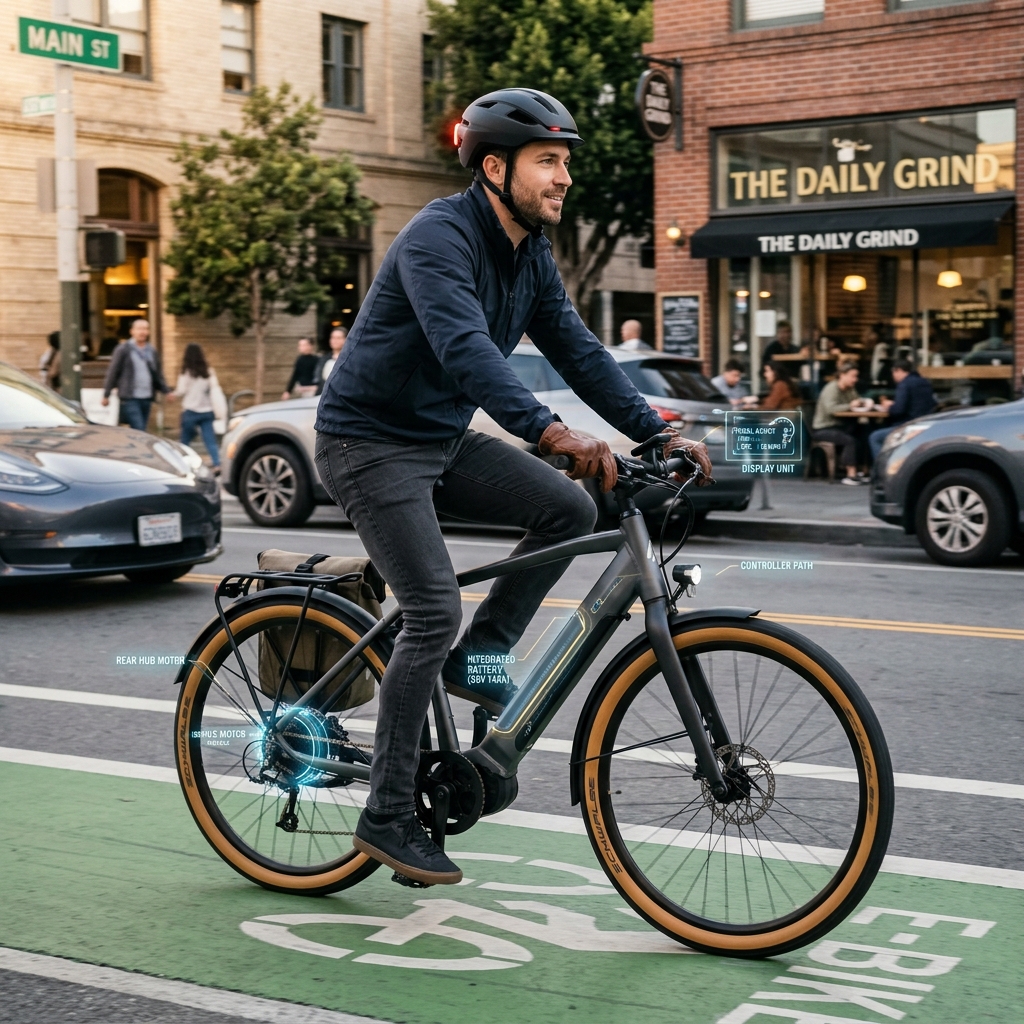
An electric bike motor converts electrical energy from the battery into mechanical force that helps move the bicycle. The motor works with the controller and sensors to deliver assistance when you pedal or, on supported models, use the throttle.
Most modern e-bikes use one of two motor layouts: a hub motor, which drives a wheel, or a mid-drive motor, which delivers power through the bicycle’s drivetrain. Neither is automatically better. The right choice depends on your terrain, load, riding style, maintenance preferences and budget.
Understanding these differences helps you compare e-bikes more accurately than looking at a single wattage or torque figure.
How an Electric Bike Motor Works

An e-bike motor is part of a larger electric bike components system. The battery supplies energy, sensors provide information about riding conditions, and the controller regulates the motor’s response.
The Main Components
| Component | What It Does |
|---|---|
| Battery | Stores the electrical energy used by the drive system. |
| Sensors | Detect information such as pedaling movement, rider-applied pedal force or bicycle speed. |
| Controller | Processes system inputs and regulates motor operation within the system’s limits. |
| Motor | Converts controlled electrical input into rotational force. |
| Hub or drivetrain | Transfers motor output toward the driven wheel. |
| Display and assist controls | Allow the rider to select assistance settings and monitor available information. |
Two processes work together when you ride.
The control-signal path: Rider input and sensor information reach the controller. The controller uses that information, the selected assist level and the system’s programmed limits to determine the motor’s response.
The energy path: Battery → controller → motor → wheel or drivetrain.
Inside a typical brushless permanent-magnet motor, electrical current creates changing magnetic fields in the stator. Their interaction with the rotor’s magnets produces torque, which creates rotation. The mechanical route from that rotation to the wheel depends on the motor layout.
This is the basic operating principle. The exact sensors, controller design, power limits and motor construction vary by manufacturer. Shimano’s manufacturer drive-unit technical specifications provide examples of how drive-system features differ between models.
For a more detailed technical explanation, see how an electric bike motor works.
Main Types of Electric Bike Motors

The two most common motor layouts are hub motor vs mid-drive. Understanding where each motor delivers its power explains most of their practical differences.
A peer-reviewed review of e-bike motor configurations also discusses motor layouts, construction and control systems.
Hub Motors
Motor located in the front or rear wheel.
A hub motor sits inside the hub of the front or rear wheel. Its motor output drives the wheel without normally passing through the bicycle’s chain and cassette.
Hub motors are common on commuter and budget-oriented e-bikes because they can provide straightforward operation and relatively simple drive arrangements.
Advantages
- Often less expensive than comparable mid-drive systems.
- Motor output normally places less additional load on the chain and cassette.
- Can work well for commuting, flat roads and everyday riding.
- Can pair with throttle assistance where the particular model supports it.
Trade-offs
- Motor weight is concentrated at the powered wheel.
- Removing a wheel containing a motor may require additional care during tire or tube service.
- The bicycle’s gears do not normally change the hub motor’s own relationship between motor speed and wheel speed.
- Performance on demanding climbs depends on the specific motor, its gearing, controller limits and operating conditions.
Hub motors are not all identical. Two important subtypes are geared and direct-drive hub motors.
Geared Hub Motors
A geared hub motor uses an internal reduction gear system between the electric motor and the wheel. This lets the motor rotate at a different speed from the wheel while the internal gears adjust the torque-and-speed relationship.
The term geared hub refers to gearing inside the motor, not to the bicycle’s cassette.
Direct-Drive Hub Motors
A direct-drive hub motor does not use the same internal reduction gearbox. Its motor structure is coupled more directly to the wheel.
Some direct-drive systems support regenerative braking, but that capability depends on the motor, controller and electrical system. Do not assume every hub motor can recover energy during braking.
Mid-Drive Motors
Motor located near the pedals and bottom bracket.
A mid-drive motor sits near the bicycle’s cranks and sends power through the drivetrain.
Because the motor uses the bicycle’s gearing, selecting a suitable gear can change the relationship between motor speed and wheel speed. This is particularly useful on steep climbs or when carrying heavier loads.
Advantages
- Often well suited to steep hills and changing terrain.
- Central motor placement can help balance the bicycle’s weight.
- The motor can benefit from the bicycle’s selected gear ratio.
- Common on many performance-oriented commuter, cargo and electric mountain bikes.
Trade-offs
- Usually more expensive than comparable hub-drive models.
- Motor power passes through the drivetrain, increasing the load on the chain, cassette or related components.
- Correct shifting and drivetrain maintenance matter, especially under heavy load.
- Repair and replacement costs depend on the drive system and its manufacturer.
A mid-drive is often a strong choice for demanding terrain, but it is not automatically the best option for every rider. An experimental comparison of hub-drive and mid-drive efficiency illustrates why efficiency depends on the tested configurations and operating conditions.
Brushless DC Motors: A Different Classification
Brushless DC (BLDC) describes a type of motor construction, not a motor’s location on the bicycle.
This distinction matters because hub versus mid-drive describes where the motor delivers power, while BLDC describes how the motor produces rotation. These are different characteristics, not mutually exclusive motor categories.
For a deeper explanation, see brushless DC motor and explore electric bike motor types.
Research on electric-bike motor construction and serviceability also describes the combination of mechanical components and electronics in these systems.
Watts, Torque, RPM and Efficiency Explained

Motor specifications are useful, but only when you understand what each number measures. A larger number does not automatically mean a better ride.
| Specification | Meaning | What It Helps You Understand |
|---|---|---|
| Watts (W) | Power | The rate at which energy is transferred or converted. |
| Torque (N·m) | Turning effect | How much rotational force is available at a specified point in the drive system. |
| RPM | Revolutions per minute | How quickly the motor or another rotating component turns. |
| Efficiency | Useful output relative to input | How effectively energy is converted under specified operating conditions. |
| Wh/mi or Wh/km | Energy consumed per distance | How much battery energy a ride uses over a given distance. |
What Do Watts Tell You?
Watts describe power, but motor specifications may refer to different measurements, including rated, nominal, continuous or peak power.
For examples of manufacturer-reported output, compare published motor power and torque specifications.
A peak figure does not necessarily represent the output a motor can sustain during a long climb. Likewise, two e-bikes with the same advertised wattage can feel different because of their controllers, gearing, battery systems, weight and other design choices.
When comparing models, check that the quoted power figures use comparable rating methods. The guide to e-bike watts and power ratings explains why different wattage figures should not automatically be treated as equivalent.
What Does Torque Tell You?
Torque is particularly relevant when starting from a stop, accelerating at low speed or climbing under load. It is commonly expressed in newton-metres (N·m).
A more detailed explanation of e-bike motor torque can help you interpret the number in context.
However, a torque rating is not a complete performance score. The measurement point, gearing, motor speed, available power and operating limits all affect how that torque translates into force at the wheel.
A torque sensor is different again: it measures rider-applied pedal force so the controller can determine how assistance should respond. For the distinction between the two pedal-assist approaches, see cadence sensor vs torque sensor. A sensor does not measure the same thing as a motor’s advertised torque output.
An e-bike motor simulator for torque, speed and efficiency can illustrate how operating conditions interact, although its results depend on the inputs and model assumptions.
Avoid rigid rules such as assuming one particular torque figure is always sufficient for commuting or always necessary for hills. Compare the complete drive system and the demands of your route.
Does a More Efficient Motor Always Give More Range?
No. Motor conversion efficiency and real-world range are related but different.
Range also depends on usable battery capacity, rider and cargo weight, terrain, speed, wind, temperature, tire pressure and assistance settings.
For a closer look at e-bike motor efficiency factors, the factors that affect electric bike range, and real-world e-bike range, see these guides.
A research assessment of electric-bike energy efficiency also emphasizes that meaningful comparisons should account for route, speed and riding style.
A bike with a larger battery can travel farther even if its motor is not more efficient.
Which Motor Type Fits Your Riding?

The best starting point is the way you actually use your e-bike—not a specification in isolation.
| Riding Situation | Motor to Consider | What to Check |
|---|---|---|
| Flat city commuting | Rear hub motor | Cost, comfort, assistance response and serviceability. |
| Everyday riding on rolling roads | Hub or mid-drive | Overall bike quality, terrain and preferred ride feel. |
| Frequent steep climbs | Mid-drive or a suitable high-torque hub system | Available torque, gearing, sustained performance and thermal limits. |
| Cargo or child-seat use | A drive system designed for the load | Total payload rating, brakes, frame, battery and motor performance. |
| Technical trail riding | Often a mid-drive | Weight distribution, assistance control, gearing and trail access rules. |
| Throttle-heavy riding | A compatible hub-drive model may suit | Actual throttle support, controller behavior, local regulations and intended use. |
| Lower drivetrain maintenance | Often a hub motor | Service access, powered-wheel maintenance and the complete bicycle’s reliability. |
These are starting points, not universal rules. A well-designed hub-drive bike can be a better purchase than a poorly matched mid-drive, and the reverse can also be true.
For a more detailed comparison of price, motor placement, drivetrain loading and riding conditions, see Electric Bike Motor Comparison.
What Affects E-Bike Motor Performance?

The motor is only one part of the system. Several other factors determine how the bicycle accelerates, climbs and uses its battery.
Battery and controller. The battery supplies energy, while the controller regulates motor operation. Battery condition, electrical limits and the controller’s settings can affect the assistance available. Learn more about what an e-bike controller does.
Sensors and assistance settings. A cadence sensor detects pedaling movement; a torque sensor measures how hard the rider pushes on the pedals. The controller’s response to those inputs also influences how natural or abrupt the assistance feels. Shimano’s example of how e-bike sensors track cadence, torque and speed illustrates how sensor information can influence gear selection.
Terrain and total load. Steep hills, repeated stops and heavier loads can demand more force and power. Sustained heavy operation can also increase thermal stress.
Gearing and drivetrain condition. On a mid-drive, selecting an appropriate gear can help the motor operate under more suitable conditions. A dirty or worn drivetrain can also affect the ride.
Speed, tires and weather. Higher speeds, underinflated tires, wind and temperature can change energy consumption and available range.
These factors explain why two e-bikes with apparently similar motors can behave differently. A study of e-bike torque, speed and battery voltage examines how these variables influence performance and electricity consumption.
They also explain why a change in performance does not necessarily mean the motor itself has failed. If your bike feels consistently underpowered, see why an electric bike feels slow.
Basic Motor Care and Warning Signs

Routine maintenance can help preserve performance and reveal developing problems before they become more serious.
- Keep tires inflated to the manufacturer’s recommended pressure.
- Keep the chain and drivetrain clean and properly maintained.
- Inspect accessible cables and connectors for visible damage. Consult an electric bike wiring system guide if you need to understand the connections.
- Keep electrical components clean and dry, and avoid pressure washing the motor area.
- Follow the manufacturer’s maintenance and charging instructions.
- Use compatible batteries and the recommended charger. The CPSC has issued a warning about universal micromobility chargers because physical fit does not guarantee compatibility.
- Listen for new or worsening sounds. The guide to e-bike motor noise can help you understand common symptoms.
- Watch for excessive or recurring heat. The guide to electric bike overheating provides additional diagnostic context.
For battery safety, the U.S. Consumer Product Safety Commission’s CPSC micromobility safety guidance recommends following manufacturer instructions and using the supplied or recommended charger and suitable replacement battery packs.
Bosch’s battery handling and charging safety guidance provides additional precautions. Where applicable, UL 2849 electrical-system safety certification evaluates the e-bike electrical drive train, battery and charger system combination.
Stop riding if you notice smoke, a burning smell, melted connectors, severe overheating or repeated unexpected power shutdowns. Do not bypass safety sensors, modify the controller to defeat system limits or open a sealed motor unless you are qualified to work on that equipment.
If your bike turns on but the motor does not provide assistance, start with the manufacturer’s basic checks and consult a qualified mechanic if the problem persists. The dedicated guide to an e-bike that turns on but has no motor assistance provides a more focused troubleshooting path.
Frequently Asked Questions

Is a Mid-Drive Motor Always Better Than a Hub Motor?
No. A mid-drive often has advantages on steep hills and demanding terrain because it uses the bicycle’s gears. A hub motor can be more affordable and may suit flat commuting or riders who value straightforward operation. The better choice depends on the whole bike and your needs.
Does Higher Wattage Always Mean a Faster E-Bike?
No. Wattage alone does not determine speed. Motor design, controller settings, battery capability, gearing, bicycle weight and other factors matter.
Applicable speed and power regulations also vary, so check the state-by-state electric bike laws that apply to your intended riding location.
What Matters More: Watts or Torque?
They describe different properties. Watts measure power, while torque describes rotational force. Torque is particularly useful when evaluating low-speed pulling and climbing, but it cannot independently establish sustained power or top speed.
Can a Hub Motor Handle Hills?
Yes. The result depends on the motor’s design, available power and torque, wheel size, controller limits, load and hill conditions. A suitable hub motor can handle many hills, but repeated steep climbs may favor a well-matched mid-drive system.
Is a Torque Sensor the Same as Motor Torque?
No. A torque sensor measures rider-applied pedal force for the assistance-control system. Motor torque describes the rotational force produced by the drive system. The two affect ride behavior in different ways.
Conclusion
Understanding electric bike motors means looking beyond the number printed on the specification sheet. Motor location determines how power reaches the wheel, while controller behavior, sensors, gearing, battery capacity and operating conditions shape the actual riding experience.
For flat commuting and straightforward everyday use, a hub motor may offer excellent value. For frequent steep climbs, demanding terrain or heavy loads, a suitable mid-drive may provide advantages. Neither choice replaces the need to evaluate the complete bicycle.
The most useful buying rule is simple: match the motor system to your terrain, load, riding style and maintenance expectations, then compare watts and torque in context. That approach will give you a much better basis for choosing an e-bike than chasing the highest specification alone.