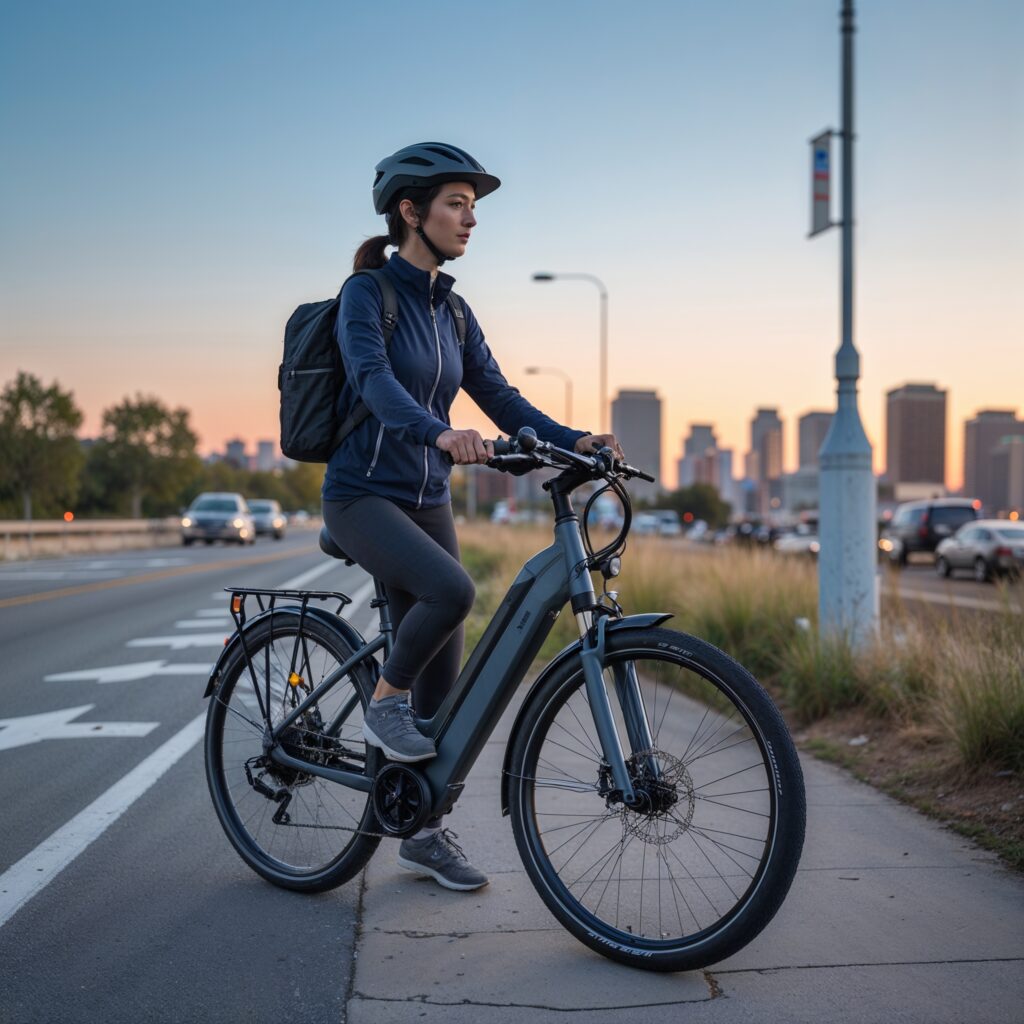
Most electric bikes travel about 20–70 miles on one full charge in normal real-world riding. The exact range depends on battery watt-hours, assist level, speed, rider and cargo weight, terrain, wind, temperature and throttle use.
A bike advertised as “up to 60 miles” may reach that number in gentle conditions, but the same bike may deliver closer to 30–45 miles if you ride fast, climb hills, carry cargo or use throttle often.
This guide explains how electric bike range really works, how to calculate it, what reduces it, and how to plan a safer range for daily USA commuting.
What Electric Bike Range Really Means

Advertised Range vs Real-World E-Bike Range
| Advertised Range | Realistic Mixed-Use Range | Heavy Use Range | Why It Drops |
|---|---|---|---|
| Up to 40 miles | 25–35 miles | 15–25 miles | Higher assist, hills, rider weight or throttle use |
| Up to 60 miles | 35–50 miles | 25–40 miles | Fast commuting, cargo, wind or stop-and-go riding |
| Up to 80 miles | 50–65 miles | 35–50 miles | Large battery helps, but speed and terrain still matter |
| Up to 100+ miles | 60–85 miles | 40–65 miles | Usually needs low assist, flat route, strong pedalling or dual batteries |
Simple rule: Treat advertised range as a best-case number. For daily riding, plan around the lower or middle estimate, not the maximum claim.
Electric bike range is the distance your e-bike can cover on a full battery.
For most riders, that means answering questions like:
- Can I ride to work and back without charging?
- Can I run errands after my commute?
- Can this e-bike handle hills?
- Is a 500Wh battery enough?
- Do I need a second battery?
- Is 100 miles on one charge realistic?
Manufacturers often advertise the best possible range under favorable conditions. That usually means low assist, steady pedaling, moderate speed, flat ground, good weather, and a lighter total load.
Real-world range changes because your e-bike has to deal with traffic lights, hills, wind, cold weather, rider weight, tire pressure, cargo, and speed.
Bosch’s e-bike range tool treats range as an estimate and uses inputs such as average speed, riding mode, total weight, cadence, bike setup, and route type to calculate possible range. Bosch also notes that range calculator results can vary from actual riding conditions.
So if you see “up to 70 miles,” read it as:
Possible in ideal or efficient conditions — not guaranteed for every rider.
How We Estimated Electric Bike Range
To estimate real-world electric bike range, we used a simple battery energy method:
Battery watt-hours ÷ watt-hours used per mile = estimated range.
For planning, we grouped riding into three simple use cases:
- Efficient low-assist riding: slow to moderate speed, steady pedalling, flat roads and little throttle use.
- Normal commuting: mixed traffic, moderate assist, some stops, normal rider weight and everyday speed.
- Demanding riding: hills, cargo, higher assist, throttle use, faster riding, wind or cold weather.
These estimates are meant for planning, not exact guarantees. Your own ride data is more accurate after you track several trips with the same bike, route, assist level and battery condition.
How Far Can an Electric Bike Go on One Charge?

Most e-bikes can travel about 20 to 70 miles on one charge in normal real-world use.
Some small city e-bikes may get less. Some long-range or dual-battery e-bikes can go farther.
Here is a practical breakdown:
| E-Bike Category | Realistic Range |
|---|---|
| Compact city e-bike | 15–30 miles |
| Standard commuter e-bike | 25–50 miles |
| Long-range commuter e-bike | 50–70 miles |
| Large-battery or dual-battery e-bike | 70–100+ miles |
These numbers are planning estimates, not promises.
A flat 12-mile commute in Phoenix is very different from a hilly 12-mile commute in San Francisco. A rider cruising in low pedal assist will usually get more range than someone using high assist and throttle at every stoplight.
The battery size gives you the potential.
Your route and riding style decide how quickly that battery gets used.
The Simple Formula Behind E-Bike Range

Most e-bike batteries are measured in watt-hours, usually written as Wh.
Think of watt-hours as the size of the fuel tank.
A larger Wh number usually means more possible range.
If your battery does not clearly show watt-hours, use this formula:
Volts × Amp-hours = Watt-hours
Example:
48V × 14Ah = 672Wh
That means the battery stores about 672 watt-hours of energy.
Now use this simple range formula:
Battery Wh ÷ Wh used per mile = Estimated range
For planning, use these rough energy-use levels:
| Riding Style | Approx. Energy Use |
|---|---|
| Efficient low-assist riding | 10–15 Wh per mile |
| Normal commuting | 15–25 Wh per mile |
| Hills, cargo, throttle, high speed | 25–35+ Wh per mile |
Example:
You have a 672Wh battery.
If you ride efficiently and use around 15Wh per mile:
672 ÷ 15 = about 45 miles
If your ride includes hills, cargo, faster speeds, and higher assist at around 28Wh per mile:
672 ÷ 28 = about 24 miles
Same battery.
Very different electric bike range.
That is why advertised range is only a starting point.
Main Factors That Affect Electric Bike Range

1. Battery Capacity
Battery capacity is the biggest starting factor.
A 750Wh battery usually gives more range than a 500Wh battery if the bike, rider, motor, terrain, and speed are similar.
But battery size is not everything.
A heavy e-bike with fat tires and high rolling resistance may use more energy than a lighter commuter e-bike with efficient tires.
So do not judge range by battery size alone.
Use battery Wh plus real riding conditions.
2. Battery Health
A new battery usually performs better than an old or poorly maintained battery.
Over time, lithium-ion batteries lose some capacity. That means a battery that once gave 45 miles may later give less.
Battery health can be affected by:
- Heat exposure
- Cold storage
- Poor charging habits
- Long-term storage at very low or full charge
- Using the wrong charger
- Physical damage
- Cheap or poorly protected battery systems
Bosch recommends storing e-bike batteries at about 30–60% charge for longer storage, in a dry room at room temperature, and away from combustible or flammable materials.
For daily use, you do not need to overthink every charge. But you should avoid treating the battery like it is indestructible.
3. Rider Weight and Cargo
More total weight means the motor has to work harder.
Total weight includes:
- Rider
- Backpack
- Groceries
- Child seat
- Cargo rack load
- Trailer
- The e-bike itself
This does not mean heavier riders cannot get good range.
It means they should plan with a more realistic battery buffer.
For example:
A 150 lb rider on flat roads may get strong range from a 500Wh battery.
A 230 lb rider carrying groceries through hills may need a larger battery to get the same distance comfortably.
If you plan to carry cargo often, choose more battery than the minimum.
4. Terrain and Road Conditions
Terrain can reduce electric bike range quickly.
Flat pavement is efficient.
Hills are not.
Your battery drains faster when the bike has to fight:
- Long climbs
- Repeated stop-and-go traffic
- Strong headwinds
- Soft gravel
- Sand or loose dirt
- Underinflated tires
- Rough pavement
- Heavy cargo
Urban riding can also drain more battery than expected because stopping and starting uses extra energy.
A suburban rider cruising 10 miles on open roads may use less battery than a city rider covering the same 10 miles through stoplights, traffic, and intersections.
5. Weather and Temperature
Temperature matters.
Cold weather can reduce battery performance. Bosch notes that cold weather reduces e-bike battery performance and recommends warming the battery before winter rides when temperatures are below 32°F.
That means your range in January may be lower than your range in May.
Heat is also a concern. Batteries do not like being stored in hot garages, direct sun, or parked cars for long periods.
For USA riders, this matters in both directions:
- Winter riders in Minnesota, Illinois, or New York may see lower range in cold weather.
- Summer riders in Arizona, Texas, or Florida should avoid cooking the battery in extreme heat.
Electric Bike Range and Speed

Speed has one of the biggest effects on range.
The faster you ride, the more energy your motor uses.
This is especially important on Class 3 commuter e-bikes that assist up to higher speeds.
In the USA, many states use the three-class e-bike system. PeopleForBikes explains that Class 1 e-bikes provide pedal assist up to 20 mph, Class 2 e-bikes can use throttle assistance up to 20 mph, and Class 3 e-bikes provide pedal assist up to 28 mph.
Higher speed can be useful for commuting.
But it usually reduces range.
A rider cruising at 14–16 mph in medium assist may get much better range than a rider holding 24–28 mph in high assist.
Simple rule:
If you want more range, reduce speed before you buy more battery.
Even a small speed reduction can noticeably improve range on longer rides.
Pedal Assist vs. Throttle: Which Uses More Battery?

Pedal assist is usually more efficient than throttle-heavy riding.
With pedal assist, you are still contributing power through your legs.
With throttle, the motor does more of the work.
Throttle is helpful for:
- Starting from a stop
- Crossing intersections
- Short bursts on hills
- Getting moving with cargo
But using throttle constantly can reduce range quickly.
For better range:
- Use low or medium pedal assist on flat roads
- Save high assist for hills and traffic
- Use throttle briefly, not constantly
- Shift gears before the motor struggles
- Pedal smoothly instead of relying only on motor power
This is where electric bike range and speed connect directly.
Fast riding plus high assist plus throttle use equals faster battery drain.
Using an E-Bike Range Calculator

E-Bike Range Calculator
Use this simple calculator to estimate your real electric bike range. Enter your battery size in watt-hours, choose your riding style, and add a safety reserve.
An ebike range calculator helps estimate how far your e-bike might go based on your ride conditions.
A useful calculator should consider:
- Battery watt-hours
- Rider weight
- Bike weight
- Cargo weight
- Assist level
- Average speed
- Terrain
- Wind
- Tire type
- Route style
Bosch’s e-bike range calculator, for example, includes variables such as total weight, riding mode, average speed, cadence, e-bike setup, and route type.
But calculators are still estimates.
The best way to know your real range is to track your own rides.
For the first few weeks, write down:
- Starting battery percentage
- Ending battery percentage
- Miles ridden
- Assist mode
- Average speed
- Hills or flat roads
- Weather
- Cargo load
After 5–10 rides, you will understand your own e-bike range much better than any marketing claim.
Can an Electric Bike Range Reach 100 Miles?

Yes, an electric bike range of 100 miles is possible.
But it is not typical for every e-bike or every rider.
A true 100-mile range usually requires one or more of these:
- Very large battery
- Dual-battery system
- Low pedal assist
- Strong rider pedaling effort
- Moderate speed
- Flat route
- Minimal cargo
- Good tire pressure
- Warm weather
- Few stops
A 100-mile claim may be realistic for a low-assist endurance ride on flat ground.
It may not be realistic for a fast commuter using high assist in hills.
Before trusting an “electric bike range 100 miles” claim, ask:
- What battery size is used?
- Was the test done in Eco mode?
- What rider weight was assumed?
- Was the route flat?
- Was throttle used?
- What average speed was used?
- Was there cargo?
- Was it a dual-battery setup?
For most everyday riders, 100 miles is not the standard expectation.
It is usually a best-case result, a specialty setup, or a dual-battery touring scenario.
What Is High Mileage for an E-Bike?

This phrase can mean two different things.
That is why it often confuses buyers.
High Mileage Per Charge
If someone means range per charge, then:
- 20–30 miles is normal for smaller city e-bikes
- 30–50 miles is solid commuter range
- 50–70 miles is strong long-range performance
- 70–100+ miles is high-range territory
So if your e-bike reliably gets 50+ miles in normal riding, that is very good for many commuters.
High Lifetime Mileage
If someone is talking about a used e-bike, “high mileage” usually means total odometer miles.
There is no single mileage number where an e-bike automatically becomes bad.
Condition matters more.
A well-maintained e-bike with higher mileage can be better than a low-mileage bike with a neglected battery.
When checking a high-mileage e-bike, inspect:
- Battery health
- Charger condition
- Brake wear
- Tire wear
- Chain and drivetrain
- Motor noise
- Frame damage
- Display errors
- Service records
- Whether the battery is original
For used e-bikes, the battery is often the most important part to check.
A replacement battery can be expensive, so do not judge only by odometer miles.
How Long Does an Electric Bike Battery Last in a Day?

An electric bike battery does not last by time alone.
It lasts by energy use.
A battery may last all day for one rider and only a few hours for another.
It depends on mileage, speed, hills, assist level, throttle use, and cargo.
Example 1: Short Urban Commute
You ride 5 miles to work and 5 miles home.
That is 10 miles per day.
Most standard commuter e-bikes should handle this easily, even with some stoplights and moderate assist.
You may not need to charge every day.
Example 2: Longer Suburban Commute
You ride 17 miles each way.
That is 34 miles per day.
Now battery size matters more.
A 500Wh battery might work if the route is flat and you ride efficiently. A 672Wh, 750Wh, or larger battery gives more comfort and less range anxiety.
Example 3: Hilly City Ride
You ride only 12 miles total, but your route has steep hills.
This can use more battery than a longer flat ride.
In a hilly city, do not choose battery size based on distance alone.
Choose based on effort required.
Example 4: Cargo or Delivery Riding
Cargo riders, delivery riders, and parents carrying kids should plan more conservatively.
Stop-and-go riding, heavier loads, and throttle use can drain the battery faster.
For daily planning, use this rule:
Your normal route should use no more than 70–80% of your battery.
That gives you a reserve for wind, detours, cold weather, traffic, and battery aging.
How to Extend Your E-Bike Range

You do not always need a bigger battery.
Often, you can improve range by riding smarter.
Use Lower Assist When You Can
Start in Eco or low assist on flat ground.
Save higher assist for hills, traffic, and moments when you really need it.
This is the simplest way to improve range.
Control Your Speed
Riding slightly slower can save a lot of battery.
If you are trying to stretch range, avoid riding at top assist speed for the entire trip.
Shift Gears Properly
Do not make the motor fight in the wrong gear.
Shift before hills.
Keep your pedaling smooth.
A motor working efficiently usually uses less energy.
Limit Throttle Use
Use throttle for short boosts, not the whole ride.
Throttle-only riding can drain a battery much faster than pedal assist.
Keep Tires Inflated
Low tire pressure increases rolling resistance.
That means the motor works harder.
Check the recommended tire pressure on your tire sidewall and adjust based on your bike type and riding surface.
Reduce Extra Weight
Remove unnecessary locks, bags, tools, or cargo when you do not need them.
Small weight savings matter more on hills and stop-and-go routes.
Plan Charging Stops
For long rides, know where you can charge.
Good options may include:
- Workplace outlet
- Friend’s house
- Café stop with permission
- RV campground
- Bike shop
- Public charging area where available
Always bring the correct charger if you plan to charge away from home.
E-Bike Range Extender Options

An e-bike range extender helps you ride farther than your main battery allows.
Common options include:
- Second removable battery
- Dual-battery setup
- Manufacturer-approved auxiliary battery
- Larger compatible battery
- Carrying your charger for mid-ride charging
The safest choice is usually a battery or range extender approved by your e-bike manufacturer.
Avoid random aftermarket batteries that are not designed for your system.
Before buying a range extender, check:
- Does it match your e-bike model?
- Is the voltage compatible?
- Is the mounting secure?
- Is it approved by the manufacturer?
- Will it affect the warranty?
- Is the charger compatible?
- Does it meet recognized safety standards?
UL explains that UL 2849 evaluates the e-bike electrical drive train system, battery system, and charger system combination for electrical and fire safety.
Range extenders are useful for long commutes, touring, rural rides, and delivery work.
But for many riders, smarter assist use and better route planning may solve the problem without adding another battery.
Battery Care Tips That Protect Range

Good battery care helps protect both daily range and long-term battery health.
Use these habits:
- Use the charger made for your e-bike
- Charge in a dry, safe area
- Avoid charging in extreme heat or cold
- Keep the battery away from direct sun
- Do not store the battery fully empty
- Avoid long-term storage at 100%
- Store around 30–60% charge for longer breaks
- Let a cold battery warm up before charging
- Stop using damaged batteries or chargers
- Do not modify battery wiring or connectors
Bosch states that lithium-ion e-bike batteries can be charged regardless of charge state and that charging interruptions do not harm the battery, but it also advises only fully charging when necessary and charging in suitable temperature conditions.
The practical takeaway:
You do not need to drain your battery to zero before charging.
And for safety, you should not plan rides that depend on using every last percent.
Quick Reference: Battery Wh to Expected Range
Use this table as a planning guide.
Actual range may be higher or lower based on your route and riding style.
| Battery Size | Efficient Low Assist | Normal Commuting | Demanding Riding |
|---|---|---|---|
| 360Wh | 24–36 miles | 14–24 miles | 10–14 miles |
| 500Wh | 33–50 miles | 20–33 miles | 14–20 miles |
| 672Wh | 45–67 miles | 27–45 miles | 19–27 miles |
| 750Wh | 50–75 miles | 30–50 miles | 21–30 miles |
| 1000Wh | 67–100 miles | 40–67 miles | 28–40 miles |
| 1200Wh | 80–120 miles | 48–80 miles | 34–48 miles |
How to Use the Table
Choose the column that matches your real riding.
Use Efficient Low Assist if you ride slowly, pedal consistently, avoid throttle, and stay mostly on flat roads.
Use Normal Commuting if you ride with moderate assist, traffic lights, mixed terrain, and everyday speed.
Use Demanding Riding if you ride fast, climb hills, carry cargo, use throttle often, or ride in cold weather.
For a safe commute, do not plan around the highest number.
Plan around the middle or lower number.
Electric Bike Range FAQs
How far can an electric bike go on one charge?
Most electric bikes can go about 20–70 miles on one charge in normal riding. Small city e-bikes may get 15–30 miles, while long-range or dual-battery e-bikes can reach 70–100+ miles in ideal conditions.
What is a good electric bike range for commuting?
For commuting, choose an e-bike that can cover your full round trip with 20–30% battery left. If your daily ride is 24 miles, look for a setup that can comfortably deliver at least 31–35 real-world miles.
Does throttle use reduce electric bike range?
Yes. Throttle use usually reduces range because the motor does more of the work without much help from your legs. Use throttle for short starts, hills or traffic situations, not for the full ride.
Is a 500Wh battery enough for an electric bike?
A 500Wh battery is enough for many short and medium commutes. It may give about 20–50 miles depending on speed, assist level, hills, rider weight, cargo, weather and throttle use.
Can an electric bike go 100 miles?
Yes, but it is not normal for every rider. A 100-mile electric bike range usually needs a large battery, dual batteries, low assist, strong pedalling, flat terrain, moderate speed and little cargo.
Why is my e-bike range lower than advertised?
Your range may be lower because of high speed, hills, cold weather, heavy rider or cargo weight, low tire pressure, battery age, frequent stops, high assist or throttle-heavy riding.
How can I increase my electric bike range?
Use lower assist when possible, ride slightly slower, keep tires inflated, reduce extra weight, shift gears properly, avoid constant throttle use and keep the battery healthy.
Does cold weather reduce electric bike range?
Yes. Cold weather can reduce battery performance and make range lower than usual. If you ride in winter, plan more battery reserve and avoid storing or charging the battery in very cold conditions.
Electric Bike Range Planning Checklist

Before a ride, ask:
- How many total miles am I riding?
- Is it round trip?
- Are there hills?
- Will I carry cargo?
- Will I use throttle often?
- Is it cold or windy?
- Am I riding fast?
- Do I have a charging option?
- Do I have at least 20–30% reserve?
- Is my battery healthy and fully secured?
For commuting, use this simple planning rule:
Total daily miles × 1.3 = safer minimum range estimate
Example:
Your commute is 24 miles total.
24 × 1.3 = 31.2 miles
So you should choose an e-bike setup that can comfortably deliver at least 31–35 real-world miles for your route.
That extra buffer helps cover wind, detours, hills, battery aging, and unexpected stops.
Final Answer: What Range Should You Expect?
For most USA riders, a realistic electric bike range is:
- 15–30 miles for compact city e-bikes
- 25–50 miles for everyday commuter e-bikes
- 50–70 miles for long-range commuter e-bikes
- 70–100+ miles for large-battery or dual-battery setups
If you want a reliable daily commuter, do not buy based only on the advertised maximum range.
Look at:
- Battery Wh
- Your total daily miles
- Hills
- Speed
- Rider and cargo weight
- Throttle use
- Weather
- Charging access
- Battery safety and quality
The best e-bike is not always the one with the biggest range claim.
It is the one that gives you enough real-world range for your actual route, with a safe reserve left over.
Pingback: Electric Bike Battery Problems: Safe Troubleshooting Guide for USA Riders - electricscootercar.com
Pingback: Electric Bike Speed Limit USA: 2026 Class & State Rules - electricscootercar.com
Pingback: How Terrain Affects Electric Bike Range: Hills, Gravel & Trails - electricscootercar.com
Comments are closed.