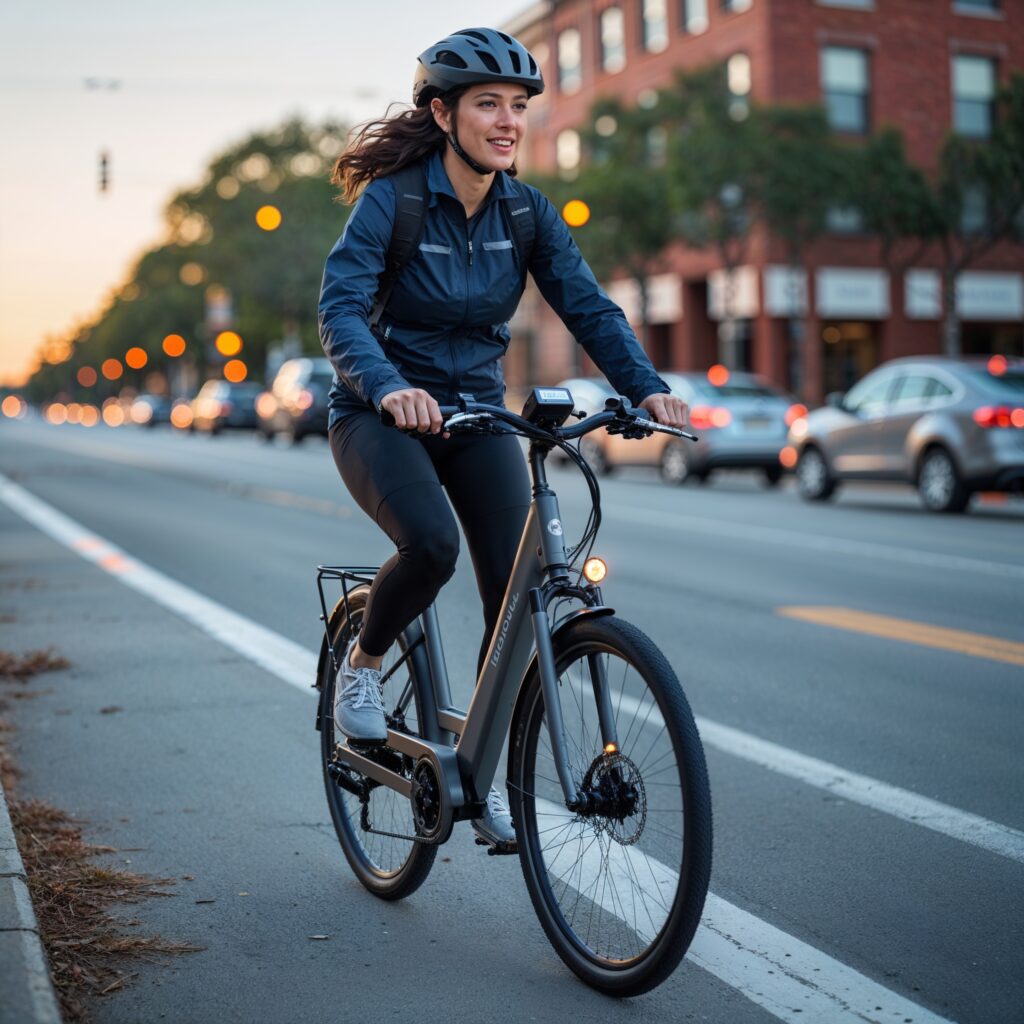
Most electric bike riders average 12–20 mph in normal riding. A city commuter may average 12–16 mph, while a Class 3 rider on a clear suburban road may average 18–24 mph. Your top assisted speed is not the same as your real average speed because stops, traffic, hills, wind, rider weight, battery level, and safety all reduce the final trip average.
| Riding type | Realistic average speed | Best for |
|---|---|---|
| Dense city commute | 12–16 mph | Traffic lights, stop signs, pedestrians |
| Open bike lanes | 15–20 mph | Smooth urban routes with fewer stops |
| Suburban roads | 16–22 mph | Longer rides with fewer interruptions |
| Class 3 open-road riding | 18–24 mph | Experienced riders on suitable roads |
| Trails or shared paths | 8–15 mph | Control, safety, and courtesy passing |
What Is the Average Speed of an Electric Bike?
For most riders in normal conditions, these are realistic average ranges:
| Riding Situation | Average Speed mph | Average Speed km/h |
|---|---|---|
| Dense city commuting | 12–16 mph | 19–26 km/h |
| Open urban bike lanes | 15–20 mph | 24–32 km/h |
| Suburban roads | 16–22 mph | 26–35 km/h |
| Rural/open roads | 18–24 mph | 29–39 km/h |
| Light trails | 8–15 mph | 13–24 km/h |
| Hilly or mixed terrain | 10–18 mph | 16–29 km/h |
In simple terms, most e-bike riders do not average the maximum assisted speed for the entire ride.
Stops, turns, traffic, hills, battery level, road surface, and safety all reduce the real average.
How We Estimated These Average Speeds
These are not advertised top speeds. They are practical full-ride averages based on how e-bikes are normally used in the USA.
We estimated the ranges by considering:
- E-bike class: Class 1 and Class 2 usually assist up to 20 mph, while Class 3 can assist up to 28 mph.
- Stops and slowdowns: Traffic lights, stop signs, turns, pedestrians, parked cars, and driveways reduce the full-trip average.
- Terrain: Hills, gravel, dirt, rough pavement, and shared paths usually lower speed.
- Rider and cargo weight: More weight can reduce acceleration and hill-climbing speed.
- Battery and assist level: Low battery or eco mode can reduce power and acceleration.
- Safety: A safe average speed is often lower than the maximum speed the bike can reach.
The goal is to estimate the speed a rider can actually maintain across a full route, not the highest number shown on the display.
Understanding Electric Bike Speeds in the USA

| Speed term | What it means | Example |
|---|---|---|
| Average speed | Your real full-trip pace, including stops, turns, hills, traffic, and slow zones | A 5-mile city commute at 14 mph average |
| Cruising speed | The speed you can hold for a short time on a clear road or bike lane | Holding 18–20 mph between traffic lights |
| Top assisted speed | The speed where the motor stops helping under the e-bike class limit | Class 1 and 2: 20 mph; Class 3: 28 mph |
| Downhill speed | Speed from gravity or rider pedalling after motor assist stops | May go above 20 mph downhill, but without motor help |
When people ask, “What is the average speed of an electric bike?” they often mix up three different things.
Average speed is your real pace across the whole ride, including slowing down, stopping, climbing hills, and turning.
Cruising speed is the speed you can comfortably hold for a while on a clear road or bike lane.
Top assisted speed is the point where the motor stops helping under the bike’s class limit.
For example, a Class 3 e-bike may assist up to 28 mph, but that does not mean your average electric bike commuting speed will be 28 mph. In real traffic, the average may be closer to 15–20 mph.
That difference matters because average speed is what helps you estimate commute time, battery use, comfort, and safety.
Factors That Affect Electric Bike Average Speed

Rider Weight and Fitness
A heavier rider or extra cargo can reduce acceleration and climbing speed. You may notice this most when starting from a stop, going uphill, or carrying bags.
Fitness still matters too. Even with pedal assist, the rider contributes power. A stronger rider can usually maintain a higher cruising speed with less battery drain.
Terrain Type: Flat, Hilly, or Mixed
Flat roads usually produce the highest average speeds. Hilly routeslower your average because climbs take more effort and more motor assistance.
Typical patterns:
- Flat city roads: faster and more consistent
- Rolling suburbs: moderate speed with some slow climbs
- Steep hills: lower average speed and higher battery use
- Gravel or dirt trails: slower because control matters more
Wind and Weather Conditions
Headwinds can reduce your speed, especially on upright commuter e-bikes. Cold weather can also reduce battery performance.
Rain, snow, leaves, sand, and low visibility should also lower your speed. The safest speed is not always the fastest speed your bike can reach.
Motor Power and Assistance Levels
A stronger motor can help with acceleration and hills, but it does not automatically mean a higher legal assisted speed.
In the U.S., many e-bikes are discussed around a motor rating below 750 watts, but the common class system is mainly about how the motor assists and when that assistance stops. PeopleForBikes describes Class 1, 2, and 3 e-bikes as using different assist/throttle rules and speed cutoffs, with Class 1 and 2 generally stopping assistance at 20 mph and Class 3 stopping at 28 mph.
Higher assist modes help you hold speed more easily, but they also drain the battery faster.
Legal Speed Limits for E-Bikes in the USA

Many U.S. states use a three-class e-bike system:
| E-Bike Class | How It Works | Assisted Speed Limit |
|---|---|---|
| Class 1 | Pedal assist only | 20 mph |
| Class 2 | Throttle capable | 20 mph |
| Class 3 | Pedal assist only | 28 mph |
The important word is assisted. The motor stops helping at the class limit, but a rider may still go faster downhill or by pedaling harder.
Also, e-bike laws are not identical everywhere. State and local rules may control where different classes can ride, including streets, bike lanes, sidewalks, shared-use paths, parks, and trails. NCSL notes that state traffic laws and vehicle codes play a major role in how e-bikes are regulated on roads and bikeways.
Before riding in a new area, check local rules for:
- Class 3 access
- Helmet requirements
- Minimum rider age
- Sidewalk riding
- Trail and park restrictions
- Shared-path speed limits
This matters most for Class 3 e-bikes because some paths and trails allow Class 1 or 2 but restrict faster e-bikes.
Important USA legal note: Federal rules and state riding rules are not the same thing. At the federal product level, a low-speed electric bicycle generally means a bike with working pedals, a motor under 750 watts, and motor-only speed under 20 mph on a paved level surface. But where you can ride, whether helmets are required, and whether Class 3 e-bikes are allowed on trails or shared paths depends on state and local rules. Check your local transportation department, DMV, park authority, or trail manager before riding in a new area.
Average Speeds You Can Expect

Typical Urban Commuting Speeds
The average electric bike commuting speed in a U.S. city is often around 12–18 mph.
That may sound lower than expected, but city riding includes:
- Stop signs
- Traffic lights
- Turning cars
- Pedestrians
- Parked vehicles
- Driveways
- Rough pavement
- Bike-lane congestion
A Class 1 or Class 2 e-bike may cruise near 18–20 mph when the road is clear. But once stops are included, the full-route average usually drops.
For many commuters, the biggest benefit is not extreme speed. It is consistency. An e-bike helps you keep moving without arriving exhausted.
Average Speeds on Suburban and Rural Roads
On open suburban roads, many riders average around 16–22 mph, especially with good pavement and fewer stops.
On rural roads, averages may be slightly higher if traffic is light and the road is smooth. Still, wind, hills, narrow shoulders, and fast-moving cars can make higher speeds less comfortable.
A realistic open-road average for experienced riders is often 18–24 mph.
Off-Road and Trail Speeds
Trail riding is usually slower. A common average is around 8–15 mph, depending on the trail type and surface.
On dirt, gravel, or shared paths, your speed should account for:
- Walkers
- Dogs
- Other cyclists
- Blind corners
- Loose surfaces
- Roots, rocks, and ruts
- Local trail rules
Even if your e-bike can go faster, trail riding rewards control more than speed.
Measuring and Tracking Your Electric Bike Speed

Using Bike Computers and Apps
Most e-bikes include a display that shows current speed, assist level, battery level, and trip distance.
You can also track speed with:
- Built-in e-bike displays
- GPS cycling apps
- Smartwatches
- Dedicated bike computers
- Wheel sensor speed trackers
For commuting, average speed is more useful than top speed. It tells you how long your route actually takes.
GPS vs. Wheel Sensor Accuracy
GPS speed is convenient, but it can be less accurate near tall buildings, under trees, or in dense city streets.
Wheel sensors are often more consistent for real-time speed because they measure wheel rotation. However, they need the correct wheel size setting. If the wheel size is wrong, your speed reading may be slightly off.
For casual riders, either method is usually fine. For more accurate tracking, a properly calibrated wheel sensor is better.
Safety and Speed Considerations

Maintaining Safe Speeds in Traffic
The safest e-bike speed depends on where you are riding.
Riding 20 mph may feel normal in a protected bike lane, but it can be too fast near pedestrians, parked cars, or intersections.
Slow down near:
- Crosswalks
- Driveways
- Intersections
- School zones
- Shared-use paths
- Parked cars
- Blind corners
- Wet or sandy pavement
Higher speed gives you less time to react. It also increases stopping distance, especially on heavier e-bikes.
Recommended Gear and Protective Equipment
At minimum, e-bike riders should use:
- Properly fitted bicycle helmet
- Front and rear lights
- Reflective clothing or details
- Bell or horn
- Reliable brakes
- Tires suited to the terrain
Helmet rules vary by state, rider age, and e-bike class. Some states have specific helmet rules for minors or Class 3 riders, while others apply different requirements.
Even where a helmet is not legally required, it is still a smart safety choice.
Real-World Examples from USA Riders

| Rider scenario | Bike type | Route type | Realistic average speed | Estimated time |
|---|---|---|---|---|
| City commuter | Class 2 commuter e-bike | 5 miles, traffic lights, bike lanes | 13–16 mph | 19–23 minutes |
| Suburban road rider | Class 3 e-bike | 10 miles, fewer stops, smooth roads | 18–22 mph | 27–33 minutes |
| Weekend trail rider | Class 1 or Class 2 e-bike | 8 miles, shared paths or light trails | 8–14 mph | 34–60 minutes |
| Hill route rider | Mid-drive e-bike | 6 miles, repeated climbs | 10–15 mph | 24–36 minutes |
| Delivery rider | Class 2 or Class 3 e-bike | Stop-and-go city grid | 12–18 mph | Depends on stops |
City Commuter Experience
A rider commuting five miles across a busy U.S. city may use a Class 2 commuter e-bike. The bike can assist up to 20 mph, but the full trip includes traffic lights, intersections, bike-lane congestion, pedestrians, and slower turns.
A realistic full-route average is usually 13–16 mph, which makes a five-mile commute about 19–23 minutes.
Suburban Road Rider Experience
A suburban rider on a Class 3 e-bike may ride on wider roads with fewer stops. The bike may assist up to 28 mph, but the rider will usually not hold that speed for the full route.
A realistic average is often 18–22 mph, so a 10-mile ride may take about 27–33 minutes in good conditions.
Weekend Trail Rider Experience
A weekend trail rider may average 8–14 mph, even on a capable e-bike. Trails include turns, walkers, dogs, loose surfaces, roots, blind corners, and courtesy passing.
For trail riding, control matters more than speed.
Hill Route Rider Experience
On a hilly six-mile route, an e-bike may not feel fast on every climb, but it helps the rider keep momentum. A mid-drive e-bike can feel especially useful on hills because it works well with the bike’s gears.
A realistic average on repeated hills is usually 10–15 mph.
Delivery Rider Experience
A delivery rider may accelerate quickly between stops but still lose time at restaurants, apartments, lights, and crossings. In dense cities, a realistic riding average may be 12–18 mph, depending on route layout and local e-bike rules.
FAQs

Why is my e-bike average speed lower than 20 mph?
Your average speed includes the whole ride, not just the fastest parts. Traffic lights, stop signs, turns, hills, pedestrians, rough pavement, wind, and battery level can all reduce your final average.
Can a 750W e-bike go faster than 20 mph?
A 750W motor can help with acceleration and hills, but it does not automatically mean the bike is legally assisted above 20 mph. In the USA, legal assisted speed depends on the e-bike class and local rules.
Is 28 mph legal on an electric bike?
A Class 3 e-bike may assist up to 28 mph in many U.S. class systems, but access rules vary. Some paths, trails, parks, or local areas may restrict Class 3 e-bikes, so check local rules before riding.
What is a safe average speed for city commuting?
For many city riders, a safe average is around 12–16 mph. Ride slower near intersections, driveways, pedestrians, parked cars, wet roads, and blind corners.
Are e-bike speed displays accurate?
They are usually close, but they can be wrong if the wheel size setting is incorrect. GPS apps can also drift near tall buildings, trees, or dense city streets. For better accuracy, use a calibrated wheel sensor or bike computer.
How fast can a typical Class 3 e-bike go?
A typical Class 3 e-bike provides pedal assistance up to 28 mph, or about 45 km/h.
That is the assisted speed limit, not the average speed. In real riding, many Class 3 riders average closer to 18–24 mph on open roads.
Does rider weight reduce average speed?
Yes. Rider weight and cargo can reduce acceleration, hill-climbing speed, and battery efficiency.
On flat roads, the difference may be less noticeable once the bike is moving. On hills or in stop-and-go traffic, it matters more.
Are e-bike speeds consistent year-round?
Not always.
Cold weather, wind, rain, tire pressure, road surface, and battery condition can all affect speed. In winter or wet conditions, it is normal and safer to ride slower.
What is the average speed of an electric bike on roads?
On roads, many riders average around 15–22 mph, depending on the bike class, traffic, terrain, and comfort level.
Dense city roads are usually slower. Open suburban roads are usually faster.
Is 20 mph fast for an e-bike?
Yes, for everyday riding, 20 mph is a strong cruising speed.
It is faster than many casual bicycle rides and requires more attention around cars, pedestrians, intersections, and parked vehicles.
Quick Summary / Checklist
The electric bike average speed for most riders is usually 12–20 mph, or 19–32 km/h.
Use this quick guide:
- City commuting: 12–18 mph
- Open urban bike lanes: 15–20 mph
- Suburban roads: 16–22 mph
- Rural/open roads: 18–24 mph
- Trails: 8–15 mph
- Class 1 assist limit: 20 mph
- Class 2 assist limit: 20 mph
- Class 3 assist limit: 28 mph
- Average speed is more useful than top speed for estimating commute time.
- Ride slower around pedestrians, intersections, wet roads, and blind corners.
- Check state and local rules before riding on sidewalks, trails, parks, or shared paths.
Pingback: Electric Bike Motors Explained: What USA Riders Need to Know - electricscootercar.com
Pingback: How Fast Do Electric Bikes Go? USA Speed Guide - electricscootercar.com
Pingback: Electric Bike Speed Limit USA: 2026 Class & State Rules - electricscootercar.com
Pingback: How Fast Do Electric Bikes Go? 20 vs 28 MPH - electricscootercar.com
Comments are closed.