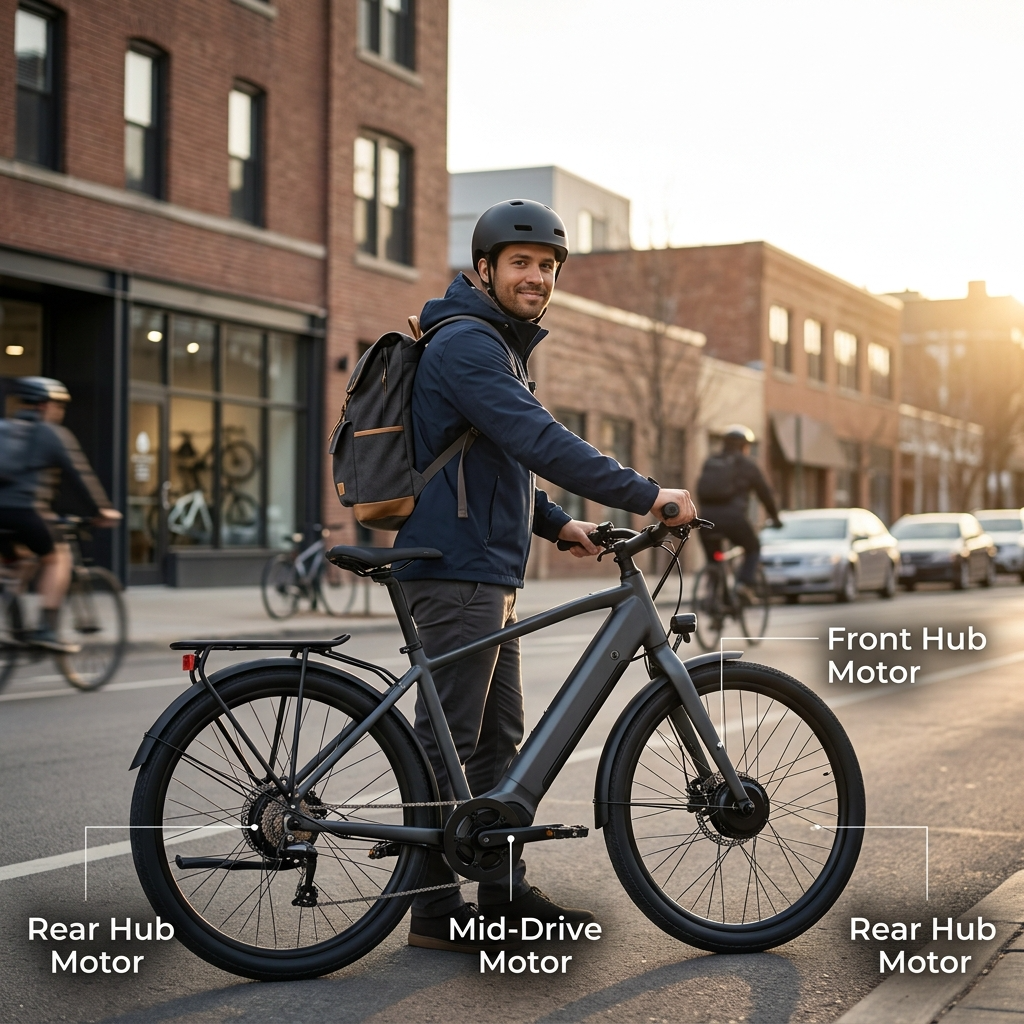
Choosing the right electric bike motor depends on where you ride, how much weight you carry, how steep your routes are, and how much maintenance you are willing to handle.
Most e-bikes use one of two main motor placements: a hub motor, which sits inside a wheel, or a mid-drive motor, which sits near the pedals. Hub motors can be further divided into geared and direct-drive designs. Separately, motors can use brushed or brushless electrical technology.
These categories describe different things, so they should not be treated as five mutually exclusive choices.
For many everyday commuters, a rear hub motor offers a practical balance of cost and simplicity. A mid-drive motor can be a better fit for sustained climbs, technical trails, and heavier loads. The right choice depends on the complete bicycle, not just its motor label.
For a broader explanation of how an e-bike motor works, start by understanding how the motor fits into the complete drive system. For a buyer-oriented overview of motor placement and ride feel, see REI’s e-bike buying guide.
Quick Comparison: Which E-Bike Motor Type Is Best?

| Motor type | How it works | Best suited to | Main trade-off |
|---|---|---|---|
| Front hub motor | Drives the front wheel | Some flat-road bikes and conversion kits | Front-wheel traction and steering feel require attention |
| Rear hub motor | Drives the rear wheel | Commuting, errands, and everyday riding | Rear-wheel service can be more involved |
| Geared hub motor | Uses internal reduction gears inside a wheel motor | Stop-and-go riding and many city routes | Internal gears and clutches can wear |
| Direct-drive hub motor | Drives the wheel without an internal reduction gearbox | Smooth cruising and some higher-powered applications | Often heavier, with performance depending on design |
| Mid-drive motor | Transfers power through the bicycle’s drivetrain | Hills, cargo, and varied terrain | Higher cost in many models and more drivetrain loading |
Two important distinctions make this table easier to understand:
- A geared hub motor is still a hub motor. Its internal gears are not the same as the bicycle’s cassette or derailleur gears.
- Brushless DC (BLDC) describes motor technology, not placement. A hub motor and a mid-drive motor can both use brushless technology.
1. Hub Motors: Power Delivered at the Wheel

A hub motor is built into the center of the front or rear wheel. It drives the wheel without normally routing motor power through the bicycle’s chain and cassette.
Hub motors are common on commuter, folding, cruiser, and budget-friendly e-bikes. Their main attraction is a relatively straightforward drive system that does not add motor power directly to the bicycle’s normal drivetrain.
Front hub motors
A front hub motor powers the front wheel. It can be used on some affordable bicycles and conversion kits, particularly for straightforward riding on relatively flat roads.
Because the motor adds weight to the front wheel and delivers driving force through the tire, traction matters. On wet pavement, loose gravel, or steep climbs, the front tire may be more prone to losing grip under acceleration.
A front hub setup may suit casual flat-road riding, but buyers should consider steering feel, tire grip, and the bicycle’s overall balance.
Rear hub motors
A rear hub motor powers the rear wheel. This layout is common on commuter and recreational e-bikes because it provides a direct and simple way to drive the bicycle forward.
Potential advantages include:
- A straightforward drive system.
- Often lower purchase cost than comparable mid-drive models.
- Less motor-driven wear on the bicycle’s chain and cassette.
- Compatibility with some throttle-assisted designs.
The main practical drawback is servicing the rear wheel. Removing it to repair a flat tire or replace a component can be more involved because the wheel may have motor wiring and electrical connections. REI’s e-bike maintenance guide provides additional guidance on wheel servicing and maintaining an electric bicycle.
A rear hub motor is worth considering if your regular routes are mostly flat or moderately hilly and you prioritize affordability and uncomplicated riding.
2. Geared Hub vs. Direct-Drive Hub Motors
Not all hub motors are built the same way. The two major designs are geared hub motors and direct-drive hub motors.
Geared hub motors
A geared hub motor uses an internal reduction gearbox. The electric motor can rotate faster than the wheel, while the gears reduce that rotation speed and transfer torque to the wheel.
This design is often compact and relatively light for its intended application. It can also provide responsive acceleration from a stop.
Geared hub motors are worth considering for:
- Urban commuting with frequent stops.
- Everyday errands.
- Folding e-bikes where weight matters.
- Moderate hills, depending on the motor and controller.
- Riders seeking a practical balance between cost and performance.
The internal gears and associated mechanisms can wear over time. Their durability depends on component quality, operating conditions, and maintenance.
One common source of confusion is the word geared. A geared hub motor has gears inside the motor assembly. It does not normally use the bicycle’s cassette to change the motor’s gear ratio.
Direct-drive hub motors
A direct-drive hub motor does not use an internal reduction gearbox. The motor’s rotating section drives the wheel through its direct-drive arrangement.
These motors can provide smooth operation and have fewer internal gearbox components to wear. They are used in some applications where steady cruising or higher sustained output is important.
Potential advantages include:
- Smooth operation.
- No internal reduction gearbox.
- Suitability for certain sustained-cruising applications.
- Regenerative braking capability on some compatible systems.
The trade-offs are equally important. Direct-drive motors are often heavier than geared hubs, and their low-speed climbing performance depends on their specific design and control system.
Regenerative braking is not available on every e-bike. Even where supported, the amount of energy recovered may be modest. It should not be assumed to provide a substantial increase in range.
Which hub design should you choose? For many city riders, a geared hub offers a useful balance of weight and responsiveness. A direct-drive motor may make sense for riders who prioritize smooth cruising and whose bicycle is designed around that system.
Neither design is automatically better for every route. For more technical information about motor construction and the trade-offs between these layouts, see Grin Technologies’ technical overview of hub motors.
3. Mid-Drive Motors: Power Through the Bicycle’s Gears

A mid-drive motor is mounted near the pedals, usually around the bottom bracket. Rather than driving the wheel directly, it sends motor power through the bicycle’s chain or belt and drivetrain.
That arrangement is its defining advantage: the motor can benefit from the bicycle’s selected gear ratio. For examples of how manufacturers configure these systems for different riding styles, see Bosch’s current e-bike drive-unit lineup.
When you approach a steep hill, shifting into a suitable lower gear can help the motor operate under more favorable conditions. The system also places motor weight near the center of the bicycle rather than concentrating it in a wheel.
Why choose a mid-drive motor?
A mid-drive motor is worth considering if you:
- Climb steep or sustained hills regularly.
- Ride varied terrain.
- Carry substantial cargo or use a cargo e-bike.
- Ride trails where balance and predictable handling matter.
- Prefer a pedal-assisted riding experience that responds naturally to your effort.
The motor’s position can help maintain a balanced feel, and its access to the bicycle’s gears can be useful on changing terrain.
However, a mid-drive is not automatically more efficient in every situation. Actual energy consumption depends on motor design, gearing, controller behavior, battery capacity, rider input, speed, and terrain.
What are the disadvantages of a mid-drive motor?
Motor power passes through the bicycle’s drivetrain, so the chain, cassette, and related components can experience additional loading.
Other considerations include:
- Often higher purchase prices than comparable hub-drive bicycles.
- Greater importance of correct gear selection.
- Potentially higher drivetrain maintenance costs.
- Repair and replacement requirements that may depend on the motor manufacturer and local service network.
Before climbing a hill, shift into an appropriate easier gear when possible. Avoid forcing a gear change under heavy motor load, and maintain the chain and drivetrain according to the bicycle manufacturer’s guidance.
A mid-drive makes sense when its climbing, handling, and riding benefits justify its cost and maintenance requirements.
4. Hub Motor vs. Mid-Drive: Which Is Better?

The central difference is how each motor transfers power to the wheel.
A hub motor drives the wheel from the hub. A mid-drive transfers power through the bicycle’s drivetrain and can take advantage of the selected gear ratio. For another technical perspective on the choice, see Grin Technologies’ hub motor vs mid-drive guide.
| Buying consideration | Hub motor | Mid-drive motor |
|---|---|---|
| Typical purchase cost | Often more affordable | Often more expensive |
| Flat commuting | Usually a practical option | Also suitable, but may be more than necessary |
| Sustained steep climbs | Depends heavily on motor sizing, speed, and thermal limits | Often advantageous because it uses the bicycle’s gears |
| Heavy cargo | Suitable systems are available | Often advantageous for heavy loads and hills |
| Drivetrain wear | Usually less motor-driven chain and cassette wear | Additional drivetrain loading |
| Wheel service | Motor wiring can complicate wheel removal | Conventional wheel arrangement can simplify some wheel repairs |
| Handling | Depends on wheel weight and complete-bike design | Central motor placement can help balance |
| Maintenance | Motor and electrical system still need care | Drivetrain maintenance deserves particular attention |
For a flat suburban commute, a rear hub motor may provide everything you need. For frequent steep climbs, cargo hauling, or demanding trail use, a well-matched mid-drive may be a better choice.
The complete bicycle matters more than the motor category alone. Frame design, battery placement, brakes, tires, controller tuning, and manufacturer support can change the ownership experience substantially. The electric bike frame design guide provides additional context on frame strength, fit, and compatibility.
For a focused hub motor vs mid-drive comparison, compare the motor alongside power, torque, and other specifications.
5. Brushed vs. Brushless Motors: A Different Classification

Motor placement and electrical design are separate questions.
A motor can be mounted in a hub or near the pedals while using a particular electrical design. The distinction between brushed DC and brushless DC motors describes how the motor is electrically commutated.
Brushed DC motors
A traditional brushed DC motor uses brushes and a mechanical commutator to switch current through the motor windings.
The brushes are wear components that require consideration over the motor’s service life. This design is less common in modern quality e-bike drive systems.
Brushless DC motors
A brushless DC motor, commonly abbreviated as BLDC, uses electronic switching instead of mechanical brushes to control the motor’s magnetic fields and rotation.
Brushless motors are widely used in modern e-bikes because they can provide efficient operation without the same brush-wear mechanism. Their real-world durability still depends on construction quality, bearings, electronics, cooling, water protection, and operating conditions.
Do not compare BLDC against hub or mid-drive as though they are competing placement options. A hub motor may be brushless, and a mid-drive may be brushless too.
For the electrical details, read the dedicated brushless DC motor guide.
6. Do Watts or Torque Matter More Than Motor Type?

Motor type is only one part of the buying decision. Two e-bikes with similar advertised wattage can feel quite different because of their torque characteristics, controller programming, gearing, weight, and battery system.
Wattage
Watts describe power. For a more detailed explanation of motor ratings, see the e-bike watts vs power guide. However, advertised motor ratings may refer to different things, including rated or continuous power and peak power.
Do not compare two bikes solely by the largest wattage number shown in a product listing. Check what the manufacturer means by the rating and consider the entire drive system. For broader engineering background, the U.S. Department of Energy’s reference on electric motor torque and load characteristics explains how motors behave under different loads.
Torque
Torque, usually expressed in newton-metres (Nm), describes turning effect. Available torque can influence acceleration, low-speed performance, and climbing ability.
The quoted torque number is not a universal score of overall motor quality. The measurement point, operating conditions, and motor system all matter.
A higher torque rating may be useful for climbing and carrying loads, but it does not automatically mean higher top speed or greater range. Bosch’s explanation of torque and cadence provides additional context on how these measurements relate to motor operation.
As one model-specific example, the Shimano E8080 drive unit lists 70 Nm of torque and 250 watts of output. Such figures should be compared with the intended riding conditions and the manufacturer’s stated ratings rather than treated as universal performance rankings.
Efficiency
Efficiency concerns how effectively electrical energy is converted into useful mechanical output under defined operating conditions.
A motor’s efficiency changes with load, rotational speed, temperature, and control strategy. The battery, tires, rider weight, terrain, and assist level also affect how much energy the bicycle uses per mile.
A peer-reviewed efficiency study of a mid-drive e-bike examines efficiency maps for the motor, battery, controller, reduction gears, and drivetrain. It illustrates why the performance of the complete system matters.
Before choosing a motor, compare the actual riding conditions and the complete specifications rather than assuming one motor category always provides better range.
For more detail, read the dedicated e-bike motor torque guide and motor efficiency guide.
What about cadence and torque sensors?
Sensors influence how assistance responds to your pedaling, but they are not motor placement types.
A cadence sensor detects pedal movement. A torque sensor measures the force applied to the pedals. These systems can create different riding experiences even when used with similar motor layouts. For a direct comparison, see the cadence sensor vs torque sensor guide.
If ride feel is important to you, compare the sensor system as well as the motor itself. The e-bike sensor guide covers this distinction in more detail.
7. Which Motor Type Suits Your Riding Style?
The following recommendations are starting points rather than universal rules.
| Your riding situation | Motor to consider | What to check before buying |
|---|---|---|
| Flat daily commute | Rear hub motor | Price, battery capacity, serviceability, and comfort |
| Short errands and casual riding | Hub motor | Ease of use, weight, and overall value |
| Frequent stop-and-go traffic | Geared rear hub or mid-drive | Low-speed response and smooth assistance |
| Steep hills | Mid-drive or a suitably rated hub system | Torque delivery, gearing, cooling, and sustained climbing performance |
| Cargo or child-carrying bicycle | A purpose-built cargo system, often mid-drive | Permitted load, frame design, brakes, stability, and motor capacity |
| Technical off-road riding | Mid-drive is often worth considering | Weight distribution, traction, gearing, and intended terrain |
| Smooth cruising on flatter routes | Suitable geared or direct-drive hub | Weight, noise, speed, and the intended duty cycle |
| Lowest long-term maintenance | Compare complete systems | Chain wear, wheel servicing, parts availability, and repair costs |
Manufacturer specifications illustrate how different mid-drive systems target different uses. Bafang’s mid-drive motor range, for example, includes options for cargo bikes, fat bikes, and electric mountain bikes.
A useful buying question is not simply, “Which motor is best?” It is, “Which motor and bicycle combination will perform reliably on my actual routes at a cost I can justify?”
Check the battery and controller too
The motor does not work in isolation. Battery capacity, controller limits, electrical compatibility, and thermal protection affect the way the system performs. Read more about what an e-bike controller does and consult the broader electric bike components guide to understand how the major parts interact.
The Bosch eBike System 2 overview illustrates how a battery, drive unit, display, and related components can work together as an integrated system.
A powerful motor paired with an unsuitable battery or poorly matched controller may not deliver the riding experience you expect. Battery voltage also needs to be compatible with the motor and controller; the e-bike battery voltage explained guide covers this electrical specification.
Battery capacity also influences range. A motor category alone cannot tell you how far the bicycle will travel. See the e-bike range guide for a broader estimate of real-world distance and the e-bike battery guide for more information about the battery’s role.
For whole-system electrical and fire safety, review the scope of UL 2849 electrical-system certification, which covers e-bike electrical drive trains, batteries, and charger-system combinations.
UL also explains motor controllers’ role in e-bike propulsion and electrical safety, including the importance of current and power limitations.
Consider service and replacement costs
Before purchasing, check whether replacement parts and qualified service are available in your area. A less expensive bicycle may not be the best value if important electrical components are difficult to replace.
Also consider tire replacement, brake maintenance, drivetrain wear, battery replacement costs, and the manufacturer’s warranty.
8. US E-Bike Rules and Safety Considerations
Motor placement does not, by itself, determine the legal classification of an e-bike.
In the United States, many jurisdictions use a three-class framework based on factors such as pedal assistance, throttle operation, and assisted speed. State and local requirements can differ, particularly for roads, shared-use paths, parks, and trails. PeopleForBikes’ three-class e-bike framework overview provides background on these classifications, but riders should verify the rules that apply in their own location.
The federal Consumer Product Safety Commission has a separate product-safety definition for low-speed electric bicycles involving fully operable pedals, a motor rated below 750 watts, and a motor-only speed below 20 mph under specified test conditions. This definition should not be mistaken for a complete statement of every state’s riding rules. See the CPSC bicycle requirements guidance.
Before buying, verify the rules that apply where you intend to ride.
Also check the complete bicycle’s braking performance and consult the e-bike brake types guide, alongside tire suitability, frame quality, lighting, battery system, and charger. A motor that provides strong acceleration is not a substitute for adequate brakes and safe handling.
9. E-Bike Motor Buying Checklist
Before making your final decision, work through these questions:
- Do I ride mostly flat roads, moderate hills, or steep climbs?
- Will I regularly carry groceries, cargo, or a child?
- Do I need throttle assistance, or do I prefer pedal assistance?
- Is low purchase cost more important than premium climbing performance?
- What are the motor’s rated and peak power figures, and how are they defined?
- Is the torque rating suitable for my intended riding conditions?
- Does the bike have an appropriate battery and controller?
- Will the motor and bicycle work well together with the gearing and frame?
- Are replacement parts and qualified repairs available?
- Do the brakes, tires, and frame suit the bike’s speed and load?
- Does the bicycle comply with the rules where I plan to ride?
Answering these questions helps narrow the options without paying extra for a motor system that does not fit your needs.
Frequently Asked Questions About Electric Bike Motor Types
What are the main types of electric bike motors?
The two main placement categories are hub motors and mid-drive motors. Hub motors can be further divided into geared and direct-drive designs. Brushed and brushless describe electrical motor technologies rather than placement.
Which e-bike motor is best for hills?
Mid-drive motors are often a strong choice for sustained or steep climbs because they can use the bicycle’s gears. A properly matched hub motor may also handle hills well. Performance depends on the motor, controller, gearing, load, speed, and thermal limits.
Is a geared hub motor the same as a mid-drive motor?
No. A geared hub motor has internal reduction gears inside the wheel motor. A mid-drive motor sits near the pedals and sends power through the bicycle’s drivetrain.
Is a 750W motor always better than a 500W motor?
No. Advertised wattage alone does not establish overall performance. Torque, rated versus peak power, controller tuning, gearing, bike weight, battery capability, and terrain all matter.
Can a hub motor be a brushless DC motor?
Yes. Hub describes where the motor is mounted, while BLDC describes its electrical design. Many modern e-bike hub motors use brushless technology.
Which e-bike motor lasts the longest?
There is no universal winner. Service life depends on motor construction, operating temperature, exposure to water, electrical components, maintenance, and how heavily the motor is used. A quality motor with good manufacturer support is generally a more useful buying criterion than motor type alone.
Does motor type determine an e-bike’s range?
No. Motor design affects energy use, but range also depends on battery capacity, efficiency, rider and cargo weight, terrain, wind, tire pressure, speed, and assist level. Compare the whole bicycle rather than relying on motor type alone.
Conclusion
The main electric bike motor types serve different needs. Hub motors often offer a straightforward and affordable solution for everyday riding, while mid-drive motors can provide advantages on steep hills, cargo routes, and varied terrain. Geared and direct-drive hubs have their own trade-offs, and brushless technology is a separate electrical design consideration.
The best choice is the system that matches your routes, load, budget, maintenance preferences, and local requirements. Compare the motor alongside the battery, controller, drivetrain, brakes, and available service before making a decision.
Pingback: Electric Bike Motors Explained: Types, Specs, Problems & Safety Tips - electricscootercar.com
Pingback: How Fast Do Electric Bikes Go? USA Speed Guide - electricscootercar.com
Pingback: Electric Bike Range Explained: Real Miles Per Charge + Calculator - electricscootercar.com
Pingback: Electric Bike Speed Limit USA: 2026 Class & State Rules - electricscootercar.com
Pingback: Electric Bike vs Bicycle: Which One Is Right for You? - electricscootercar.com
Pingback: Electric Bike Components: Every Major Part Explained - electricscootercar.com
Pingback: SEO title: Brushless DC Motor Explained: What Replaces the Brushes and How It Works - electricscootercar.com
Pingback: SEO title: E-Bike Motor Noise: Diagnose Grinding, Clicking & Buzzing - electricscootercar.com
Pingback: SEO title: What Is a Hub Motor on an E-Bike? How It Works and What Changes on the Road - electricscootercar.com
Pingback: SEO title: What Is RPM on an E-Bike? Motor vs Wheel vs Cadence Explained - electricscootercar.com
Pingback: SEO title: Lightweight E-Bike Frame Materials: Best Choices & Future Tech - electricscootercar.com
Pingback: SEO Title: Does Rider Weight Affect E-Bike Performance? Range, Speed & Hills - electricscootercar.com
Pingback: Do Electric Bikes Need a License? 2026 U.S. Rules by State - electricscootercar.com
Pingback: Brushless DC Motor Explained: What Replaces the Brushes and How It Works - electricscootercar.com
Comments are closed.