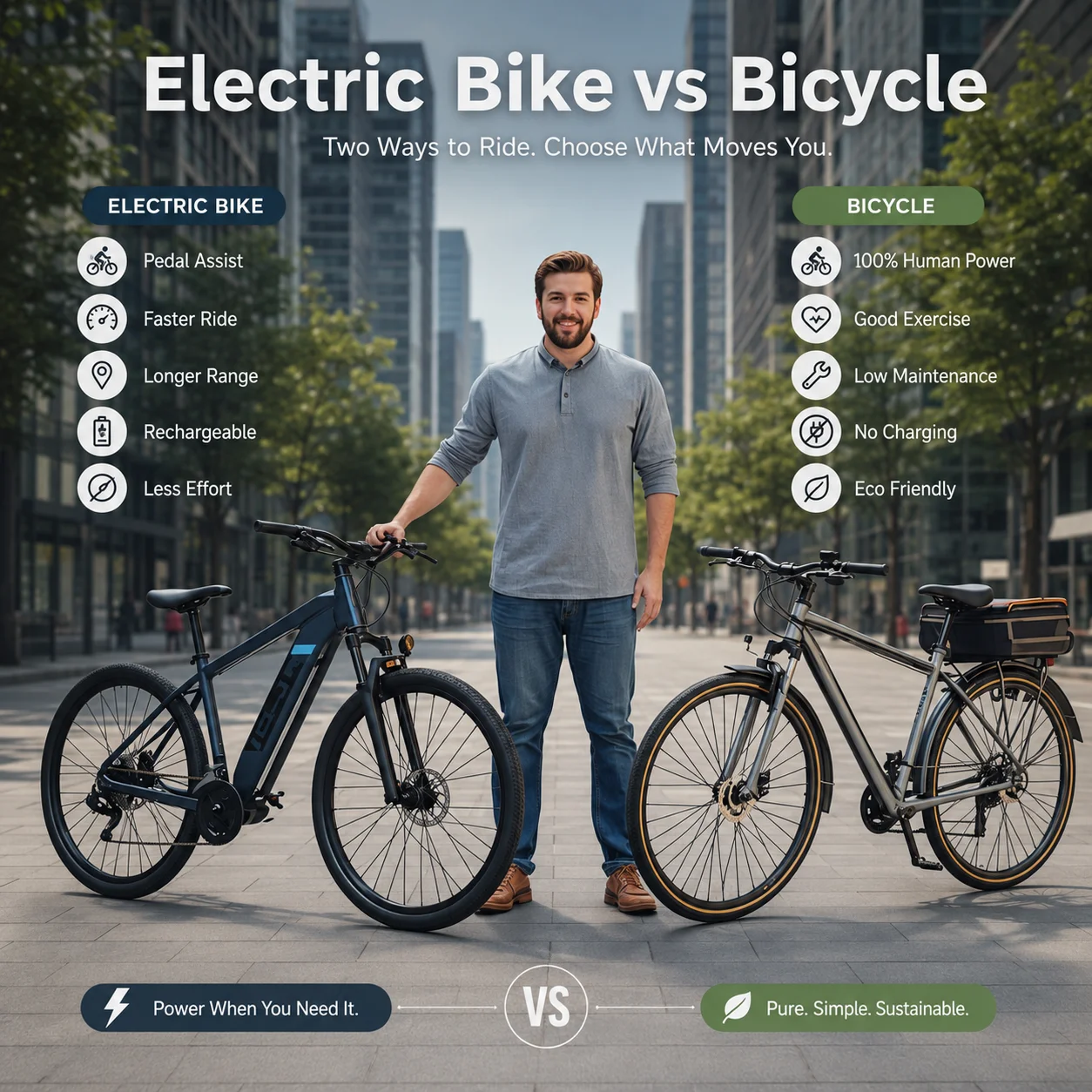
An electric bike is usually the better choice for longer commutes, repeated hills, cargo, or riders who want less physical strain. A regular bicycle is usually better for lower cost, lighter weight, easier storage, simpler repairs, and more exercise per mile.
The right choice is not the bike that wins the most categories. It is the one you can realistically ride, lift, store, charge, secure, repair, and afford.
In this guide, electric bike means a pedal-equipped bicycle with an electric-assist motor. Regular bicycle means a conventional bicycle powered entirely by the rider.
The 60-Second Decision
Choose an e-bike when:
- Distance or hills prevent you from riding consistently.
- You regularly carry cargo or a passenger.
- You need to reduce physical strain.
- More predictable effort would help you replace car trips.
- You have secure storage, an appropriate charging location, and local repair support.
Choose a regular bicycle when:
- Your normal routes are already manageable.
- You must carry the bike frequently.
- Purchase cost is your main constraint.
- You want more exercise from each mile.
- You cannot charge or service an e-bike conveniently.
The central trade-off is simple: an e-bike expands what feels practical, while a regular bicycle minimizes cost, weight, and complexity.
Electric Bike vs Bicycle at a Glance

| Factor | Electric bike | Regular bicycle |
|---|---|---|
| Purchase cost | Usually higher | Usually lower |
| Weight | Motor and battery add weight | Generally lighter |
| Riding effort | Adjustable assistance | Rider supplies all power |
| Hills and cargo | Assistance can reduce strain | Depends on fitness and gearing |
| Exercise | Usually lower effort under similar conditions | Usually higher effort under similar conditions |
| Range | Limited motor-assisted range | Limited by rider endurance and time |
| Maintenance | Bicycle and electrical systems | Bicycle systems only |
| Storage | Usually harder to lift | Usually easier to carry |
| Charging | Requires a suitable routine | No charging needed |
| Access rules | Can vary by system and location | Usually simpler, but local rules still apply |
The table provides orientation, but it cannot identify whether a bike will work in your home, on your route, or with nearby repair services. Check those potential deal-breakers before comparing detailed specifications.
Rule Out the Wrong Bike First

A bicycle can perform well on the road and still be a poor purchase. Start with the conditions that could make it difficult or impossible to use.
Can You Lift and Store It?
A bike that feels easy while rolling can be difficult to:
- Carry upstairs
- Lift onto a wall or vehicle rack
- Turn through a narrow hallway
- Load onto public transportation
- Store securely at work
- Move without motor assistance
Do not judge weight by lifting one wheel in a showroom. Reproduce the complete movement you will perform several times per week.
Can You Charge It Properly?
An e-bike needs a suitable charging location and the correct charger. You also need permission to charge it at home or work and enough space to avoid blocking an exit.
CPSC advises owners to follow the manufacturer’s instructions, stay present while charging, avoid charging while asleep or away from home, and use only the supplied or manufacturer-recommended charger.
Can a Nearby Shop Repair It?
Most bicycle shops can service tires, brakes, chains, and gears. Not every shop will diagnose every motor, controller, display, battery, sensor, or proprietary electrical system.
Call local shops before buying. A low purchase price loses much of its appeal when no nearby technician will service the bike.
Does Your Route Actually Need Assistance?
Motor assistance provides the most value when distance, hills, cargo, wind, fatigue, or physical limitations would otherwise stop you from riding consistently.
It offers less practical value when your trips are short, flat, and already easy.
Can You Afford the Complete Ownership Cost?
Compare more than the sticker price. Include:
- Essential accessories
- Secure locks
- Maintenance
- Insurance
- A compatible vehicle rack
- Electrical diagnosis
- Model-specific replacement parts
- A possible future battery replacement
When one of these factors makes a bike impractical, do not let an attractive motor specification or temporary discount overrule it.
Match the Bike to Your Real Trips

Short, Flat Rides
A regular bicycle is often enough when your normal trips are short, reasonably flat, and already feel manageable.
Suppose you ride one mile to a nearby store, can keep the bicycle indoors, and do not mind the effort. Motor assistance may save little time, while a lighter and mechanically simpler bicycle provides benefits every time you lift or maintain it.
An e-bike can still make sense for a short route when you carry heavy groceries, face strong winds, need to limit exertion, or would otherwise drive.
Longer Daily Rides
An e-bike becomes more compelling when a route exceeds the distance you would willingly ride several times per week.
The important question is not whether you could complete the trip once. Ask whether you would still ride it:
- After a difficult workday
- Into a headwind
- In warm weather
- While carrying a laptop or groceries
- When the return route includes a climb
Research reviews suggest that personal e-bike use can support longer or more frequent cycling and may reduce some motorized travel, although the result depends on which transportation mode the e-bike replaces.
Hills and Heavy Loads
Assistance becomes especially valuable when several sources of effort combine.
A moderate hill may be manageable on a light bicycle with suitable gears. Add a child seat, groceries, a headwind, and a second climb at the end of the day, and the practical result may change.
Do not choose an e-bike using motor wattage or torque alone. Hill performance also depends on:
- Gearing
- Motor placement
- Total rider and cargo weight
- Hill length
- Tire traction
- Assistance programming
- Heat management
- Rider contribution
Fitness-Focused Riding
A regular bicycle generally creates more physical demand under similar route and speed conditions because the rider supplies all propulsion.
An e-bike may produce less effort per mile, but it can still support meaningful physical activity when assistance helps someone ride farther, ride more often, or replace a passive trip.
Choose according to the habit you want:
- Greater effort during a defined workout: regular bicycle
- More manageable daily transportation: e-bike
- A combination of training and assistance: an e-bike with adjustable support may work, provided its cost and weight remain practical
Apartments and Public Transportation
A regular bicycle usually has an advantage when frequent lifting is required.
Before choosing an e-bike, verify:
- Stair and elevator access
- Transit-operator rules
- Bicycle-rack weight limits
- Tire and wheelbase compatibility
- Peak-hour restrictions
- Loading height
- Whether the battery should be removed
- Whether you can load the bike without assistance
A folding e-bike may use less space, but folding does not necessarily make it light.
Three Situations That Change the Answer

The Hilly Commuter
A rider has a seven-mile commute with two long climbs. A regular bicycle can complete the route, but the rider drives whenever the weather is warm or the return journey feels tiring.
An e-bike may be the better transportation choice because it solves the problem preventing consistent cycling.
The Third-Floor Apartment
A rider travels two miles on flat streets but must carry the bike up three narrow flights of stairs.
An e-bike would make the ride easier, but its weight could make storage so difficult that it is used less. A light regular bicycle is likely the more practical option.
The Grocery and School-Run Rider
A rider regularly carries groceries and occasionally transports a child. The route is not especially long, but the combined load makes starts and hills difficult.
An appropriately designed e-bike may provide more value here than distance alone would suggest. Braking capacity, load limits, secure child-carrying equipment, and low-speed handling are as important as motor assistance.
Compare the Whole Commute, Not Top Speed

The better commuter is not necessarily the bike with the highest moving speed. It is the one that creates the easiest repeatable journey from your door to your destination.
Evaluate the Round Trip
Ask:
- How many days per week will I ride?
- How difficult is the return journey?
- Does the route include sustained climbing?
- Will I carry work equipment or groceries?
- Would fatigue cause me to drive instead?
- Where will I park and charge?
An e-bike can reduce the effects of hills and fatigue. A regular bicycle may remain more convenient when the route is short and the e-bike’s carrying or charging requirements add more work than its motor removes.
Calculate Door-to-Door Time
Use:
Door-to-door time = riding + waiting + parking + locking + carrying + changing
An e-bike may reduce moving time on hills, into wind, or over a longer route. A lighter regular bicycle may save time when it must be carried through a station or up several flights of stairs.
A bike that saves four minutes while moving can still be slower overall when storage and handling add ten minutes.
Plan for Sweat and Clothing
Assistance can reduce exertion, but it does not guarantee a sweat-free arrival.
The result also depends on:
- Temperature and humidity
- Clothing
- Riding speed
- Terrain
- Individual response
Plan where you will change, store wet clothing, keep work clothes dry, and leave riding equipment.
Include Parking and Security
Both bicycle types need suitable locks. A more expensive e-bike can increase the financial consequences of theft.
Before buying, determine:
- Whether the frame can be secured to a fixed object
- Whether indoor workplace storage is available
- Whether the battery and display can be removed
- Whether replacement keys are obtainable
- Whether insurance covers the bicycle
- Whether an appropriate lock fits your budget
Calculate the Real Three-Year Cost

There is no reliable universal annual ownership cost. Mileage, weather, labor rates, component quality, battery system, cargo, replacement-part availability, and owner-performed maintenance all affect the result.
Include the Complete Setup
Possible initial expenses include:
- Bicycle
- Helmet
- Lights
- Lock
- Fenders
- Rack, basket, or bags
- Repair equipment
- Insurance
- Vehicle rack
- Professional assembly or fitting
An e-bike may also require a heavier-duty rack, an additional approved charger, replacement keys, or model-specific accessories.
Include Ongoing Costs
Both bike types may require tires, brake parts, chains, gears, bearings, and labor.
An e-bike may add:
- Electrical diagnosis
- Charger replacement
- Sensor or display replacement
- Wiring repairs
- Motor or controller service
- Proprietary parts
- Battery-replacement planning
Electricity may be a relatively small part of ownership compared with the purchase price, specialized repairs, or a replacement battery.
Use a Transparent Formula
Calculate both options using:
Three-year cost = purchase price + accessories + maintenance + electricity + insurance + battery reserve − estimated resale value
| Input | Regular bicycle | E-bike |
|---|---|---|
| Purchase price | $___ | $___ |
| Accessories | $___ | $___ |
| Three-year maintenance | $___ | $___ |
| Electricity | $0 | $___ |
| Battery reserve | $0 | $___ |
| Insurance | $___ | $___ |
| Estimated resale value | −$___ | −$___ |
| Three-year total | $___ | $___ |
Then calculate:
Cost per mile = three-year total ÷ expected three-year mileage
The battery reserve is a planning allowance, not a prediction that the battery will fail during that period.
Count Only Real Transportation Savings
A more expensive e-bike may offer value if it replaces journeys you would otherwise make using paid transportation.
Estimate:
- How many trips you will realistically replace.
- What those trips currently cost.
- Whether you will continue paying fixed car or transit expenses.
- What new storage, insurance, charging, and maintenance costs you will add.
Do not use a generic annual-savings claim.
Choose the Exercise You Will Actually Do

Which Requires More Effort?
Under comparable conditions, a regular bicycle normally requires more rider effort.
A pedal-assist e-bike still involves physical activity, but its assistance setting changes the intensity. Research reviews have found that e-cycling can contribute to physical-activity recommendations and improve fitness, while generally producing lower intensity than conventional cycling under comparable conditions.
Intensity Is Not the Whole Story
An e-bike may increase total activity when it helps someone:
- Ride more frequently
- Travel farther
- Continue on hilly routes
- Return to cycling after inactivity
- Replace driving or another passive trip
A regular bicycle may provide the greater training stimulus when the rider would complete the same trips just as often without assistance.
Avoid Fixed Calorie Comparisons
Calories depend on rider weight, duration, terrain, wind, speed, fitness, assistance setting, heart rate, cargo, and riding position.
Claims such as “a regular bicycle burns exactly twice as many calories” are not defensible without controlled testing.
The better exercise choice is the one that matches both the intensity you want and the amount you will realistically ride.
Test the Weight Before You Buy

Ask one question:
Can I safely lift the complete bike from the floor to the exact height required by my stairs, rack, vehicle, or storage area?
Perform a Ten-Minute Handling Test
- Walk the bike without motor assistance.
- Start and stop several times.
- Turn at low speed.
- Lift it to the required height.
- Carry it around a corner.
- Remove and reinstall the battery.
- Attach your planned bag or lock.
- Check whether it fits the storage area.
- Repeat the lift at least three times.
- Reject it if the process feels unsafe or unrealistic.
A removable battery can reduce some carrying weight. It does not remove the motor, reinforced frame, wider tires, racks, and other components.
Check Your Vehicle Rack
Confirm:
- Per-bike and total weight limits
- Wheelbase compatibility
- Tire-width compatibility
- Frame compatibility
- Loading height
- Battery-removal instructions
- Approval for e-bike use
Do not assume a rack designed for a light road bicycle can safely carry a heavy e-bike.
Plan for Hills, Range, and an Empty Battery

Which Climbs Better?
An e-bike generally reduces the rider effort required to climb, but not every model handles every hill equally well.
Consider:
- Maximum gradient
- Hill length
- Number of climbs
- Rider and cargo weight
- Motor location
- Gear range
- Surface and traction
- Starting from a stop
- Manufacturer load limits
A regular bicycle may remain entirely suitable when climbs are short, the gearing is appropriate, the load is modest, and the rider wants the effort.
What Changes E-Bike Range?
Assisted range can be affected by:
- Assistance level
- Hills
- Rider and cargo weight
- Headwinds
- Frequent starts
- Temperature
- Tire pressure
- Riding speed
- Battery age and condition
Treat advertised range as an estimate under stated conditions, not a guarantee for your route.
Plan using the hardest normal version of your journey: the complete round trip, expected cargo, hills, weather, and a reasonable reserve.
What Happens When the Battery Runs Out?
Many pedal-equipped e-bikes can still be pedaled after motor assistance stops.
However:
- Acceleration may feel harder.
- Hills may become significantly more difficult.
- The extra bicycle weight remains.
- Battery-powered lights or displays may be affected.
Confirm the exact behavior in the model’s owner’s manual.
A regular bicycle has no battery limit, but it is still limited by rider endurance, weather, available time, food, terrain, and recovery.
Check Repair Support Before You Pay

An e-bike shares ordinary bicycle parts while adding some combination of a motor, battery, charger, controller, display, sensors, wiring, and diagnostic software.
Those additions do not mean that every e-bike will fail frequently. They create more categories of repairs and a greater possibility that model-specific parts or tools will be needed.
Ask a Local Shop
Before purchasing, ask:
- Do you service this exact brand?
- Can you diagnose its electrical system?
- Can you order replacement parts?
- Will you service a bike purchased online?
- Who processes warranty claims?
- Is a replacement battery currently available?
- Are proprietary software tools required?
- What support remains after the warranty ends?
Look for Long-Term Support
Prefer products with:
- Clear warranty terms
- Named service locations
- Replacement batteries and chargers
- Standard bicycle components where practical
- Parts diagrams
- Verifiable manufacturer contact details
- A documented recall process
- A workable shipping or return procedure
A cheap bike that cannot be repaired locally may become an expensive disposable product.
Treat Battery Safety as a Buying Criterion

Use the Correct Charger
Use only the charger supplied with or recommended for the exact battery system. A connector that fits does not prove electrical compatibility.
CPSC specifically warns against incompatible universal micromobility chargers and recommends using approved replacement battery packs.
Stop Using a Damaged Battery
Stop charging or using a battery and follow manufacturer or emergency guidance if you notice:
- Swelling
- Cracks or impact damage
- Unusual heat
- Smoke
- A strong odor
- Leaking
- Sparking
- Melted connectors
- Repeated charging errors
Do not open, rebuild, or modify a battery through an unqualified repair process.
Understand What UL 2849 Covers
UL 2849 evaluates the combination of an e-bike’s electrical drivetrain, battery system, and charger for electrical and fire-related hazards. It does not evaluate every mechanical component or whether a rider can maintain control of the bicycle.
A claim that a product was “tested to” a standard should not automatically be treated as proof of independent certification.
Check Recalls and Recycle Correctly
Register the bike with its manufacturer, retain its model and serial number, and periodically check current government recalls.
Do not place an e-bike lithium-ion battery in household trash or curbside recycling. EPA directs consumers to separate battery-recycling or household hazardous-waste collection points.
Damaged or recalled batteries may require special handling. Contact the manufacturer or local hazardous-waste authority before transporting one.
Verify Where You Can Ride

An e-bike is not automatically permitted everywhere a conventional bicycle can travel.
Under currentfederal product rules, the bicycle definition includes certain two- or three-wheeled vehicles with fully operable pedals, an electric motor below 750 watts, and a motor-only maximum speed below 20 mph under specified test conditions. That federal product definition does not decide access to every state road, city path, or recreational trail.
Local requirements can differ for helmets, riding locations, roadway use, paths, and other operating conditions. CPSC advises riders to follow the laws and posted rules that apply in the community where they ride.
Before riding:
- Check the current state rule.
- Check city or county requirements.
- Check the exact park, trail, property, or transit authority.
- Confirm that the rule applies to your specific bike.
- Recheck when traveling somewhere new.
Do not rely solely on an old national summary or a seller’s description.
Test the Real Route Before Buying

Whenever possible, ride both bicycle types on part or all of your normal route.
Record:
- Door-to-door time
- Hill effort
- Low-speed handling
- Comfort
- Sweat and arrival condition
- Ease of starting and stopping
- Carrying and storage difficulty
- Locking time
- Battery use
- Whether you would willingly repeat the trip tomorrow
Do not test only on a flat showroom parking lot when your routine includes hills, traffic, cargo, stairs, or public transportation.
A useful test answers a behavioral question, not only a performance question:
Which bike am I more likely to use consistently?
Make the Final Decision

Choose an electric bike when assistance solves a problem that would otherwise stop or reduce your riding, such as:
- Distance
- Hills
- Cargo
- Fatigue
- Physical strain
- Inconsistent journey effort
- A desire to replace car trips
Choose a regular bicycle when your routes are already practical and you value:
- Lower purchase cost
- Lighter weight
- Simple ownership
- Easy transport
- Greater effort per mile
- Broad repair compatibility
- No charging requirement
Ask yourself six final questions:
- Would I willingly ride the full round trip several days per week?
- Will hills, wind, cargo, or fatigue prevent consistent riding?
- Do I want greater effort per ride or more manageable daily activity?
- Can I safely lift, store, secure, and transport the bike?
- Can I charge and repair it using appropriate local services?
- Can I afford its complete three-year cost?
A regular bicycle is the better default when it already meets your needs. An e-bike becomes the better tool when motor assistance turns difficult, inconsistent, or avoided journeys into rides you can realistically make.
Your Next Step
Start with the concern most likely to change your decision:
- For hills and motor choice, continue to the electric bike motor guide.
- For trip planning, use the electric bike range guide.
- For service requirements, read the electric bike maintenance guide.
- For budgeting, complete the three-year ownership-cost calculator.
- For daily transportation, test your actual route before comparing product models.
Frequently Asked Questions

Is an electric bike better than a regular bicycle?
An e-bike is better when assistance makes an otherwise difficult route practical. A regular bicycle is better when you do not need assistance and prefer lower cost, lower weight, simpler repairs, or greater physical effort.
Is an e-bike worth it for a short commute?
It can be when the route includes hills, cargo, heat, wind, or a need to limit exertion. A regular bicycle may be more practical when the route is flat and the bike must frequently be carried or stored in a small space.
Can you pedal an e-bike when the battery is empty?
Many pedal-equipped e-bikes can still be ridden without motor assistance, but the added weight can make starting and climbing harder. Confirm the behavior in the specific model’s owner’s manual.
Does riding an e-bike count as exercise?
Yes. Pedal-assist riding involves physical activity, although the intensity is generally lower than conventional cycling under similar conditions. Total benefit also depends on how often and how far the person rides.
Is an e-bike always faster?
No. Assistance may improve moving speed on hills, into wind, or over longer routes. Traffic, intersections, parking, stairs, locking, and storage can change total door-to-door time.
Are e-bikes allowed on every bicycle trail?
No. Access varies by location and the rules applying to the specific bike. Check current state, local, and trail-authority requirements before riding.
Pingback: Are Electric Bikes Vehicles or Bicycles? U.S. Laws Explained - electricscootercar.com
Pingback: Are Electric Bikes Eco-Friendly? When They Are—and What Changes the Answer - electricscootercar.com
Pingback: How E-Bikes Affect Urban Mobility: When They Cut Car Trips—and When They Don’t - electricscootercar.com
Comments are closed.