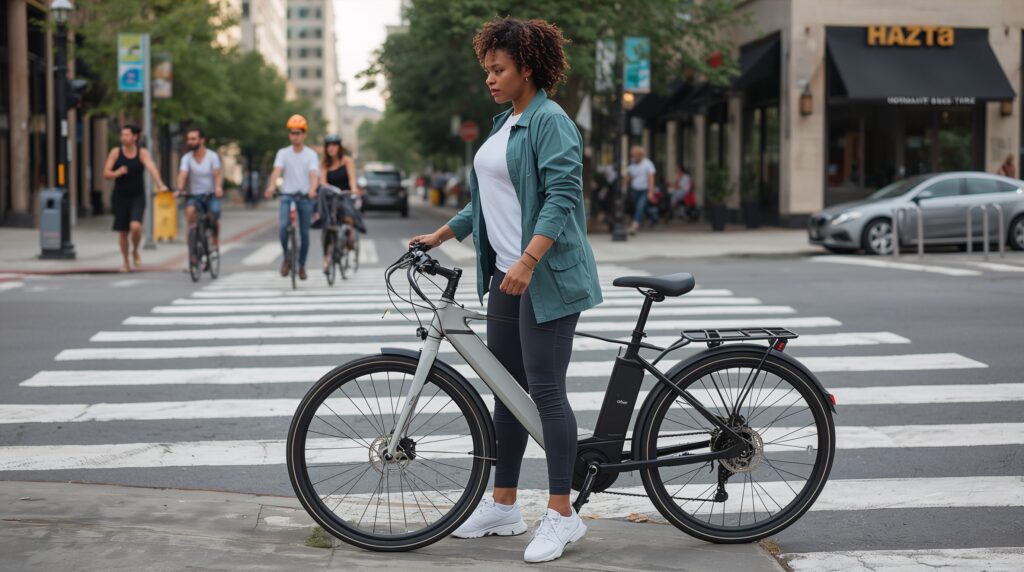
An electric bike does not send full battery power straight to its motor. It works more like a conversation: you pedal, sensors report what you are doing, and a controller decides how much help to provide. The battery supplies the energy, and the motor converts that energy into turning force.
The simplest way to remember it is:
You request help → the controller decides → the battery supplies energy → the motor assists
You still steer, balance, shift gears, and brake like you would on a regular bicycle.
Quick answers
Do you have to pedal? On a pedal-assist-only e-bike, yes. A throttle-equipped bike may provide assistance without pedaling.
Can you ride after the battery runs out? Usually, although the added weight may make the bike harder to pedal.
Is the motor always running? No. The controller starts, adjusts, or stops assistance according to your input and the bike’s operating limits.
Research basis: This guide draws on current US Consumer Product Safety Commission guidance, federal regulations, UL Solutions information, US Department of Energy battery explanations, and manufacturer technical documentation. It does not claim hands-on testing.
How an Electric Bike Works in Six Steps

1. You pedal or use the throttle
A pedal-assist e-bike waits for rider input.
Some systems detect that the pedals are moving. Others measure how much force you apply. A throttle-equipped model can receive a separate request from a thumb lever or twist grip.
2. Sensors detect what you are doing
A cadence sensor detects pedal rotation.
A torque sensor measures pedal force.
A speed sensor monitors how quickly the bicycle is moving.
Some modern systems analyze cadence, torque, and speed together to adjust assistance. Shimano, for example, describes systems that use real-time information from all three sensor types.
The sensors do not send meaningful riding power to the motor. They send information to the controller.
3. The controller evaluates your request
The controller is the electrical system’s decision-maker.
Depending on the bike, it may consider:
- Whether the pedals are moving
- How hard you are pedaling
- Throttle position
- Selected assist level
- Bicycle speed
- Battery condition
- Brake signals
- Temperature
- Electrical limits
4. The battery supplies energy
Once the controller accepts the request, it draws energy from the battery.
The battery does not simply release unrestricted power. The controller regulates how much electrical current reaches the motor.
5. The motor produces torque
The motor converts electrical energy into mechanical turning force, called torque.
A hub motor applies that force directly at a wheel. A mid-drive motor applies it through the cranks and bicycle drivetrain.
6. You feel the assistance
The motor’s torque combines with your pedaling.
Depending on the system, assistance may feel like:
- A gentle push
- Stronger legs
- Easier acceleration
- Less effort on a hill
- A noticeable surge after the pedals begin turning
Motor support can change according to rider effort, speed, and the selected riding mode.
Two Flows Make the Bike Move

Most basic explanations focus only on energy traveling from a battery to a motor. That leaves out half the process.
An e-bike uses a signal path and an energy path.
Signal path
Rider → sensor or throttle → controller
This path communicates what you want the bike to do.
Energy path
Battery → controller → motor → wheel or drivetrain
This path supplies the energy that creates assistance.
The controller sits in both paths. It receives your request and controls the energy response.
The key insight
The battery stores energy, but the controller decides when and how that energy reaches the motor.
This is one reason two e-bikes with similar battery and motor specifications can feel different. Their sensors, software, current limits, assist modes, and mechanical layouts may not respond in the same way.
Visual 1 — place here: Original dual-path diagram showing the signal path above the energy path.
Suggested caption: How rider instructions and battery energy travel through an electric bike.
Suggested alt text: Diagram showing rider input reaching the controller through a sensor while battery energy passes through the controller to the motor and wheel.
What Does the Rider Feel?

Starting from a traffic light
On a basic cadence-sensor bike, you may need to turn the pedals part of a rotation before the motor begins helping. The assistance may then arrive as a noticeable push.
On a torque-sensor bike, assistance can begin as the system detects pressure at the pedals. This often feels more proportional because the motor response follows your effort.
System tuning matters, so not every cadence-sensor or torque-sensor bike feels the same.
Changing assist levels
Most e-bikes provide several assistance settings.
A lower setting normally permits less motor contribution. A higher setting normally provides stronger assistance within the bike’s electrical and speed limits.
The motor is not necessarily delivering the selected level’s maximum output all the time. The controller can continue adjusting output according to rider input and operating conditions.
Stopping pedaling
When you stop pedaling, the pedal-assist request ends.
Assistance may stop immediately or fade after a brief programmed delay. This response time is worth learning before riding in traffic or crowded spaces.
Pedal Assist or Throttle: Do You Have to Pedal?

The answer depends on how motor assistance is activated.
How pedal assist works
Pedal assist adds motor support while you pedal.
The system detects your input, evaluates the selected assistance setting, and provides motor support within its limits.
An assistance level is not the same as a bicycle gear:
- Assist level: changes how much the motor contributes.
- Mechanical gear: changes the relationship between pedal rotation and wheel rotation.
You often need to use both.
Cadence sensor versus torque sensor
| Feature | Cadence sensor | Torque sensor |
|---|---|---|
| Measures | Pedal rotation | Pedal force |
| Common response | Provides support after movement begins | Adjusts support according to effort |
| Typical feel | More level-based | More proportional |
| Starting behavior | May have a short delay | Can respond to pedal pressure |
| Common price position | Lower | Higher |
| Often suits | Straightforward commuting and value-focused bikes | Riders seeking a natural bicycle feel |
These are common tendencies rather than guarantees. Controller programming and sensor quality can substantially change the result.
How a throttle works
A throttle sends a direct request to the controller.
Depending on the bicycle, it may let the motor provide assistance without normal pedaling. Its behavior may still be restricted by speed, battery condition, operating mode, or controller programming.
Because the motor may be providing more of the total effort, frequent throttle use can increase battery demand.
The Main Parts and Their Jobs

| Component | Main job |
|---|---|
| Battery | Stores electrical energy |
| Battery-management system | Monitors battery conditions and applies protective limits |
| Cadence sensor | Detects pedal rotation |
| Torque sensor | Measures pedal force |
| Speed sensor | Monitors bicycle speed |
| Throttle | Sends a direct assistance request |
| Controller | Regulates motor operation and power delivery |
| Motor | Converts electrical energy into torque |
| Drivetrain | Transfers rider and mid-drive force to the wheel |
| Display or controls | Show information and change settings |
| Brakes | Physically slow the bicycle |
| Brake cutoff, when fitted | Tells the controller to cancel motor assistance |
Battery-management system
The battery-management system, or BMS, monitors the battery.
Exact protections vary by manufacturer. Bosch states that its BMS detects faults and protects its batteries against excessive temperatures, overload, and deep discharge. This is an example of Bosch system behavior, not evidence that every battery offers identical protection.
A BMS reduces certain risks, but it cannot make damaged, modified, incompatible, or poorly handled equipment safe.
Display and controls
A display or compact control unit may show:
- Speed
- Battery status
- Assist setting
- Trip distance
- Estimated range
- System warnings
A large screen is optional. Some bikes use only buttons and indicator lights.
Visual 2 — place here: Original side-view illustration labeling the battery, controller, sensors, motor, drivetrain, display, and brakes.
Hub Motor or Mid-Drive: How Does Power Reach the Road?

The motor’s location changes its mechanical power path.
Hub motor
A hub motor sits inside the front or rear wheel.
Its path is:
Motor → wheel
The rider still uses the chain and bicycle gears, but the motor normally turns the wheel independently of those gears.
This arrangement does not send the motor’s torque through the bicycle chain.
Mid-drive motor
A mid-drive sits near the cranks.
Its path is:
Motor → crank → chain or belt → gears → rear wheel
The motor and rider use the same drivetrain. That allows the motor to benefit from the bicycle’s mechanical gears.
Why shifting matters
An easier gear lets the cranks and mid-drive motor turn faster relative to the rear wheel.
That can help when:
- Starting on a hill
- Carrying cargo
- Climbing steep terrain
- Riding slowly through a difficult section
Remaining in a hard gear at very low speed can make pedaling difficult and increase drivetrain load.
Visual 3 — place here: Side-by-side hub and mid-drive power paths.
Suggested caption: Hub motors turn a wheel directly; mid-drives send motor force through the bicycle drivetrain.
What Makes an E-Bike Climb Hills?

Hill performance is not determined by motor watts alone.
It depends on the complete system:
- Hill steepness
- Rider, bicycle, and cargo weight
- Motor torque
- Mechanical gearing
- Controller current limits
- Battery condition
- Motor operating speed
- Rider effort
- Tire traction
- Temperature
- Length of the climb
Example: Two riders on the same hill
The first rider selects maximum assistance but remains in a hard mechanical gear. The bicycle slows, pedal speed drops, and the motor must work under a heavy load at low speed.
The second rider shifts into an easier gear before the steep section, maintains a steady cadence, and continues contributing pedal effort.
The second approach will often feel smoother, especially on a mid-drive.
A smoother climbing sequence
- Shift into an easier gear before your pedal speed becomes very low.
- Select enough assistance to maintain a steady rhythm.
- Continue contributing pedal effort.
- Avoid forcing the bike to crawl in a hard gear.
- Reduce the load or pause if the display shows a temperature or fault warning.
A larger watt figure does not automatically guarantee better climbing. Gearing, battery output, controller limits, motor design, cooling, and rider contribution all matter.
How Do the Battery and Controller Work Together?

The battery stores energy. The controller manages its delivery.
Watts versus watt-hours
These terms are easy to confuse:
- Watts describe power.
- Watt-hours describe stored energy.
- Voltage relates to electrical potential.
- Amp-hours describe charge capacity.
A simple nominal-capacity calculation is:
Voltage × amp-hours = watt-hours
For example:
48 volts × 10 amp-hours = 480 watt-hours
A 750-watt motor and a 750-watt-hour battery are describing different characteristics.
What happens during charging and discharging?
A rechargeable battery stores chemical potential energy. During use, electrons travel through the external circuit while ions move inside the battery. Charging reverses the process so the battery can store energy again.
For the rider, the practical operating path is:
Battery → controller → motor
What the controller decides
| Situation | Typical controller action |
|---|---|
| Low assist selected | Limit motor contribution |
| High assist selected | Permit stronger support |
| Rider pedals harder | Increase support on a torque-responsive system |
| Throttle is pressed | Respond according to throttle position and system limits |
| Cutoff speed is reached | Reduce or stop assistance |
| Battery becomes very low | Restrict output or end assistance |
| Excessive heat is detected | Reduce or stop operation |
| Brake cutoff activates | Cancel motor assistance |
| Fault is detected | Restrict operation and possibly display an error |
The exact response is model-specific.
What Happens When Assistance Stops?

Motor assistance can stop for several different reasons. They should not be confused.
You stop pedaling
The normal pedal-assist request ends. The motor stops immediately or after a short programmed delay.
You reach the assistance cutoff speed
The controller reduces or stops motor support. It does not apply the brakes.
You can continue moving faster through pedaling, gravity, or momentum.
Many US e-bikes are described using Class 1, Class 2, and Class 3 terminology:
| Class | Motor activation | Assistance cutoff |
|---|---|---|
| Class 1 | Pedal assist | 20 mph |
| Class 2 | May propel without pedaling | 20 mph |
| Class 3 | Pedal assist | 28 mph |
These definitions appear in federal rules governing e-bike use in certain national wildlife refuge contexts. State and local rules determine how e-bikes are classified and where they may be ridden.
A separate federal consumer-product definition covers certain two- or three-wheeled bicycles with fully operable pedals, motors below 750 watts, and a motor-only maximum speed below 20 mph under specified test conditions.
Check the rules for the state, road, trail, city, or park where you plan to ride.
You apply the brakes
Two separate things may happen:
- A brake-cutoff switch, when fitted, tells the controller to cancel motor assistance.
- The mechanical or hydraulic brakes create the physical force that slows the wheels.
Important
A brake cutoff does not stop the bicycle. The brakes stop the bicycle.
Regenerative braking is not a standard feature on every e-bike. It requires a compatible motor, controller, battery, and system design.
The battery runs out
When the battery reaches its lower operating limit, motor assistance normally stops.
On a typical e-bike with a conventional mechanical drivetrain, the pedals remain connected to the wheel. You can usually continue riding, but the bicycle may feel harder to pedal because you are carrying the battery, motor, reinforced parts, and accessories.
Depending on the model, you may also lose:
- The display
- Integrated lights
- Electronic shifting
- Electronic locks
- Tracking functions
- Accessory power
Do not assume a battery-powered safety feature will remain available after the battery is depleted.
Visual 4 — place here: Four-state diagram showing stopped pedaling, speed cutoff, braking, and battery depletion.
How to Charge an E-Bike More Safely

Use the specified charger
Use the charger supplied with the bicycle or specifically recommended by its manufacturer.
A connector that physically fits does not prove that a charger has the correct voltage or charging profile.
Stay present while charging
The US Consumer Product Safety Commission advises users to follow manufacturer instructions, remain present during charging, avoid charging while asleep or away from home, unplug the product when charging is complete, and use only a supplied or manufacturer-recommended charger.
Charge on a stable, dry surface away from materials that can burn. Do not block an exit with the bicycle or battery.
Stop using a damaged battery
Stop riding or charging if a battery:
- Swells
- Leaks
- Smells unusual
- Produces smoke
- Makes hissing or popping sounds
- Becomes abnormally hot
- Has a crushed, cracked, or melted case
- Has suffered serious impact or water damage
Do not open, rebuild, or modify a lithium-ion e-bike battery unless you have appropriate professional training and equipment.
CPSC advises against putting lithium-ion batteries in household trash or general recycling. Use an appropriate battery recycler or hazardous-waste collection program and follow any applicable recall instructions.
What does UL 2849 mean?
UL 2849 evaluates an e-bike’s electrical drivetrain, battery, and charger as a combined system for electrical and fire-safety hazards.
It does not evaluate whether the rider can maintain control of the bicycle.
Certification is useful evidence, but it does not replace proper charging, maintenance, recall checks, or manufacturer instructions.
Five Ways to Get Smoother Assistance

Start in an easier gear
Use an easier mechanical gear when starting uphill or carrying a heavy load.
Increase assistance gradually
Begin in a lower assist setting until you understand how quickly the motor responds.
Pedal smoothly
A steady pedal rhythm usually produces more predictable assistance than repeatedly stopping and restarting.
Shift before a hill becomes steep
Waiting until the bicycle has almost stopped makes shifting more difficult and can increase drivetrain strain.
Practice how the motor starts and stops
Before riding in traffic, learn:
- How quickly assistance engages
- How quickly it stops after you stop pedaling
- Whether the bike has brake cutoffs
- How the throttle responds
- Where the assistance cutoff occurs
Practice in a controlled, low-traffic area.
Quick Answers

Does the motor help while you coast?
Pedal-assist systems normally require valid pedal input. Assistance may continue briefly while the controller processes the end of that input.
A throttle-equipped model may provide motor power without pedaling, depending on its configuration.
Can you pedal faster than the assistance cutoff?
Yes. The cutoff ends motor assistance; it does not prevent the bicycle from moving faster.
Do all electric bikes have throttles?
No. Many e-bikes are pedal-assist only.
Does pedaling recharge the battery?
Ordinary pedaling does not meaningfully recharge most e-bike batteries. Do not expect energy recovery unless the manufacturer documents a compatible system.
The Main Idea
An electric bike coordinates rider input with controlled electrical assistance.
The sensor or throttle tells the system what you want. The controller decides how to respond. The battery provides energy. The motor converts that energy into torque. The wheel or drivetrain transfers the combined rider and motor effort to the road.
Once that sequence is clear, the rest becomes easier to understand: sensor feel, assist modes, gears, hills, speed cutoffs, braking, battery range, and charging safety.
Choose Your Next Guide

Continue according to the question that matters most:
- Ride feel: Compare cadence and torque sensors.
- Hill performance: Compare hub motors and mid-drives.
- Distance: Learn what affects e-bike range.
- Electrical behavior: See how an e-bike controller works.
- Safety: Review battery charging, storage, and warning signs.
Pingback: How Fast Do Electric Bikes Go? 20 vs 28 MPH - electricscootercar.com
Pingback: Electric Bike vs Bicycle: Which One Is Right for You? - electricscootercar.com
Pingback: What Is a Throttle on an Electric Bike? How It Works - electricscootercar.com
Pingback: 10 Types of Electric Bikes Compared: Which One Fits You? - electricscootercar.com
Pingback: What Is an Electric Bike? How It Works, Classes & Range - electricscootercar.com
Pingback: How E-Bikes Affect Urban Mobility: When They Cut Car Trips—and When They Don’t - electricscootercar.com
Pingback: SEO title: Electric Bike Won’t Turn On? Safe No-Power Checks to Try First ** - electricscootercar.com
Comments are closed.