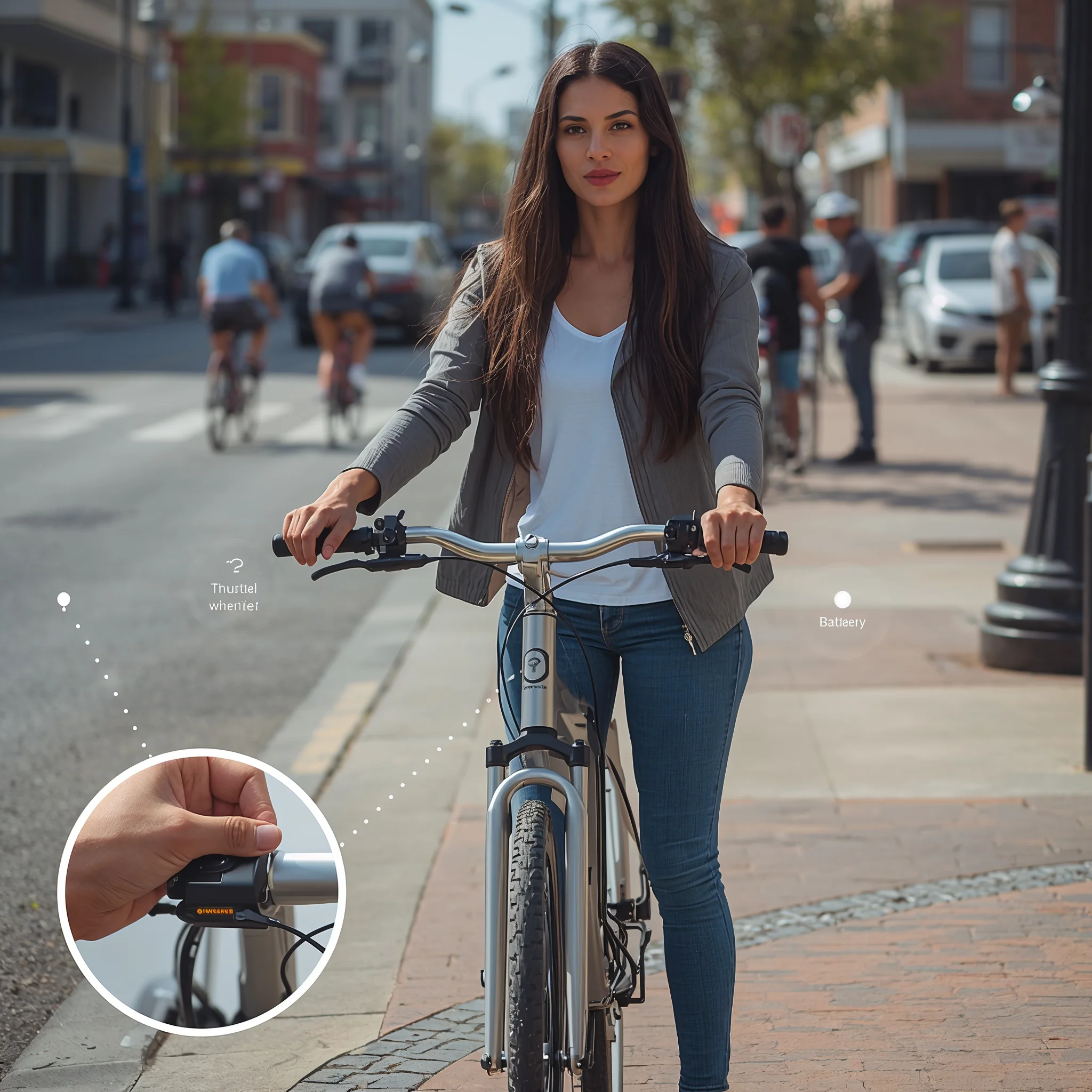
An electric-bike throttle is a handlebar control that asks the motor to provide assistance when you press or twist it. On some e-bikes, it can move the bicycle from a complete stop without pedaling. On others, it works only after you begin pedaling or reach a minimum speed.
The throttle does not normally send the motor’s full working current. It sends a low-power signal to the motor controller, which regulates how much battery power reaches the motor.
The answer at a glance
- A throttle controls motor assistance with your hand.
- Some throttles work from a complete stop; others require pedaling first.
- Thumb and twist throttles offer different ergonomics, but neither is universally better.
- Throttle-only riding often uses more battery because the rider contributes less energy.
- Under the common US classification system, a throttle-powered e-bike that stops assisting at 20 mph is generally associated with Class 2.
- State and local rules determine where a particular e-bike may be ridden.
Can You Ride an Electric Bike Without Pedaling?

Sometimes. A throttle-equipped e-bike may move without pedaling, but the throttle does not necessarily work from a complete stop.
Most systems fall into one of three categories.
Zero-start throttle
A zero-start throttle can activate while the bicycle is stationary.
This can help when:
- Starting at an intersection
- Beginning on a hill
- Moving a loaded cargo bike
- Riding in repeated stop-and-go traffic
Because assistance is available immediately, accidentally touching the throttle can also make the bike move unexpectedly.
Pedal-first throttle
A pedal-first throttle remains inactive until the rider begins turning the pedals. After the system recognizes pedal movement, the throttle may become available.
A throttle that works only after pedaling is therefore not necessarily faulty.
Speed-gated throttle
A speed-gated throttle becomes active only after the bicycle reaches a minimum rolling speed.
Throttle operation may also depend on the selected riding mode, display setting, software configuration, or brake-lever position.
Before assuming something is wrong, check the owner’s manual for:
- Zero-start or pedal-first operation
- Minimum activation speed
- Modes in which the throttle works
- Maximum throttle-assisted speed
- Whether the throttle can be disabled
- Startup and brake-cutoff conditions
How Does an E-Bike Throttle Work?

The basic process is simple:
Your hand → throttle sensor → motor controller → battery power → motor torque → wheel movement
When you press or twist the throttle:
- A sensor detects how far the control has moved.
- The throttle sends an input signal to the motor controller.
- The controller interprets the requested assistance.
- It draws the required energy from the battery.
- The motor produces torque and helps move the bicycle.
Most conventional e-bike throttles use a Hall-effect sensor and magnet. Technical documentation from Grin Technologies describes common throttle signals that sit at approximately 0.8–0.9 volts when inactive and rise toward roughly 3.6–4.1 volts at full input. Exact specifications vary by system.
The rider does not need to understand these voltages to operate the bike. The practical point is that the throttle is a signal device, while the controller manages motor power.
What can interrupt throttle assistance?
The controller may ignore or interrupt the throttle request when:
- A brake cutoff is active
- The selected mode disables the throttle
- The bike reaches a programmed speed limit
- Initial pedaling is required
- Battery voltage is too low
- The system detects an invalid throttle signal
- The controller or motor activates temperature protection
- A connector or component fault is detected
Some systems also check the throttle position during startup. If the control is pressed while the bike switches on, the controller may display an error or refuse to activate the motor. This can help prevent an unexpected launch.
Why Do Similar Throttles Feel Different?

The lever or grip is only one part of the system.
Actual throttle behavior depends on:
| Factor | What it changes |
|---|---|
| Throttle design | How the rider provides input |
| Controller programming | Acceleration, delay, and power delivery |
| Riding mode | Whether the throttle works and how much output it can request |
| Speed settings | Minimum activation and maximum assisted speed |
| Brake cutoffs | Whether braking interrupts the motor |
| Motor and gearing | How strongly and smoothly the bike responds |
| Bicycle weight | How quickly the bike accelerates |
| Rider and cargo load | How much motor effort is required |
One controller may deliver substantial assistance after a small control movement. Another may increase assistance gradually.
A throttle can therefore feel:
- Smooth
- Abrupt
- Delayed
- Progressive
- Difficult to modulate
The physical throttle type alone does not determine response quality.
Thumb Throttle vs. Twist Throttle

There is no universally best throttle.
The right choice depends on your hand position, shifter layout, gloves, grip strength, ride duration, and how frequently you plan to use it.
| Throttle type | How it works | Potential advantage | Potential limitation |
|---|---|---|---|
| Thumb | Press a small lever | Main grip remains stationary | Thumb fatigue or shifter interference |
| Half-twist | Rotate part of the grip | Provides wrist control with a fixed grip section | Possible accidental rotation |
| Full-twist | Rotate most or all of the grip | Familiar to motorcycle and scooter riders | Wrist fatigue or unintended input |
| Trigger | Pull with a finger | Compact and comfortable for some riders | May compete with brake access |
| Button | Press for assistance | Mechanically simple | May provide limited control over output |
Grin Technologies notes that thumb throttles commonly fit well with twist shifters, while twist or split-grip throttles may fit more naturally beside lever-style shifters. The full handlebar arrangement matters more than the throttle in isolation.
A thumb throttle may suit you when:
- You use the throttle mainly for starts or short boosts
- You want the main grip to remain stationary
- The lever is easy to reach
- It does not interfere with the shifter
A twist throttle may suit you when:
- Wrist movement feels more comfortable than thumb pressure
- You expect longer periods of throttle use
- You are familiar with motorcycle-style controls
- The grip still allows secure braking and steering
What to check during a test ride
Do not judge a throttle only by its shape. Check whether it:
- Returns immediately when released
- Is reachable without changing your braking grip
- Provides predictable low-speed assistance
- Allows small, controlled inputs
- Interferes with the shifter or display
- Remains comfortable with your usual gloves
- Feels manageable when the bike is loaded
Throttle vs. Pedal Assist

Throttle and pedal assist both activate the motor, but they use different rider inputs.
| Question | Throttle | Pedal assist |
|---|---|---|
| How is it activated? | Hand input | Pedal movement or pedal force |
| Must you pedal? | Not always | Yes |
| Can it help from a stop? | Yes on zero-start systems | Yes, but sensor response may be delayed |
| How much effort do you provide? | As much or as little as you choose | You continue contributing |
| How does it feel? | Direct motor control | More like assisted cycling |
| Which encourages more exercise? | Depends on rider behavior | Usually pedal assist |
| Which commonly conserves energy? | Depends on use | Pedal assist when the rider contributes meaningful power |
Pedal-assist systems generally use cadence or torque sensing. A cadence sensor detects pedal rotation, while a torque sensor responds to how much force the rider applies. A throttle allows hand-operated motor input without waiting for pedal activity.
Many bikes include both systems. A rider may use the throttle to begin moving and then pedal normally with pedal assist.
Choose a throttle when you prioritize:
- Easier starts
- Direct motor control
- Stop-and-go convenience
- Brief motor-only movement
- Assistance before finding a comfortable cadence
Choose pedal assist when you prioritize:
- Exercise
- A natural bicycle feel
- Continuous rider contribution
- Fewer handlebar controls
- Access to places that restrict throttle-assisted classes
A bike with both offers flexibility, but only when both systems are predictable and comfortable to use.
When Is a Throttle Most Useful?

The throttle’s clearest advantage often appears during the first few seconds of movement.
At an intersection: It can help the bicycle begin moving before the rider settles into a normal pedaling rhythm.
On a hill: It can reduce the difficulty of balancing while applying the first strong pedal stroke.
With cargo: It can help overcome the extra effort required to accelerate a loaded bicycle.
In stop-and-go traffic: It can reduce the effort required for repeated launches.
During a short pause from pedaling: Compatible systems may allow temporary motor-only riding.
These are possible benefits, not guarantees that a throttle is suitable for every person or physical condition. Bike fit, stability, braking performance, weight, and predictable power delivery remain essential.
Does Using the Throttle Reduce Battery Range?

Throttle-only riding often uses more battery because the rider contributes less human power. The throttle itself does not reduce range by one fixed percentage.
Energy consumption depends on:
- Speed
- Acceleration
- Hills
- Wind
- Rider and cargo weight
- Tire pressure
- Road surface
- Temperature
- Stop frequency
- Motor efficiency
- Assistance setting
- Rider contribution
A rider who repeatedly accelerates at high power without pedaling will generally use more energy than a rider who contributes steady pedal power.
However, gentle throttle use on level ground could consume less energy than high-speed pedal-assist riding uphill or into a strong headwind. The control method is only one variable.
Use watt-hours per mile for a fairer comparison
A more useful efficiency measure is:
Battery energy used ÷ distance traveled = watt-hours per mile
Hypothetical example:
- 300 Wh used over 20 miles = 15 Wh per mile
- 300 Wh used over 15 miles = 20 Wh per mile
The second ride consumed battery energy faster.
A credible throttle-versus-pedal-assist test should record:
- Watt-hours used
- Distance
- Average speed
- Elevation
- Rider and cargo weight
- Tire pressure
- Temperature and wind
- Number of stops
- Assistance mode
- Rider contribution
Without these controls, a universal throttle range-loss percentage is not defensible.
What Class Is an E-Bike With a Throttle?

Under the common three-class system, an e-bike whose motor can propel it without pedaling and stops assisting at 20 mph is generally associated with Class 2. State definitions are not completely uniform.
To understand whether you can ride a throttle-equipped bike somewhere, answer three separate questions.
1. Does it meet the federal product definition?
Federal bicycle regulations include a two- or three-wheeled vehicle with fully operable pedals, an electric motor of less than 750 watts, and a motor-only maximum speed below 20 mph under the specified test conditions.
This is a federal product definition. It does not create one nationwide access rule for every street, path, park, or trail.
2. How does your state classify it?
Many states use Class 1, Class 2, and Class 3 definitions. States also determine operational requirements such as rider age, helmet use, equipment, and where certain classes may be used.
3. Is that class permitted in the exact location?
A city, county, park, trail manager, or land agency may apply additional restrictions.
Before riding, verify:
- The bike’s motor power and assisted-speed specifications
- Its state classification
- The rules for the specific road, path, park, or trail
- Any applicable age, helmet, labeling, or equipment requirements
Changing the controller, adding a throttle, increasing motor-only speed, or modifying the motor system may affect the bike’s classification and permitted use.
How to Use an E-Bike Throttle Safely

A zero-start throttle may move the bicycle immediately. Practice in an open, level area before using it near traffic, pedestrians, or obstacles.
Use a controlled start
- Select a low assistance setting.
- Point the front wheel straight.
- Hold both grips securely.
- Keep the brake levers within reach.
- Place one foot firmly on the ground.
- Apply a small amount of throttle.
- Begin pedaling after the bicycle is stable.
- Release the throttle when it is no longer needed.
The goal is to begin moving smoothly—not to accelerate as quickly as possible.
CPSC research and rulemaking materials recognize that e-bikes differ from conventional bicycles in acceleration, achievable speed, stopping behavior, and other mechanical characteristics.
Prevent accidental activation
- Switch the bike off before lifting or transporting it.
- Do not rest bags or clothing against the throttle.
- Switch the system on without pressing the control.
- Confirm that the throttle returns freely after release.
- Inspect a lever or grip that has been struck or damaged.
- Keep accessories from restricting control movement.
- Do not bypass brake cutoffs or other safety systems.
Stop riding immediately if the motor continues pushing after you release the throttle.
Apply the brakes, switch the electrical system off when safe, and have the bicycle inspected before riding again.
Why Is My E-Bike Throttle Not Working?

First determine whether you are seeing normal programming or a possible fault.
| What happens | Possible explanation | Safe first check |
|---|---|---|
| No response | System or battery is inactive | Check the battery, key, and display |
| Works after pedaling | Pedal-first programming | Check the owner’s manual |
| Works only while moving | Minimum-speed requirement | Confirm the activation rule |
| Works only in certain modes | Software restriction | Select an approved mode |
| Stops while braking | Brake cutoff is active | Fully release both brake levers |
| Shows an error at startup | Throttle was active when switched on | Restart without touching the control |
| Works intermittently | Loose external connection or damaged control | Switch off and inspect accessible parts |
| Feels jerky | Aggressive programming or a fault | Select a lower mode and stop if it continues |
| Remains engaged | Stuck control or electrical fault | Brake, switch off, and stop riding |
A physically matching connector does not prove that a replacement throttle is compatible. Controllers can expect different signal ranges and wiring arrangements, and an out-of-range input may be treated as a fault.
Do not use this article as a guide for:
- Controller bypasses
- Brake-cutoff bypasses
- Speed unlocking
- Unknown wiring pinouts
- Unapproved throttle substitutions
Detailed electrical diagnosis belongs with the manufacturer or a qualified e-bike technician.
Can You Add a Throttle to Any E-Bike?

No.
A successful retrofit depends on compatibility with the:
- Motor controller
- Wiring harness
- Display
- Firmware
- Battery voltage
- Brake-cutoff system
- Riding modes
- Manufacturer’s warranty requirements
The controller must provide a supported input and interpret the signal correctly. A matching plug shape is not sufficient evidence.
Adding a throttle may also change the bicycle’s legal class or where it can be ridden. Use a manufacturer-approved part or qualified service provider rather than relying on a universal wiring diagram.
Should You Buy an E-Bike With a Throttle?

A throttle is worthwhile when it solves a specific riding problem.
A throttle may suit you when:
- You frequently stop in traffic
- You carry cargo
- You find hill starts difficult
- You value assistance before beginning to pedal
- You want direct control over brief boosts
- You want the option of temporary motor-only riding
Pedal assist alone may suit you better when:
- Exercise is your main goal
- You prefer a conventional bicycle feel
- You want fewer handlebar controls
- You rarely make repeated stops
- Your preferred trails restrict Class 2 e-bikes
- You want to contribute as much human power as possible
Bring this checklist to a test ride
| Question | Why it matters |
|---|---|
| Does it work from a complete stop? | Determines launch behavior |
| Does it require initial pedaling? | Prevents confusion after purchase |
| Is there a minimum activation speed? | Explains delayed response |
| Is the control proportional? | Affects low-speed precision |
| What is the throttle-assisted speed limit? | Affects use and classification |
| Which riding modes support it? | Reveals software restrictions |
| Does it return immediately when released? | Essential for safe operation |
| Do the brakes interrupt motor assistance? | Adds a motor-stopping path |
| Does it interfere with the shifter? | Affects daily comfort |
| Can it be disabled? | Useful for storage and restricted areas |
| Is its class allowed where you ride? | Determines practical access |
| Are replacement parts supported? | Affects long-term ownership |
The phrase “includes throttle” does not provide enough information to make a good buying decision.
Frequently Asked Questions

Do all electric bikes have throttles?
No. Some e-bikes use pedal assist only, while others include both pedal assist and a throttle.
Can you use a throttle and pedal assist together?
Often, yes. The exact behavior depends on the bike’s controller, mode settings, and manufacturer programming.
Does braking cancel throttle power?
Many e-bikes have brake-cutoff sensors that instruct the controller to stop motor assistance when a brake lever is pulled. Confirm how the feature works on the specific model.
Why does my throttle work only after I pedal?
The bike may use pedal-first programming. This can be an intentional operating rule rather than a defect.
The Bottom Line

An e-bike throttle is a hand-operated control that sends an assistance request to the motor controller. It may allow the bicycle to move without pedaling, but its behavior depends on programming, riding modes, speed limits, brake cutoffs, and model-specific settings.
Before buying or troubleshooting a throttle-equipped e-bike:
- Read the exact model’s owner’s manual.
- Confirm the bike’s classification and local access rules.
- Take a controlled test ride using the checklist above.
Those three steps will tell you more than a product listing that simply says the bike “has a throttle.”
How this guide was researched
This guide draws on current federal regulations, state-law resources, CPSC materials, and technical controller documentation. It does not claim that every throttle configuration described was personally tested.
Before publication, legal details should be date-checked and the technical guidance reviewed by a named e-bike service professional. Any future hands-on test should disclose the bike, controller settings, rider and cargo weight, route, weather, and measurement method.
Pingback: What Is Pedal Assist? How It Works and What It Feels Like - electricscootercar.com
Pingback: 10 Types of Electric Bikes Compared: Which One Fits You? - electricscootercar.com
Pingback: Electric Bike Helmet Laws by State (2026): Age & Class Rules - electricscootercar.com
Pingback: E-Bike Road Safety Tips: How to Ride Safely in Traffic - electricscootercar.com
Pingback: Electric Bike Import Rules USA (2026): CPSC, Customs & Duties - electricscootercar.com
Comments are closed.