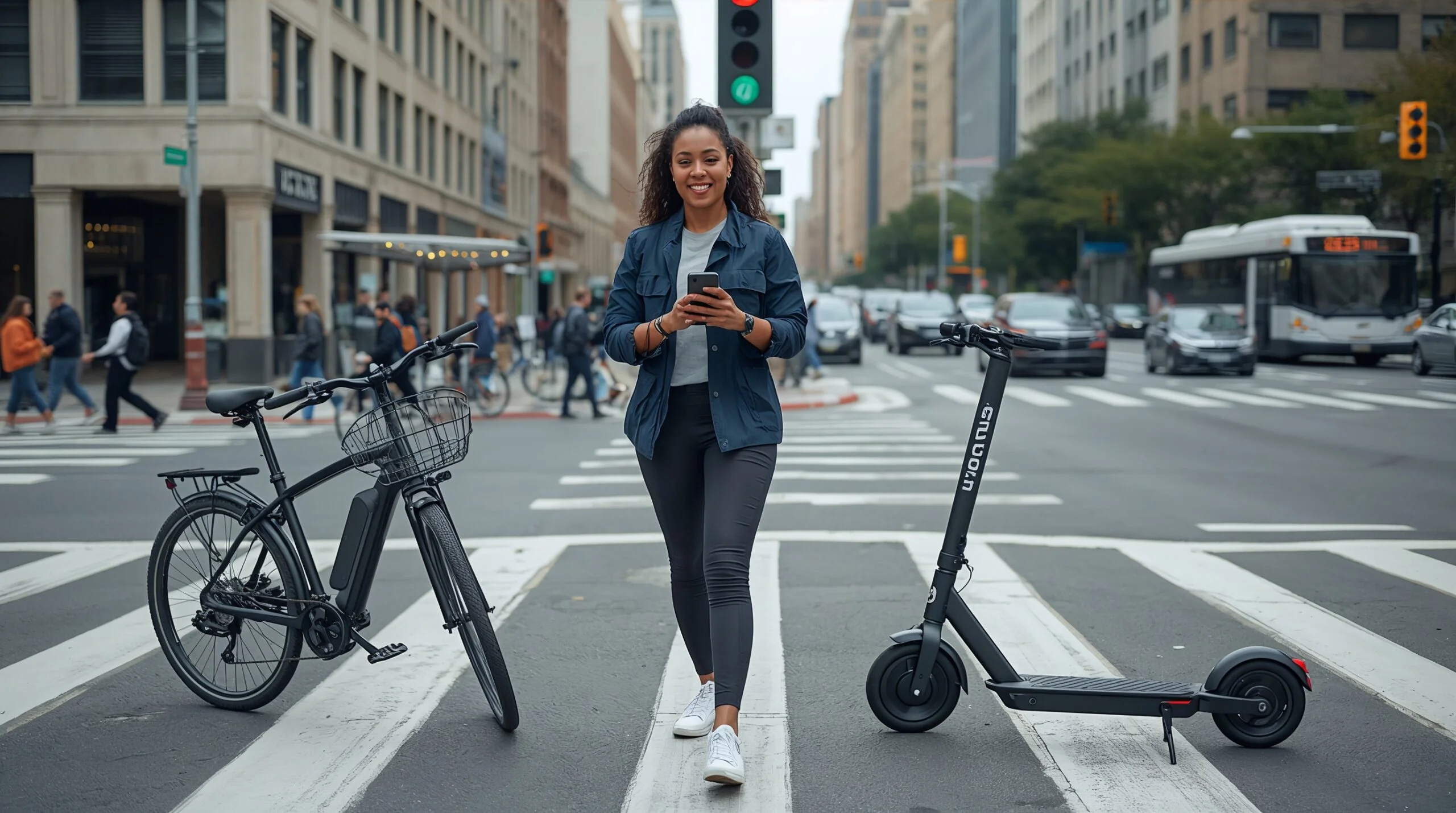
Choose an electric bike if your journey is longer, hilly, rough, or requires regular cargo. Choose an electric scooter if your trips are short, storage is limited, and you frequently need to carry your vehicle upstairs or onto public transportation.
For most buyers, three facts decide the answer: the condition of the route, how often the vehicle must be lifted, and how long each ride lasts.
Scope: This guide compares electric bicycles with stand-up electric kick scooters. It does not cover mobility scooters, seated motor scooters, or electric mopeds.
Electric Bike vs Scooter: Quick Comparison
| Your situation | Better starting choice |
|---|---|
| Longer direct commute | Electric bike |
| Short last-mile trip | Electric scooter |
| Frequent or steep hills | Electric bike |
| Rough pavement | Electric bike |
| Public transportation connection | Electric scooter |
| Daily stair carrying | Lightweight scooter |
| Longer riding time | Electric bike |
| Groceries or work equipment | Electric bike |
| Very limited storage | Electric scooter |
| Continuing after the battery dies | Electric bike |
| Lowest initial price | Usually a scooter |
| Simplest long-term ownership | Depends on brand support |
These are category-level patterns, not guarantees. A heavy performance scooter may be harder to carry than a folding e-bike, while a weak or poorly fitted e-bike may not suit a demanding route.
The Three Questions That Usually Decide

1. What does your route look like?
Choose an e-bike when the route is longer, hilly, windy, or uneven.
Choose a scooter when it is short, relatively flat, and mostly smooth.
2. How often must you lift the vehicle?
Choose an e-bike when you can roll it directly into storage and rarely need to lift it.
Choose a lightweight scooter when stairs, trains, office entry, or indoor storage make carrying unavoidable.
3. How long will you ride continuously?
Choose an e-bike when you expect to ride for more than about 20–30 minutes at a time.
A scooter can work well for shorter last-mile segments where compactness matters more than seated comfort.
If those answers point in different directions, keep reading. Range, road quality, repair access, and charging may break the tie.
Which One Fits Your Complete Commute?

Do not compare only the riding portion. Consider everything between leaving home and storing the vehicle at your destination.
Choose an electric bike when…
An e-bike is usually the stronger option when your commute includes:
- Longer distances
- Repeated hills
- Broken pavement
- Regular cargo
- Headwinds
- Extended riding time
- Few charging opportunities
- A need to continue by pedaling
A seated position, larger wheels, bicycle gearing, and cargo accessories make e-bikes adaptable to more demanding journeys.
Choose an electric scooter when…
A scooter is normally better when:
- The trip is short.
- The surface is smooth.
- A train or bus is part of the journey.
- Storage space is extremely limited.
- You must bring the vehicle indoors.
- You carry little more than a backpack.
A scooter’s main advantage often appears after the riding stops: at the station, elevator, doorway, desk, or apartment.
When either can work
Either category may suit a short, flat journey with secure storage and suitable riding infrastructure.
The decision may then depend on:
- Sitting versus standing
- Whether you want to pedal
- Actual vehicle weight
- Cargo requirements
- Local repair support
- Confidence during a test ride
When neither is the right choice yet
Delay the purchase when:
- The route lacks a reasonably safe place to ride.
- The vehicle is prohibited on an essential part of the journey.
- You cannot comfortably control or lift it.
- Battery or charger documentation is unclear.
- You lack a suitable charging location.
- Replacement parts are unavailable.
- No local business will service the product.
A conventional bicycle, folding bicycle, walking, or public transportation may solve the trip more effectively.
Will It Complete Your Trip?

An e-bike usually offers more range flexibility because the rider contributes energy and can normally continue pedaling after the motor stops assisting.
That does not mean every e-bike travels farther than every scooter. Real range depends on the product, route, rider, and conditions.
Advertised range is not guaranteed range
Published estimates may assume:
- Flat ground
- Moderate speed
- Warm temperatures
- Correct tire pressure
- A lighter rider
- Low assistance
- Minimal stopping
- No cargo
Hills, higher speeds, frequent acceleration, cold weather, headwinds, load, and battery age can all reduce range.
Treat a claimed range as a comparison input, not a promise.
What happens when the battery dies?
An e-bike can normally still be pedaled. A heavy model may feel slow or difficult without assistance, but it usually retains a way to move under human power.
A scooter generally has to be pushed. Kicking may work for a short distance, but deck height and vehicle weight can make it impractical.
“Foldable” also does not mean “easy to carry.”
Keep a reserve
Do not choose a vehicle whose claimed maximum barely matches your normal trip.
Use this planning rule:
Required planning range = normal round-trip distance + reserve for hills, weather, detours, and battery aging
For example, a rider with a 12-mile round trip should not depend on a product that promises only 12 miles under ideal conditions.
Example: a longer hilly commute
Hypothetical situation: Maria travels eight miles each way across rolling hills and sometimes carries groceries.
She has ground-floor storage and rarely needs to lift the vehicle. An e-bike is the stronger choice because range resilience, hills, comfort, and cargo matter more than compactness.
Which Gets You There Faster?

Top speed does not determine total travel time.
Compare:
- Advertised maximum speed
- Motor-assistance or factory limit
- Speed permitted on the route
- Average moving speed
- Complete door-to-door time
A faster vehicle may still produce a longer journey if it is difficult to park, lock, fold, or carry.
Count every stage
Include time spent:
- Unlocking
- Folding
- Carrying
- Parking
- Locking
- Waiting for elevators
- Entering stations
- Changing trains or buses
- Walking from storage to the destination
An e-bike may be faster and more comfortable during a direct commute. A scooter may save more time during a short journey connected to transit.
Example: a train connection
Hypothetical situation: David rides 1.5 miles to a station, takes a train, and rides another half mile to work.
A lightweight scooter may create the faster complete journey because it is easier to fold, carry, and store—even if an e-bike would be more comfortable while moving.
Which Handles Hills and Rough Streets Better?

An electric bike usually has the advantage on hills and damaged pavement.
Motor wattage does not tell the full story
Climbing performance also depends on:
- Torque
- Motor design
- Controller programming
- Bicycle gearing
- Total rider and cargo weight
- Battery condition
- Hill grade
- Hill length
- Heat management
A larger advertised wattage does not automatically mean better climbing.
An e-bike rider can combine motor assistance with pedal input and a suitable mechanical gear. A scooter normally relies entirely on its motor and controller.
Some powerful scooters climb well, but the additional battery and motor capacity can make them heavy and inconvenient to carry.
Small wheels change how obstacles feel
CPSC warns that small e-scooter tires can stop abruptly when they encounter objects or uneven surfaces. It advises riders to keep both hands on the handlebars, keep items off them, slow down around bumps, and inspect the vehicle before riding.
Inspect your intended route for:
- Potholes
- Gravel
- Drain covers
- Rail tracks
- Curbs
- Broken pavement
- Construction plates
- Wet leaves
- Hidden surface changes
Larger bicycle wheels do not eliminate these hazards, but they generally encounter the same obstacle less abruptly.
Which Gives You Better Control?

An e-bike commonly provides a more forgiving platform on rough roads. A scooter may feel agile and convenient during short, low-speed rides on smooth surfaces.
Neither category is automatically safe.
Control depends on:
- Vehicle fit
- Tire condition
- Brake performance
- Rider skill
- Speed
- Surface
- Visibility
- Load placement
- Maintenance
NHTSA recommends using a bicycle that fits, checking the brakes, using visible equipment, planning lower-traffic routes where practical, watching for hazards, and riding predictably. These principles are also useful when evaluating a micromobility route.
Test before entering traffic
Practice the following in a quiet area:
- Smooth starts
- Low-speed turns
- Progressive braking
- Emergency stops
- Looking behind without swerving
- Hill starts
- Dismounting
- Avoiding obstacles
A test ride on a safe surface reveals more about control than a specification sheet.
Which Is More Comfortable?

For longer journeys, an e-bike normally has the comfort advantage.
A scooter rider remains standing and absorbs vibration through the feet, legs, arms, and torso. An e-bike provides saddle support, although poor fit can still cause discomfort.
Comfort by riding time
| Continuous riding time | Likely pattern |
|---|---|
| Under 10 minutes | Either may work |
| 10–25 minutes | Fit, tires, and road quality matter |
| 25–45 minutes | E-bike usually gains an advantage |
| More than 45 minutes | Seated fit and posture become major factors |
This is a practical decision aid, not medical guidance.
Compare actual equipment as well as categories. A scooter with pneumatic tires and effective suspension may be considerably more comfortable than a rigid model with solid tires. An incorrectly fitted e-bike can remain uncomfortable despite having a seat.
Which Is Easier to Carry and Store?

Scooters generally require less space, but portability involves more than a published weight.
Evaluate:
- Total weight
- Weight distribution
- Folded dimensions
- Carrying points
- Whether the frame locks when folded
- How far it must be carried
- How often it must be lifted
Perform the stair test
Before buying, carry an object of similar weight:
- Through your doorway
- Up your normal stairs
- Along the station route
- Into the intended storage space
- For the same duration as the real trip
Imagine repeating the process in rain, in a crowded station, or after a tiring workday.
Confirm whether the vehicle’s published weight includes its battery.
Example: fourth-floor apartment
Hypothetical situation: Leah has a flat three-mile commute but lives on the fourth floor without an elevator.
An e-bike would be more comfortable during the ride, but daily lifting could make it impractical. A genuinely lightweight scooter may be the better choice if the route is smooth and the model is manageable on the stairs.
Which Costs Less to Own?

A scooter frequently has a lower purchase price. Long-term value depends on the exact product and the support available for it.
Include:
- Vehicle price
- Helmet
- Lock
- Lights
- Cargo accessories
- Assembly
- Tires
- Brake parts
- Routine service
- Replacement charger
- Replacement battery
- Shipping
- Secure storage
- Resale value
Use a complete cost formula
Ownership cost = purchase price + accessories +
+ expected battery and charger costs + security costs − resale value
Avoid unsupported category-wide five-year totals. Use current, product-specific prices and explain your assumptions.
Battery and parts availability can change the answer
Before buying, determine:
- Whether an official replacement battery is sold
- Its current cost
- Whether it ships to your location
- Whether a local shop can diagnose or install it
- Battery-warranty length
- Charger availability
- Whether essential parts are proprietary
A cheap vehicle can become expensive when a minor failure cannot be repaired.
Which Is Easier to Maintain and Repair?

An e-bike contains more familiar mechanical parts. A scooter may look simpler but depend on proprietary assemblies and electronics.
Typical e-bike service areas
- Tires and tubes
- Brakes
- Chain and gears
- Spokes
- Bearings
- Sensors
- Wiring
- Battery mounts
Typical scooter service areas
- Tires
- Brakes
- Folding latch
- Stem
- Bearings
- Controller
- Display
- Wiring
- Charger
- Battery
The eight-point repairability test
Give a product one point for each confirmed statement:
- A local business services the exact brand.
- The manufacturer publishes a parts catalog.
- A replacement battery is available.
- An approved charger is available.
- Tires use an obtainable size.
- The warranty procedure is clear.
- Repair documentation exists.
- Diagnostic help is available.
A higher score does not guarantee reliability. It indicates that the product may be easier to support when something fails.
Contact local repair shops before buying and name the exact model.
How Do You Check Battery and Charger Safety?

Battery safety should be evaluated before purchase, not after a problem appears.
Understand the standards in plain language
- UL 2849 covers electrical systems for e-bikes.
- UL 2272 covers electrical systems for personal e-mobility devices, including stand-up scooters.
- UL 2271 covers batteries used in light electric vehicle applications.
UL explains that UL 2849 examines the e-bike’s electrical drivetrain, battery, and charger as a system. It addresses electrical and fire-related risks, but it does not evaluate whether a rider can maintain control of the vehicle.
Verify the exact model
Check:
- Vehicle label
- Battery label
- Charger label
- Exact model number
- Manufacturer documentation
- Certification listing
A statement such as “made with certified cells” is not necessarily the same as certification of the complete vehicle system.
Use the correct charger
CPSC advises consumers to use the charger supplied with or recommended by the manufacturer, remain present while charging, avoid charging while sleeping or away from home, and use only approved replacement batteries.
Stop using or charging the product if you notice:
- Swelling
- Unusual heat
- Smoke
- Hissing
- Strong odor
- Melted connectors
- Impact damage
- Water intrusion
- Repeated charging failure
Follow the manufacturer’s instructions and appropriate emergency guidance rather than attempting an improvised repair.
Which Is More Practical in Rain?

An e-bike often has a conditional advantage in wet conditions because of its larger wheels and riding platform. The actual tires, brakes, lighting, product instructions, and route still matter more than the category name.
Water-resistant does not mean waterproof
An IP rating describes performance under defined testing conditions. It does not mean the vehicle can be submerged, pressure-washed, or ridden through deep standing water.
Follow the manufacturer’s documented limits.
Use additional caution around:
- Painted markings
- Metal covers
- Leaves
- Mud
- Oil
- Rail tracks
- Puddles
- Hidden potholes
Reduce speed and allow more stopping distance.
After a wet ride, dry the vehicle as directed, inspect the charging port, check the brakes and tires, and avoid charging while connectors may still be wet.
Which Carries More?

An e-bike usually provides more practical cargo capacity through racks, panniers, baskets, frame bags, and approved cargo systems.
Verify both:
- The vehicle’s total payload
- The separate load limit of each rack or basket
A scooter is normally best paired with a properly fitted backpack. Avoid hanging bags from the handlebars because they can interfere with steering and braking; CPSC specifically advises keeping items off scooter handlebars.
Payload includes the rider, clothing, backpack, lock, accessories, groceries, and work equipment.
Additional load can affect:
- Range
- Braking
- Steering
- Acceleration
- Hill performance
- Tire requirements
What Laws Must You Check?

Federal product classification does not tell you everywhere a vehicle may legally be ridden.
Federal law defines a low-speed electric bicycle as a two- or three-wheeled vehicle with fully operable pedals, a motor of less than 750 watts, and a motor-only maximum speed below 20 mph under specified conditions. State and local authorities can separately regulate operation and access.
Before buying, check:
- State classification and equipment rules
- City street, bike-lane, and sidewalk rules
- Trail, park, or campus restrictions
- Transit-operator policies
- Employer, landlord, and building requirements
Look specifically for rules covering:
- Rider age
- Helmet use
- Registration
- Assistance or speed classes
- Road access
- Sidewalk use
- Trail access
- Battery restrictions
- Indoor storage
This is general information, not legal advice. Recheck official sources because local rules can change.
Final Five-Minute Buying Exercise

Before opening another product review, write down these five facts:
- Round-trip distance: Include detours, not just the shortest map route.
- Worst route condition: Record the steepest hill and roughest surface.
- Carrying requirement: Record the vehicle weight you can realistically lift.
- Storage and charging: Identify the exact location.
- Repair option: Name a shop or manufacturer service process.
Then eliminate every model that fails any non-negotiable requirement.
Do not compensate for an unsafe route, unavailable battery, or unmanageable weight by choosing a faster motor.
Final Verdict

Choose an electric bike when distance, hills, rough pavement, seated comfort, cargo, and the ability to pedal matter most.
Choose an electric scooter when the route is short and smooth, storage is limited, transit is part of the journey, and regular carrying is unavoidable.
Choose neither yet when:
- The route is unsafe.
- The vehicle is prohibited.
- Battery documentation is unclear.
- You lack an appropriate charging location.
- You cannot control or carry it comfortably.
- Replacement parts and repairs are unavailable.
The best vehicle is not the one with the most impressive maximum speed or claimed range. It is the one that completes your real trip without creating a larger problem in control, storage, legality, charging, or ownership.
Your next step
Use your five route facts to shortlist no more than three models. Compare their verified weight, usable range, battery documentation, parts availability, and warranty before comparing optional features.
Frequently Asked Questions
Is an electric bike safer than an electric scooter?
Not automatically. E-bikes normally have larger wheels and may handle rough surfaces more forgivingly. Safety still depends on the route, speed, product condition, visibility, and rider skill.
Is a scooter cheaper than an e-bike?
A scooter often costs less initially. Long-term cost depends on tires, service, replacement batteries, parts availability, warranty, and resale value.
Which is better for a five-mile commute?
An e-bike is usually better when the route is hilly, rough, or cargo-heavy. A scooter may be better when the route is smooth and the vehicle must be carried onto transit or upstairs.
Which is easier to carry upstairs?
Usually a lightweight scooter. Some performance scooters weigh more than folding e-bikes, so verify the exact weight and test an equivalent load.
Can an e-bike work when the battery dies?
Usually, yes. It can normally be pedaled, although its weight and drivetrain may make riding more difficult.
Do e-bikes and scooters follow the same laws?
No. State, city, trail, transit, campus, and building rules can classify and regulate them differently. Check current official sources for every part of the intended trip.
Editorial methodology
This guide provides a category-level decision framework based on route conditions, ownership requirements, official U.S. safety guidance, relevant electrical-system standards, and federal product law.
It does not claim that every electric bike or scooter performs the same way, and no individual products were physically tested for this article. Product specifications, certification, local laws, prices, and parts availability should be verified before publication and purchase.
Last reviewed: July 24, 2026
Pingback: How E-Bikes Affect Urban Mobility: When They Cut Car Trips—and When They Don’t - electricscootercar.com
Pingback: Autonomous Micromobility: Uses, Safety & Real-World Limits - electricscootercar.com
Comments are closed.