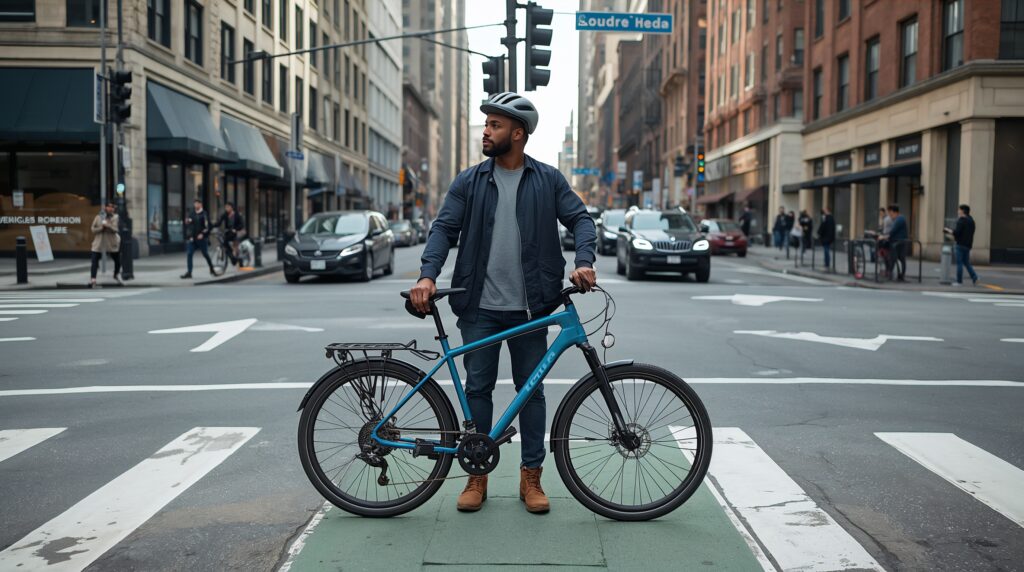
Electric bikes are vehicles, and qualifying e-bikes can also be legally treated as bicycles. A compliant low-speed e-bike is not considered a motor vehicle for federal motor-vehicle safety standards. State and local laws determine whether you need a license or registration, where you may ride, and which helmet, age, or access rules apply.
The answer at a glance
- Is an electric bike a vehicle? Yes.
- Can it still be legally classified as a bicycle? Yes.
- Does an electric motor automatically make it a motor vehicle? No.
- Do the same rules apply throughout the United States? No.
- Can a state require a license or registration? Yes.
What this means for you: The words “electric bike” on a product page do not settle its legal category. Check the bike’s pedals, motor rating, assisted speeds, throttle, operating modes, class label, and modification history. Then check the rules where you plan to ride.
This guide was researched on July 24, 2026. It provides general U.S. legal information, not legal advice.
How Can an E-Bike Be Both a Vehicle and a Bicycle?

A bicycle is a type of vehicle. The two labels are not opposites.
An electric bicycle can have four different but related classifications:
- Physical design: It has bicycle-style wheels, pedals, and controls.
- Federal product category: It may meet the federal definition of a low-speed electric bicycle.
- State vehicle category: A state may classify it as an electric bicycle, bicycle, moped, motorized bicycle, or another vehicle.
- Local access category: A city, park, or trail manager may decide whether it is permitted in a particular place.
This explains how both of these statements can be correct:
- “An electric bike is a vehicle.”
- “This electric bike is regulated like a bicycle.”
The more useful question is: Which category applies to the specific rule you are checking?
What Is the Federal Definition of a Low-Speed Electric Bicycle?

Under federal law, a low-speed electric bicycle is a two- or three-wheeled vehicle with:
- Fully operable pedals
- An electric motor of less than 750 watts
- A maximum speed of less than 20 mph on a paved, level surface when powered solely by the motor under the statute’s test conditions
The test specifies a 170-pound operator. Qualifying products are covered by CPSC bicycle requirements.
Why “motor-only speed” matters
The federal definition does not say that an e-bike can never travel faster than 20 mph.
It refers to speed when the bicycle is powered solely by its motor. A rider may travel faster by pedaling, descending a hill, or carrying momentum. Some states also recognize higher-speed pedal-assist categories.
These specifications are therefore different:
- Motor-only cutoff
- Pedal-assist cutoff
- Total speed reached while riding
A product description that only says “top speed: 20 mph” may not provide enough information to classify the bike accurately.
Is an Electric Bike a Motor Vehicle?

A qualifying federal low-speed electric bicycle is not considered a motor vehicle for federal motor-vehicle safety standards. It is regulated as a bicycle product rather than under the federal safety standards applied to cars and motorcycles.
That does not mean every device advertised as an e-bike qualifies.
A state may place a device in another category when it:
- Has no fully operable pedals
- Exceeds an applicable power limit
- Provides motor-only assistance beyond an allowed speed
- Provides pedal assistance beyond a state limit
- Has been modified or derestricted
- Has motorcycle-style design or performance
- Does not satisfy the state’s electric-bicycle definition
Depending on the device and jurisdiction, it may instead be treated as a moped, motorized bicycle, motorcycle, off-highway vehicle, electric dirt bike, or another motorized device.
Common mistake: A device that falls outside the federal low-speed definition does not automatically become a motorcycle in every state. The replacement category depends on its design and the applicable state law.
Which Laws Actually Control Your Ride?

The easiest way to avoid confusion is to separate product rules from riding rules.
Federal law covers the product
Federal law establishes the low-speed electric bicycle product category. CPSC bicycle requirements apply to qualifying products.
Federal status does not create one nationwide answer for bike lanes, sidewalks, registration, licenses, helmets, or trails.
State law covers most road operation
Two State Examples That Show Why the Answer Changes
- The electric-bicycle definition
- Whether Class 1, 2, and 3 are recognized
- Roadway rights and duties
- License and registration requirements
- Helmet and age rules
- General bicycle-facility access
NCSL reports that 44 states and Washington, D.C., define electric bicycles in some form, while 26 states use a three-tier classification system. Other states use different definitions or older motorized-vehicle categories.
Local rules cover particular places
Depending on state law, cities, counties, parks, and trail managers may regulate:
- Sidewalks
- Shared-use paths
- Parks
- Beaches
- Greenways
- Natural-surface trails
- Local riding speeds
An e-bike may therefore be legal on a state roadway but prohibited on a specific local trail.
Two State Examples That Show Why the Answer Changes

Florida: A vehicle that receives bicycle treatment
Florida law says an electric bicycle is a vehicle to the same extent as a bicycle. It gives e-bike riders the rights and duties of bicyclists while exempting qualifying e-bikes from requirements involving driver or motor-vehicle licenses, registration, titles, and financial responsibility.
Florida also permits local authorities and land managers to restrict e-bikes on certain streets, sidewalks, paths, trails, beaches, and dunes.
What this shows: Calling an e-bike a vehicle does not necessarily make it a licensed and registered motor vehicle. Bicycle treatment also does not guarantee access everywhere.
New Jersey: Registration and licensing exemptions are not universal
New Jersey’s new e-bike requirements took effect in July 2026. Riders generally must be at least 15 and have either an e-bike license or a valid driver’s license. E-bikes must also be registered with the New Jersey Motor Vehicle Commission. Low-speed electric bicycles do not require insurance, although motorized bicycles do.
New Jersey also instructs out-of-state riders bringing their own e-bikes into the state to meet its licensing and registration requirements.
What this shows: “E-bikes never need a license or registration” is not a reliable nationwide answer.
Where Do Class 1, Class 2, and Class 3 Fit?

The three-class system is common, but it is not a federal classification.
| Class | Common model definition |
|---|---|
| Class 1 | Pedal assistance only, ending at 20 mph |
| Class 2 | Motor may propel the bicycle without pedaling, ending at 20 mph |
| Class 3 | Pedal assistance only, generally ending at 28 mph |
The exact definitions and restrictions must still be checked under state law.
New York illustrates why. Its Class 3 category applies only within a city with at least one million residents, allows motor-only propulsion, and ends assistance at 25 mph. That differs from the common 28 mph pedal-assist model.
A manufacturer’s class label is useful evidence, but it is not the final legal answer in every jurisdiction.
Does a Throttle Make an E-Bike a Moped?

Not automatically.
The federal definition measures the bicycle’s performance under motor-only power. Throttle capability therefore does not by itself exclude a bike from the federal low-speed electric bicycle category.
States using the common Class 2 model may permit a motor to propel the bicycle without pedaling until it reaches the applicable cutoff.
A throttle becomes a classification concern when:
- It continues propelling the bike beyond the permitted speed
- It operates in a class that does not permit motor-only propulsion
- Its settings or controller have been modified
- The bike lacks functional pedals
- The device exceeds another applicable requirement
The throttle is one part of the classification—not the entire test.
When Can a Modification Change the Category?

The bike’s current capabilities matter more than the specifications it had when it left the factory.
Potentially relevant changes include:
- Removing a speed limiter
- Reprogramming a controller
- Installing different firmware
- Replacing the motor
- Increasing battery voltage
- Altering throttle behavior
- Removing or disabling pedals
- Changing operating modes
- Removing or failing to update the class label
Florida, for example, prohibits changing an e-bike’s motor-powered speed capability or motor engagement without replacing its required classification label after the modification.
A slower mode is not proof of compliance
Some bikes offer a limited mode alongside faster sport, unlocked, or off-road modes.
Do not classify the device from its slowest selectable mode alone. Check what the bike is capable of doing, how the relevant state definition is written, and whether the higher mode can be readily selected while riding.
Buying a used e-bike
Before purchasing a used bike, ask for:
- Its original specification sheet
- The owner’s manual
- Motor and controller details
- The class label
- Its modification history
- Details of app or firmware changes
- Current motor-only and pedal-assist cutoff speeds
Classify the bike being sold today—not merely the original model described on an old product page.
What Rules Could You Face?

License, registration, and insurance
Many states exempt qualifying e-bikes from these requirements, particularly states using the typical three-class system. The exemption is not nationwide.
Check:
- The state’s electric-bicycle definition
- The bike’s actual specifications
- Whether a license or permit is required
- Whether registration is required
- Whether insurance applies to the category
Helmet and age rules
Requirements may vary according to the state, class, rider’s age, passenger’s age, and riding location.
Do not assume that the rule for an adult on a Class 1 bike also applies to a minor riding a Class 3 bike.
Bike lanes and sidewalks
A state may allow e-bikes where bicycles are permitted while giving cities authority to restrict sidewalk or path operation.
Check both the statewide traffic rule and the local ordinance.
Parks and trails
Parks, beaches, forests, and natural-surface trails often have separate land-manager rules.
Confirm the policy for the exact facility rather than assuming state bicycle treatment guarantees access.
Riding with the motor turned off
Most e-bikes can physically be pedaled with assistance disabled. Their weight and drivetrain may make this harder than riding a conventional bicycle.
Turning off the motor does not necessarily change the legal category. A restriction may apply to the device itself rather than to its temporary operating mode.
Check Your E-Bike in 7 Steps

1. Confirm the pedals are fully operable
The pedals should be present and capable of propelling the bike. Decorative, disconnected, or unusable pedals may not satisfy the applicable definition.
2. Record the motor rating
Use the motor label and manufacturer documentation. Do not rely only on a retailer’s headline or model name.
3. Find both assistance cutoffs
Record:
- The speed at which motor-only propulsion stops
- The speed at which pedal assistance stops
These are not necessarily the same.
4. Check the throttle
Determine whether it:
- Works from a standstill
- Requires initial pedaling
- Stops at a defined speed
- Continues past the labeled class limit
- Has been modified or reprogrammed
5. Check the label and every riding mode
Record the stated class, motor wattage, and assisted speed.
Then check standard, sport, off-road, unlocked, or app-controlled modes. Do not classify the bike from one limited mode while ignoring its other capabilities.
6. Identify modifications
Review the motor, controller, firmware, battery voltage, speed limiter, throttle, pedals, and class label.
7. Check the state and exact riding location
Use current official sources from the:
- State legislature
- Motor-vehicle agency
- Transportation department
- City or county
- Park or trail manager
A retailer, forum post, or outdated national chart should not be the final authority.
Frequently Asked Questions

Is a 750-watt e-bike automatically legal?
No. Federal law refers to a motor of less than 750 watts, and wattage is only one part of the test. Pedals, motor-only speed, pedal-assist speed, throttle behavior, modifications, state definitions, and location may also matter.
Is a Class 3 e-bike still a bicycle?
It may be an electric bicycle under the applicable state definition, but the class definition and operating restrictions vary. New York’s Class 3 category, for example, differs from the common model definition.
Can an electric dirt bike qualify as an e-bike?
Not merely because it has an electric motor or pedal-like equipment. Its functional pedals, power, speed, design, operating modes, and state classification must all be checked.
Does removing a speed limiter change the class?
It can. Increasing the bike’s motor-only or pedal-assisted capability may move it outside the specifications supporting its original class or legal category.
Which law applies when traveling?
Follow the rules where the bike is being operated. A class label, exemption, or permission from the owner’s home state does not automatically apply in another jurisdiction. New Jersey’s requirements for visiting riders provide a current example.
Final Answer

An electric bike can be both a vehicle and a bicycle. A qualifying low-speed electric bicycle is not considered a motor vehicle under federal motor-vehicle safety law, but that federal status does not create one nationwide riding rule.
State law determines most classification, licensing, registration, helmet, age, and roadway requirements. Local rules may determine whether the bike is allowed on a particular sidewalk, path, park, beach, or trail.
Before your next ride:
- Photograph the class and motor labels.
- Record the motor-only and pedal-assist cutoff speeds.
- Check the current official state rule and the policy for the exact place where you will ride.
Those three actions provide a more reliable answer than the product name alone.
Pingback: How Fast Do Electric Bikes Go? 20 vs 28 MPH - electricscootercar.com
Pingback: What Is a Throttle on an Electric Bike? How It Works - electricscootercar.com
Pingback: Electric Bike vs Scooter: Which Is Better for Your Commute? - electricscootercar.com
Pingback: Do Electric Bikes Need a License? 2026 U.S. Rules by State - electricscootercar.com
Pingback: How E-Bikes Affect Urban Mobility: When They Cut Car Trips—and When They Don’t - electricscootercar.com
Comments are closed.