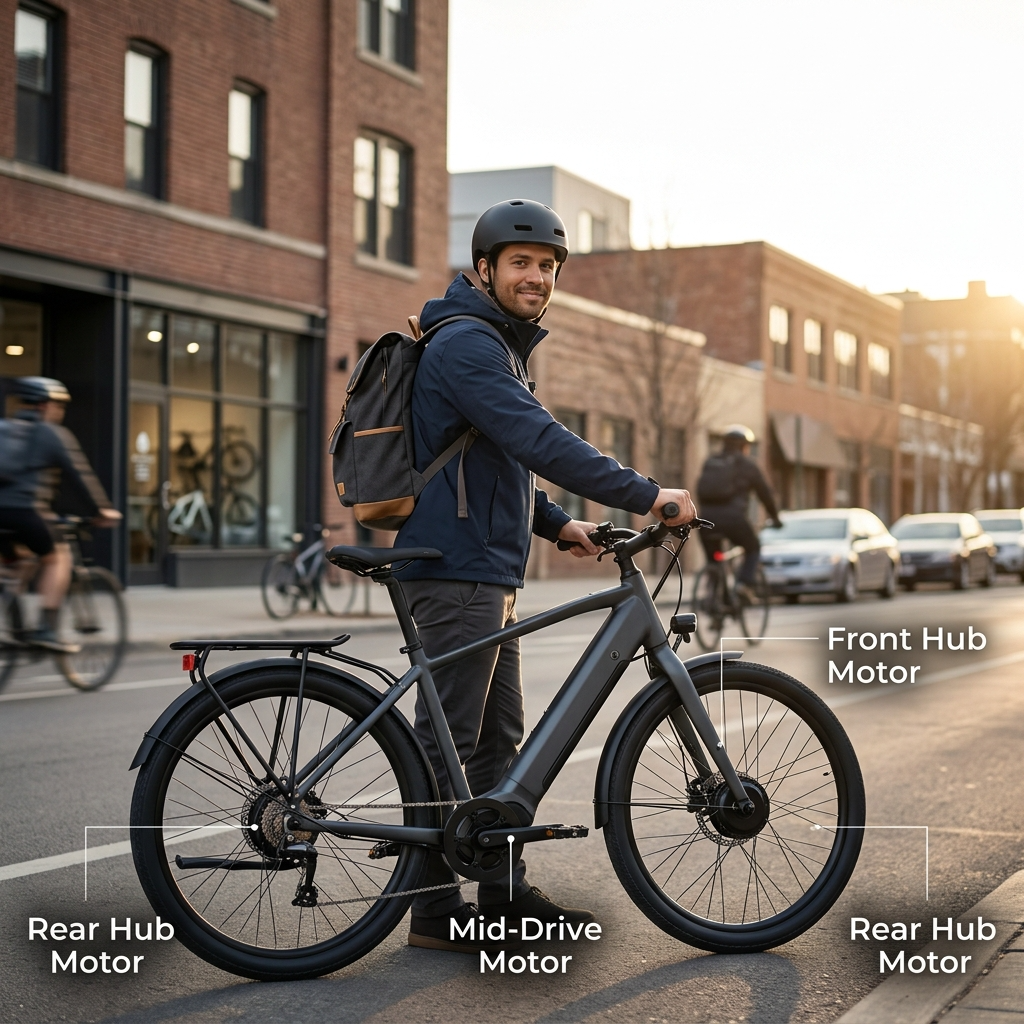
Choosing an e-bike is easier when you understand the motor.
The motor affects how the bike feels when you start from a stop, climb a hill, carry groceries, ride in traffic, or cruise on a bike path. It also affects price, maintenance, battery use, and long-term reliability.
This guide breaks down the main electric bike motor types explained in simple language, with practical examples for USA riders.
Quick Answer: Which E-Bike Motor Type Is Best?

For most everyday riders, a rear geared hub motor is the best value. It works well for commuting, errands, bike lanes, paved paths, and moderate hills.
For riders who deal with steep hills, cargo, child seats, or trail riding, a mid-drive motor is usually the better choice.
Here is the simple version:
| Rider need | Best motor type | Why it fits | Avoid if |
|---|---|---|---|
| Flat city commute | Rear hub motor | Simple, affordable and smooth for paved roads | You climb steep hills daily |
| Budget-friendly e-bike | Rear geared hub motor | Good value, lighter feel and better low-speed help | You carry heavy cargo often |
| Steep hills | Mid-drive motor | Uses the bike’s gears for stronger climbing | You want the lowest purchase price |
| Cargo or child seat | Mid-drive motor | Better low-speed torque and control with weight | You ride only short flat routes |
| Smooth flat cruising | Direct drive hub motor | Quiet, smooth and durable for steady riding | You need quick hill acceleration |
| Trail or off-road riding | Mid-drive motor | Better balance and control on changing terrain | You want simple wheel maintenance |
| Simple casual riding | Hub motor | Easy to use and usually lower maintenance | You need premium hill performance |
Understanding E-Bike Motors
What an Electric Bike Motor Does
An e-bike motor helps move the bike forward by adding power to your pedaling, throttle, or both, depending on the bike.
On most e-bikes, the motor works with:
- Battery: stores the electrical energy
- Controller: manages how much power goes to the motor
- Sensors: detect pedaling, speed, or pedal pressure
- Display: lets you choose assist levels
When you pedal, the system adds support based on the assist level you choose. On some e-bikes, a throttle can move the bike without pedaling.
The motor does not replace good bike handling. You still need to steer, brake, shift properly, and ride within safe speeds.
Why Motor Type Matters for Riders in the USA
Motor type matters because USA riders use e-bikes in very different ways.
A rider in a flat Florida suburb may care more about smooth cruising and low maintenance. A commuter in San Francisco, Seattle, Pittsburgh, or Denver may need better hill-climbing power. A parent carrying a child seat or groceries may care more about low-speed torque than top speed.
Motor type also connects to e-bike class rules. Many U.S. states use a three-class system: Class 1, Class 2, and Class 3. Class 1 generally means pedal assist up to 20 mph, Class 2 includes throttle assistance up to 20 mph, and Class 3 generally means pedal assist up to 28 mph. State and local access rules can still vary, especially on paths, parks, and trails.
At the federal product-safety level, a low-speed electric bicycle is defined as a two- or three-wheeled vehicle with fully operable pedals, an electric motor of less than 750 watts, and motor-onlyspeed under 20 mph under the stated test condition.
For buyers, the practical point is simple: do not choose only by wattage. Look at motor type, torque feel, bike weight, brakes, battery quality, and where you actually ride.
Torque Sensor vs Cadence Sensor: Why Ride Feel Changes
Motor type is not the only thing that changes how an e-bike feels. The sensor system also matters.
A cadence sensor checks whether you are pedalling. When it detects pedal movement, it turns motor assist on. This can feel simple and easy, but sometimes the power feels less natural.
A torque sensor measures how hard you press on the pedals. The harder you pedal, the more help the motor gives. This usually feels smoother, more natural and easier to control on hills, in traffic and when carrying cargo.
| Sensor type | How it works | Ride feel | Best for | Watch out for |
|---|---|---|---|---|
| Cadence sensor | Detects pedal movement | More on/off assist feel | Budget e-bikes, casual riding, flat commuting | Can feel less natural in tight traffic or hills |
| Torque sensor | Measures pedal pressure | Smooth, natural and responsive | Hills, cargo, premium commuting, riders who want bicycle-like control | Usually increases bike cost |
Simple rule: If you want the lowest price and easy cruising, a cadence sensor can be fine. If you want smoother control, better hill feel and a more natural ride, choose an e-bike with a torque sensor.
Main Electric Bike Motor Types

Most e-bikes use one of two motor placements:
- Hub motor: motor inside the front or rear wheel hub
- Mid-drive motor: motor near the pedals at the center of the bike
Both can work well. The better choice depends on your riding conditions.
Hub Motors
A hub motor sits inside the wheel hub. It directly powers the wheel.
Hub motors are common on commuter e-bikes, budget e-bikes, folding e-bikes, cruiser e-bikes, and many throttle-equipped models.
Front Hub Motors
A front hub motor powers the front wheel.
This setup is simple and can be affordable, but it is less common on higher-quality modern e-bikes because the front wheel has less traction under acceleration. On loose gravel, wet pavement, or steep climbs, the front tire can feel less planted.
Best for:
Flat city rides, simple conversion kits, light commuting, casual use.
Watch out for:
Reduced front-wheel traction, especially on wet roads or loose surfaces.
Rear Hub Motors
A rear hub motor powers the rear wheel.
This usually feels more natural than a front hub motor because bicycles already put more rider weight over the rear wheel. Rear hub motors are popular because they are simple, reliable, and often less expensive than mid-drive systems.
Best for:
Daily commuting, neighborhood riding, paved paths, budget-friendly e-bikes, riders who want simple maintenance.
Watch out for:
Rear-wheel removal can be more complicated because of the motor wiring.
Geared Hub vs Direct Drive Hub Motor

Not all hub motors feel the same. The two common types are geared hub motors and direct drive hub motors.
Geared Hub Motors
A geared hub motor uses internal gears to multiply torque.
That means it can feel quick from a stop and more helpful on small to moderate hills. Geared hubs are usually lighter than direct drive hubs and are common on commuter, folding, and city e-bikes.
Pros:
- Good low-speed acceleration
- Better hill help than many direct drive hubs
- Usually lighter
- Often efficient for stop-and-go city riding
Cons:
- Internal gears can wear over time
- Slight motor noise is possible
- Not ideal for every heavy-load or high-speed use case
For a rider doing a 5–12 mile commute with traffic lights, bike lanes, and occasional hills, a geared rear hub motor often makes practical sense.
Direct Drive Hub Motors
A direct drive hub motor has fewer internal moving parts. The wheel hub is part of the motor itself.
These motors are usually larger and heavier. They can be very smooth and durable, especially for steady cruising. Some direct drive systems can support regenerative braking, although the real-world battery recovery on e-bikes is usually modest.
Pros:
- Smooth and quiet
- Fewer internal wear parts
- Good for steady riding
- Can handle sustained cruising well
Cons:
- Heavier
- Often weaker from a stop compared with geared hubs
- Can feel less efficient on steep hills
- Adds more wheel weight
For flat roads, long straight commutes, or riders who value smoothness over punchy hill climbing, a direct drive hub can work well.
Mid-Drive Motors
A mid-drive motor sits near the pedals, usually around the bottom bracket.
Instead of directly spinning the wheel, it sends power through the bike’s chain or belt drivetrain. This allows the motor to use the bike’s gears.
That is the biggest advantage.
When you shift into an easier gear on a hill, the motor also benefits from that easier gear. This makes mid-drive motors strong for climbing, cargo hauling, and efficient riding over changing terrain.
Why Riders Like Mid-Drive Motors
Mid-drive motors usually feel more balanced because the motor weight is low and centered.
That helps the bike feel stable when turning, climbing, or carrying weight. This is why many premium commuter bikes, electric mountain bikes, trekking e-bikes, and cargo e-bikes use mid-drive motors.
Best for:
- Hilly cities
- Long commutes with changing terrain
- Cargo e-bikes
- Electric mountain bikes
- Riders who want a natural pedaling feel
Watch out for:
- Higher purchase price
- More wear on chain, cassette, or belt system
- More need to shift correctly
- Repairs maycost more than hub motor repairs
A mid-drive motor is not automatically “better” for every rider. It is better when you need climbing ability, balance, and efficient use of gears.
For a flat 3-mile ride to work, it may be more motor than you need.
Beginner Tip for Mid-Drive Motors
Mid-drive e-bikes work best when you shift gears like you would on a normal bike.
Before a hill, shift into an easier gear. Avoid shifting under heavy motor load if possible. This helps the motor work efficiently and reduces stress on the chain and cassette.
Electric Bike Motor Types Compared

Hub Motor vs Mid-Drive E-Bike Motor
The hub motor vs mid-drive eBike motor decision is one of the most important choices.
Here is the simple version:
Choose a hub motor if you want:
- Lower cost
- Simple commuting
- Less drivetrain wear
- Throttle-friendly riding
- Easy cruising on flat or moderate terrain
Choose a mid-drive motor if you want:
- Better hill climbing
- Better weight balance
- More natural pedal feel
- Better performance with cargo
- Better control on trails or steep roads
A hub motor pushes or pulls from the wheel. A mid-drive works through the bike’s gears.
That difference matters most on hills. A mid-drive can stay efficient when you shift into a low gear. A hub motor has to work harder directly at the wheel, which can drain the battery faster or heat the motor on long steep climbs.
For a Chicago commuter on mostly flat roads, a rear hub motor may be perfect. For a Seattle rider climbing steep streets every day, a mid-drive will usually feel more confident.
Geared Hub vs Direct Drive Hub Motor: Which Works Best?
A geared hub motor is usually better for everyday city riding with starts, stops, and moderate hills.
A direct drive hub motor is usually better for riders who want smooth, quiet cruising and do not mind extra weight.
City Riding
For traffic lights, stop signs, apartment parking, bike lanes, and short errands, a geared hub is often more practical. It gives better low-speed response and usually keeps the bike lighter.
Suburban Riding
For flatter suburban roads, either can work. A geared hub will feel more responsive. A direct drive hub may feel smoother once moving.
Trail Riding
For real off-road riding, a mid-drive is usually the better choice. Hub motors add weight to the wheel and can feel less controlled on rough surfaces.
Heavy Riders or Cargo
A strong geared hub can handle moderate cargo, especially on flat roads. But for steep hills, frequent heavy loads, or child-carrying cargo bikes, mid-drive motors usually provide better control and climbing performance.
DC vs BLDC Motors

This question can be confusing because BLDC means brushless DC motor.
So when people ask, “which motor is best, DC or BLDC?” they usually mean:
Brushed DC motor vs brushless DC motor.
For modern e-bikes, BLDC motors are generally the better choice.
Why BLDC Motors Are Common in E-Bikes
BLDC motors do not use brushes that physically rub inside the motor. Instead, they use electronic control to manage motor movement.
That usually means:
- Better efficiency
- Less heat
- Longer motor life
- Lower maintenance
- Smoother power delivery
Most modern hub motors and mid-drive motors are brushless DC designs.
Brushed DC motors are simpler, but they are less common in quality e-bikes because brushes wear down over time. For a normal buyer, the practical answer is easy: choose an e-bike with a brushless motor from a reputable brand.
Do Not Judge an E-Bike Motor by Watts Alone
Many beginners compare e-bikes by motor wattage first.
That can be misleading.
A 750W hub motor is not automatically better than a 500W mid-drive motor. Real-world performance depends on:
- Motor placement
- Torque output
- Controller tuning
- Battery voltage
- Bike weight
- Wheel size
- Gear range
- Rider weight
- Hill length and steepness
For hills and cargo, torque and gearing often matter more than peak wattage.
For flat commuting, a moderate-power motor with good battery efficiency may be more useful than a high-watt motor that drains the battery faster.
How to Choose the Right E-Bike Motor

Best Motor Type by Riding Style
For Daily Commuting
A rear geared hub motor is often the best value for normal commuting.
It works well for paved streets, bike lanes, errands, and moderate hills. It also keeps the bike more affordable.
Good choice: rear geared hub motor
Better choice for hills: mid-drive motor
For Steep Hills
Choose a mid-drive motor if hills are part of your daily ride.
This is especially true if you live in a hilly city, carry a backpack, ride with a child seat, or want the bike to feel controlled when climbing.
Good choice: mid-drive motor
Avoid: weak front hub motors on steep or slippery hills
For Cargo and Utility Riding
Cargo e-bikes benefit from strong low-speed torque.
A powerful rear hub can work on flat streets, but a mid-drive is usually better for heavier loads and hills because it uses the bike’s gears.
Good choice: mid-drive motor
Budget option: strong rear geared hub motor
For Casual Weekend Riding
A hub motor is usually enough.
If you ride around the neighborhood, visit parks, cruise beach paths, or make short store runs, you probably do not need a premium mid-drive system.
Good choice: rear hub motor
Simple option: geared hub motor
For Off-Road or Trail Riding
A mid-drive motor usually gives better balance and control.
It keeps the weight centered and works better with the bike’s gears on changing terrain.
Good choice: mid-drive motor
Avoid: heavy direct drive hub motors for technical trails
Safety and Legal Considerations in the USA
Motor type is important, but safety depends on the whole bike.
Pay attention to brakes, tires, frame quality, lighting, battery certification, and local e-bike rules.
Check Your E-Bike Class
Many USA e-bikes are sold as Class 1, Class 2, or Class 3. These classes affect where you may ride, especially on bike paths, trails, parks, and shared-use paths. Electric bike laws differ by state, and access rules can be confusing for riders and retailers.
Federal Definition Is Not the Same as Local Access
Federal rules help define what can be sold as a low-speed electric bicycle. Local riding rules decide where and how you can use it.
That means an e-bike may be legal to sell but still restricted on a certain trail, park path, school campus, or local road.
Before buying a faster Class 3 e-bike, check your state and city rules.
Match Speed With Braking Power
Faster e-bikes need better brakes.
If you ride in city traffic, down hills, or near pedestrians, strong disc brakes are often worth it. Extra motor power is not helpful if the bike does not stop confidently.
Look for Electrical Safety Certification
Battery and charger quality matter.
UL 2849 is a safety standard for e-bike electrical systems. It examines the electrical drivetrain, battery system, and charger system together.
This does not tell you how the bike will handle on the road, but it helps address electrical and fire-safety risk. It is especially important if you charge indoors, live in an apartment, or use the bike daily.
Ride Within Real Conditions
A motor can make a bike feel easier, but it cannot remove risk.
Be extra careful when:
- Starting from a stop in traffic
- Riding in rain
- Going downhill
- Carrying cargo
- Riding near pedestrians
- Turning with a heavy rear hub motor
- Climbing long hills in hot weather
If the motor feels strained, slow down, use a lower assist level, or stop and let the system cool.
FAQs About E-Bike Motors

FAQs About E-Bike Motors
What are the main electric bike motor types?
The main electric bike motor types are front hub motors, rear hub motors, geared hub motors, direct drive hub motors and mid-drive motors. Most modern e-bikes use brushless DC motor technology.
Which e-bike motor type is best for commuting?
For most daily commuters, a rear geared hub motor is the best value. It is simple, affordable and works well on paved roads, bike lanes and moderate hills.
Are mid-drive motors better than hub motors?
Mid-drive motors are better for steep hills, cargo, trail riding and riders who want a natural pedal feel. Hub motors are usually better for simple commuting, lower cost and easier everyday use.
Is a geared hub motor better than a direct drive hub motor?
A geared hub motor is usually better for stop-and-go city riding and moderate hills. A direct drive hub motor is usually better for smooth, quiet cruising on flatter roads.
What is the difference between a torque sensor and a cadence sensor?
A cadence sensor detects whether you are pedalling. A torque sensor measures how hard you press on the pedals. Torque sensors usually feel smoother and more natural, especially on hills or in traffic.
Is 750W always better than 500W?
No. A 750W hub motor is not automatically better than a 500W mid-drive motor. Real performance depends on torque, gearing, controller tuning, bike weight, battery quality and terrain.
Which motor type is best for hills?
A mid-drive motor is usually best for steep hills because it can use the bike’s gears. A strong rear geared hub motor can work on moderate hills, especially for lighter loads.
Which motor type is best for cargo e-bikes?
A mid-drive motor is usually the best choice for cargo e-bikes, child seats and heavier loads because it gives better low-speed control and climbing support.
Do e-bike motors need maintenance?
Hub motors usually need less drivetrain maintenance. Mid-drive motors can add more wear to the chain, cassette or belt system, so correct shifting and regular drivetrain checks are important.
What does BLDC mean on an electric bike?
BLDC means brushless DC motor. Most quality modern e-bikes use brushless motors because they are efficient, smooth and lower maintenance than older brushed motor designs.
What are the different types of eBike motors?
The main types are hub motors and mid-drive motors.
Hub motors sit in the front or rear wheel. Mid-drive motors sit near the pedals and use the bike’s gears. Hub motors are common for commuting and budget e-bikes. Mid-drive motors are common for hills, cargo, premium commuters, and electric mountain bikes.
Which type of motor is used in electric bikes?
Most modern electric bikes use brushless DC motors, often called BLDC motors.
The motor may be placed in the wheel hub or near the pedals as a mid-drive system.
Are mid-drive motors better for hills?
Yes, mid-drive motors are usually better for hills because they use the bike’s gears.
When you shift into an easier gear, the motor can climb more efficiently. This makes mid-drive motors a strong choice for hilly cities, cargo bikes, and trail riding.
Can hub motors handle heavy cargo?
Some hub motors can handle cargo, especially on flat roads.
For frequent heavy loads, steep hills, or child-carrying cargo bikes, a mid-drive motor is usually the stronger and more controlled choice.
What motor type lasts longest?
A quality brushless motor can last a long time, whether it is a hub motor or mid-drive.
Direct drive hub motors have fewer internal moving parts, but the whole bike matters. Battery quality, controller quality, heat management, water resistance, and maintenance habits all affect lifespan.
Which motor is best, DC or BLDC?
BLDC is usually best for e-bikes.
BLDC stands for brushless DC motor. Compared with older brushed DC motors, BLDC motors are typically more efficient, longer-lasting, and lower maintenance.
Quick Summary / Checklist
| Motor Type | Best Use Case | Maintenance Note |
|---|---|---|
| Front hub motor | Flat casual riding, simple conversions | Watch front-wheel traction |
| Rear geared hub motor | Commuting, errands, city riding | Internal gears may wear over time |
| Direct drive hub motor | Smooth cruising, flatter roads | Heavier wheel feel |
| Mid-drive motor | Hills, cargo, trails, premium commuting | More drivetrain wear |
| BLDC motor | Most modern e-bikes | Best general choice over brushed motors |
Fast Buying Checklist
Before choosing an e-bike motor, ask:
- Do I ride mostly flat roads or hills?
- Will I carry groceries, kids, or cargo?
- Do I need throttle assistance?
- Do I want low maintenance or better climbing?
- Are my local paths open to my e-bike class?
- Are the brakes strong enough for the bike’s speed?
- Is the battery and charger system from a reputable, safety-tested brand?
Simple Recommendation
For most USA commuters, a rear geared hub motor is the best value.
For hills, cargo, and off-road riding, a mid-drive motor is usually the better long-term choice.
For modern e-bikes, choose a BLDC motor over an older brushed motor design.
Pingback: Electric Bike Motors Explained: Types, Specs, Problems & Safety Tips - electricscootercar.com
Pingback: How Fast Do Electric Bikes Go? USA Speed Guide - electricscootercar.com
Pingback: Electric Bike Range Explained: Real Miles Per Charge + Calculator - electricscootercar.com
Pingback: Electric Bike Speed Limit USA: 2026 Class & State Rules - electricscootercar.com
Pingback: Electric Bike vs Bicycle: Which One Is Right for You? - electricscootercar.com
Pingback: Electric Bike Components: Every Major Part Explained - electricscootercar.com
Pingback: SEO title: Brushless DC Motor Explained: What Replaces the Brushes and How It Works - electricscootercar.com
Pingback: SEO title: E-Bike Motor Noise: Diagnose Grinding, Clicking & Buzzing - electricscootercar.com
Pingback: SEO title: What Is a Hub Motor on an E-Bike? How It Works and What Changes on the Road - electricscootercar.com
Pingback: SEO title: What Is RPM on an E-Bike? Motor vs Wheel vs Cadence Explained - electricscootercar.com
Pingback: SEO title: Lightweight E-Bike Frame Materials: Best Choices & Future Tech - electricscootercar.com
Pingback: SEO Title: Does Rider Weight Affect E-Bike Performance? Range, Speed & Hills - electricscootercar.com
Pingback: Do Electric Bikes Need a License? 2026 U.S. Rules by State - electricscootercar.com
Pingback: Brushless DC Motor Explained: What Replaces the Brushes and How It Works - electricscootercar.com
Comments are closed.