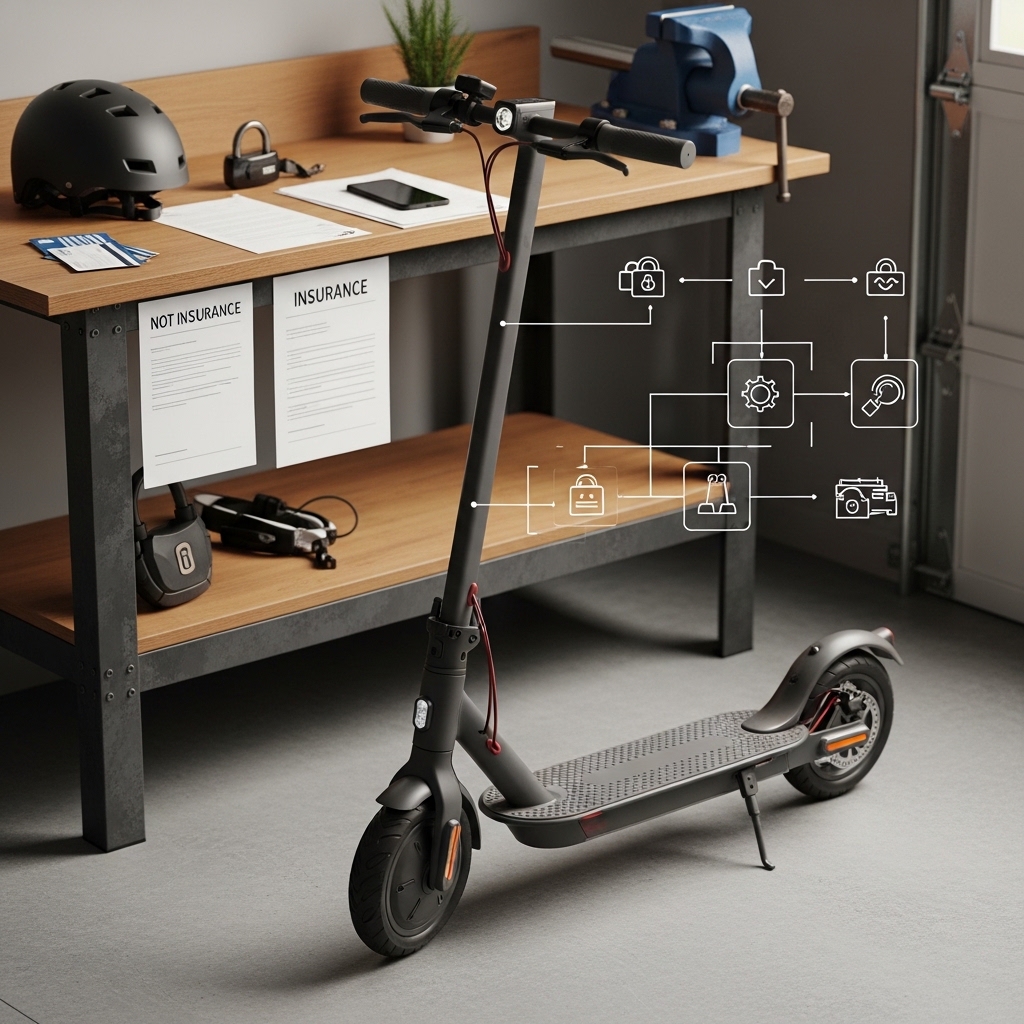
Do electric scooters need insurance in the USA? For many low-speed stand-up electric scooters, insurance is not legally required. However, the answer depends on your state, the scooter’s legal classification, and how you use it.
A regular stand-up electric scooter is not necessarily treated the same way as an electric moped or motorcycle. Different rules can apply to registration, licensing, and insurance.
Even when insurance is optional, riding without appropriate protection can expose you to expensive losses. A stolen scooter, an accident involving a pedestrian, or damage to someone else’s vehicle could cost far more than you expect.
The important question is not only whether the law requires insurance. It is also whether your existing policies would protect you financially if something went wrong.
This guide explains electric scooter insurance requirements in the USA, available coverage types, insurance costs, theft protection, state-specific rules, and how to find a policy that actually covers your scooter.
Do You Need Insurance for an Electric Scooter in the USA?

There is no single insurance rule covering every electric scooter across all 50 states.
In many states, ordinary stand-up electric scooters are regulated as micromobility devices rather than conventional motor vehicles. Qualifying devices may therefore be exempt from standard motor vehicle insurance requirements.
However, that exemption does not necessarily apply to every model sold as an electric scooter.
The legal answer depends on several factors:
- Your state and local laws
- The scooter’s design and legal classification
- Maximum speed and other technical specifications
- Whether it is a stand-up scooter or a road-going moped
- Whether it is privately owned or rented
- Whether you ride for personal or commercial purposes
Stand-up electric scooters
A typical stand-up electric scooter has a deck, handlebars, wheels, and an electric motor. These scooters are commonly used for commuting, short neighborhood trips, and urban transportation. Our guide to the benefits and limitations of scooter commuting gives more context on those everyday uses.
Many states have established separate rules for qualifying devices.
In those states, owners may not need the same registration or liability insurance required for cars and motorcycles.
However, local operating restrictions can still apply.
For instance, a city may restrict where scooters are ridden, impose age requirements, or regulate rental operators even when the state does not require individual riders to purchase vehicle insurance.
For a broader explanation of licensing and registration requirements, see our electric scooter license laws by state.
Electric mopeds and motorcycle-style scooters
Some electric scooters resemble small motorcycles or mopeds. They may have larger motors, seats, higher operating speeds, or different construction.
Depending on state law, these vehicles may be classified as mopeds, motor-driven cycles, motorcycles, or another vehicle category.
That distinction matters because some classifications require insurance, registration, or a specific driver’s license.
A seat alone does not determine the classification. State definitions may consider several characteristics together.
Before purchasing insurance, identify how your state legally classifies your exact scooter model.
Is insurance necessary if the law does not require it?
Legal requirements and financial protection are separate issues.
Consider two situations.
A rider owns a $400 scooter and uses it occasionally on permitted neighborhood routes. The owner may decide to pay personally for theft or damage rather than purchasing physical-damage insurance.
Another rider owns a $2,000 commuter scooter and regularly travels around vehicles, pedestrians, and cyclists. That rider may have much greater concerns about theft, damage, and third-party liability.
Neither example alone determines whether insurance is legally required.
However, it demonstrates why the value of insurance depends on the financial risks associated with your actual riding habits.
Electric Scooter Insurance Requirements by State

Electric scooter laws vary across the United States.
The following examples demonstrate why vehicle classification matters.
| State | Qualifying electric scooter rules | Insurance consideration |
|---|---|---|
| California | Recognizes motorized scooters as a separate vehicle category | Qualifying scooters are exempt from vehicle-code financial-responsibility requirements |
| Florida | Exempts qualifying motorized scooters and micromobility devices from specified registration and insurance requirements | No standard motor-vehicle insurance requirement under the cited exemption |
| New York | Allows qualifying electric scooters on certain roads; separately regulates mopeds | Different insurance rules apply to limited-use motorcycles |
| Other states | Requirements depend on state definitions and applicable local rules | Verify your exact vehicle classification and current state law |
This comparison is not a complete 50-state legal guide. It illustrates how substantially the rules can differ.
California electric scooter insurance laws
California provides a relatively clear legal distinction between motorized scooters and other motor vehicles.
Under California Vehicle Code Section 21224, people operating qualifying motorized scooters are exempt from the vehicle-code provisions relating to financial responsibility, registration, and license plates.
According to the California DMV:
- Qualifying motorized scooters do not require vehicle registration.
- Riders must have a valid driver’s license or permit.
- Riders must be at least 16 years old.
- The maximum permitted riding speed is 15 mph.
- Sidewalk riding is prohibited.
- Roadway and bicycle-facility restrictions apply.
Does this mean California electric scooters never need insurance?
No. The exemption applies to vehicles meeting the relevant legal definition.
A vehicle classified as a motorcycle or another type of motor vehicle may face different requirements.
Also, an exemption from mandatory insurance does not protect a rider against a personal liability claim.
California scooter owners should confirm the scooter’s classification and ask their insurer whether theft, damage, and riding-related liability are covered.
Florida electric scooter insurance laws
Florida addresses motorized scooters and micromobility devices under Florida Statutes Section 316.2128.
The statute states that qualifying motorized scooters and micromobility devices are exempt from the registration and insurance requirements referenced in Section 320.02.
It also provides that operators of qualifying devices are not required to have a driver’s license.
However, Florida permits local governments to establish certain operating restrictions, including minimum age requirements.
This means a qualifying stand-up scooter rider may not need conventional motor vehicle insurance, but local requirements and the device’s legal definition still matter.
Owners of faster or differently classified electric vehicles should not automatically apply this exemption to their scooters.
New York electric scooter insurance laws
New York distinguishes qualifying electric scooters from limited-use motorcycles, commonly known as mopeds.
The New York DMV’s electric scooter guidance explains that qualifying electric scooters may operate on certain streets and highways.
An electric scooter meeting New York’s statutory definition has a maximum motor-powered capability of 20 mph, while operating it faster than 15 mph is prohibited.
Local governments can impose additional restrictions.
New York separately classifies registered mopeds by maximum performance speed.
According to the New York DMV moped registration guide:
- Class A mopeds require insurance.
- Class B mopeds require insurance.
- Insurance is recommended for privately operated Class C mopeds.
- Rental Class C mopeds must be insured.
A qualifying electric scooter and a registered Class C moped are not automatically the same legal vehicle.
Always identify the applicable category before making an insurance decision.
How to check insurance requirements in your state
Start with your state DMV or equivalent motor vehicle agency.
Check the official definition of an electric scooter, its registration requirements, insurance obligations, and permitted riding locations.
You should also confirm whether your city has additional rules.
Our electric scooter road-use guide provides related information about roads, bicycle lanes, and operating restrictions.
What Is Electric Scooter Insurance?
Electric scooter insurance is a general term for insurance protection against certain risks associated with owning or using an electric scooter.
Depending on the insurer and product, it may include protection for:
- Damage or injuries caused to other people
- Theft of an insured scooter
- Certain accidents that damage the scooter
- Specified non-collision losses
- Certain medical expenses
- Eligible accessories or equipment
However, no single insurance policy automatically includes all these protections.
Some products focus primarily on theft. Others address third-party liability or offer broader coverage.
Additionally, insurance designed for registered mopeds or motorcycles may exclude stand-up electric scooters.
The Insurance Information Institute explains that personal insurance coverage for electric scooter accidents can vary considerably and may contain important exclusions.
The safest approach is to verify exactly what a policy covers before purchasing it.
Types of Electric Scooter Insurance Coverage

Understanding the different coverage types helps you choose insurance based on your actual needs.
| Coverage type | Potential protection | Key consideration |
|---|---|---|
| Liability insurance | Injury or property damage caused to other people | Must cover your scooter while riding |
| Theft insurance | Loss of an eligible stolen scooter | Deductibles and security conditions may apply |
| Collision coverage | Covered accident-related scooter damage | Not available under every scooter policy |
| Comprehensive or specified-perils coverage | Certain non-collision events | Covered risks and exclusions vary |
| Medical or personal accident coverage | Eligible injury-related expenses | Coverage availability and limits vary |
| Accessory coverage | Certain eligible scooter accessories | May have separate limits or exclusions |
Liability insurance
Liability coverage is particularly important for riders who regularly share roads or paths with other people.
Suppose you lose control of your electric scooter and collide with a parked car.
The car’s owner may seek compensation for the damage.
If your policy includes applicable property-damage liability coverage, the insurer may respond according to the policy’s terms and limits.
Now consider a more serious situation involving a pedestrian.
Medical expenses, lost earnings, and other potential damages could make the financial consequences much greater.
This is why liability insurance may be worth considering even when your scooter is relatively inexpensive.
However, confirm that the policy covers your exact vehicle and its operation.
Collision insurance
Collision coverage, when available, may help pay for damage to your scooter following a covered accident.
Examples of components that could be damaged include:
- Wheels and tires
- Frame and folding mechanism
- Brakes
- Display
- Suspension
- Other electrical or mechanical components affected by the accident
Coverage will depend on the cause of the damage and the policy wording.
Normal wear, mechanical failure, and gradual battery deterioration are generally different from accident damage.
A stand-up electric scooter may not qualify for the same collision products available to registered motorcycles.
Comprehensive and theft coverage
Comprehensive or other non-collision protection may cover certain losses such as theft, vandalism, or specified accidental damage.
The exact covered events vary by policy.
For example, an insurer may cover theft but impose special conditions for scooters parked outdoors.
A different policy may limit coverage for certain weather-related damage or battery incidents.
Do not assume that every product advertised as comprehensive includes identical protection.
Medical and personal accident coverage
Medical benefits may help with certain injury-related expenses after an eligible accident.
However, different insurance products may provide different benefits.
Health insurance, personal accident insurance, medical payments coverage, and personal injury protection are not interchangeable.
Your health insurance may help pay for eligible medical treatment, but it does not automatically cover damage you cause to another person or property.
Electric scooter accessory coverage
Many owners spend additional money on scooter accessories.
These may include premium locks, lighting, bags, mounts, and additional equipment.
Some policies may cover eligible accessories, while others exclude them or provide limited reimbursement.
Ask whether the accessory must be declared separately and whether any special deductible applies.
Does Homeowners or Renters Insurance Cover Electric Scooters?

One of the biggest insurance mistakes is assuming an existing policy automatically covers electric scooter accidents.
Your homeowners or renters insurance may help in certain situations, but exclusions can significantly reduce protection.
Homeowners insurance
Homeowners insurance typically provides certain protections for personal property and personal liability.
However, motorized-vehicle exclusions may affect scooter claims.
A policy might provide some protection for an eligible scooter stolen from a residence without covering injuries caused while riding it.
Those are two different insurance questions.
Ask your insurer whether the policy covers:
- Theft from your property
- Theft away from your property
- Accidental damage to the scooter
- Liability while riding
- Damage involving another person or vehicle
Do not rely on a general statement that personal belongings are insured.
Renters insurance
Renters insurance can sometimes provide protection for personal property, including eligible theft losses.
However, the insurer may exclude particular motorized vehicles or impose special conditions.
For example, a policy could potentially address theft from an apartment while excluding liability arising from riding the scooter.
The deductible also matters.
If the deductible is close to the scooter’s current value, the financial benefit of making a small theft claim may be limited.
Apartment residents should pay particular attention to shared garages, outdoor parking, and off-premises theft restrictions.
Does auto insurance cover electric scooters?
Standard auto insurance should not be assumed to cover stand-up electric scooters.
Personal auto policies frequently define which vehicles are insured and may exclude vehicles with fewer than four wheels.
The Insurance Information Institute specifically identifies this as a potential coverage gap.
If you own an electric moped or motorcycle, a different policy category may be appropriate.
The critical issue is whether the insurer has accepted your exact vehicle, not whether the product has the word scooter in its name.
Does umbrella insurance cover electric scooters?
A personal umbrella policy may provide additional liability coverage in some circumstances.
However, exclusions and underlying insurance requirements vary.
An umbrella policy does not automatically eliminate every exclusion in an auto or homeowners policy.
Confirm whether liability arising from your exact scooter model is covered.
Does health insurance cover electric scooter accidents?
Health insurance may cover eligible medical treatment following an accident, subject to policy conditions.
However, it generally does not pay to replace your scooter or compensate another person for property damage you cause.
Your medical expenses and your liability to others should be considered separately.
Does Rental Electric Scooter Insurance Cover Riders?

Rental electric scooters are widely used for short trips in cities and near campuses.
However, riders should not assume that insurance included with a rental operator automatically protects them against every accident.
The National Association of Insurance Commissioners warns riders not to assume a scooter-sharing company’s insurance will cover them after an accident.
Similarly, the Texas Department of Insurance advises rental scooter users to review their agreements and check their existing insurance coverage.
Rental terms may differ by company, city, and insurance arrangement.
Before using a rental scooter, determine:
- Whether the operator provides personal accident benefits
- Whether the rider receives liability protection
- Whether medical expenses are included
- What deductibles or exclusions apply
- Whether a police report is required after an incident
- Whether the protection applies in your location
For example, a rental company’s business insurance might address certain obligations of the operator without providing broad personal protection for every rider.
Always review the current agreement for the specific service you are using.
How Much Does Electric Scooter Insurance Cost in the USA?

There is no universal electric scooter insurance price in the United States.
A meaningful insurance quote depends on the scooter’s legal classification, its value, the available insurance product, and the coverage selected. Compare premiums separately from routine ownership expenses, such as electric scooter charging costs.
The price of a policy for a registered moped should not be treated as the expected cost of insuring an ordinary stand-up scooter.
Similarly, theft-only protection and liability coverage are different products and cannot be compared solely by their premiums.
What affects electric scooter insurance premiums?
Potential pricing factors include:
- Scooter make and model
- Purchase price and insured value
- State and ZIP code
- Available coverage type
- Liability and physical-damage limits
- Deductible
- Storage and theft exposure
- Personal or commercial use
- Rider information, where relevant
- Modifications and accessories
Not all insurers use the same factors.
How insurance deductibles affect claims
A deductible is the amount a policyholder must pay or absorb before the insurer pays an eligible claim, depending on the terms. The NAIC explains how insurance deductibles and covered losses fit into a policy.
Consider this hypothetical example.
A rider owns an electric scooter with an eligible insured replacement value of $1,200.
The policy has a $250 theft deductible.
If the entire $1,200 loss qualifies for coverage, the potential payment would be:
$1,200 − $250 = $950
The policyholder would absorb the $250 deductible.
However, if the policy pays depreciated actual cash value rather than replacement cost, the insurer’s calculation could be lower.
Additional policy limits or conditions may also affect the settlement.
This example demonstrates how deductibles work. It is not an actual insurer quotation or a guaranteed claim amount.
Should you choose the cheapest insurance policy?
Not necessarily.
A cheaper policy may have:
- A higher deductible
- Lower liability limits
- More restrictive theft conditions
- Reduced accessory protection
- Limited riding coverage
- Exclusions affecting your particular scooter
For example, a low-cost policy providing theft protection only would not serve the same purpose as one that includes applicable third-party liability coverage.
Before comparing premiums, confirm that both policies insure the same risks.
Ways to potentially reduce insurance costs
Depending on the insurer, you may be able to reduce costs by:
- Selecting an appropriate deductible
- Keeping the scooter in secure storage
- Comparing policies with equivalent coverage
- Avoiding unnecessary optional benefits
- Providing accurate vehicle information
- Avoiding unauthorized performance modifications
- Reviewing available discounts
Do not select inadequate liability limits solely to reduce the premium without understanding the potential financial exposure.
Electric Scooter Theft Insurance: Is It Worth Buying?

Theft can be a significant concern for people who own expensive scooters or regularly park in public areas.
A scooter may represent a substantial investment once its battery, accessories, and commuting equipment are considered.
However, theft insurance is valuable only when the policy covers realistic theft situations.
What does theft insurance usually require?
Requirements vary, but insurers may request:
- Purchase receipts
- Serial number details
- Photographs of the scooter
- Approved locking arrangements
- Storage information
- Police reports after theft
- Evidence supporting the circumstances of the loss
Some policies may impose conditions on unattended public parking or overnight storage.
Read these conditions before buying insurance.
Actual cash value versus replacement cost
An important distinction is how the insurer values the scooter.
Actual cash value generally reflects the item’s value after depreciation or other applicable adjustments.
Replacement-cost coverage may reimburse eligible replacement expenses under the policy’s specific conditions.
Suppose two riders each lose an older scooter.
One has a policy based on actual cash value, while the other has replacement-cost protection.
Their claim payments could differ substantially even if the original scooters cost the same.
How to reduce electric scooter theft risk
Insurance should complement practical theft prevention.
Useful precautions include:
- Use a high-quality lock suitable for the scooter.
- Secure the scooter to an appropriate fixed object.
- Follow the manufacturer’s battery-removal recommendations where relevant.
- Store the scooter indoors when possible.
- Record the serial number.
- Keep purchase receipts and photographs.
- Consider a compatible tracker as an additional security measure.
- Avoid leaving the scooter unattended in high-risk locations.
A tracker or expensive lock does not guarantee recovery or an approved claim.
The insurance policy’s requirements still apply.
How to Get Insurance for an Electric Scooter

Finding the right insurance starts with understanding what type of scooter you own.
A policy marketed for motorcycles or mopeds may not accept stand-up scooters.
Follow this process before purchasing coverage.
Step 1: Identify your electric scooter
Record the following information:
- Manufacturer
- Model
- Purchase date and price
- Serial number or VIN, if applicable
- Maximum speed
- Motor specifications
- Battery specifications
- Any modifications
- Intended use
These details help an insurer determine whether the vehicle qualifies for its products.
Step 2: Check state and local laws
Confirm whether your scooter is legally classified as a motorized scooter, moped, motorcycle, or another category.
Also check the applicable registration and insurance rules.
Do not assume that a product’s marketing description establishes its legal classification.
Step 3: Review your existing insurance
Contact your homeowners, renters, auto, or umbrella insurer as appropriate.
Ask whether your policy provides any protection for:
- Scooter theft
- Accidental damage
- Riding-related liability
- Incidents away from home
- Rental scooter use
Request written clarification when possible.
Step 4: Compare suitable insurance products
Contact licensed insurance providers or agents who can confirm whether coverage is available for your scooter type.
Be clear about what you need.
For example, a daily commuter may be most concerned about liability, while someone storing a valuable scooter in a shared garage may prioritize theft protection.
Some riders may want both.
Step 5: Read exclusions carefully
Common issues worth checking include:
- Commercial delivery work
- Racing or stunts
- High-performance modifications
- Unapproved battery or controller changes
- Unauthorized riders
- Theft while unsecured
- Unapproved storage
- Riding in restricted areas
The existence of an insurance certificate does not mean every activity or loss is covered.
Step 6: Compare policy limits and deductibles
A useful comparison should include:
| Policy detail | Question to ask |
|---|---|
| Vehicle eligibility | Is my exact scooter model insured? |
| Liability coverage | Does it cover injuries or damage caused while riding? |
| Theft coverage | What theft circumstances qualify? |
| Physical damage | Are collisions and eligible non-collision events included? |
| Deductible | What amount must I pay on a claim? |
| Settlement method | Is payment based on actual cash value or replacement cost? |
| Accessories | Are batteries and other equipment covered? |
| Exclusions | Which uses or situations are not covered? |
Step 7: Obtain written confirmation
Before purchasing a policy, ask:
“Can you confirm in writing that this policy covers my exact electric scooter model while I am riding it, and explain which events are excluded?”
This is particularly important when the scooter does not fit a conventional motor vehicle category.
Is Electric Scooter Insurance Worth It for Daily Commuters?

For people who regularly commute on electric scooters, insurance can be worth investigating because frequent use creates more opportunities for accidents and property loss.
However, not every rider needs identical coverage.
Occasional riders
Someone using an inexpensive scooter occasionally may decide that replacing the scooter personally is more economical than purchasing physical-damage insurance.
That decision should still account for any legal requirements and potential liability to others.
Daily city commuters
Daily commuters often encounter traffic, pedestrians, parked vehicles, intersections, and changing road conditions. Our electric scooter braking and speed performance guide discusses practical riding characteristics; the CPSC micromobility safety guidance also emphasizes pre-ride safety checks.
For these riders, liability protection may deserve particular attention. Riders planning recurring trips can separately consult our real-world electric scooter range guide to assess the commuting pattern they are insuring.
The financial consequences of an accident involving another person can be greater than the value of the scooter itself.
High-value scooter owners
Owners of expensive scooters may find theft and damage coverage more attractive because replacement costs are higher.
However, the benefit depends on deductibles, valuation terms, exclusions, and premiums.
Apartment residents
Shared garages, outdoor storage, and public parking may create additional theft concerns.
A theft-focused policy may be useful if it specifically covers the owner’s normal storage conditions.
Commercial riders
Scooters used for deliveries or other business activities require special attention.
Some personal insurance products exclude commercial use.
Disclose the intended use to the insurer before purchasing coverage.
Electric Scooter Insurance vs. Manufacturer Warranty
Insurance and warranties are designed to address different problems.
A manufacturer’s warranty generally concerns eligible defects in materials, manufacturing, or components under the warranty terms.
Insurance addresses particular financial losses or liabilities under an insurance contract.
For example:
- A motor fails because of a covered manufacturing defect: potentially a warranty issue.
- A scooter is stolen from an eligible parking location: potentially a theft insurance claim.
- A rider damages another person’s vehicle: potentially a liability insurance claim.
- A battery gradually loses capacity through normal aging: not automatically an insurance or warranty claim.
For a separate charging fault rather than ordinary battery aging, see our battery-not-charging safety checks; diagnosis does not by itself establish insurance coverage.
For more information about product protection, read our electric scooter warranty guide.
You can also review our electric scooter maintenance cost guide to understand expenses that are generally separate from insurance.
How Electric Scooter Insurance Claims Work

The claims process varies by insurer, but the general approach is similar to other insurance products.
Step 1: Report the incident
Contact your insurer as soon as reasonably possible and follow the reporting requirements. The NAIC also explains insurance claims documentation and reporting in its consumer guidance.
For theft or certain accidents, a police report may be necessary.
Step 2: Provide evidence
The insurer may request:
- Policy details
- Proof of ownership
- Photographs
- Repair estimates
- Police or incident reports
- Information about other parties
- Details about how the loss occurred
If a dashboard displayed a fault during the incident, record the exact message or code; our electric scooter error-code guide explains why codes can differ by model.
Step 3: Coverage review
The insurer evaluates whether the scooter, incident, and claimed loss fall within the policy.
It may also investigate exclusions, limits, deductibles, and other conditions.
Step 4: Claim settlement
If the claim is approved, the insurer determines the payable amount according to the policy.
That amount may differ from the scooter’s original purchase price.
Why electric scooter insurance claims may be denied
A claim may be denied if:
- The scooter was not an eligible insured vehicle.
- The incident falls within a policy exclusion.
- Required theft-security conditions were not met.
- The policy was inactive.
- Material information provided to the insurer was inaccurate.
- Commercial or modified-vehicle use was excluded.
- Necessary claim requirements were not satisfied.
If a scooter fails to power on after an incident, document the symptoms; our electric scooter won’t-turn-on guide covers potential causes, but symptoms alone do not establish an insured loss.
If a claim is denied, request the written explanation and relevant policy provisions. You may have access to an insurer’s appeal process or a state insurance department complaint procedure.
Common Electric Scooter Insurance Mistakes to Avoid

1. Assuming insurance is unnecessary because it is not legally required
A legal exemption does not protect you against theft, property damage, or liability.
Better approach: Evaluate financial risk separately from legal requirements.
2. Confusing stand-up scooters with mopeds
Different vehicle categories may have different insurance obligations.
Better approach: Verify your scooter’s legal classification.
3. Assuming homeowners insurance covers every scooter accident
Personal property coverage and riding-related liability are separate issues.
Better approach: Ask your insurer directly about each type of loss.
4. Buying insurance based only on monthly price
A cheap policy may exclude the specific risk that concerns you.
Better approach: Compare coverage, limits, deductibles, and exclusions first.
5. Ignoring rental scooter terms
Rental companies may not provide the broad insurance protection riders expect.
Better approach: Read the current agreement and verify your personal coverage.
6. Failing to disclose scooter modifications
Changes to motors, batteries, controllers, or performance settings can affect insurance eligibility.
Better approach: Disclose modifications before the policy begins.
7. Failing to keep ownership records
Missing receipts or serial numbers can make claims harder to support.
Better approach: Maintain clear proof of ownership and scooter condition.
Frequently Asked Questions About Electric Scooter Insurance

1. Do electric scooters legally need insurance in every U.S. state?
No. There is no universal insurance requirement covering every electric scooter in every state. Qualifying stand-up scooters may be exempt from standard motor vehicle insurance rules, while mopeds and other vehicle categories can have different requirements.
2. Can you insure a stand-up electric scooter?
Some stand-up electric scooters can be insured, depending on the insurer, state, scooter specifications, and available insurance products. Confirm eligibility for your exact model before purchasing.
3. How much is electric scooter insurance per month?
There is no reliable universal monthly rate for all electric scooter types. Premiums depend on the provider, vehicle classification, location, coverage, limits, and deductible. Obtain a quote specifically for your scooter.
4. Does renters insurance cover electric scooter theft?
Renters insurance may cover certain theft losses, but motorized-vehicle exclusions, deductibles, and other limitations can apply. Ask your insurer whether your specific scooter qualifies.
5. Does auto insurance cover stand-up electric scooters?
Standard auto insurance should not be assumed to cover stand-up scooters. Personal auto policies often exclude vehicles that do not meet their insured-vehicle definitions.
6. Is electric scooter insurance required in California?
Qualifying motorized scooters are exempt from California’s vehicle-code financial-responsibility requirements under Vehicle Code Section 21224. Different classifications can have different requirements.
7. Is electric scooter insurance required in Florida?
Florida Statutes Section 316.2128 exempts qualifying motorized scooters and micromobility devices from the specified registration and insurance requirements. The exemption does not automatically apply to every electric vehicle sold as a scooter.
8. Does electric scooter insurance cover battery damage?
Not automatically. Some policies may cover certain battery-related losses, while excluding normal degradation, mechanical problems, or other specified causes. Check the policy’s battery and component coverage. Our electric scooter charging-fault guide provides troubleshooting context, not an insurance-coverage determination.
9. Does insurance cover electric scooter accidents?
An applicable policy may cover certain accidents through liability, collision, or other benefits. The exact protection depends on the product and insured vehicle. Theft-only coverage does not automatically cover riding accidents.
10. What happens if I hit someone while riding without insurance?
You may face personal legal responsibility for injuries or property damage, depending on the circumstances and applicable law. Being exempt from mandatory insurance does not eliminate potential civil liability.
11. Is electric scooter theft insurance worth buying?
It may be worth considering for an expensive scooter or one frequently stored in locations with theft exposure. Compare the premium, deductible, covered theft situations, and potential claim payment.
12. What is the best insurance for a daily commuter scooter?
The most suitable policy is one that accepts your exact scooter and addresses your main financial risks. Daily commuters should pay particular attention to applicable third-party liability coverage, along with theft and damage protection when needed.
Final Checklist: Before Buying Electric Scooter Insurance

Before purchasing a policy, make sure you can answer these questions:
- Have I confirmed my scooter’s legal classification?
- Have I checked applicable state and local insurance rules?
- Have I reviewed my existing insurance policies?
- Does the new policy specifically cover my scooter model?
- Is riding-related liability included?
- Does theft protection apply where I normally park?
- Do I understand the deductible and coverage limits?
- Have I reviewed exclusions and claim requirements?
- Have I received clear written confirmation of coverage?
Conclusion: Do You Really Need Electric Scooter Insurance in the USA?
Electric scooter insurance is not legally required for every rider in the United States.
Many qualifying stand-up electric scooters are exempt from conventional motor vehicle insurance requirements. However, legal obligations vary by state and vehicle classification.
More importantly, not being required to purchase insurance does not mean you are financially protected.
A scooter can be stolen. A collision can damage another person’s property. An accident can result in injuries and unexpected expenses.
Before making a decision, identify your scooter’s legal category, check the applicable rules, review your existing coverage, and compare insurance options that specifically accept your model.
For an inexpensive scooter used occasionally, self-funding certain losses may be reasonable. For an expensive scooter or a daily commuter, appropriate theft, damage, or liability protection may be more valuable.
The right choice is not necessarily the cheapest policy or the one offering the longest list of benefits.
It is the policy that genuinely covers the financial risks you face when owning and riding your electric scooter.
Pingback: Autonomous Micromobility: Uses, Safety & Real-World Limits - electricscootercar.com
Comments are closed.