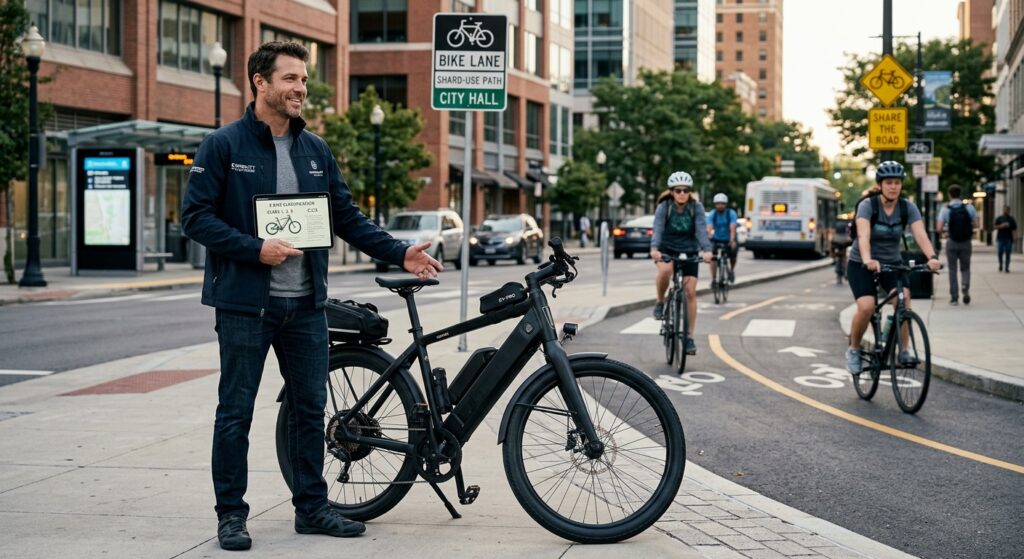
There is no single U.S. e-bike rule that answers every legal question. What applies to you depends mainly on your bike’s current configuration, the state and locality you’re in, and where you intend to ride.
That means the fastest route to a reliable answer is not memorizing a national list of rules. Use this sequence instead:
Bike configuration → legal classification → applicable jurisdiction → rider and vehicle requirements → riding-location rules → current official verification
That sequence is the core task identified by the underlying U.S. e-bike research.
If you only need one answer, focus on the relevant section below:
- License or registration: classify the bike first, then check your state.
- Speed or Class 1/2/3: separate motor-assistance limits from actual road or path restrictions.
- Where you can ride: check the facility, not just the bike.
- Helmet requirements: check age, class and jurisdiction.
- Insurance: determine whether your bike is still treated as an ordinary e-bike.
- Modified or high-performance bike: run the classification check again.
Important: E-bike laws can change quickly. State and local rules, class definitions, licensing, registration, insurance, helmet requirements and access rules should be checked against current official sources before you rely on them.
What Legally Counts as an Electric Bike?

The name on the product page is not enough to settle the legal question.
Start with the bike you actually have today. Record:
- whether it has functional pedals;
- whether the motor only assists pedaling or can propel the bike independently;
- whether it has a throttle and how that throttle works;
- the speed at which motor assistance stops;
- motor information where the applicable law uses it;
- any controller, limiter, motor or software changes; and
- whether its current configuration differs from the factory specification.
Those details matter because classification can determine whether later rules about licensing, registration, helmets, insurance and access still apply as ordinary e-bike rules.
Federal Product Rules and State Vehicle Rules Answer Different Questions
One of the easiest mistakes is finding a federal e-bike definition and treating it as the complete answer for riding on public roads.
Federal product rules and state vehicle rules have different jobs. A federal consumer-product definition does not automatically determine whether your state requires registration, which e-bike classes it recognizes, or whether a local trail permits your bike.
The supplied legal research specifically separates the federal product layer from state vehicle law and local operating/access rules.
For an actual ride, continue beyond the federal question and check the state and local rules that govern operation.
When an E-Bike May Need a Different Classification

Ordinary e-bike guidance may stop being reliable if the bike’s configuration falls outside the definition used by the relevant jurisdiction.
Reasons to stop and recheck can include:
- unusually high motor-assisted speed;
- motor or controller changes;
- altered throttle behavior;
- removal of a speed limiter;
- loss or removal of functional pedals; or
- another modification affecting a characteristic used in the legal definition.
The key is not whether the seller still calls the vehicle an e-bike. The key is whether its current configuration still fits the applicable legal category.
Hypothetical example: A rider buys a bike labeled Class 2, then modifies the controller so the motor provides assistance beyond the original configuration. The old label may no longer be enough to answer licensing, helmet or access questions. The safer legal workflow is to classify the modified bike again before relying on the previous rules.
Which E-Bike Law Applies: Federal, State or Local?

A rule can be perfectly accurate and still be useless if it comes from the wrong authority.
Use this three-layer model:
| Authority | Question to ask |
|---|---|
| Federal | Does a federal product or consumer-safety rule apply? |
| State | How is the vehicle classified, and what statewide operating requirements apply? |
| Local or land manager | May this bike use this particular street, path, trail, park or other facility? |
Federal Rules
Use federal sources for federal questions.
Do not assume that satisfying a federal product definition automatically gives you permission to operate the bike everywhere that bicycles are permitted.
State Rules
State law is central to practical questions such as vehicle classification and many licensing, registration, age, helmet and insurance requirements.
Read the definition before reading the obligation.
For example, finding a rule that applies to a particular motorized-vehicle category does not tell you whether it applies to your bike until you know how your bike is classified.
Also check the law’s status. These are different things:
- a bill has been proposed;
- a bill has been enacted;
- a new rule has taken effect.
A recently published article can still be wrong if it confuses those stages.
City, Park and Trail Rules
State legality does not automatically mean universal access.
Cities, counties, park systems, trail authorities and other land managers can have rules for specific facilities. Posted restrictions may also apply.
So the correct question is not simply:
“Is my e-bike legal?”
It is:
“Is this class and configuration of e-bike permitted here?”
Do You Need a License or Registration to Ride an E-Bike?

There is no reliable nationwide yes-or-no answer based only on the word e-bike.
Use this order:
- Determine the bike’s current legal classification.
- Check the state rule for rider licensing.
- Separately check vehicle-registration requirements.
- Check any age or permit conditions that apply to your situation.
- Recheck if the bike has been materially modified.
The supplied research deliberately places licensing downstream from classification because treating it as a standalone yes/no question can produce the wrong answer.
License and Registration Are Different Legal Questions
A rider license concerns permission or qualification to operate.
Vehicle registration concerns the legal registration of the vehicle itself.
A driver’s license, a special rider permit and vehicle registration should not be treated as interchangeable terms.
If a bike is reclassified into another motorized-vehicle category, several requirements may change together. That is why the classification step matters more than a generic statement such as “e-bikes don’t need licenses.”
What Speed Limits and E-Bike Classes Apply?

Speed rules become confusing when three different concepts are collapsed into one number.
A clearer model is:
| Concept | What it answers |
|---|---|
| Classification threshold | What legal vehicle category may apply? |
| Motor-assistance cutoff | When must the motor stop providing assistance? |
| Operating restriction | How fast, or under what conditions, may you ride at this particular location? |
The underlying research identifies this “three different limits” distinction as a major opportunity to prevent the common assumption that an e-bike’s class speed automatically becomes its lawful speed everywhere.
Assisted-Speed Cutoff Is Not the Same as Actual Riding Speed
Suppose motor assistance stops at the limit associated with a particular classification. The bike may still be capable of moving faster through pedaling, coasting or downhill travel.
That does not mean the rider has permission to travel at any physically achievable speed on every road or path.
Whenever you see a speed figure in an e-bike rule, ask:
What does this number control?
Is it:
- the vehicle’s classification;
- the point where motor assistance must stop; or
- a riding restriction for the road, path or facility?
That question resolves much of the apparent contradiction in e-bike speed advice.
Class 1, Class 2 and Class 3 Are Common, but Do Not Assume Uniform Rules
Class-based systems are widely discussed in U.S. e-bike guidance, but the exact legal treatment should be checked in the jurisdiction that matters to you.
Verify:
- whether the state uses the relevant class framework;
- how pedal assist is defined;
- how throttle operation is treated;
- the applicable assistance cutoff;
- whether age or helmet rules differ by class; and
- whether access changes for a particular class.
The manufacturer’s label is useful evidence about the intended configuration. It is not a substitute for the applicable law.
Where Can You Ride an E-Bike?

A legally classified e-bike is not necessarily permitted on every facility that allows ordinary bicycles.
This distinction is one of the most useful checks in the entire process:
Legal vehicle ≠ legal access everywhere.
The source research treats access as a separate critical question covering roads, bike lanes, sidewalks, shared-use paths, trails and parks.
Roads and Bike Lanes
Check:
- whether your e-bike classification is permitted;
- whether the state or locality limits particular classes;
- whether the road or bicycle facility has its own rule; and
- whether posted restrictions apply.
Once you know you are legally permitted to ride there, road positioning, braking, intersections and defensive riding become safety questions, not access-law questions.
Sidewalks, Shared Paths, Trails and Parks
These locations often require a separate local or land-manager check.
| Place | What to verify |
|---|---|
| Sidewalk | State or local permission and class restrictions |
| Shared-use path | Facility and jurisdiction rules |
| Trail | Trail or land-manager policy |
| Park/public land | Managing authority’s current rule |
Do not assume that “bicycles allowed” automatically means every e-bike configuration or class is allowed.
When Are Helmets Required?

There is no single helmet answer that can safely be applied to every U.S. e-bike rider.
The legal requirement may depend on:
- state or local law;
- rider age;
- e-bike classification;
- passenger status;
- speed-related categories; or
- the location or type of use.
That is why “Are helmets required?” is better treated as a short decision process than a national yes/no question.
Check Age and Class Together
Use this sequence:
jurisdiction → rider age → bike classification → passenger/use conditions
If any one of those changes, the answer may change.
Also keep the legal question separate from the safety question. A jurisdiction may not legally require a helmet in a particular situation, while wearing an appropriate helmet can still be the safer choice.
Helmet Laws and Helmet Standards Are Not the Same Thing

There are two separate issues:
- Must the rider wear a helmet?
- What type or standard of helmet is acceptable?
A product standard for helmets does not by itself establish that every e-bike rider is legally required to wear one.
Check which question the source is actually answering.
Do Electric Bikes Need Insurance?

Do not begin with insurance products. Begin with the legal category of the bike.
Use:
jurisdiction → vehicle classification → mandatory-insurance rule
If the vehicle falls within ordinary e-bike treatment, one set of requirements may apply. If it is classified differently, insurance, registration and rider-licensing questions can change together.
Keep these two questions separate:
Is insurance legally required?
and
Would optional insurance be useful for liability, theft or damage?
The first is a compliance question. The second is a personal insurance decision.
What Changes for High-Power, Throttle or Modified E-Bikes?

A modification does not automatically make a bike illegal.
It does mean that any old legal conclusion should be reconsidered when the modification changes a fact used in the applicable classification rule.
Potential recheck triggers include:
- assisted-speed changes;
- motor or controller upgrades;
- altered throttle operation;
- speed-limiter removal;
- software modes affecting assistance; or
- changes to functional pedals.
The research framework treats modification as a possible chain reaction:
Modification → classification recheck → licensing/registration → insurance → helmet/access
Riding Slowly Does Not Necessarily Solve a Classification Problem
A common mistake is assuming that a high-performance or modified bike must count as an ordinary e-bike simply because the rider promises to keep the speed low.
That may not answer the legal question.
The applicable definition may focus on the vehicle’s configuration or capability rather than only the speed recorded during one trip.
If a modification changes a legally relevant characteristic, recheck the classification first.
How to Verify the Exact Rule for Your Bike and Location

A national guide is useful only if it gets you to a reliable local answer.
Use this process.
1. Record the Bike as It Exists Now
Write down:
- pedals;
- throttle behavior;
- assistance type;
- assisted-speed capability;
- relevant motor information; and
- modifications.
Do not rely on an old product listing if the bike has changed.
2. Find the Current Official State Definition
Start with primary or official state material such as:
- the state code or statute;
- the relevant transportation authority;
- an official motor-vehicle or DMV-type agency source.
Determine how the law classifies your configuration.
3. Check Each Obligation Separately
Verify, as relevant:
- rider licensing;
- registration;
- age restrictions;
- helmet requirements; and
- insurance.
One answer does not automatically determine the others.
4. Check the Exact Place You Intend to Ride
If your trip involves a sidewalk, park, recreational path or trail, identify the authority that controls that facility.
Check its current rule rather than relying only on a statewide summary.
5. Confirm the Rule Is Actually in Effect
Look for:
- current statutory or regulatory text;
- effective dates;
- agency implementation dates where relevant; and
- whether the material you’re reading describes enacted law or merely proposed legislation.
6. Keep a Simple Source Record
Record:
| Field | What to save |
|---|---|
| Jurisdiction | State, city, park or trail system |
| Rule | Classification, helmet, access, etc. |
| Official source | URL or document |
| Effective date | If provided |
| Date checked | Your verification date |
| Bike configuration | Relevant current details |
The supplied writer brief recommends this kind of last-verified workflow because legal data is volatile and needs to be rechecked after a modification or rule change.
7. Recheck When Something Material Changes
Run the process again if:
- you modify the bike;
- you move to another state;
- you change where you intend to ride;
- a relevant law changes; or
- your existing source has become outdated.
A useful source hierarchy is:
current statute or regulation → official state agency → local authority or land manager → secondary reference for discovery or cross-checking
For an important legal conclusion, return to the authoritative source.
Special Cases: Riding Abroad and Imported E-Bikes

Most U.S. riders can stop after the verification process above. Two situations need a separate branch.
Taking a U.S. E-Bike Abroad
Do not assume a U.S. classification travels with the bike.
Another country may define e-bikes differently based on power, assisted speed, throttle operation or other characteristics. Licensing, registration, insurance, helmet and access rules can also differ.
Restart the process for the destination:
bike configuration → destination’s legal classification → rider requirements → access rules
A country-specific legal guide is a better source for those details than a U.S. national page.
Importing an E-Bike Does Not Automatically Make It Road-Legal
Import/product compliance and legal road operation are two separate tests.
A bike may satisfy the requirements relevant to importation or product compliance and still need to fit the applicable state and local vehicle rules before it can be legally operated where you intend to ride.
Think of it as two gates:
Gate 1: May the product legally enter or be supplied in the relevant U.S. context?
Gate 2: How does the state and locality classify and regulate it for actual use?
Passing the first does not automatically answer the second.
Before You Ride: Run This Final Check

You do not need to memorize every U.S. e-bike law.
You do need reliable answers to five questions:
- What is my bike’s current configuration?
- How does my state classify that configuration?
- What license, registration, helmet, age or insurance requirements follow from that classification?
- Does the road, path, trail or park I plan to use allow it?
- Have I confirmed those answers against current official sources?
If the bike or location changes, run the check again.
That approach is more dependable than relying on a generic statement such as “e-bikes are legal” or “Class 3 bikes can go 28 mph.” The useful question is always narrower:
What rules apply to this bike, in this jurisdiction, for this ride?
Pingback: How E-Bikes Affect Urban Mobility: When They Cut Car Trips—and When They Don’t - electricscootercar.com
Pingback: Electric Bike Tire Types: Choose the Right Size, Tread & Fit - electricscootercar.com
Pingback: Do Electric Bikes Need a License? 2026 U.S. Rules by State - electricscootercar.com
Pingback: E-Bike Road Safety Tips: How to Ride Safely in Traffic - electricscootercar.com
Pingback: Electric Bike Speed Limits in the USA: 20 vs 28 MPH, Classes & Local Rules - electricscootercar.com
Pingback: Electric Bike Helmet Laws by State (2026): Age & Class Rules - electricscootercar.com
Pingback: E-Bike Laws by Country: Check Power, Speed & Road Legality - electricscootercar.com
Comments are closed.