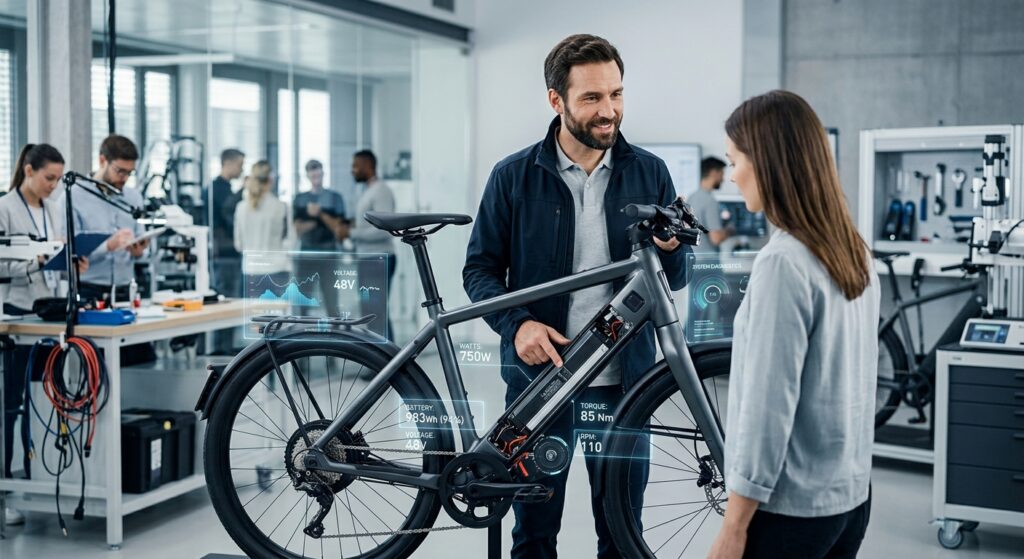
An e-bike spec sheet becomes much easier to read once you know what each number is allowed to tell you. Watts describe power, watt-hours describe stored energy, volts describe the electrical system, amps describe current, torque describes turning force, and RPM describes rotational speed. The BMS, controller, sensors and motor determine how those electrical quantities become assistance at the wheel.
The important part is how those specifications work together. A larger number in one column does not automatically mean better climbing, more range, higher speed or a better e-bike.
By the end of this glossary, you should be able to look at an e-bike specification sheet and know which numbers matter for the question you are trying to answer—and which conclusions the numbers cannot support on their own.
How the Core E-Bike System Fits Together

Start with the system rather than the acronyms:
Battery → BMS → controller → motor → wheel
The rider-input path runs alongside it:
Pedaling → sensor → controller → motor assistance
Each specification belongs somewhere in those two paths.
The battery stores energy. Voltage and current describe electrical operating conditions. Together they relate to electrical power, measured in watts. The controller regulates motor drive. The motor converts electrical input into mechanical output, which can be described partly through torque and rotational speed.
Not all battery energy becomes useful motion. Losses occur, and real-world energy use also changes with riding conditions. That connects the electrical system to the outcome many riders care about most: range.
A useful mental model is:
stored energy → controlled electrical power → motor output → energy consumption → distance
Battery, controller and motor
These components have different jobs.
The battery provides energy. The controller manages motor drive according to system limits and rider inputs. The motor turns electrical input into mechanical motion.
That distinction prevents two common mistakes:
- A large battery does not necessarily mean a powerful motor.
- A high motor watt rating does not necessarily mean long range.
Sensors and rider input
Pedal-assist systems also need information about the rider.
A cadence sensor detects pedal or crank movement. A torque-sensing system responds to rider-force-related input. The controller then uses that information, together with its programming and assist settings, to determine motor assistance.
The sensor is therefore part of the control system, not a measure of motor output.
Watts: What Power Means on an E-Bike

A watt (W) measures power: the rate at which energy is transferred. In SI units, one watt equals one joule per second.
For electrical input at a given operating point:
Power = Voltage × Current
or:
W = V × A
That relationship explains why watts, volts and amps repeatedly appear together in e-bike specifications.
What a watt number does not do is summarize the whole bike.
Motor wattage alone cannot establish:
- hill-climbing performance;
- wheel torque;
- acceleration;
- top speed;
- range;
- efficiency;
- ride quality;
- overall component quality.
Those outcomes depend on other specifications and operating conditions.
Watts vs watt-hours

This distinction solves one of the most common e-bike specification misunderstandings:
Watts (W) describe power. Watt-hours (Wh) describe energy.
A motor listed as 500W and a battery listed as 720Wh are not two versions of the same measurement.
The motor figure describes a power rating.
The battery figure describes stored energy.
If a battery’s nominal voltage and amp-hour capacity are known, nominal battery energy can be estimated as:
Wh ≈ V × Ah
For example:
48V × 15Ah ≈ 720Wh
Use the manufacturer’s stated Wh figure when available, because nominal values and rating conventions can make a simple multiplication only an approximation.
Nominal vs peak power
Motor descriptions may use terms such as:
- nominal;
- continuous;
- rated;
- maximum;
- peak.
Those labels need context.
A brief maximum-power capability and a continuously sustainable rating do not answer the same question. Two bikes can also display the same headline watt number while using different motors, controllers, batteries and rating methods.
So when comparing two “750W” systems, first ask:
750W according to which rating definition?
Legal definitions can also use power terminology differently. Do not infer an e-bike’s legal status from wattage alone; check the current rules for the jurisdiction where the bike will be used.
Volts: What Battery and System Voltage Means

Voltage (V) describes an electrical characteristic of the system. Labels such as 36V, 48V and 52V usually refer to nominal battery or system voltage.
Voltage is not the same as power.
It is also not the same as battery energy.
Instead, voltage participates in both:
V × A = electrical power in watts
and, for a nominal battery-energy estimate:
V × Ah ≈ Wh
That means a higher voltage number alone does not prove that one e-bike will be faster, stronger or better.
What voltage matters for in practice
Voltage becomes especially important when you are checking whether electrical components belong in the same system.
Battery, controller, charger and motor specifications need to be compatible with the system they are designed for.
A connector fitting physically is not enough to prove compatibility.
For chargers, replacement batteries and other electrical components, use the manufacturer’s documented compatibility information rather than matching components by connector shape or one specification alone. The supplied research specifically treats charger and system compatibility as a safety-sensitive area.
Amps: Current, Controllers and Battery Demand

An ampere (A) measures electric current.
Current ratings can appear on batteries, controllers, chargers and other components, but the number means something different depending on what is being rated.
Because:
W = V × A
current is one part of electrical power.
But that does not mean you can increase current without considering the rest of the system. Battery capability, BMS limits, controller design and other component limits still matter.
Amps vs amp-hours
Amps (A) and amp-hours (Ah) answer different questions.
- A describes current.
- Ah describes charge capacity.
- W describes power.
- Wh describes energy.
- V describes voltage.
A useful buying implication follows from that distinction.
Suppose one battery is rated 36V and another 48V. Comparing only their Ah figures can hide the difference in stored energy. Wh provides the more useful common energy measure because voltage is part of the calculation.
For example:
36V × 15Ah ≈ 540Wh
while:
48V × 15Ah ≈ 720Wh
Both batteries show 15Ah, but they do not represent the same nominal energy.
Torque: Turning Force, Hills and Acceleration

Torque describes rotational turning force and is commonly expressed in newton-metres (Nm).
On an e-bike, torque matters because the motor has to produce rotational force against load. That makes it relevant to starting, acceleration and climbing.
It is not, however, a universal hill-climbing score.
Gearing, rotational speed, motor architecture and the point at which torque is measured all affect how an advertised torque figure should be interpreted. The supplied technical outline specifically warns against treating watts and torque as interchangeable measures.
Torque vs watts
Torque is rotational force.
Power describes the rate of doing work.
For rotating systems:
Mechanical power = torque × angular velocity
So two motors can produce power differently across their operating ranges.
A torque figure without rotational-speed context is incomplete. A watt figure without torque and architecture context is incomplete too.
Motor torque vs torque sensing

The word torque also appears in a completely different part of an e-bike specification.
Motor torque refers to mechanical output.
A torque sensor detects or estimates rider-force-related input so the control system can respond to how hard the rider is pedaling.
They are related only in name and broader system context. A motor’s Nm rating should not be confused with the type of pedal-assist sensor the bike uses.
RPM: First Ask What Is Rotating

RPM means revolutions per minute.
But an e-bike can have several different RPM measurements.
| RPM type | What is rotating | What it helps explain |
|---|---|---|
| Motor RPM | Motor | Motor operating speed |
| Wheel RPM | Wheel | Wheel rotation and road-speed relationship |
| Cadence | Pedals/crank | Rider pedaling rate |
Motor RPM does not necessarily equal wheel RPM. Gearing can change their relationship.
Pedaling cadence is different again.
So when you see an RPM specification, the first question should be:
RPM of what?
That matters because rotational speed also connects torque to power and can influence where a motor operates efficiently.
Efficiency: Why Similar Bikes Can Use Energy Differently

Not all electrical energy drawn from a battery becomes useful motion.
Losses occur across components such as the controller, motor and drivetrain. The amount of energy a complete e-bike uses per mile or kilometre also changes with riding conditions.
This creates an important distinction.
Efficiency vs energy consumption
Conversion efficiency describes the relationship between input and useful output.
Energy consumption describes how much battery energy the bike uses to cover a given distance.
Those are related, but they are not the same measurement.
Real-world consumption can change with:
- assist level;
- speed;
- terrain;
- total load;
- tires;
- wind;
- temperature;
- rider contribution;
- repeated acceleration.
This is why a motor-efficiency figure cannot, by itself, tell you how many Wh per mile an entire e-bike will use.
And Wh per mile is the number that connects battery energy to range.
Range: Turn Battery Energy Into a Useful Distance Estimate

E-bike range is conditional, not fixed.
A useful rough relationship is:
Estimated range ≈ battery Wh ÷ energy use per mile or kilometre
The research blueprint treats this as the central connection between battery energy, consumption and practical riding distance.
Battery energy vs energy use
Consider a hypothetical 720Wh battery.
If a particular ride averages 18Wh per mile:
720 ÷ 18 ≈ 40 miles
If tougher conditions increase consumption to 24Wh per mile:
720 ÷ 24 ≈ 30 miles
The battery has not become smaller. The bike is simply using its energy faster.
That is why equal-Wh batteries do not guarantee equal range.
It is also why the same bike can travel different distances depending on speed, terrain, wind, temperature, rider input, load and assist level.
Treat advertised range as meaningful only in the context of the conditions behind the claim.
BMS: What the Battery’s Protection System Actually Does

BMS stands for Battery Management System.
At a high level, the BMS monitors relevant battery or cell conditions. Depending on its design, it may enforce protections related to voltage, current and temperature and may perform or coordinate cell balancing.
It also sits inside the relationship between:
battery limits ↔ charging/discharging ↔ current demand ↔ controller
A useful distinction is what a BMS cannot promise.
Having a BMS does not make damaged, defective or incompatible hardware inherently safe. It is one protection layer within a larger battery and electrical system.
Do not bypass battery protection systems or use the existence of a BMS as justification for incompatible chargers, batteries or components.
Detailed BMS wiring, bypassing, replacement and repair procedures belong in specialist technical guidance, not a beginner glossary.
Cadence Sensors: How the Bike Knows You Are Pedaling

A cadence sensor detects pedal or crank movement.
The basic control path is:
pedaling → cadence sensor → controller → motor assistance
The sensor provides an input. The controller decides how that input translates into motor response.
This is why two cadence-sensor bikes do not necessarily feel identical: assistance behavior also depends on controller logic and implementation.
Cadence sensor vs torque sensor

A cadence sensor primarily responds to pedal rotation or movement.
A torque-sensing system responds to rider-force-related input.
Neither term refers to motor torque in Nm.
Keeping those three concepts separate avoids a recurring specification mistake:
- cadence = rider rotational speed/input;
- torque sensor = rider-force-related input;
- motor torque = mechanical motor output.
The supplied architecture treats that distinction as important enough to keep motor torque and torque sensing under separate topic ownership.
Hub Motors: Why Motor Location Changes the Context

A hub motor places the motor in the front or rear wheel hub.
That makes the hub the point where electrical power becomes mechanical wheel motion.
Motor location matters because watts, torque and RPM need to be interpreted in the context of the drive architecture.
Geared vs direct-drive hub motors
E-bike hub motors can use geared or direct-drive architectures.
The key point at glossary level is not that one type always wins. It is that the architectures differ, so headline watt and torque numbers should not be treated as if every hub motor behaves identically.
Detailed questions about heat, fitment, hill performance, wiring, maintenance and troubleshooting belong in a dedicated hub-motor guide. The supplied content architecture intentionally keeps those topics out of the parent glossary.
Hub motor vs mid-drive
The parent-level difference is motor location and how motor output reaches the wheel.
A hub motor drives at the wheel hub.
A mid-drive is positioned around the crank area and works through the bicycle’s drivetrain.
That difference changes the mechanical context in which torque, RPM and gearing are interpreted.
It does not support a simple “hub is cheap, mid-drive is premium” rule.
How to Read an E-Bike Spec Sheet Without Being Misled
Once the individual terms make sense, the useful skill is reading them in the right order.
Do not start by finding the largest number.
Use this sequence instead:
- Define the intended use. Commuting, hills, cargo, leisure riding and other use cases place different demands on a bike.
- Check the applicable legal classification. Verify current rules for the place where the bike will actually be used.
- Look at battery energy in Wh. This gives you the clearest headline measure of stored energy.
- Identify the motor architecture. Know whether you are looking at a hub or mid-drive system before interpreting motor figures.
- Read the watt rating carefully. Check whether it is nominal, continuous, rated, maximum or peak.
- Interpret torque with context. Consider architecture and how the figure is stated instead of treating Nm as a universal performance score.
- Check system voltage. Use it as an electrical-system specification, not as an independent quality ranking.
- Review current/controller information when available. Battery capability, controller demand and protection limits interact.
- Identify the pedal-assist sensor. Cadence sensing and torque sensing describe different rider-input methods.
- Evaluate range assumptions. Compare battery Wh with the conditions behind the manufacturer’s range claim.
- Check compatibility and safety documentation. For batteries, chargers and electrical components, use manufacturer documentation rather than guesswork.
The supplied research identifies this ordered interpretation framework as one of the page’s strongest opportunities to provide value beyond isolated glossary definitions.
What each specification tells you—and what it cannot tell you
| Specification | Helps you understand | Does not prove by itself |
|---|---|---|
| Watts | Power | Hill ability, range or overall quality |
| Volts | Electrical system | Total stored battery energy |
| Amps | Current | Battery energy |
| Amp-hours | Charge capacity | Comparable energy across different voltages |
| Watt-hours | Stored energy | Exact real-world range |
| Torque | Rotational force | Complete motor performance |
| RPM | Rotational speed | Road speed without gearing and wheel context |
| Efficiency | Input/output relationship | Whole-bike consumption in every condition |
| Range claim | Expected distance under stated assumptions | Your distance on every ride |
| BMS | Monitoring and protection functions | Universal battery safety |
| Cadence sensor | Pedal-rotation input | Motor torque |
| Motor architecture | How motor output reaches the wheel | Overall bike quality |
The practical rule is straightforward:
Use each number only for the question it actually answers.
A hypothetical spec-sheet example
Suppose an e-bike specification lists:
- 48V battery;
- 15Ah capacity;
- approximately 720Wh;
- 750W nominal motor;
- 80Nm advertised torque;
- cadence-sensor pedal assist;
- rear hub motor.
You can extract several useful facts.
The battery represents roughly 720Wh of nominal energy if 48V × 15Ah appropriately reflects the manufacturer’s rating.
The 750W figure describes motor power according to the manufacturer’s definition of “nominal.”
The 80Nm figure describes advertised torque, but it still needs architecture and measurement context.
The cadence sensor tells you that pedal rotation is an input to the assist system.
The rear hub motor tells you where the motor delivers its output.
What you still cannot establish from those numbers alone is just as important:
- exact climbing performance;
- exact range;
- legal classification;
- ride feel;
- thermal performance;
- component quality.
That is the difference between reading a spec sheet and simply comparing headline numbers.
Go Deeper Based on the Question You Actually Have
Once you know which specification is blocking your decision, move to the narrower guide instead of trying to solve everything from one glossary page.
If you need to understand:
- motor ratings and power → read the e-bike watts guide;
- 36V, 48V, 52V or compatibility → use the e-bike voltage guide;
- A versus Ah or current limits → use the e-bike amps guide;
- Nm, gearing or climbing-related interpretation → use the e-bike torque guide;
- motor, wheel or cadence RPM → use the e-bike RPM guide;
- Wh-per-distance and energy use → use the e-bike efficiency guide;
- distance per charge → use the e-bike range guide;
- battery monitoring and protection → use the e-bike BMS guide;
- pedal-assist sensing → use the cadence-sensor guide;
- motor architecture → use the hub-motor guide.
You do not need to memorize every acronym. You need to know which measurement answers which question, what it cannot answer, and which other specifications must be considered before you make a decision.