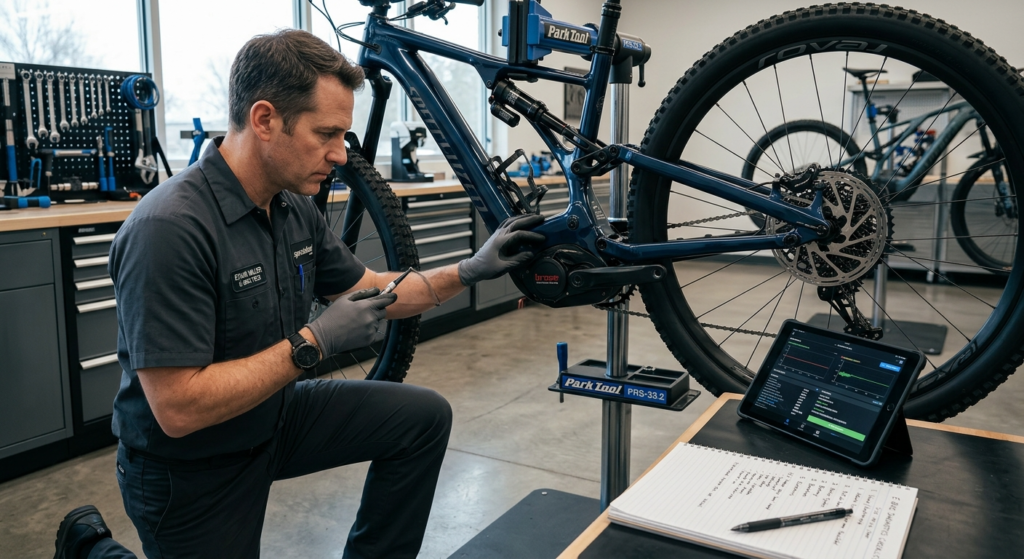
Some e-bike motor noise is normal. A consistent whir, hum or gear sound that has always appeared under the same riding conditions does not automatically mean something is failing.
What matters more is change. A new grinding, clicking, scraping or buzzing sound deserves investigation, especially if it comes with vibration, weaker assist, jerking, repeated cutouts or an error code.
Before blaming the motor, confirm that the sound actually comes from it. Brakes, spokes, pedals, drivetrain parts and loose hardware can transmit noise through the frame and sound surprisingly close to the drive unit. Current troubleshooting guidance emphasizes this combination of source + operating condition + other symptoms, rather than diagnosing a part from the sound alone.
Stop normal riding rather than repeatedly testing the bike if the new noise comes with severe vibration, abnormal wheel movement, smoke, sparking, a strong electrical or burning smell, obvious electrical damage, or major loss of control or power.
Is E-Bike Motor Noise Normal?

Yes. An operating electric motor does not have to be silent.
Bafang, for example, separates motor noise into mechanical sources such as gears, bearings and rotor balance, and electromagnetic noise created by the interaction of the motor’s electrical and magnetic components.
That is why there is no useful universal loudness number that tells every rider whether an e-bike motor is healthy.
A better question is:
Is this sound normal for this bike under this riding condition, or has something changed?
| What you notice | Usually less concerning | Worth investigating |
|---|---|---|
| Change over time | Stable and familiar | New or worsening |
| Sound | Smooth and repeatable | Harsh, irregular or suddenly different |
| Motor assistance | Normal | Weak, jerky or cutting out |
| Vibration | Familiar bike feedback | New or pronounced |
| Load | Changes predictably | Suddenly becomes rough under load |
The table is a screening tool, not a diagnosis. A familiar sound can still deserve attention if the bike’s behavior changes with it.
How Motor Type Changes What “Normal” Sounds Like

Motor design changes the noises a bike can produce.
A geared hub motor has internal reduction gearing. A direct-drive hub motor has no internal gear reduction: the hub itself is the motor. Grin Technologies notes that geared hubs therefore contain more internal moving parts and can produce audible gear noise, while direct-drive motors eliminate that gear train.
A mid-drive creates a different diagnostic challenge because it sends motor power through the bicycle’s drivetrain. A chain, cassette, chainring or shifting problem may become louder only when motor torque is applied, making an ordinary drivetrain issue feel like a motor fault.
If you need the broader differences between these systems, the site’s e-bike motor types guide covers them in more detail. Here, the important point is simply that different designs should not be expected to sound identical.
A Familiar Sound and a New Sound Are Not the Same Problem

Suppose your motor has always produced a smooth whine on one steep hill. If the pitch and bike behavior remain consistent, that observation carries much less diagnostic weight than a grind that appeared yesterday and now gets worse every time you accelerate.
Ask yourself:
- Has it always sounded this way?
- Did the noise begin suddenly?
- Does it happen only when assistance engages?
- Is it more obvious on hills or during hard acceleration?
- Has the motor started vibrating or delivering power differently?
- Did anything get repaired, removed or replaced just before it started?
This baseline comparison is more useful than asking only, “Is my motor too loud?”
How to Diagnose E-Bike Motor Noise Without Guessing From the Sound

The most useful troubleshooting sequence is:
Sound → Where it happens → When it happens → Other symptoms → What changed → Next check
Do not start with:
Sound → Buy a replacement part.
First, Make Sure the Motor Is Actually the Source
Noise travels through a bicycle frame. A click near a rear hub may come from a spoke. A sound near a mid-drive may originate at a pedal, chainring or cassette.
If there are no stop-riding warning signs, use these observations to narrow the source.
- Compare assist on and assist off.
On a safe, low-stress ride, notice whether the sound remains when electrical assistance is disabled. If it does, ordinary bicycle components deserve attention before an internal motor fault. - Compare pedaling with coasting.
A noise tied to every pedal revolution points in a different direction from one tied to wheel rotation. - Listen for a wheel-speed pattern.
Repeating sounds can come from a brake rotor, tire, spoke, hub or other wheel-area component. - Notice what braking does to the sound.
If the noise changes as the brake is lightly applied under safe conditions, inspect the braking system rather than assuming the motor is responsible. - Check visible hardware and accessories.
Fenders, racks, kickstands, battery mounts, cables and other parts can rattle only when the frame flexes under load.
This source-isolation step matters because replacing a controller, bearing or motor will not fix a brake rotor or loose spoke. Current e-bike troubleshooting pages repeatedly make the same point: the pattern often tells you more than the sound name.
Next, Record When the Noise Happens
Once you know approximately where the sound originates, pay attention to the trigger.
Does it happen:
- only when assistance starts;
- while pedaling but not coasting;
- while coasting too;
- during hard acceleration;
- only on hills;
- at one particular speed;
- once per pedal revolution;
- once per wheel revolution;
- in one gear;
- under heavy rider or cargo load?
These conditions help separate several very different problems.
A click that continues with the motor disabled and occurs once per pedal revolution does not justify starting with the motor controller.
A rough growl that appears only when the motor is energized, comes with uneven power delivery and began immediately after motor/controller wiring work deserves much more attention on the electrical-control side.
Use the Sound to Choose a Diagnostic Branch, Not a Failed Part
Here is the practical way to interpret common noises.
Grinding, scraping or rumbling
First ask whether it happens with motor assistance disabled.
If it does, rule out brake rub, wheel contact, bearings outside the motor and drivetrain problems. If it appears primarily when the motor is operating, internal bearings, gears on applicable motors or another mechanical-contact problem become more relevant.
Clicking, rattling or clunking
Find the rhythm.
A click once per pedal revolution may lead toward pedals, crank hardware or the drivetrain. Once per wheel revolution suggests a different group of components, including spokes, rotor, tire or wheel hardware. A clunk that appears only as torque is applied may justify checking motor mounting or internal mechanical components after simpler causes have been eliminated.
Whining
A smooth whine can be characteristic of an electric drive, particularly as motor speed or load changes.
A newly developed whine deserves more attention if it comes with rough operation, vibration, unusual heat, weaker assistance or another change in behavior. Bafang specifically identifies electromagnetic forces as one source of motor noise, so a whine or buzz by itself does not prove that a bearing or gear has failed.
Buzzing or humming
Ask what the motor is doing while you hear it.
A consistent operating hum with normal performance is very different from a motor that buzzes but struggles to start, shakes or delivers uneven power.
Bafang notes that motor-controller matching can affect electromagnetic noise. That makes the electrical/control branch relevant in some cases, but “buzzing = bad controller” is still too simplistic.
Stuttering, cogging or heavy growling
This combination matters most when it appears under electrical assistance and power delivery itself feels rough.
Possible areas include motor connections, controller behavior and, on systems that use them, Hall-sensor or phase-related faults.
A Hall sensor helps the controller determine rotor position on applicable brushless motor systems. Hall sensors are common, but system designs differ, so symptoms should not be used to declare a Hall sensor faulty without model-specific diagnosis. Grin’s controller documentation shows how controller waveform and Hall-sensor operation can materially affect motor smoothness and noise.
For a deeper explanation of these sensors, see the site’s guide to e-bike sensors and Hall sensors.
New vibration or shaking
Do not treat vibration as an audio problem alone.
Check whether it follows wheel speed, motor power or load. Wheel seating, brake or tire problems and mounting issues need to be ruled out before concluding that something inside the motor is responsible.
Bafang lists rotor imbalance, bearing problems, gear problems, water ingress and motor/frame resonance among possible mechanical sources of motor noise and vibration.
What Changed Just Before the Noise Started?
This question often gives more useful information than finding a better adjective for the sound.
Think back to the last repair or unusual event.
Did the problem begin after:
- wheel removal or installation;
- motor replacement;
- controller replacement;
- motor-cable or connector work;
- Hall-sensor work;
- bearing or gear service;
- drivetrain work;
- a crash or hard impact;
- significant water exposure;
- pressure washing?
A noise that appears immediately after a repair should put that repair high on the list of things to re-check.
A 60-Second Noise Log Before You Call a Shop
Record these details while they are fresh:
- Bike and motor model
- What the sound resembles
- Approximate location
- Assist on or off
- Pedaling or coasting
- Flat road, hill or acceleration
- Whether speed changes it
- Any vibration, power loss, cutout or error
- What changed before it began
- A short recording, if it can be made safely
That turns “my motor sounds weird” into something a technician can actually work with.
Hypothetical example: a bike is quiet while coasting and while pedaling with assistance disabled. When assistance starts, the motor develops a heavy growl and the power feels uneven. The problem began immediately after controller work.
That pattern makes an electrical/control-system investigation more relevant. It does not, by itself, prove that the controller or Hall sensors are faulty.
That distinction prevents expensive parts swapping.
Can You Keep Riding With a Noisy E-Bike Motor?
Sometimes. The sound alone does not decide the answer.
The real question is whether the bike is showing noise only or noise plus another sign of mechanical or electrical trouble.
| Situation | Safer next step |
|---|---|
| Familiar, stable sound with normal operation | Compare and monitor |
| New sound without major secondary symptoms | Inspect and diagnose before demanding rides |
| Worsening noise plus vibration, resistance or poor assistance | Stop normal riding and investigate |
| Serious mechanical/electrical warning signs | Stop using the bike and arrange appropriate service |
Stop Riding When the Noise Comes With a More Serious Symptom
Do not keep reproducing the fault under load if you notice:
- severe or rapidly worsening grinding;
- pronounced new vibration;
- abnormal wheel or axle movement;
- a sudden major change in steering or handling;
- motor noise with substantial power deterioration;
- repeated jerking or cutouts;
- visibly damaged motor wiring;
- persistent drive-system errors;
- smoke or sparking;
- a strong electrical or burning smell.
A bike that still moves is not automatically safe to keep testing.
If smoke, sparking or another obvious battery/electrical hazard is present, treat that as a broader electrical safety issue rather than merely a “noisy motor.” Model-specific safety notices also override generic troubleshooting advice. For example, the U.S. Consumer Product Safety Commission has issued stop-use warnings for specific e-bike models where batteries or wiring presented fire hazards.
A Mild, Stable Sound Is a Different Situation
A familiar motor sound may reasonably be compared or monitored when:
- it has been consistent over time;
- motor assistance remains smooth;
- the bike handles normally;
- there is no new vibration;
- there are no recurring errors;
- there is no visible damage;
- the sound changes predictably with normal motor load.
If you still cannot tell whether it is characteristic, comparing it with another correctly operating bike using the same motor model is more useful than comparing it with a random e-bike online.
Know When the Drive Unit Needs Model-Specific Diagnosis
Many modern drive units are not good candidates for exploratory DIY disassembly.
Professional or manufacturer diagnosis is the better next step when:
- the drive unit is sealed or proprietary;
- internal bearings or gears are strongly suspected;
- damaged motor wiring needs repair;
- a recurring error requires diagnostic software;
- electrical behavior remains unresolved;
- the fault started after internal service;
- the bike is covered by a warranty that could be affected by disassembly.
Bosch recommends an e-bike specialist retailer for drive-related faults and notes that dealers may use dedicated software diagnostic tools. It also warns that an improper repair can compromise the safety of the overall system.
How to Fix a Noisy E-Bike Motor Without Creating a Second Problem

The safest repair strategy is simple:
Fix what the diagnosis supports, not what the sound reminds you of.
Buying a motor, controller, bearing or sensor before narrowing the fault can turn a noise problem into an expensive guessing exercise.
Start With Low-Risk External Checks
Follow the bike and drive-system manual for your model.
Before motor disassembly, appropriate checks may include:
- visible brake or wheel rubbing;
- debris or interference;
- drivetrain condition;
- loose external accessories;
- obviously damaged or displaced external hardware;
- pinched, abraded or damaged motor cabling;
- owner-accessible connectors, where the manufacturer permits inspection;
- a recent installation or service issue;
- manufacturer instructions for a displayed error code.
Use the manufacturer’s torque specification for the exact fastener and model rather than a generic internet torque number.
Do not spray lubricant into a drive unit because it sounds rough. Do not open a sealed motor simply to “see what is making the noise.”
Match the Repair to the Cause You Actually Found
If the diagnosis points to a brake, drivetrain, spoke or ordinary wheel problem, repair that component rather than the motor.
If it identifies an external mounting problem, correct it using the manufacturer’s installation specification.
If there is strong evidence of a bearing or internal gear fault, follow the service path appropriate to that motor. A geared hub has internal gearing; a direct-drive hub does not, so the same repair advice cannot sensibly apply to both.
If the evidence points toward motor wiring, Hall sensors, phase connections or controller behavior, use the diagnostic procedure for that particular motor/controller system instead of swapping electrical components blindly.
If the drive unit is proprietary or sealed, manufacturer/dealer service may be the shortest and safest route.
Verify the Fix Under the Condition That Originally Triggered the Noise
This is the step many troubleshooting guides stop too early to include.
A repair is not confirmed because the bike became quiet while stationary in a garage.
If it can be done safely, reproduce the original condition.
If the noise originally happened:
- climbing a particular hill;
- during moderate acceleration;
- at a certain assist level;
- at one speed range;
- with a particular load;
compare the bike under that same relevant condition after the repair.
Then ask:
- Has the original noise disappeared or returned to its normal baseline?
- Is motor assistance smooth again?
- Is the vibration gone?
- Has the error stopped returning?
- Did the repair create a different symptom?
- Does the problem return after normal riding?
That closes the troubleshooting loop:
Diagnose → Repair → Reproduce the original condition → Verify
If you cannot safely reproduce the condition, verification belongs with the shop or manufacturer rather than on the road.
The main takeaway is simple: don’t diagnose an e-bike motor from the sound word alone. Establish what is normal for your bike, isolate the real source, identify when the problem occurs, look for secondary symptoms, and let that evidence determine the next check.
If power loss or repeated cutouts have become the main problem rather than the noise itself, continue with the site’s e-bike power-loss troubleshooting guide instead of trying to solve two different diagnostic journeys on one page.
*Editorial basis: the four-stage reader journey used here—normality → diagnosis → ride decision → fix and verification—comes from the supplied final content re-audit, which specifically consolidated mechanical and electrical causes into the diagnosis task to reduce repetition and keep the troubleshooting flow reader-led. *
Pingback: Brushless DC Motor Explained: What Replaces the Brushes and How It Works - electricscootercar.com
Pingback: SEO title: How Does an E-Bike Motor Work? From Pedaling to Wheel Power** - electricscootercar.com
Comments are closed.