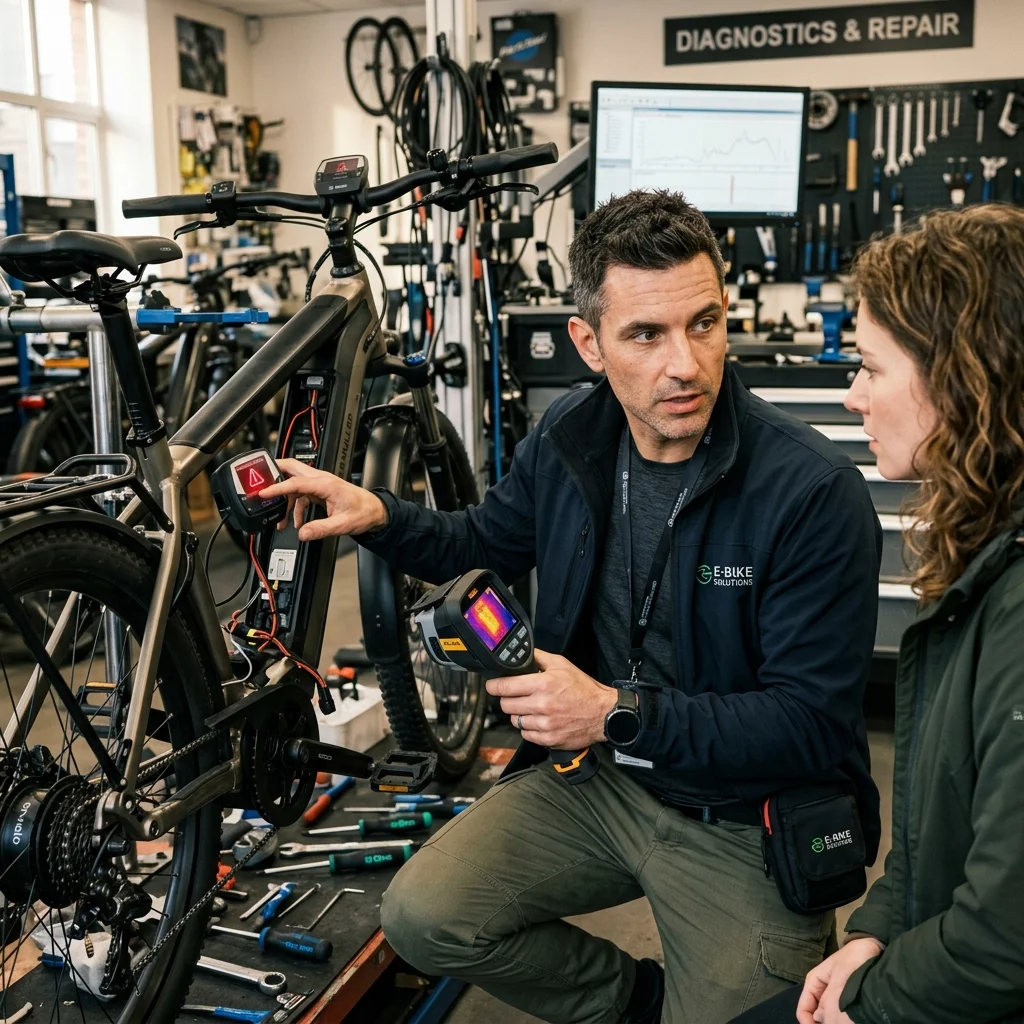
An e-bike can get warm during a hard ride without anything being wrong. Heat becomes more concerning when it is excessive for the riding conditions, keeps returning during normal use, comes with weaker assistance or shutdowns, triggers a temperature warning, or is concentrated around a battery or electrical connection.
If the battery is swelling, leaking, smoking, making hissing or cracking sounds, producing a strong unusual smell, or becoming extremely hot, stop using and charging it. If it is smoking or on fire, move away and contact your local emergency services. Those are battery-safety warning signs, not routine troubleshooting symptoms.
If none of those danger signs are present, diagnose the problem in this order:
Is it safe? → What is getting hot? → What triggered it? → What happened to the power? → What can you safely check?
That sequence can usually tell you far more than simply assuming the battery, motor, or controller has failed.
Is Your E-Bike Actually Overheating—and Is It Safe to Keep Riding?

Start with the circumstances and symptoms rather than trying to find one temperature that supposedly applies to every e-bike.
Manufacturers use different components, sensors, thermal limits, and protection strategies. Trek, for example, documents separate motor, battery, and controller thermal conditions, while Decathlon distinguishes an actual controller-overheating error from several temperature-sensor faults on one model.
That is why a generic “anything above X degrees is overheating” rule can be misleading.
Use three practical categories instead.
Normal operating warmth: A component becomes warm after a demanding climb or prolonged assistance, but the bike behaves normally. There is no error message, unusual smell, visible damage, or unexpected loss of assistance.
Investigate: Heat repeatedly returns, appears during modest riding, is concentrated in one connector or component, or comes with weaker assistance, shutdowns, abnormal battery behavior, or a warning on the display.
Stop using: The battery swells, leaks, smokes, becomes extremely hot, produces unusual noises or odors, or there is obvious melting or serious electrical damage.
What to Do Immediately If the Bike Seems Too Hot
If there are no emergency signs:
- Pull over somewhere safe.
- Stop demanding high power from the motor.
- Reduce assistance or switch the e-bike system off as appropriate.
- Move the bike out of strong direct sunlight if practical.
- Note any warning or error message before resetting anything.
- Allow normal operating heat to dissipate.
- Do not immediately charge a battery that is unusually hot.
London Fire Brigade specifically advises letting an e-bike battery cool before charging after a ride and not charging a battery that already feels very hot.
Avoid universal cooldown promises such as “wait 30 minutes and it is safe.” Follow the operating and charging guidance for your exact bike and battery.
Which Part of Your E-Bike Is Getting Too Hot?

“E-bike overheating” does not identify the faulty component.
The quickest way to narrow the problem is to locate where the unusual heat is concentrated without opening sealed electrical parts.
If the Battery Is Unusually Hot
Pay attention to whether the heat seems to come from the battery pack itself or from its mounting contacts or connector.
If the battery has any of the danger signs from the opening section, stop there. Do not continue testing it.
If it is simply warmer than expected but otherwise appears normal, record:
- What the bike was doing immediately beforehand.
- Whether the whole bike lost power.
- Whether a battery or temperature warning appeared.
- Whether the problem repeats under ordinary riding conditions.
Do not open an e-bike battery pack to inspect cells or the BMS. Bosch, for example, explicitly warns that its battery housings are not intended to be opened by users because improper opening or repair can compromise insulation, connections, sealing, and safety.
If the Motor Is Getting Hot
Motor heat is most useful diagnostically when you compare it with the workload.
Warmth following a long, demanding climb is less suspicious than recurring excessive heat after a short, easy ride.
Record whether the problem occurred during:
- A long or steep climb.
- Low-speed riding under heavy load.
- Prolonged high assistance.
- Heavy cargo or towing.
- Stop-start riding.
- Very hot weather.
Do not conclude that the motor has failed simply because its exterior is hot. The riding context and what happened to the assistance matter too.
If the Controller Area Is Getting Hot
Some e-bike systems monitor controller temperature and may reduce or stop assistance when a protective threshold is reached. Trek’s Hyena documentation, for example, includes separate controller-overheat and thermal-control conditions.
If the controller area appears unusually hot, record:
- Whether assistance faded gradually or disappeared suddenly.
- Whether the display remained on.
- Whether a warning appeared.
- What load the bike was under.
A controller-related temperature warning should be interpreted using documentation for the exact drive system, not a generic error-code list.
If One Connector, Cable, or Battery Terminal Is Hot
A small localized hot spot deserves attention, especially if the surrounding motor or battery is much cooler.
Power the bike down and visually inspect only accessible areas for:
- Discoloration.
- Warped or melted plastic.
- Damaged insulation.
- Corrosion.
- Moisture.
- A visibly loose or damaged connection.
Do not keep loading a connection that is melting, badly discolored, or producing a burnt smell.
If diagnosing it would require opening sealed power electronics or working on high-current wiring, move to professional service.
If the charger rather than the bike becomes excessively hot, use charger-specific troubleshooting instead of treating it as the same fault.
What Causes an E-Bike to Overheat While Riding?

Once you know what is getting hot, reconstruct the few minutes before the problem appeared.
Overheating often makes more sense when you look at the combined workload rather than searching for one dramatic cause.
Long Climbs and Sustained High Load
Climbing requires more power than ordinary level riding, and sustained high output generates more heat.
Bosch explains that maximum drive-unit power is intended for shorter periods and that how long it can be delivered depends partly on cooling and outside temperature. Continued maximum output heats the components, so full peak power cannot necessarily be maintained indefinitely.
A bike carrying substantial weight up a long incline therefore presents a very different thermal situation from the same bike cruising gently on flat ground.
Low Cadence and Gearing on Mid-Drive Bikes
On a mid-drive e-bike, gear choice affects crank cadence and the mechanical conditions under which the drive unit works.
Bosch recommends using a low gear when starting and on inclines and notes that low cadence corresponds with higher torque demand.
That does not mean one cadence guarantees a cool motor. It means an unnecessarily hard gear during a climb can be one part of a high-load pattern worth correcting.
High Assist, Throttle, and Heavy Payloads
High assistance is not inherently a problem. The more useful question is how long the system is being asked to provide high power and what other loads are present at the same time.
For example, this combination is much harder on the system than any one factor alone:
steep climb + slow speed + high assistance + heavy cargo + hot weather
If overheating only appears under an unusually demanding combination, reducing that workload may prevent recurrence.
If the same heat or warning appears during ordinary flat riding, treat it as a diagnostic problem rather than simply changing your riding style.
Hot Weather Reduces Your Thermal Margin
An e-bike that handles a route comfortably in mild weather may run hotter when the ambient temperature is much higher.
Hot weather is particularly important for the battery. London Fire Brigade warns that high temperatures can stress lithium-ion batteries and advises avoiding prolonged direct sunlight, storing batteries in cool and dry conditions, and letting them cool before charging.
Weather can therefore contribute to the problem without necessarily being the only cause.
If overheating keeps returning during easy riding after conditions moderate, investigate further.
Mechanical Drag Can Make the Electrical System Work Harder
Before blaming the electronics, make sure the bicycle itself rolls normally.
Check:
- Tire pressure.
- Brake rubbing.
- Wheel movement.
- Obvious drivetrain binding or damage.
Bosch’s maintenance guidance likewise recommends regularly checking brakes and tire pressure.
A dragging brake or badly underinflated tire does not directly prove why an electrical component is hot, but it does increase the work required to move the bike. Removing that unnecessary resistance is one of the simplest checks you can make before replacing electrical parts.
Why Does an E-Bike Lose Power or Shut Off When It Gets Hot?

Power loss is one of the most useful clues in an overheating diagnosis, but it is easy to misinterpret.
Thermal protection is one possible explanation. It is not proof.
Some systems deliberately reduce or disable assistance when temperatures rise. Trek documents both motor-overheat and controller thermal-protection behavior in which assistance can be restricted or stopped.
Other electrical faults can create similar symptoms.
First Check What Stayed Powered
| What you observeWhat to investigate next | |
|---|---|
| Assistance gradually weakens but the display remains on | Thermal limiting or another motor/controller/assist-side problem becomes more plausible |
| Motor assistance disappears but the display remains active | Check the exact error and investigate the motor/controller/sensor side |
| The display and entire bike go dark | Battery, BMS, main-power connection, or another power-path issue deserves more attention |
| A temperature or fault code appears | Use the exact manufacturer’s documentation before drawing conclusions |
These are diagnostic directions, not guaranteed diagnoses.
FavoriteBikes’ own support material illustrates why the distinction matters: it separately describes gradual loss of motor power on demanding climbs while the display remains on, versus other shutdown or sensor-related patterns.
“It Worked Again After Cooling” Is a Clue, Not Proof
A bike that functions again after sitting may indeed have triggered temperature-related protection.
But the recovery does not tell you which component caused the problem.
A thermal event is only one possibility among several system faults capable of interrupting assistance or power. Even Trek’s motor-overheat documentation lists both motor and controller faults among possible causes for its relevant error condition.
So avoid this shortcut:
Bike works after rest → motor must be bad.
A better conclusion is:
The fault appears to depend on load, temperature, time, or another condition that changes after the bike rests. Investigate further before replacing anything.
That one distinction can prevent an expensive wrong-part diagnosis.
Error Codes Are Model-Specific
Do not search for an error number and assume the first generic table applies to your bike.
Decathlon’s Original 900E documentation is a useful example. It distinguishes:
- Controller overheating.
- Controller-temperature-sensor malfunction.
- Battery-temperature-sensor malfunction.
- Motor-temperature-sensor malfunction.
Those are different faults requiring different actions.
Use this order:
Exact displayed code/message → exact bike and drive system → official manual/support page → prescribed action
If the official documentation tells you to stop riding or seek service, follow that instruction rather than trying to override the protection.
How to Confirm the Cause Before You Replace Parts

This is where overheating troubleshooting becomes much more useful than a list of possible causes.
The objective is to build a consistent symptom pattern before buying a battery, motor, or controller.
Step 1: Record Where the Heat Is Concentrated
Note the hottest area you can identify externally:
- Battery.
- Motor.
- Controller area.
- Battery mount or terminals.
- Wiring or connector.
Do not open components simply to improve your diagnosis.
Step 2: Record What Happened Immediately Before It
Write down the conditions that preceded the symptom:
- Flat road or climb.
- Easy or demanding ride.
- Approximate speed.
- Assist level.
- Throttle use, if applicable.
- Rider and cargo load.
- Hot weather or direct sun.
- Stop-start riding.
The trigger often tells you whether you are dealing with a demanding-use pattern or something that also occurs under ordinary conditions.
Step 3: Record Exactly What the Bike Did
Do not write only “lost power.”
Record whether:
- Assistance became gradually weaker.
- Motor assistance stopped suddenly.
- The display stayed on.
- The entire system went dark.
- An error code appeared.
- The battery indication changed unexpectedly.
- Power returned after resting.
Those details separate several faults that otherwise feel identical from the saddle.
Step 4: Rule Out Simple Mechanical Load
Before buying electrical parts:
- Check tire pressure.
- Look for brake rub.
- Confirm the wheels turn normally.
- Check for obvious drivetrain resistance.
If you find a clear mechanical problem, correct it before deliberately repeating a demanding test.
Step 5: Inspect Accessible Electrical Areas
With the e-bike powered down, visually inspect accessible wiring and connections for:
- Damage.
- Discoloration.
- Corrosion.
- Moisture.
- Crushed insulation.
- Deformed or melted connector housings.
Do not open the battery pack or bypass safety systems. If safe diagnosis requires internal electrical work, that is the point to hand the bike to an appropriately trained technician.
Step 6: Check the Manufacturer’s Documentation
Photograph an error before clearing or resetting it.
Then identify:
- Exact bike make and model.
- Drive-system manufacturer.
- Motor model if known.
- Battery model.
- Display model.
- Exact warning or error code.
Use the manufacturer’s manual or support documentation for that combination.
Step 7: Ask What Changed Before the Problem Started
This question is easily missed.
Did overheating begin after:
- A replacement battery?
- A controller or motor replacement?
- A repair?
- A firmware or settings change?
- An accessory installation?
- A crash or water exposure?
- Work on an electrical connector?
The timing does not prove the new part or change caused the fault, but it gives the technician or manufacturer a much narrower starting point.
For batteries in particular, CPSC recommends using replacement packs tested and approved to work safely with the device and confirmed as suitable by the device manufacturer. It also warns against packs modified or reworked by unqualified personnel.
Step 8: Retest Only If the Symptom Is Safe to Reproduce
Do not repeatedly recreate severe overheating just to make the diagnosis more certain.
A limited retest makes sense only when:
- There are no battery danger signs.
- There is no visible melting or serious electrical damage.
- The manufacturer does not tell you to stop using the bike.
- The bike has returned to its normal operating state.
- You can deliberately reduce the load rather than reproduce the harshest conditions.
Stop the test if abnormal heat, shutdown, or a warning returns.
When Should You Stop Troubleshooting and Get Professional Help?

Move from owner-level checks to manufacturer or professional diagnosis when the problem is recurring, unexplained, electrically damaged, or requires internal testing.
Service is the sensible next step when:
- Overheating repeatedly happens during normal or moderate riding.
- Assistance repeatedly limits or shuts down after ordinary use.
- A manufacturer-specific thermal or fault warning keeps returning.
- Performance is deteriorating without an obvious demanding-use trigger.
- A connector or terminal is melted, badly discolored, or damaged.
- Electrical insulation or wiring is visibly damaged.
- The bike began heating abnormally after a crash or significant water exposure.
- An internal motor, controller, or battery problem is suspected.
- The component is still under warranty.
- Diagnosis requires proprietary software, internal measurements, or sealed-component disassembly.
Bosch recommends consulting a specialist e-bike retailer for faults involving its drive system and notes that professional dealers have diagnostic tools that consumers generally do not.
Bring Useful Evidence to the Technician
Instead of arriving with “my e-bike gets hot,” bring:
- Bike make and exact model.
- Drive-system name.
- Battery model.
- Where the heat appeared.
- Terrain and route type.
- Rider and cargo load.
- Assist level.
- Weather conditions.
- Photo of any error code.
- Whether the display stayed on.
- Whether the entire bike shut down.
- Whether the problem returned after the bike rested.
- Photos of visible connector or wiring damage.
- Any repair, replacement, crash, water exposure, or settings change shortly before the problem began.
That information can make the service visit far more useful than repeatedly recreating the fault yourself.
How to Prevent Your E-Bike From Overheating Again

Prevention only makes sense after you have ruled out a defect that actually needs repair.
Make Demanding Climbs Easier on the System
For bikes where gearing affects the drive unit, use an appropriate lower gear on climbs rather than forcing a very hard gear at low cadence.
Avoid stacking unnecessary load when the system is already working hard:
- Prolonged high assistance.
- Steep grades.
- Very low speed.
- Heavy cargo.
- Hot ambient conditions.
The aim is not to avoid using the motor’s performance. It is to avoid unnecessarily demanding maximum performance for long periods when conditions are already difficult.
Keep the Mechanical Bike Efficient
Regularly check:
- Tire pressure.
- Brakes.
- Wheels.
- Drivetrain condition.
A mechanically efficient bicycle gives the electrical system less unnecessary work to overcome.
Be More Conservative in Extreme Heat
Avoid leaving the battery in strong direct sunlight for long periods.
After riding in hot conditions, follow the manufacturer’s charging limits and allow an unusually warm battery to return to an appropriate charging condition first. London Fire Brigade specifically recommends cooling before charging and avoiding charging a battery that already feels very hot.
Use the Correct Charger and Replacement Battery
CPSC recommends following the manufacturer’s charging instructions, being present while charging, using the charger supplied or recommended for the device, and using replacement battery packs approved as suitable for that device.
Those precautions matter more than generic charging tricks.
The Most Useful Rule: Heat Alone Is Not a Diagnosis

Do not start an overheating problem by guessing which expensive component needs replacing.
Start with the pattern:
Where is the heat? What was the bike doing? What happened to the assistance or display? Does the problem occur only under severe load or during normal riding?
Warmth after an unusually demanding ride may simply mean the system has been working hard. Repeated heat during easy riding, persistent temperature warnings, recurring shutdowns, damaged connections, or abnormal battery behavior deserve deeper diagnosis.
And remember the most important diagnostic nuance:
If the bike works again after cooling, heat may be involved—but you still have not proved which component is responsible.
Collect the evidence first. Replace parts only when the evidence or the manufacturer’s diagnostic process points to them.
If the bike’s main problem is losing power rather than getting hot, continue with the dedicated e-bike power-loss troubleshooting guide.
If the charger itself is the hot component, use the e-bike charger heat and safety guide instead.
Pingback: SEO title: How Does an E-Bike Motor Work? From Pedaling to Wheel Power** - electricscootercar.com
Comments are closed.