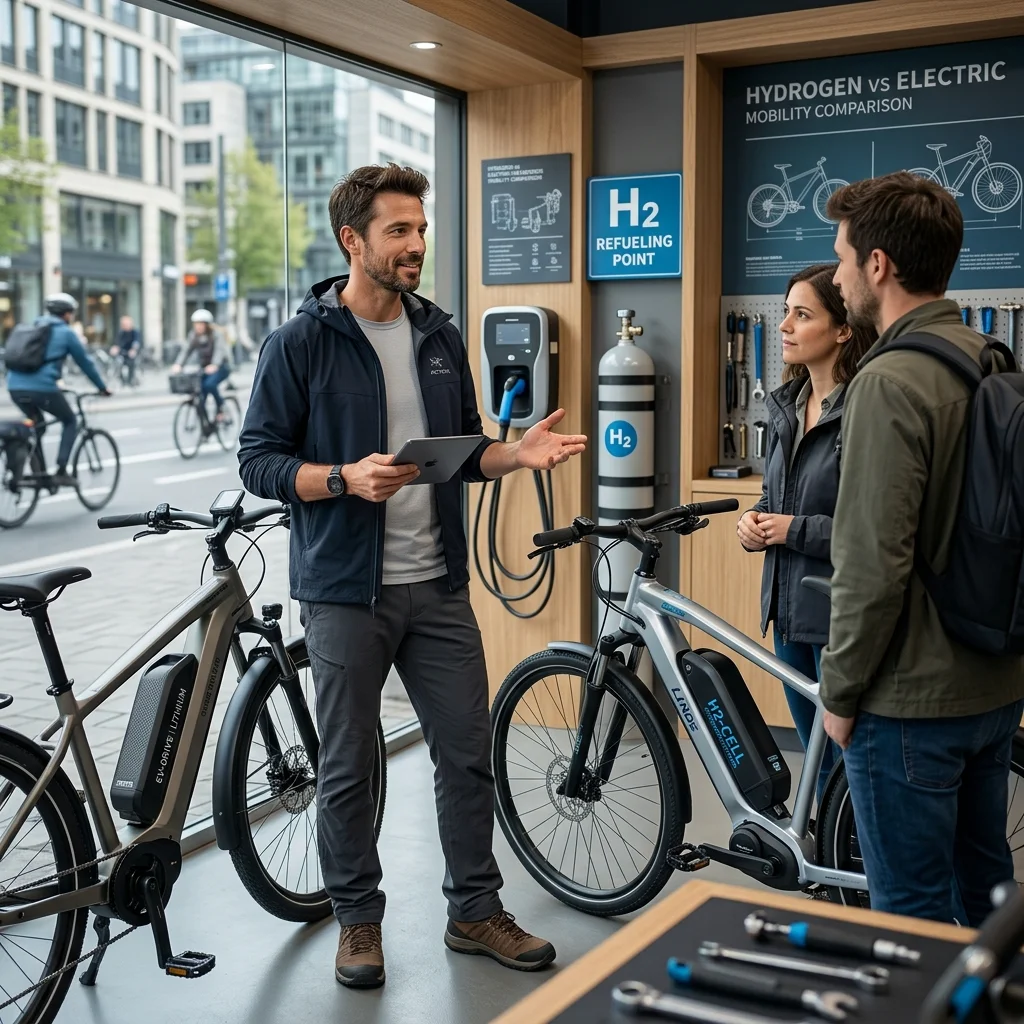
For most U.S. riders, a battery e-bike is the practical choice in 2026. Hydrogen fuel-cell e-bikes are technically real, and some models offer long claimed ranges and very fast refueling. But those advantages matter only when compatible hydrogen, specialist service, and a use case that genuinely benefits from reduced charging downtime are already available.
That distinction changes the comparison. A hydrogen bike is still an electric bike: both technologies use an electric motor. The real question is whether producing, storing, and converting hydrogen into electricity provides enough benefit to justify a more complicated energy system.
For a private rider who can charge overnight, the answer is usually no. For a high-utilization fleet with centralized fueling, the answer can be different.
Research note: Manufacturer specifications in this article are treated as model-specific claims, not universal hydrogen-bike performance figures. U.S. infrastructure figures use the DOE Alternative Fuels Data Center snapshot captured for this research on September 4, 2026. Automotive hydrogen-station availability is never assumed to mean a bicycle can use that station.
Hydrogen vs Electric Bikes: The Practical Answer

The easiest way to decide is to start with your actual operating problem.
A battery e-bike is usually the better fit if you:
- ride privately rather than as part of a managed fleet;
- can charge at home, work, or another regular stop;
- do not need continuous all-day vehicle operation;
- want easy access to replacement batteries, chargers, and service;
- do not already have access to a compatible hydrogen system.
Hydrogen deserves serious investigation if you:
- operate bikes for long shifts where charging creates costly downtime;
- can centralize refueling;
- have a verified source of compatible hydrogen;
- can support specialist fuel-cell and storage-system maintenance;
- have already tested whether spare batteries or opportunity charging solve the problem more simply.
Hydrogen’s strongest advantage is therefore not automatically range. It is the possibility of restoring usable energy quickly when the fueling ecosystem already exists.
That last condition is what most headline comparisons leave out.
Can a Hydrogen Fuel Cell Really Work on a Bicycle?

Yes. The technology works at bicycle scale. But there is no single standard “hydrogen-bike architecture,” which is why broad claims about weight, pressure, range, or refueling can be misleading.
How the System Works
A battery e-bike stores electrical energy directly in a lithium-ion battery. That battery supplies electricity through the bike’s electronics to the motor.
A hydrogen fuel-cell bike adds an energy-conversion stage:
Hydrogen storage → fuel cell → electrical buffer/control system → electric motor
The fuel cell converts hydrogen into electrical energy. Depending on the bike, a small battery or supercapacitor may help handle short bursts of power for acceleration, climbing, or changing loads.
One useful example is Pragma Mobility’s Alpha Neo. Pragma describes a system using a 480 W PEM fuel cell with supercapacitor hybridization.
That tells us fuel-cell bicycles are technically viable. It does not tell us that every hydrogen bicycle uses the same tank pressure, buffer system, weight, or refill method.
Compare the Whole Bike, Not the Weight of the Fuel
Hydrogen has attractive energy-per-mass characteristics, but comparing the mass of hydrogen alone with the mass of a complete e-bike battery creates the wrong impression.
A usable hydrogen bicycle may also need:
- a pressure-rated storage vessel;
- valves and pressure regulation;
- the fuel-cell stack;
- power electronics;
- sensors and control hardware;
- a battery or supercapacitor buffer;
- mounting hardware and frame integration.
Pragma lists the Alpha Neo at roughly 30 kg, with 3-liter, 300-bar hydrogen storage.
That whole-bike figure is far more useful to a rider than saying hydrogen itself is light.
A fair comparison is always:
complete hydrogen bike vs complete battery bike under similar rider, cargo, terrain, and performance conditions.
Performance Depends on the Whole System
Fuel-cell output is also not the same thing as motor output.
A bike may use the fuel cell for relatively steady power while a buffer provides short peaks during acceleration or climbing. Hill performance, payload capacity, handling, and cold-weather behavior therefore depend on the complete drivetrain rather than the fuel cell alone.
Some individual fuel-cell systems have demonstrated low-temperature operation. That is useful evidence about those systems, but it is not enough to conclude that hydrogen bikes universally outperform battery e-bikes in winter.
Range and Refueling: Where Hydrogen Can Look Better on Paper

Long range and short refill times are hydrogen’s most visible selling points. They are also two of the easiest specifications to misuse.
The source set reviewed for this article contains materially different examples:
- Pragma Alpha Neo: manufacturer claim of up to roughly 150 km of range, with approximately two-minute refueling at a compatible dedicated 300-bar station.
- Velhy systems: manufacturer material describes configurations around roughly 40–60 km, using a materially different hydrogen-storage and home-electrolyzer approach.
- Hydroride demonstration: Electrek’s 2024 firsthand ride coverage discussed a system with roughly 60 km of range.
Those are not contradictory figures. They describe different products, architectures, and evidence sources.
The same warning applies to battery e-bikes. Real range changes with terrain, rider and cargo weight, assistance level, speed, temperature, tires, battery capacity, and drivetrain condition.
So “150 km hydrogen vs 60 km battery” is not a useful technology comparison unless the bikes and test conditions are genuinely comparable.
A Two-Minute Refill Does Not Mean Two Minutes From Empty to Ready
This is one of the most important distinctions in the entire comparison.
Refueling means transferring already-available hydrogen into the bike’s storage system.
Hydrogen production means creating that hydrogen in the first place.
A dedicated station may refill a compatible bike in minutes because the hydrogen has already been produced, processed, and made available for dispensing.
A small home electrolyzer starts much earlier in the chain. Manufacturer material reviewed for some systems describes several hours to generate and fill hydrogen.
The more useful metric is therefore time to riding again:
obtain or produce hydrogen → make it available at the correct pressure/storage state → dispense or swap it → resume riding
For batteries:
reach electrical power → charge the battery, or install a charged spare → resume riding
That comparison matters because a fleet with interchangeable batteries may be back on the road almost immediately without introducing a hydrogen system.
When Faster Refueling Has Real Value
Imagine two riders.
Rider A commutes 20 miles a day and parks the bike overnight. A four-hour battery charge does not cost this rider four productive hours because the bike was going to sit overnight anyway.
Fleet B needs cargo bikes circulating through long delivery shifts. If a vehicle regularly stops operating because its battery is depleted, turnaround time can affect productivity.
Hydrogen’s fast-refill proposition is much more relevant to Fleet B.
Even then, the comparison should be against realistic battery alternatives:
- larger batteries;
- removable batteries;
- charged-spare rotation;
- opportunity charging during loading or meal breaks.
If one of those options removes the downtime problem, hydrogen loses much of its operational advantage.
The U.S. Problem: Buying, Fueling, and Servicing One

This is where the comparison becomes much less favorable to hydrogen for ordinary U.S. ownership.
Hydrogen bicycles exist. That does not automatically mean they are readily purchasable, fuelable, serviceable, and supported where you live.
Treat “availability” as three separate questions.
1. Does the Product Exist?
For several fuel-cell bicycle and cargo-bike systems, yes.
2. Can You Actually Buy and Support It in Your Market?
That requires verification from the manufacturer or an authorized distributor.
You need to know whether the exact model has:
- U.S. sales or distribution;
- warranty support;
- replacement parts;
- trained service capability;
- documentation appropriate to the intended market.
A European product page does not establish U.S. ownership practicality.
3. Can You Operate It With Compatible Hydrogen?
This is the biggest trap.
In the DOE Alternative Fuels Data Center snapshot captured for this research on September 4, 2026, the U.S. public table showed 39 retail and six non-retail hydrogen stations. The retail network was overwhelmingly concentrated in California, with 38 retail locations there and one in Hawaii.
But those are hydrogen-station counts, not hydrogen-bike compatibility counts.
A nearby automotive station does not prove that it can safely or correctly fill a particular bicycle.
The Refueling Hardware Has to Match the Bike
A hydrogen bike’s storage pressure, connector, dispensing method, and manufacturer requirements all matter.
Pragma, for example, describes the Alpha Neo around 300-bar storage and dedicated 300-bar refueling.
Other reviewed systems take different approaches.
So before treating any station as usable, confirm compatibility for the exact bicycle.
Do not improvise hydrogen refueling. Tank modification, homemade connectors, improvised compression, or unapproved filling arrangements introduce serious safety risks. Use only manufacturer-approved equipment and qualified systems.
Five Things to Verify Before Considering a Hydrogen E-Bike
Before spending money, get clear answers to all five:
- Is the exact bike sold and supported where you live?
- Where will its hydrogen actually come from?
- Is the pressure, connector, and refill method compatible?
- Who services the fuel-cell and storage system?
- What certification, warranty, and replacement-component documentation is available?
If any one of those answers is vague, the bike may exist technically without being a practical ownership option.
Ownership Cost: Why Fuel Price Alone Tells You Very Little

There is not enough comparable current evidence to support one universal “hydrogen costs X per mile” figure for bicycles.
The correct comparison is total ownership burden.
For a private rider, that includes:
bike purchase + energy + maintenance + replacement components + any required fueling equipment + service access
For a fleet, add:
infrastructure + technician/training costs + downtime + inventory of spare bikes, batteries, or tanks
Purchase Cost Is Only the Beginning
Battery e-bikes operate inside a mature ecosystem of chargers, batteries, shops, parts, and suppliers.
A hydrogen bike may use many conventional bicycle components, but the fuel-cell, storage, and refueling portions of the system can require specialized support.
That creates a practical cost even before you calculate the price of the hydrogen itself.
A cheaper fuel source is not particularly helpful if reaching it or servicing the bike creates operational downtime.
Why Cost-Per-Mile Comparisons Can Be Misleading
Hydrogen operating cost depends on:
- how the hydrogen was produced;
- whether it is purchased or generated on site;
- electricity prices if electrolysis is involved;
- storage and dispensing equipment;
- utilization of that equipment;
- fuel-cell system efficiency.
Battery operating cost depends on electricity pricing, charging losses, battery efficiency, and battery replacement over time.
Without an equivalent route, payload, vehicle, duty cycle, and local energy price, a precise cross-technology cents-per-mile figure creates more confidence than the evidence deserves.
For Fleets, Calculate the Cost of Downtime
Hydrogen becomes financially interesting only if its additional complexity buys something valuable.
A useful fleet calculation is:
annual ownership cost = vehicle/equipment cost + energy + maintenance + infrastructure + cost of operational downtime
If hydrogen saves enough productive operating time to offset the extra infrastructure and service burden, it may justify a pilot.
If a $1 spare-battery strategy—figuratively speaking—solves the same problem as a far more complicated fueling system, the hydrogen case becomes much harder.
The exact numbers should come from the fleet’s own operating data, not from generic online cost claims.
Emissions: “Water Vapor” Is Not the Whole Environmental Story

A hydrogen fuel cell does not produce carbon-dioxide exhaust while generating electricity on the bicycle.
That is useful, but it answers only a narrow part of the environmental question.
To compare hydrogen and battery e-bikes responsibly, look at the energy pathway.
For hydrogen:
energy source → hydrogen production → compression/storage → delivery → fuel cell → motor
For a battery:
electricity generation → grid → battery charging → battery → motor
A full lifecycle comparison may also include manufacturing and replacement of batteries, tanks, fuel cells, and other components.
The Source of the Hydrogen Matters
The U.S. Department of Energy notes that emissions from electrolysis depend on the electricity used to produce the hydrogen.
That gives us several very different situations.
Hydrogen made using low-carbon electricity:
Production emissions can be relatively low, although storage, compression, delivery, and reconversion still require energy.
Hydrogen produced from fossil resources:
Production emissions can materially change the lifecycle result.
Battery charged with low-carbon electricity:
The direct electricity pathway can have low operating emissions.
Battery charged on a more carbon-intensive grid:
Charging-related emissions rise.
There is therefore no responsible universal statement that “hydrogen bikes are zero-emission” or that one technology is always environmentally superior.
Why Direct Electricity Usually Has an Efficiency Advantage
When both systems ultimately start with electricity, the battery route is more direct.
Electrolysis-based hydrogen typically requires electricity to create hydrogen, energy to prepare and store it, and then another conversion inside the fuel cell to turn that hydrogen back into electricity.
A battery stores and releases electrical energy with fewer conversion stages.
That does not settle every lifecycle question, but it explains why low-carbon hydrogen should not automatically be assumed to beat using the same low-carbon electricity directly in a battery.
For a strong environmental comparison, the production pathway matters more than the word hydrogen on the bike.
Safety: Different Hazards, Different Controls

The useful question is not “Which one can catch fire?”
Both energy systems have hazards. They are different hazards, managed with different engineering controls.
There is not enough comparable bike-level incident evidence in the reviewed research to justify calling all hydrogen bikes safer than all lithium-ion e-bikes, or vice versa.
What Can Go Wrong With Hydrogen Systems?
Hydrogen-specific concerns can include:
- pressurized storage;
- leakage;
- ignition of released hydrogen;
- damaged tanks or fittings;
- incorrect refueling pressure or hardware.
The appropriate controls include pressure-rated storage, regulators, valves, pressure-relief systems where applicable, leak management, compatible connectors, and manufacturer-defined inspection and servicing procedures.
The DOE’s high-pressure hydrogen tank-testing material describes extensive testing approaches used for high-pressure vehicle storage systems.
That evidence shows why engineered controls matter. It does not prove every hydrogen-bike system has the same risk profile.
What Can Go Wrong With Lithium-Ion Systems?
Battery e-bikes have a different set of concerns:
- damaged or defective cells;
- electrical faults;
- charger incompatibility;
- poor-quality battery packs;
- overheating and thermal runaway.
Battery-management systems, properly matched chargers, quality cells, and system-level safety certification are important controls.
UL 2849, for example, addresses the e-bike electrical system, including the drivetrain, battery system, and charger.
That standard does not cover the hydrogen-fuel portion of a fuel-cell bike. The systems require different documentation.
What Buyers Should Actually Check
For either technology, verify:
- safety documentation for the complete system;
- manufacturer-approved charging or refueling equipment;
- operating and temperature limits;
- replacement-part requirements;
- inspection and service procedures;
- warranty and technical support.
A viral lithium-battery fire video does not establish an incident rate. Neither does a successful hydrogen tank test prove that an entire class of bikes is categorically safer.
The evidence should match the claim being made.
Why Hydrogen E-Bikes Are Still Rare

If hydrogen bikes can work and some can refill quickly, why have they not become common?
Because a specification advantage is not the same thing as a useful operating advantage.
A fuel-cell bike needs an ecosystem around it:
product availability → compatible hydrogen → reliable refueling → service → safety procedures → enough operating benefit to justify all of the above
If one link is weak, the value proposition can collapse.
What Real Cargo-Bike Deployments Reveal
A 2026 Frontiers study of fuel-cell cargo-pedelec deployment provides unusually useful evidence because it examines what happened when the technology moved beyond specifications and into real operating environments.
The reported obstacles included issues around refueling access, standards and interoperability, specialist maintenance, safety procedures, and organizational complexity.
More importantly, the potential hydrogen advantages were not always needed by the actual duty cycles being served.
That finding deserves careful interpretation. The study concerns European cargo and fleet deployments, not ordinary U.S. consumer bicycles.
But the operating principle transfers:
extra range is valuable only when the bike needs the extra range; faster refueling is valuable only when charging time is actually constraining the operation.
That explains much of the gap between an impressive technical specification and slow adoption.
When Hydrogen E-Bikes Could Actually Make Sense

Hydrogen is easier to justify when the operating environment is controlled and the bikes are used intensively.
High-Utilization Delivery and Cargo Fleets
This is the clearest potential fit.
Consider hydrogen when:
- bikes operate long enough to exhaust practical battery capacity;
- stopping to charge meaningfully reduces productive hours;
- vehicles return to one or a few depots;
- compatible hydrogen can be stored or supplied centrally;
- specialized service is available;
- utilization is high enough to spread infrastructure cost across many operating hours.
Even then, compare hydrogen against removable batteries first.
A technology should win because it solves the fleet’s problem better—not because its refill specification is more impressive.
Campuses, Industrial Sites, and Controlled Fleets
Closed environments may also make more sense than consumer ownership.
Examples could include:
- large campuses;
- industrial facilities;
- controlled bike-sharing systems;
- logistics depots;
- research or demonstration fleets.
Centralization makes fueling, training, inspection, and maintenance easier to manage.
Tank swapping may also be more practical in these environments. A July 2026 study specifically modeled hydrogen cargo-bike refueling and tank-swapping infrastructure, reinforcing how strongly the concept is tied to fleet logistics rather than ordinary home ownership.
The Four-Question Hydrogen Test
Before pursuing hydrogen, answer these in order.
1. Is battery charging genuinely limiting useful operation?
If the bike can recharge overnight or during normal downtime, stop here. The main hydrogen advantage may not solve a real problem.
2. Have you tested simpler battery alternatives?
Compare larger batteries, removable packs, spare-battery rotation, and opportunity charging.
If they solve the problem at lower complexity, use them.
3. Do you have verified compatible hydrogen and specialist service?
An automotive hydrogen station nearby is not enough.
Confirm the exact fueling system and service path for the exact bike.
4. Does the uptime benefit still justify the added infrastructure and operating complexity?
If yes, a controlled hydrogen pilot may be reasonable.
If no, the technology may be technically interesting without being operationally better.
The Bottom Line

For most private U.S. riders in 2026, a battery e-bike remains the sensible choice. Charging access, product selection, repair options, and replacement components are simply easier to obtain.
Hydrogen becomes interesting in a much narrower situation: high vehicle utilization, expensive charging downtime, centralized refueling, compatible equipment, and enough operating scale to justify specialist infrastructure.
That is also the best way to think about the technology’s future. The important question is not whether a hydrogen bike can travel farther or refill faster under particular conditions.
It is whether those capabilities solve a problem that batteries do not already solve more simply.
If range is the main reason you’re considering hydrogen, start by calculating how much range you actually need and what reduces it in normal use. See our guide to what affects electric-bike range before deciding that you need a different energy system.
Pingback: SEO title: Future of Electric Bikes: What’s Real, Emerging & Worth Waiting For *** - electricscootercar.com
Comments are closed.