Safety information checked: September 9, 2026
E-bike battery fires are a real hazard, but current U.S. evidence does not support one universal “1 in X” fire probability for a typical owner. What matters more is whether your battery has a specific warning sign or known risk factor.
If the battery is smoking, venting gas, rapidly getting hotter, making escalating hissing or popping sounds, or on fire, get away, evacuate others and call 911. If it is swollen, leaking, badly damaged, giving off a burning or chemical odor, or covered by an official stop-use warning, do not ride or charge it.
Use the quick check below to decide what to do next.
Is Your E-Bike Battery a Fire Risk Right Now?

You do not need to diagnose individual cells. You need to decide whether the battery can still be treated as normal.
Normal use: The battery has no swelling, cracks, leaks, strange odor, smoke or unusual heat; charging behavior has not changed; you are using the approved charger; and you have found no applicable recall or safety warning.
Continue using it according to the manufacturer’s instructions. However, a normal-looking exterior does not prove that a battery is undamaged after a serious crash, flooding or other unusual event.
Caution: Something has changed, such as repeated charging errors, a connector becoming unusually hot, unexplained shutdowns or a charging pattern that suddenly differs from normal.
Do not keep charging simply to see whether the problem disappears. Check the manufacturer’s instructions or obtain qualified service advice.
Stop using the battery: Swelling, deformation, cracking, leaking, a burning or chemical smell, melted components, suspected internal water exposure, significant impact damage, an incompatible charger, or an official stop-use warning means the battery should no longer be treated as routine.
Do not ride or recharge it until the appropriate manufacturer, service provider or safety authority tells you what to do.
Emergency: Smoke, flames, visible gas venting, rapidly increasing heat or escalating popping/hissing means the situation has moved beyond troubleshooting.
Leave the area and call 911. USFA identifies bulging, physical damage, hissing or popping, visible gas venting and rising temperature among signs associated with battery damage or thermal runaway.
The useful distinction is simple:
Changed behavior deserves investigation. Physical or thermal warning signs mean stop use. Active failure means get out.
How Common Are E-Bike Battery Fires?

The most accurate answer is:
They clearly occur, but the available national data cannot tell an individual U.S. owner an exact personal probability.
CPSC’s April 2026 report reviewed 145 completed in-depth e-bike incident investigations from its Consumer Product Safety Risk Management System. Fire hazards were identified in 106 of those investigated incidents. Among those 106 fire-hazard reports:
- 62 described fires beginning while charging;
- 13 occurred while the battery was idle and not charging;
- 4 happened during use;
- other cases involved maintenance, wiring, powering on, or circumstances CPSC could not fully determine.
Those numbers are useful for understanding how fires can occur. They are not evidence that 106 out of every 145 e-bikes catch fire.
Why? These were investigations of reported incidents, not 145 randomly chosen e-bikes from the U.S. population. CPSC itself describes the relevant CPSRMS data as anecdotal and not nationally representative, and notes that data collection remains ongoing.
What that means for you
Be skeptical of any precise-looking claim such as “one battery in X catches fire” unless it clearly explains:
- which batteries were counted;
- which country and years were studied;
- what qualified as a fire;
- how many e-bikes or batteries were actually in use;
- and how the probability was calculated.
Without a suitable denominator, an incident count is not an individual risk percentage.
For an owner, the more useful question is not “What are my exact odds?” but “Does my particular battery have factors that make continued use questionable?”
Why Do E-Bike Batteries Catch Fire?

A severe lithium-ion battery failure can enter thermal runaway, an uncontrolled self-heating chain reaction that can result in fire or explosion.
USFA identifies conditions including overheating and physical damage as potential contributors and notes that lithium-ion batteries can release flammable gases when exposed to high temperatures or damage.
In simple terms:
damage or electrical failure → increasing internal heat → further cell breakdown → additional heat and gas → possible fire, venting or propagation to nearby cells.
The practical lesson is more important than the chemistry: if you have reason to suspect internal damage, the fact that the bike still powers on does not prove the battery is safe to recharge.
The charger is part of the safety system
A connector that physically fits your charging port does not prove that a charger is compatible.
CPSC warns that chargers marketed as “universal” can fit a micromobility device while still being electrically incompatible. Between January 2023 and May 16, 2024, CPSC received 156 reports of fire or thermal incidents involving universal micromobility chargers.
CPSC therefore recommends using the supplied charger or a replacement that has been specifically tested and approved for the device.
The 2026 CPSC incident review also noted that at least four of the 62 investigated e-bike charging-fire reports mentioned aftermarket battery packs or chargers. That does not prove the aftermarket equipment caused those fires, but it reinforces why exact compatibility matters.
A BMS is protection, not permission to ignore other problems
A battery management system is part of an e-bike’s electrical safety architecture, but the entire system still matters.
UL 2849 evaluates combinations involving the e-bike’s electrical drivetrain, battery and charger rather than treating the battery as an isolated component.
So “this pack has a BMS” should not override swelling, physical damage, an incompatible charger, an official warning or other abnormal behavior.
Can an E-Bike Battery Catch Fire When It Is Not Charging?

Yes. Unplugged does not automatically mean safe.
In CPSC’s 2026 investigation review, 13 of the 106 e-bike fire-hazard incidents occurred while the battery was idle and not charging.
A product-specific warning shows why this matters. In CPSC’s warning about certain Rad Power Bikes batteries, the agency reported fires that occurred while some batteries were not charging, the bikes were not being used and the products were in storage. The warning also identified water and debris exposure as a particular concern for those battery models.
That does not mean a healthy stored e-bike battery is expected to ignite.
It means disconnecting a battery does not undo a defect or internal damage that already exists.
A realistic delayed-risk scenario
Suppose your bike falls hard enough to strike the battery pack.
The pack still turns the bike on. Nothing smells unusual. There is no smoke.
That is reassuring, but it is not the same as proving nothing inside was damaged.
If a battery has experienced a significant impact, suspected water ingress or abnormal overheating, do not use the next charging cycle as an experiment.
Warning Signs That Mean Stop Using the Battery

You do not need a dozen separate symptom guides. The important question is what action the symptom requires.
Stop riding and charging
Stop using the battery and seek manufacturer or qualified guidance if you notice:
- swelling, bulging or a change in shape;
- cracks, crushing or significant physical damage;
- leaking;
- a burning-plastic or unusual chemical smell;
- unexpected or persistent abnormal heat;
- melted connectors or casing;
- sparking;
- suspected water inside the battery, connector or harness;
- an applicable CPSC recall or product safety warning.
USFA lists mechanical damage, bulging and rising temperature among warning signs associated with battery damage or thermal runaway.
Move from “stop use” to “emergency”
Smoke, visible gas, rapidly escalating heat, flames or repeated hissing/popping should not lead to more inspection.
Get out.
FDNY’s current lithium-ion battery guidance likewise tells users to stop using or charging batteries showing conditions such as smoke, overheating, shape changes, odd noises, leaking or strange smells, and to call 911 in an emergency.
Warmth by itself is not enough to diagnose a dangerous battery. A temperature that is unexpectedly high, increasing, or accompanied by another warning sign is what changes the decision.
What Should You Do After a Drop, Crash, Water Exposure or Overheating?

A battery can require attention even before obvious warning signs develop.
After a significant drop or crash
If the battery itself, its casing or its mounting area took a hard impact:
- stop before recharging it;
- look for cracking, deformation, looseness, damaged connectors or unusual heat;
- follow the bike or battery manufacturer’s post-impact guidance;
- obtain qualified inspection when damage is uncertain.
Do not open a sealed battery pack to inspect the cells yourself.
After rain, flooding or other water exposure
A normal ride in conditions explicitly permitted by the manufacturer is different from flooding, submersion, damaged seals, visible corrosion or water reaching the battery connector/harness.
If you suspect water entered the electrical system, do not recharge the battery merely to test whether it still works.
CPSC’s warning concerning specific Rad Power Bikes batteries is an example of why water ingress should not automatically be dismissed: the agency said those batteries could unexpectedly ignite, particularly after battery or harness exposure to water and debris.
After unusual overheating
If the pack became significantly hotter than its normal behavior, let that change your next decision.
Do not immediately put it back on the charger.
If the temperature continues to rise or heat appears with odor, swelling, gas, smoke or unusual noises, move away and call emergency services.
What Should You Do if the Battery Smokes, Hisses or Catches Fire?

Once a battery is actively failing, your job is no longer to diagnose it.
1. Get people away.
Leave the affected area and preserve your escape route.
2. Call 911 from a safe location.
Tell the dispatcher that a lithium-ion battery or e-bike is involved.
3. Do not take unnecessary risks to move or save the bike.
A smoking, burning or rapidly heating pack should not be carried through an occupied home simply to protect property.
USFA’s public safety guidance says that if a lithium-ion battery fire occurs, users should evacuate and call 911 rather than attempting to put it out themselves.
FDNY also warns residents not to allow micromobility devices or batteries to block their exit route.
The priority is people and a clear exit, not the battery.
How to Reduce Fire Risk While Charging and Storing

For a healthy battery, most everyday fire-prevention habits are straightforward.
CPSC currently advises consumers to be present while charging, never charge while sleeping, use the supplied charger, use approved replacement battery packs, follow manufacturer charging instructions and unplug when charging is complete.
A practical routine is:
- use the charger supplied or specifically approved for your exact system;
- follow the manufacturer’s charging and temperature instructions;
- stay awake and present while charging;
- unplug when charging is complete;
- do not charge a damaged, swollen, wet or otherwise questionable pack;
- keep the bike and battery from blocking your route out;
- stop charging if abnormal heat, odor, smoke, swelling or unusual sounds appear.
If you live in an apartment
Escape-route placement matters more than convenience.
Fire-service guidance from FDNY specifically tells residents not to block exits with e-bikes or batteries and warns against charging near apartment exits where a fire could prevent escape. Local building and fire rules vary, so check your own jurisdiction and property rules rather than assuming NYC requirements apply everywhere.
If you charge several batteries
Do not let several packs turn into an unidentified collection of chargers and batteries.
Keep each approved charger associated with the correct pack, remove questionable batteries from normal use, keep charging areas uncluttered and seek qualified electrical advice if you are unsure whether the circuit or charging setup is appropriate for multiple devices.
What about “fireproof” bags, boxes or cabinets?
Do not use a containment product as justification for continuing to charge a damaged, recalled or otherwise unsafe battery.
Before relying on a containment claim, ask what was actually tested: a small cell or a full e-bike pack, what battery capacity was involved, whether heat, flame, smoke and gas were considered, and whether charging was taking place.
Without applicable test evidence, treat containment as an additional precaution, not a way to make an unsafe battery safe.
How to Check Recalls and Verify Battery Safety Claims

A recall check becomes useful only when you can match the warning to your exact product.
CPSC now maintains a combined Recalls & Product Safety Warnings search, and its data are updated as new actions are announced. Remedy information can also change.
Check your battery in six steps
- Record the e-bike brand and model.
- Find the battery’s exact model number and identifying label information.
- Record the charger model when relevant.
- Search the CPSC Recalls & Product Safety Warnings database.
- Check the manufacturer’s official safety or recall page.
- Match the exact model and follow the official instructions rather than assuming every product from that brand is affected.
Do not search only for the word “recall.”
Some dangerous products receive a CPSC product safety warning when a manufacturer has not agreed to an acceptable recall. CPSC’s Rad battery warning is one example.
UL 2849 vs UL 2271
The two standards solve different verification questions.
UL 2849 concerns the electrical system of the e-bike and examines the drivetrain, battery and charger system combination.
UL 2271 applies to batteries used in light electric vehicle applications. UL’s own UL 2849 information distinguishes the full e-bike electrical-system standard from UL 2271 battery certification.
For a complete e-bike, “the cells are certified” or “the battery uses UL cells” is not the same statement as certification of the full battery pack or complete electrical system.
Verify the listing, not just the logo
Do not rely solely on a UL-looking image in an online marketplace listing.
UL Product iQ is UL Solutions’ certification-information database and can be searched using identifiers such as model numbers, file numbers and other product information.
The practical workflow is:
product label → exact model → standard claimed → certification database → matching listing.
If you cannot make that match, treat the certification claim as not yet verified.
Certification is also not permission to ignore physical damage or a later recall.
Do Conversion Kits and Modified E-Bikes Need Extra Caution?

A conversion kit is not automatically unsafe.
The important issue is whether the components work together as a documented system.
Think of the chain as:
battery → BMS → charger → controller → motor/electrical system
A matching voltage label or a plug that fits does not establish every compatibility requirement.
UL 2849’s system-level approach is useful here because it evaluates the battery, charger and electrical drivetrain combination rather than considering one component alone.
Be more cautious when:
- the battery and charger came from unrelated sellers;
- compatibility documentation is missing;
- wiring or connectors have been modified;
- the battery’s history is unknown;
- the pack is rebuilt or recelled without traceable workmanship;
- certification claims cannot be verified.
There is also direct product-safety evidence behind this concern. CPSC warned consumers to stop using specific Unit Pack Power U004 and U004-1 batteries sold for converting pedal bicycles to e-bikes after U.S. overheating and fire reports. CPSC also noted that those specific batteries had not been certified by an accredited laboratory to the applicable UL safety standard.
That case does not prove all conversion-kit batteries are dangerous.
It shows why origin, compatibility, workmanship and exact product verification matter.
When Should an Old or Questionable Battery Be Replaced?

Do not treat age and danger as the same thing.
An aging battery may gradually lose usable capacity. A battery that has become swollen, unusually hot, damaged, leaking, foul-smelling or subject to an official stop-use warning presents a different decision.
USFA identifies cycling and aging as factors in lithium-ion battery degradation, but its immediate warning signs focus on conditions such as mechanical damage, bulging, unusual sounds, gas venting and rising temperature.
So ask two separate questions:
Is the battery becoming inconvenient?
Gradual range loss may be primarily a performance/replacement issue.
Is the battery becoming unsafe to keep using or charging?
Swelling, damage, abnormal heat, leaking, odor, smoke, a safety warning or unresolved compatibility problem turns replacement into a safety decision.
Do not attempt to make an unsafe battery economical again through unqualified cell replacement or BMS bypass work.
How to dispose of an e-bike battery safely
EPA says lithium-ion batteries and devices containing them should not go in household garbage or ordinary recycling bins. They should go through separate battery-recycling or household hazardous-waste channels.
A damaged, defective or recalled e-bike battery can require different handling from an ordinary end-of-life battery.
For example, CPSC’s Rad warning tells consumers to contact their municipal household hazardous-waste facility ahead of time to confirm that it accepts hazardous lithium-ion batteries.
For a questionable battery:
- Check the manufacturer’s or CPSC’s exact disposal instructions.
- Contact your local household hazardous-waste program before transporting it.
- Tell them that it is an e-bike lithium-ion battery and describe its condition.
- Follow their transport and drop-off instructions.
Do not personally transport a battery that is smoking, actively venting or rapidly overheating. Call emergency services instead.
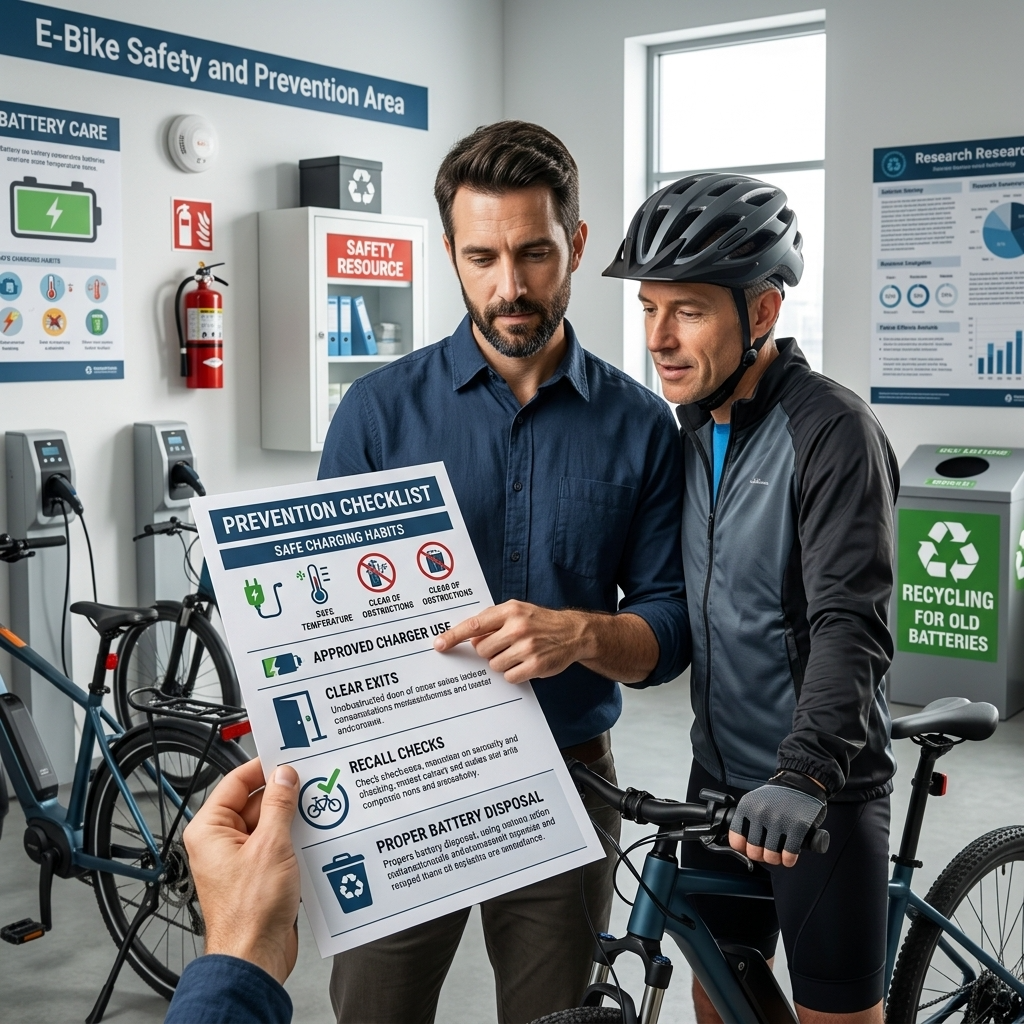
E-Bike Battery Fire-Prevention Checklist
Before charging or riding, make these checks routine:
- Use the supplied or specifically approved charger.
- Never treat “the connector fits” as proof of charger compatibility.
- Charge while you are awake and present.
- Follow the manufacturer’s charging instructions.
- Unplug when charging is complete.
- Keep your exit route clear.
- Do not recharge a battery with serious impact damage, suspected internal water exposure, swelling, leaking, smoke or abnormal heat.
- Check both CPSC recalls and product safety warnings for your exact model.
- Verify safety-certification claims against the exact product rather than trusting a marketplace logo.
- Be more cautious with undocumented conversions, unknown secondhand packs and unqualified rebuilds.
- Do not put lithium-ion e-bike batteries in household trash or normal recycling.
- If the battery begins smoking, venting gas, rapidly heating, hissing repeatedly or burning, get out and call 911.
The goal is not to be afraid of every e-bike battery.
It is to recognize the point where a battery stops being a routine charging problem and becomes a stop-use or emergency problem.
If your battery is healthy and you want more detailed day-to-day charging guidance, continue with the site’s E-Bike Battery Charging Tips guide. If the pack is swollen, damaged or behaving abnormally, move instead to How to Check E-Bike Battery Health Safely rather than continuing to experiment with charging.
Pingback: SEO title: Electric Bike Battery Safety: Charging, Warning Signs & UL Checks - electricscootercar.com
Pingback: E-Bike Road Safety Tips: How to Ride Safely in Traffic - electricscootercar.com
Pingback: SEO title: Electric Bike Overheating? Diagnose the Cause Before Replacing Parts - electricscootercar.com
Pingback: Battery Recycling Process: How E-Bike & EV Batteries Become New Materials - electricscootercar.com
Pingback: Why Does My E-Bike Cut Out While Riding? Diagnose It Without Guessing - electricscootercar.com
Pingback: What Is a BMS on an E-Bike? How It Works, Protects & Troubleshoots Problems - electricscootercar.com
Pingback: Electric Bike Import Rules USA (2026): CPSC, Customs & Duties - electricscootercar.com
Comments are closed.