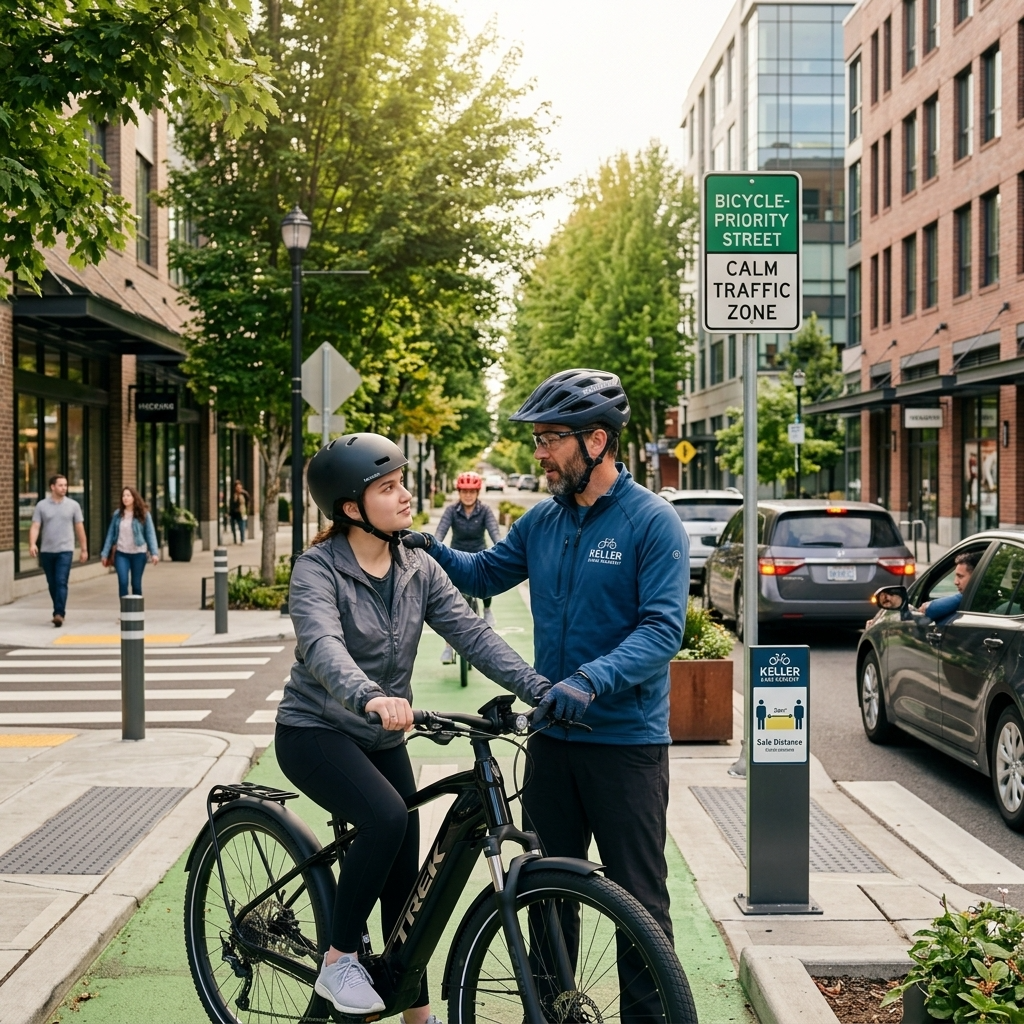
The most important e-bike road safety skill is creating time and space before a traffic conflict becomes an emergency. That means controlling your bike confidently, riding predictably, choosing a position where you can see and be seen, slowing before intersections and uncertain hazards, and keeping enough room to stop.
If you’re new to an e-bike, practice its acceleration, braking, turns and shoulder checks away from busy traffic first. NHTSA recommends learning bike-control skills in a safe environment before riding in traffic and emphasizes predictable riding, hazard awareness and checking behind before changing position.
One important qualification: e-bike access and road rules vary across U.S. states and local jurisdictions. Use the riding principles below as safety guidance, but verify current official rules for the roads, bike lanes, sidewalks and paths you intend to use. CPSC likewise advises riders to follow the traffic and riding-location rules that apply where they live.
Quick E-Bike Road Safety Checklist

Before entering traffic:
- Wear a properly fitted bicycle helmet.
- Check your tires, brakes, wheels, steering, lights and controls.
- Make sure you can start, stop, turn and look behind without losing your line.
- Use an assist or throttle level you can control smoothly.
- Ride with traffic and follow applicable signs, signals and markings.
- Hold a predictable line rather than weaving around obstacles at the last second.
- Scan ahead, across intersections and behind before changing position.
- Slow before driveways, intersections, parked cars and blocked sightlines.
- Stay out of parked-car door zones and vehicle blind spots where possible.
- Leave enough space to react and stop.
- Use lights, reflectors and clear signals appropriate to the conditions.
- End the ride if your bike, visibility, road conditions or ability to control the bike becomes unsafe.
A useful mental check whenever traffic becomes uncertain is:
What could cross my path? Can they detect me? Can I stop in time? Do I have somewhere to go if they move?
That question is more useful than simply telling yourself to “be careful.”
Get Comfortable With Your E-Bike Before Entering Traffic

Knowing how to ride a conventional bicycle does not automatically mean a new e-bike will feel familiar.
Motor assistance can change how quickly the bike accelerates after a slow turn or restart. The bike may also be heavier than the bicycle you are used to, and braking response differs between models.
Practice the Skills Traffic Will Demand
Use a traffic-free area first.
Make sure you can reliably:
- Start without wobbling or surging forward.
- Stop smoothly and under control.
- Turn tightly at low speed.
- Look over either shoulder while continuing straight.
- Signal without drifting sideways.
- Slow down and accelerate again smoothly.
- Perform increasingly firm stops without losing control.
NHTSA specifically recommends beginning in a safe environment away from traffic before developing traffic-riding skills.
A sensible learning progression is:
Traffic-free area → quiet street → familiar low-traffic route → more complex traffic
There is no benefit in moving to the next stage before basic control feels routine.
Learn Exactly When the Motor Adds Power
Before mixing with cars, understand how your particular e-bike behaves.
Find out:
- When pedal assist begins.
- How strongly each assist level responds.
- Whether assistance continues briefly after you stop pedaling.
- How a throttle responds, if fitted.
- How the bike behaves when you brake.
- Whether the manufacturer specifies any brake motor-cutoff behavior.
Use your owner’s manual for model-specific information.
In tight turns, congested areas, crowded paths and uncertain intersections, aggressive assistance can reduce your margin for correcting a mistake. Select a level that lets you accelerate smoothly rather than using maximum available power simply because it is available.
Do a One-Minute Go/No-Go Check
NHTSA recommends a pre-ride check, and its current guidance stresses that a bike must be mechanically functional before rider skill can help. Its pre-ride material specifically highlights tires, brakes and drivetrain condition.
Before leaving, confirm:
- Brakes respond normally.
- Tires appear properly inflated and undamaged.
- Wheels and steering feel secure.
- Lights needed for your riding conditions work.
- The battery is firmly secured.
- Assist and throttle controls behave normally.
- Nothing feels newly loose, unstable or abnormal.
If something safety-critical feels wrong in the driveway, it will not become safer because you enter traffic.
Ride So Drivers Can Predict What You Will Do

Defensive riding does not mean riding timidly. It means giving yourself enough information and space to respond before another road user’s mistake forces an emergency reaction.
NHTSA advises bicyclists to ride with the flow of traffic, obey traffic controls, remain focused, anticipate what other road users may do and ride predictably.
A useful traffic rhythm is:
Scan → predict → communicate → position → preserve space → scan again.
Hold a Predictable Line
Avoid unnecessary weaving between parked cars, traffic and the curb.
Before moving sideways:
- Look behind.
- Signal when appropriate.
- Check that the intended space is still available.
- Move progressively rather than abruptly.
A predictable rider gives a driver more time to understand what is happening.
Scan Farther Than the Wheel in Front of You
Split your attention between three areas.
Ahead: brake lights, turning vehicles, parked-car activity, potholes, pedestrians, lane endings and traffic signals.
Across: driveways, side streets, oncoming vehicles waiting to turn and people entering the road.
Behind: overtaking traffic that matters before you turn, merge or move around an obstruction.
The earlier you recognize a possible conflict, the less dramatic your response needs to be.
Do Not Treat Eye Contact as a Guarantee
A driver may look directly toward you without correctly judging your speed or realizing where you intend to go.
Use driver behavior as information, but do not make your safety depend on being certain that another person has seen and understood you.
If you are unsure, create more time:
slow down, increase space and prepare to stop.
Where Should You Position an E-Bike in Traffic?

There is no single position that works on every U.S. road.
Instead of memorizing “always ride here,” evaluate the situation in front of you.
Ask:
- Is this space actually usable?
- Can turning drivers see me?
- Are parked-car doors a threat?
- Is the lane becoming too narrow for a safe pass?
- Is there debris or broken pavement?
- Can I move predictably if the bike lane ends?
- Do local rules affect where I may ride?
NHTSA recommends riding where you are expected to be seen, minimizing blind spots and checking over your shoulder before changing lane position or turning.
In a Painted Bike Lane
Do not assume the entire painted area is automatically safe.
Watch for:
- Parked-car doors.
- Delivery vehicles.
- Broken pavement.
- Debris.
- Drainage grates.
- Vehicles crossing the lane to reach driveways.
- Right-turning vehicles.
If an obstruction forces you out of the lane, avoid waiting until the final second.
Slow first. Check behind. Signal when appropriate. Identify a usable gap. Then move progressively if doing so is lawful and safe.
In a Protected Bike Lane
Physical separation reduces some interaction with moving traffic, but it does not eliminate conflict.
Pay extra attention where protection ends:
- Intersections.
- Driveways.
- Parking entrances.
- Cross streets.
- Bus stops.
- Areas where turning vehicles cross the cycling path.
A barrier between intersections cannot protect you from a vehicle crossing your path at the next junction.
On a Narrow Road
The important question is not simply “How far right should I ride?”
Ask whether the available width allows you and a passing vehicle to occupy the space safely under the applicable local rules.
Narrow lanes can create squeeze-pass situations. Shoulders may offer more room but can contain gravel, debris, drainage features or poor pavement.
There is no nationally correct position for every configuration.
When the same road repeatedly leaves you uncomfortable or exposed to close traffic, changing the route can be a better safety strategy than trying to solve every bad interaction while riding.
NHTSA specifically recommends considering routes with lower traffic volumes and lower vehicle speeds.
When a Bike Lane Ends
A disappearing bike lane should not create a surprise merge.
Start planning before the lane disappears:
Look behind → identify traffic → signal → reassess the gap → merge progressively.
If a safe opportunity has not developed, reducing speed or waiting where appropriate is better than forcing yourself into a gap.
How to Ride Safely Through Intersections

Intersections are difficult because several possible travel paths overlap in one place.
Instead of relying on the vague instruction to “look both ways,” identify the actual conflict that could develop.
Use the Same Intersection Scan Every Time
Before entering an uncertain intersection:
- Reduce speed early.
- Check traffic behind you when it affects your movement.
- Scan across the intersection.
- Identify vehicles positioned to turn.
- Look for blocked sightlines.
- Choose a position where you are easier to detect.
- Prepare to brake.
- Reassess as you pass each conflict point.
That routine also works at many driveways and parking-lot entrances.
Watch for Right-Hook Conflicts
A right hook happens when a vehicle traveling in your direction turns right across your path.
Picture this common situation:
A car passes you shortly before an intersection. You continue straight. The driver then turns right across the bike lane.
Possible warning cues include:
- A right-turn signal.
- The vehicle slowing.
- Movement toward the curb or turn lane.
- A driveway immediately ahead.
- A vehicle that has only just overtaken you.
Avoid lingering beside a vehicle that can turn across your path.
If you cannot tell what the driver will do, reducing speed and allowing the situation to resolve gives you more options than accelerating alongside the vehicle.
Watch for Left-Cross Conflicts
A left cross develops when an oncoming vehicle turns left across your path.
An e-bike’s approach speed may be greater than a driver expects from a bicycle.
Do not assume that because the driver appears to see you, they have accurately judged how soon you will reach the intersection.
When an oncoming vehicle is waiting to turn, cover your brakes and approach with enough margin to respond if it moves.
Treat Driveways Like Small Intersections
A driveway may look less threatening than a cross street, but the same paths can collide.
Be especially cautious when:
- Parked vehicles block sightlines.
- A building or hedge hides the driveway.
- A vehicle is edging forward.
- You are riding beside a queue of stopped cars.
- A gap in traffic gives a driver an opportunity to turn.
If you cannot see through the conflict area, lower your speed before reaching it.
Avoid Dooring, Blind Spots and Side Conflicts

Many vehicle conflicts give warning cues before they become emergencies.
Learning those cues is one of the biggest improvements you can make over generic “stay alert” advice.
Read Parked Cars Before You Reach Them
The door zone is the space beside a parked vehicle that may be occupied if a door opens.
Do not rely on one universal number for how far away you should ride. Vehicle size, parking angle, lane width and local rules all vary.
Instead, look for clues that a door may open:
- Someone sitting inside.
- Interior lights.
- Brake lights.
- A car that has just parked.
- Taxi or rideshare activity.
- Passengers.
- Delivery activity.
- Movement around mirrors or windows.
When your escape options are limited, reduce speed before reaching the vehicle.
The worst time to discover that you have nowhere to go is after the door starts moving.
Avoid the “Door or Traffic” Trap
A rider close to parked cars may instinctively swerve outward when a door opens.
That can turn one danger into another if moving traffic is already beside you.
The better strategy is prevention:
recognize the door risk early, preserve lateral space where lawful and practical, and lower your approach speed when that space disappears.
Do Not Linger Beside Trucks and Buses
Large vehicles deserve extra space, particularly near turns, merges and bus stops.
Avoid spending unnecessary time beside a truck or bus when:
- It may turn.
- Its lane is narrowing.
- Traffic is beginning to move.
- It is approaching a stop.
- You cannot easily leave the area beside it.
NHTSA recommends minimizing blind-spot exposure rather than assuming visibility equipment alone will make a rider detectable.
Prepare for Close Passes Before the Road Narrows
Watch road geometry ahead.
A parked vehicle, traffic island, construction area or narrowing lane may squeeze you and an overtaking vehicle into the same space.
Before the pinch point:
- Check behind.
- Reduce speed if needed.
- Choose your lawful road position early.
- Avoid a last-second sideways move.
- Keep an escape option where possible.
Planning five seconds earlier is usually easier than correcting five feet later.
Choose Speed Based on What You Can See and Stop For

A universal “safe e-bike speed” does not exist.
The useful question is:
At this speed, under these conditions, do I have enough distance to recognize a hazard and stop before reaching it?
Your available stopping margin changes with:
- Speed.
- Rider and bike mass.
- Cargo.
- Brake condition.
- Tire grip.
- Road surface.
- Downhill or uphill grade.
- Rain.
- Visibility.
- Rider technique.
That is why one impressive-looking stopping-distance number can be misleading.
Slow Before Uncertainty, Not After It
Reduce speed before:
- Busy intersections.
- Hidden driveways.
- Parked-car rows.
- Blind corners.
- Pedestrian-heavy areas.
- Congestion.
- Rough pavement.
- Steep descents.
- Wet or loose surfaces.
If you can see only a short distance ahead, your useful stopping distance must fit inside that visible space.
Leave Space for More Than Braking
Reaction space is also decision space.
Ask yourself:
- If this vehicle stops suddenly, can I respond?
- If that door opens, where can I go?
- If the bike lane ends, can I merge gradually?
- If a pedestrian steps out, can I stop?
- If the vehicle beside me turns, do I have space to avoid the conflict?
The goal is not to predict which problem will happen. It is to preserve enough room that several different problems remain manageable.
Use Smooth, Progressive Braking
Learn the braking behavior of your own e-bike.
For normal stops:
- Stop adding motor power.
- Apply braking progressively.
- Use both braking systems in a controlled manner according to your bike’s design and manufacturer instructions.
- Keep the bike stable.
- Complete major speed reduction before a tight turn where possible.
Avoid universal front/rear braking percentages. Brake systems, surfaces, tires, bikes and rider technique differ.
Practice Harder Stops Before You Need One
Emergency braking should not be learned for the first time when a car pulls across your path.
Practice on a flat, dry, traffic-free surface.
Start slowly. Make a controlled straight-line stop using progressively firmer braking. Once that feels stable and repeatable, practice from slightly higher speeds.
Do not turn it into a maximum-speed test.
If the bike skids unexpectedly, feels unstable or braking performance seems abnormal, stop practicing and have the bike inspected or seek qualified riding instruction.
Being Visible Is Not the Same as Being Seen

Visibility equipment matters, but it cannot replace good positioning.
Think of three separate steps:
Visible → detected → understood
A rider may be visually conspicuous but still remain in a vehicle’s blind spot.
A driver may see the rider but not understand that the rider intends to merge.
NHTSA recommends bright or reflective equipment where appropriate and front and rear lighting when riding at night or in poor visibility.
Combine Visibility With Predictability
Use appropriate:
- Front lighting.
- Rear lighting.
- Reflectors.
- Reflective or high-contrast equipment where useful.
- Clear hand signals.
But also:
- Check behind before moving sideways.
- Avoid sudden lane changes.
- Do not remain unnecessarily in blind spots.
- Position yourself where conflicts can be recognized early.
Conspicuity may improve detection, but NHTSA’s broader review of rider conspicuity also notes that visibility measures alone do not eliminate crashes.
Give Yourself More Margin at Night
At night, dawn, dusk, in fog or during heavy rain:
- Reduce speed.
- Increase reaction space.
- Expect hazards to appear later.
- Expect other road users to detect you later.
- Choose better-lit or lower-stress routes when practical.
If you cannot see far enough ahead to ride within your stopping margin, slow substantially or do not continue.
What Changes When the Road Is Wet or Slippery?

Wet weather does not create one new hazard. It reduces several safety margins at the same time.
You may have:
- Less tire grip.
- Longer or less predictable stopping behavior.
- Poorer visibility.
- Hidden potholes.
- More slippery painted or metal surfaces.
NHTSA advises extra care in wet conditions, including lower speed and more stopping time and space.
On Reduced-Grip Surfaces
Use smoother inputs.
That means:
- Brake earlier.
- Steer more gently.
- Avoid abrupt motor assistance.
- Reduce speed before turning.
- Increase following and reaction space.
Be particularly cautious around:
Wet road paint: grip can fall when wet.
Metal covers and grates: can become slippery.
Wet leaves: may conceal the pavement while reducing traction.
Loose gravel or sand: can reduce steering and braking grip.
Potholes: may become harder to judge when filled with water.
Railroad tracks: approach deliberately and avoid shallow crossing angles where practical.
Standing water: may hide road damage or debris.
Do not describe an e-bike as “waterproof” unless the manufacturer specifically supports that claim for the relevant conditions.
Check the Rules Before Riding Somewhere New

U.S. e-bike access rules are not uniform.
A state may classify e-bikes one way while a city, trail authority, park, campus or other local jurisdiction imposes additional restrictions.
Before using an unfamiliar facility, check current official sources for:
- Whether your e-bike class is permitted.
- Road access.
- Bike-lane access.
- Sidewalk access.
- Trail or park rules.
- Helmet requirements.
- Age restrictions.
- Lighting or other equipment requirements.
CPSC advises riders to follow local traffic laws and riding-location requirements.
Keep three questions separate:
Is riding here legal?
Is this infrastructure appropriate for my type of e-bike?
Is riding here sensible under today’s traffic and conditions?
A “yes” to one does not automatically answer the other two.
On Shared Paths, Reduce the Speed Difference
When sharing space with pedestrians or slower riders:
- Slow before passing.
- Leave adequate space.
- Give an audible warning when appropriate or required.
- Expect unpredictable movement from children and dogs.
- Slow before blind corners.
- Avoid sudden high-assist acceleration during a pass.
The faster you approach another path user, the less time both of you have to understand what the other is doing.
When Should You Stop Riding?
Good safety decisions include knowing when continuing is no longer worthwhile.
Stop Because of the Bike
Do not continue normally if you notice:
- Braking performance has changed significantly.
- A brake control behaves abnormally.
- Steering feels loose.
- A wheel appears loose or damaged.
- A tire is seriously damaged.
- Throttle or assist behaves unpredictably.
- The battery is not secure.
- The bike has taken a significant impact and safety-critical damage is possible.
CPSC’s current micromobility guidance advises riders to inspect devices and stop using products with significant damage or safety problems.
If a battery is unusually hot, swollen, deformed, leaking, producing smoke, hissing or behaving abnormally, stop using the bike and follow manufacturer and CPSC guidance rather than experimenting with repairs.
CPSC issued multiple e-bike safety warnings in 2026 involving battery fire hazards and other serious mechanical hazards, reinforcing why an abnormal safety-critical component should not be ignored.
Stop Because of the Conditions
Ending or postponing a ride may be the safer choice when:
- You cannot see hazards far enough ahead.
- Severe wind prevents normal control.
- Ice or flooding creates unpredictable traction.
- Traffic conditions exceed your current skill level.
- Your required lighting is unavailable for the conditions.
- A route repeatedly leaves you with no acceptable safety margin.
Choosing another route or another time is a riding skill too.
Stop Because of Your Condition
Do not continue when fatigue, distraction, alcohol, drugs or another condition prevents normal control and judgment.
NHTSA specifically advises riders to stay focused and avoid impaired riding.
The Road-Safety Habit That Matters Most
You do not need to predict every driver’s mistake.
You need enough time, space and control that a mistake does not immediately become a crash.
Before an uncertain situation, ask:
What could cross my path?
Can they detect me?
Can I stop before the conflict point?
Do I have another option if they move?
If the answer to the last two questions is no, change something before you arrive: reduce speed, increase space, improve your position or choose a lower-stress route.
Once these road-riding fundamentals are comfortable, the most useful next steps are deeper guides on pre-ride inspection, emergency braking practice, rain riding, U.S. e-bike access rules, shared-path etiquette, safety equipment and battery safety.
Pingback: SEO title: E-Bike Laws by Country: Check Power, Speed & Road Legality - electricscootercar.com
Pingback: How E-Bikes Affect Urban Mobility: When They Cut Car Trips—and When They Don’t - electricscootercar.com
Pingback: Smart Electric Bike Features: What’s Worth Paying For—and What to Skip - electricscootercar.com
Pingback: Electric Bike Speed Limits in the USA: 20 vs 28 MPH, Classes & Local Rules - electricscootercar.com
Pingback: Do Electric Bikes Need a License? 2026 U.S. Rules by State - electricscootercar.com
Pingback: Electric Bike Helmet Laws by State (2026): Age & Class Rules - electricscootercar.com
Comments are closed.