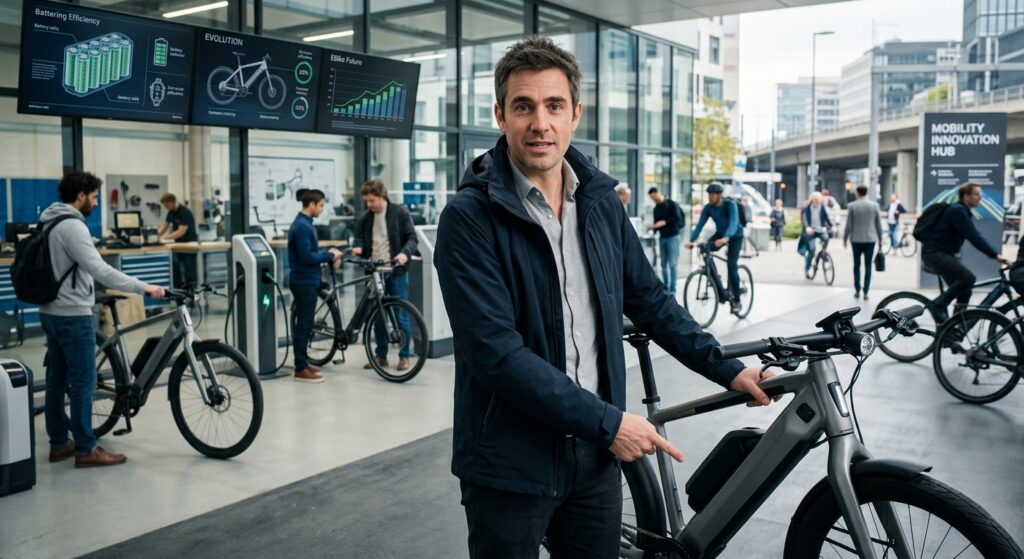
Electric bikes are not waiting on one breakthrough technology. The next generation is already taking shape through better-integrated motors and drivetrains, improving batteries, smarter security and software, more specialized designs, and stronger attention to battery safety.
For buyers, the useful distinction is simpler: some changes are already real, some are credible but still developing, and others remain speculative. Knowing which is which matters more than trying to predict a single “e-bike of the future.”
It also changes what you should look for today. A genuinely future-ready e-bike needs more than impressive specifications. Its battery, replacement parts, software and service ecosystem need to remain usable after the initial warranty period.
Research status: U.S.-focused documentary research, reviewed September 2026. Time-sensitive product and regulatory claims should be rechecked before publication or purchase.
What’s Already Real—and What Still Belongs in the Future?

Future-e-bike coverage often mixes commercial products, research projects and concepts as though they are equally close to widespread adoption. They are not.
A useful way to evaluate any claim is to ask three questions:
- Can riders buy or use it now?
- If not, is there credible development or real-world deployment behind it?
- What still has to happen before it becomes practical at scale?
Here is the current picture.
| Development | Maturity | What that means for riders |
|---|---|---|
| Connected apps, tracking and electronic immobilization | Already real | Available on current e-bike platforms |
| Integrated motor-and-gearbox systems | Already real | Commercial systems prove the architecture is practical |
| Electronic or automatic shifting | Already real | Available on selected systems, not universal |
| Battery swapping | Real but limited | Useful in specific urban or fleet settings where compatible infrastructure exists |
| Lighter, more integrated systems | Emerging | Likely to expand as manufacturers improve packaging and efficiency |
| Incremental lithium-ion battery improvements | Emerging | More credible than expecting an abrupt battery revolution |
| Solid-state batteries for e-bikes | Developmental | Genuine R&D exists, but mainstream availability is not established |
| Universal swappable batteries | Uncertain | Requires interoperability that does not currently exist across the industry |
| Ubiquitous wireless charging | Uncertain | Convenience is attractive, but infrastructure and compatibility remain barriers |
| Autonomous consumer e-bikes | Speculative | Not necessary to explain the credible near-term e-bike trajectory |
Pinion already sells integrated motor-and-gearbox technology, while the Ilika/Brompton program demonstrates genuine e-bike-specific solid-state battery development. Those examples belong in different maturity categories: one is commercial technology; the other is developmental evidence.
That distinction should follow every future-e-bike claim: technology existing is not the same as technology becoming common.
The Five Changes Most Likely to Matter to Riders

The most consequential developments are likely to come from batteries, charging, drivetrain integration, software and design. In each case, the benefit comes with a trade-off.
Batteries Should Improve Gradually Before They Improve Dramatically
Battery progress affects range, bike weight, charging, longevity and safety at the same time.
Higher energy density could let manufacturers increase range without making the battery proportionally heavier. It could also let them build smaller batteries while keeping enough capacity for daily riding.
That second possibility matters.
A commuter who rides modest distances and carries a bike upstairs may benefit more from a smaller, lighter battery than from maximum possible range. A cargo rider moving heavy loads may reasonably make the opposite trade-off.
Battery-management systems, thermal control and pack engineering also matter. A future battery does not become better simply because its cells store more energy.
For riders, the useful measures are:
- how much usable range the pack provides for the intended trip;
- what the complete bike weighs;
- how quickly and conveniently it can be charged;
- how the system manages battery health and safety;
- whether a replacement pack will still be available later.
Solid-State Batteries Are Worth Watching, Not Waiting For

E-bike-specific development is real. The Ilika/Brompton project in the supplied research is evidence that the technology is being pursued for bicycles rather than discussed only in automotive or laboratory contexts. But pack development and planned trials are not the same thing as a commercially available production bike.
Several hurdles still sit between promising chemistry and a mainstream product: manufacturability, durability, cost, pack integration and production scale.
That makes a guaranteed solid-state e-bike launch date a poor basis for a buying decision.
For now, the more defensible expectation is continued improvement in conventional lithium-ion systems while solid-state development progresses separately.
Charging Will Become More Flexible, Not Necessarily Universal
Different riders have different charging problems.
Someone with a garage may be perfectly served by overnight charging. An apartment resident may care far more about a removable battery that can be carried indoors. A delivery rider may value extremely low downtime.
That is why faster charging, removable batteries, public charging and battery swapping should not be treated as competing versions of the same solution.
Battery swapping is especially useful where a vehicle spends many hours in service. Replacing a discharged pack can make more sense for a delivery fleet than waiting for it to recharge.
Real swapping deployments cited in the source research show that the model can work, but they also expose its biggest limitation: riders need a compatible battery, compatible bike and accessible swapping network.
For an ordinary rider who charges at home several times a week, accepting a proprietary battery ecosystem merely to gain rapid swapping may offer little benefit.
Wireless charging is further from becoming a decisive everyday feature. Convenience alone does not solve infrastructure, alignment, efficiency and compatibility questions.
Motors and Drivetrains Are Moving Toward Integration
For ordinary riding, compact packaging, smooth assistance, responsive sensing, efficiency and better integration with gearing can matter more.
Integrated motor-and-gearbox systems are one example. Pinion’s commercial MGU products show that combining motor and transmission functions is already technically and commercially possible.
This direction can support cleaner packaging and electronic or automatic shifting. It may also reduce some externally exposed drivetrain components.
The trade-off is dependence.
A conventional component can often be replaced independently. A tightly integrated unit may require brand-specific diagnostics, parts or trained service.
So the buyer’s question should not be:
“Is an integrated system more advanced?”
It should be:
“Does the integration improve the ride enough to justify how dependent I become on that ecosystem?”
Smart E-Bikes Will Also Be Software Products

Connected systems can already provide useful functions such as theft tracking, electronic immobilization, navigation, ride customization, diagnostics and firmware updates.
Those are meaningful improvements when they solve a real rider problem.
A vague “AI-powered” label is less informative. The important question is what the software actually does.
As software becomes more central, however, a new ownership risk appears.
A mechanical bicycle does not stop working because a smartphone operating system changes. A connected feature can.
Long-term use may depend on:
- continued firmware support;
- phone-app compatibility;
- online accounts;
- manufacturer servers;
- access to diagnostics;
- continued support for cloud-dependent functions.
A feature that works perfectly when the bike is new is not automatically a feature that will work throughout the physical life of the bike.
That makes software-support policy part of product durability.
Future E-Bikes Will Become More Specialized
There is no single ideal future e-bike because riders are solving different transportation problems.
A folding commuter may prioritize weight and compactness. A cargo-bike owner may accept considerably more mass in exchange for carrying capacity and range. Performance-oriented riders may care about natural assistance and low system weight.
This creates an important counterpoint to the industry’s tendency to advertise larger numbers.
A smaller battery can be an improvement if it makes the entire bicycle lighter without compromising the rider’s actual trips. More integration can be an improvement if service access remains sensible. More technology can be an improvement if it does not create unnecessary dependence.
The best future technology is not automatically the technology that adds the most features. It is the technology that solves the rider’s problem without creating a larger ownership problem.
Will E-Bikes Become Mainstream Transportation in the U.S.?

E-bikes are likely to become a more ordinary transportation option in the United States, but “mainstream” should not be interpreted as “everyone replaces their car with an e-bike.”
A more useful test is whether e-bikes become a normal choice for a meaningful share of everyday trips.
Industry evidence cited in the supplied research points toward growing U.S. commuter, cargo and everyday-transport use, alongside development of a second-hand market. That evidence supports a direction of travel, not a guaranteed national growth forecast.
Everyday Trips Matter More Than Headline Sales Forecasts
E-bikes become more important as transportation when they make recurring trips realistically rideable.
Cargo and family-oriented e-bikes expand that range further.
This does not mean an e-bike can replace every vehicle trip. It means some trips that previously defaulted to a car may become practical by bike.
Potential examples include commuting, errands, school runs, first- and last-mile connections and shorter cargo trips.
Some e-bike trips will also replace conventional bicycle trips. That is still growth in electric-bike use, but it should not be counted as equivalent to replacing a car journey.
Technology Alone Will Not Make E-Bikes Mainstream
Wider adoption depends on a system of conditions working together.
What helps: useful commuter and cargo designs, manageable prices, secure storage, practical charging, safe cycling infrastructure, theft protection and reliable service.
What slows adoption: high purchase prices, unsafe roads, theft, poor storage options, weather, limited local service, inconvenient charging and unclear local operating rules.
This is why an excellent new motor or battery cannot by itself determine the future of electric bikes.
A bike can be technologically capable and still be impractical where the owner has nowhere safe to ride or store it.
The Used Market Could Matter More Than Another Battery Breakthrough
A stronger used and refurbished e-bike market could lower the cost of entry without requiring manufacturers to make every new bike dramatically cheaper.
But buyers need more confidence than they typically need with a conventional used bicycle.
Battery condition can materially affect value. So can replacement-pack availability, firmware support, proprietary electronics and service history.
A mature second-hand market therefore needs better answers to questions such as:
- How healthy is the battery?
- Can it still be replaced?
- Is the drive system still supported?
- Is the bike properly certified?
- Can a local shop service it?
- Will the manufacturer still supply important parts?
That connects affordability directly to long-term support.
More E-Bikes Also Mean More End-of-Life Batteries
Replacing some combustion-vehicle trips with e-bike trips can reduce direct tailpipe emissions from those journeys. That does not make an e-bike impact-free across its complete lifecycle.
As the installed e-bike population grows, battery circularity becomes more important.
A larger market does not remove the end-of-life problem. It makes solving that problem more necessary.
What Could Change in U.S. E-Bike Rules and Battery Safety?
Future U.S. e-bike regulation is unlikely to become one perfectly uniform national rulebook.
State and local operating rules can differ, while battery-safety standards and federal product-safety regulation operate at different levels.
Confusing those layers creates two common errors: assuming a local operating rule applies nationally and assuming a safety certification on one component certifies the entire bicycle.
Operating Laws Will Still Depend on Where You Ride
That means a national future-of-e-bikes article cannot responsibly give one set of operating rules and imply that it applies everywhere.
Check the jurisdiction where the bike will actually be used, particularly when access rules matter.
The future trend worth watching is whether classifications and access rules become more consistent, not whether one nationwide rule suddenly replaces every local difference.
Certification Is Not the Same Thing as Traffic Law
UL 2849 addresses the electrical system relationship involving an e-bike’s drive train, battery and charger. UL material cited in the source research also cautions that having a UL-certified battery or charger does not automatically mean the complete e-bike is UL-certified.
Battery-level certification can involve different scope, including UL 2271.
For buyers, the practical rule is simple: read the certification claim literally.
Do not assume:
- certification of one component applies to the whole bike;
- “tested to” automatically means independently certified;
- a safety standard determines where the bike may legally be ridden.
Those are different questions.
The 2026 CPSC Battery Rulemaking Is Still a Proposal in the Supplied Research
The most freshness-sensitive point in this article concerns U.S. Consumer Product Safety Commission rulemaking.
The supplied research checked CPSC listings through September 3, 2026 and found docket CPSC-2025-0012 associated with a June 24 notice of proposed rulemaking, with no later final-rule listing surfaced. It should therefore be described as a proposed federal rule, not existing federal law, based on that evidence.
That status should be rechecked immediately before publication or before anyone relies on the article for a current regulatory decision.
A proposal can change before a final rule is issued. Its eventual wording, implementation date and compliance obligations should not be predicted as though they are settled.
What Buyers Should Verify Before Purchase
For safety and legal confidence, check four things separately:
- Local operating rules: where and how the bike can legally be used.
- Certification: exactly what product or system is certified.
- Battery and charger compatibility: use the battery and charging equipment approved for that system.
- Current regulatory status: recheck any federal proposal cited in older articles or buying guides.
This takes a few minutes and is more useful than relying on a seller’s generic phrase such as “UL compliant” without understanding what it refers to.
The Ownership Question Most Future Forecasts Miss

A future e-bike can become more sophisticated and less practical to own at the same time.
More integration may improve appearance, weather protection and riding performance. More electronics can improve security and diagnostics.
But every proprietary battery, paired component, diagnostic requirement or cloud-dependent feature creates another dependency.
That is why the most useful definition of repairability is broader than “a mechanic can remove the part.”
A Repairable E-Bike Needs a Complete Support Chain
A repair only works if all of these conditions are met:
- The failed component can be accessed.
- It can be replaced rather than requiring replacement of an unnecessarily large system.
- A compatible replacement is still available.
- The failure can be diagnosed.
- Required firmware or software remains supported.
- A qualified service route exists.
- The repair cost still makes economic sense.
The source research identifies this wider stack—parts, compatibility, diagnostics, software, documentation, skilled service and economics—as one of the clearest information-gain opportunities for the article.
A removable component is therefore not automatically a repairable component.
Replaceable Battery Packs Matter More Than DIY Battery Repair
For long-term ownership, the useful question is whether an approved replacement battery pack will be available.
That should not be confused with opening the housing and rebuilding the battery at cell level.
Bosch, for example, states that its battery housings should be opened only by qualified and trained personnel. Its guidance cited in the supplied research connects opening the housing with the battery’s certified condition and safety risk.
The same ownership logic applies to motors, controllers and displays.
A modular part only provides long-term value if replacements remain available and the system can accept them.
Parts Policies Are Becoming a Buying Criterion
Manufacturers rarely receive as much attention for spare-parts policy as they do for motor power or battery range.
That may need to change.
Bosch currently states an aim, in principle, to keep spare parts available for at least six years after final supply to bicycle manufacturers, while also noting exceptions. That is a useful example of a support commitment, not an industry-wide standard.
Before buying a highly integrated e-bike, it is reasonable to ask:
- How long are replacement batteries expected to remain available?
- Can the display, controller and drive unit be replaced independently?
- Does service require proprietary diagnostics?
- Is there a local dealer or qualified repair network?
- What happens when the original component is discontinued?
A slightly less sophisticated bike with dependable parts support can be a better long-term purchase than a technologically impressive bike built around an unsupported ecosystem.
Software Can Make a Mechanically Healthy Bike Obsolete
Connected bikes introduce a failure mode that conventional bicycles largely avoid: the hardware may still work while the digital service around it disappears.
An app may stop supporting an older phone. A cloud service may close. A login system may change. A firmware-dependent function may no longer receive updates.
That does not mean connected features are undesirable. Tracking, immobilization and diagnostics can provide real value.
It means buyers should distinguish useful software from essential software.
A useful question before purchase is:
If the manufacturer’s app or online service disappeared tomorrow, which important functions of this bike would I lose?
The fewer essential riding functions that depend on a remote service, the lower the digital-obsolescence risk.
How to Judge a “Future-Proof” E-Bike Today

No manufacturer can guarantee that an e-bike will never become outdated. “Future-proof” is more useful as an ownership test than as a marketing claim.
Before buying, try to answer these questions:
- Can the complete battery pack be replaced with an approved unit?
- Does the manufacturer publish any parts-availability commitment?
- Are normal wear parts standard or proprietary?
- Is competent service available where you live?
- Can technicians access the diagnostics required for the system?
- What happens if the original display, controller or motor is discontinued?
- Does the bike depend on an app for essential riding functions?
- Is there a clear software or firmware support policy?
- Is the certification claim specific about what is actually certified?
- Would a future buyer be able to assess battery health and obtain service?
Several Unknown answers are not automatically a reason to reject a bike, especially for a new platform. But they show where the ownership risk actually sits.
The most important future developments to watch are also straightforward: commercial deployment of new battery chemistries, broader interoperable charging or swapping systems, finalized federal battery-safety requirements, longer software-support commitments and stronger U.S. transportation-use evidence. The source architecture identifies those as the signals most likely to change the current forecast materially.
For someone shopping now, waiting for an undefined technological breakthrough is usually less useful than choosing a bike with a suitable battery, clear certification, accessible service and realistic replacement-part support.
The future of electric bikes will matter most when better technology also produces better long-term ownership.