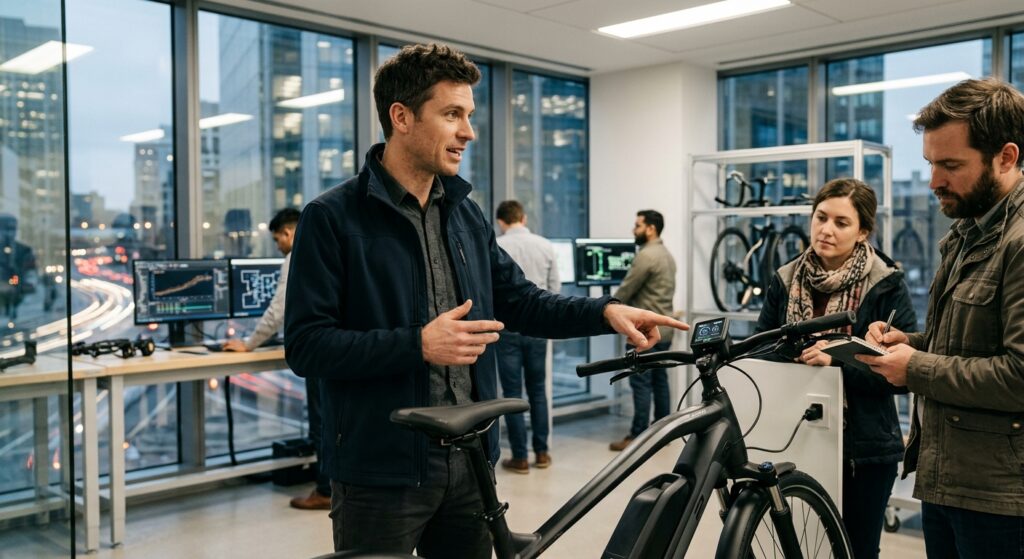
Most near-term e-bike progress is likely to come from several technologies improving together, not from one dramatic breakthrough. Expect better batteries and battery management, more integrated drivetrains, lighter designs, smarter software and easier charging.
Other developments, including all-solid-state batteries, advanced wireless charging, hydrogen powertrains and autonomous riding, are much earlier or more dependent on infrastructure.
If you are considering an e-bike today, that leads to one practical rule: do not wait simply because a futuristic technology has been announced. Wait only when current bikes cannot meet a specific need and an emerging technology has credible evidence of solving it soon.
This guide separates what is commercially real from what is emerging, experimental or still speculative, then explains what each development could change for an actual rider.
Research note: The underlying research was conducted on September 6, 2026. It specifically flags battery commercialization, wireless-charging interoperability, AI features, safety standards, regulations, hydrogen infrastructure and autonomy as fast-moving areas requiring publication-date verification.
What Will Change First—and What Is Still Hype?

“Future technology” covers developments at very different stages.
A useful way to judge any claim is to place it in one of four groups:
- Commercial now: available in real products, even if not universally.
- Emerging: commercially relevant, but adoption or availability remains limited.
- Prototype or pilot: demonstrated outside a laboratory, but not evidence of broad availability.
- Research or speculative: technically interesting, but too early to influence most purchasing decisions.
That distinction matters because a manufacturer announcement is not the same as a shipping product. A successful demonstration is not the same as repeatable mass production. And technology that works in cars or other EVs may not yet make sense in a bicycle, where mass, packaging and price are much more constrained.
A quick readiness map
| Technology | September 2026 position | What matters to riders |
|---|---|---|
| Better lithium-ion packs and BMS software | Commercial and evolving | Range, battery protection, charging and reliability |
| Connected tracking, displays and apps | Commercial | Security and convenience, but greater software dependence |
| Adaptive and predictive software | Commercial to emerging by function | Better estimates, control and diagnostics |
| Integrated motor/transmission systems | Emerging | Smoother operation and potentially simpler drivetrains |
| Sodium-ion batteries | Scaling in wider battery markets | Potential application-specific cost and supply advantages |
| All-solid-state e-bike batteries | Development/prototype territory | Potential weight, density and safety gains |
| Wireless charging | Limited/emerging | Convenient charging where compatible infrastructure exists |
| Hydrogen fuel-cell e-bikes | Niche/development pathway | Fast refueling in specialized settings |
| Fully autonomous consumer e-bikes | Research/speculative | Far more demanding than rider-assistance technology |
The strongest future technologies will not necessarily have the most impressive specifications. They will be the ones that improve something riders actually notice without creating unacceptable problems elsewhere.
A lighter battery can make carrying a bike upstairs easier. Better range prediction can reduce uncertainty without increasing battery capacity. An integrated drivetrain may reduce exposed components but increase dependence on specialist service. GPS tracking can improve security while creating an app or subscription dependency.
That is the central theme of the next generation of e-bikes: every improvement is part of a system.
The Battery Future Is Bigger Than Solid-State

Batteries matter because they influence several rider priorities at once: range, bike weight, charging time, cost and packaging.
But the future of e-bike batteries is not simply a race to solid-state.
Meaningful improvements can come from at least four directions.
Better cells. Incremental improvements to conventional lithium-ion technology can raise usable energy or improve performance without requiring an entirely new battery architecture.
Better packs and battery-management systems. Smarter monitoring, thermal management and charge control can improve reliability and usable performance even when the underlying chemistry changes very little.
Alternative chemistries. Different chemistries may win in different applications. A battery does not have to outperform lithium-ion on every measure to be useful if it offers advantages in cost, supply chain, durability or a particular duty cycle.
Better charging. Faster wired charging, swapping and wireless charging each address different problems. Faster charging reduces waiting; swapping minimizes turnaround time; wireless systems reduce the need for manual connection.
The IEA evidence cited in the underlying research places sodium-ion further along in scale-up than almost/all-solid-state batteries and identifies shorter-range two- and three-wheel applications as a potentially relevant use case.
For an e-bike owner, the practical comparison looks like this:
| Battery direction | Possible benefit | Main question |
|---|---|---|
| Improved lithium-ion | More range or smaller packs | How does it perform over its useful life? |
| Better BMS and pack design | Reliability and battery protection | Is the system repairable and well supported? |
| Sodium-ion | Application-specific cost/supply advantages | Does the energy-density trade-off suit e-bikes? |
| Faster charging | Less downtime | What does repeated fast charging mean for heat and degradation? |
| Battery swapping | Very short turnaround | Are packs and stations standardized enough? |
| All-solid-state | Potential density, packaging and safety gains | Can it be manufactured affordably at pack scale? |
The important question is therefore not “Which battery chemistry wins?”
It is “Which combination of cells, pack design, software and charging solves the rider’s problem with the fewest compromises?”
Solid-State Batteries Are Promising, but an Announcement Is Not Availability

Solid-state batteries attract disproportionate attention because their potential benefits sound ideal for e-bikes: more energy in a smaller or lighter package, improved safety characteristics and potentially better charging or longevity.
Those possibilities deserve attention. They do not justify treating every “solid-state” claim as proof of mass-market readiness.
True solid-state and semi-solid are not interchangeable
A true or all-solid-state design is not necessarily the same thing as a semi-solid or hybrid-electrolyte design.
That distinction becomes important when evaluating commercialization claims. Commercial availability of something described as semi-solid does not establish that all-solid-state batteries have reached the same stage.
Even impressive cell-level performance does not answer all the questions an e-bike manufacturer faces.
The battery still needs to:
- work reliably as a complete pack;
- integrate with the battery-management system and charger;
- tolerate real vibration, temperature and weather conditions;
- meet applicable safety requirements;
- be manufactured consistently;
- fit an acceptable price point;
- remain serviceable through the useful life of the bike.
Should you wait for solid-state?
Usually, not merely because development has been announced.
The source research cites an April 2026 Ilika-Brompton development program in which on-bike trials were targeted for mid-2027 subject to technical milestones. That is meaningful evidence of development, but the conditional trial milestone should not be described as mainstream commercialization.
This provides a useful test for any future-battery headline:
What exactly is the evidence?
A shipping battery, production contract, prototype pack, laboratory cell, announced development program and conceptual roadmap are six different things.
Buyers should treat them differently.
Future E-Bike Motors and Drivetrains Are Becoming More Integrated

Battery development gets more attention, but the motor and drivetrain may change the feel of future e-bikes just as much.
One important direction is closer integration among the motor, transmission, sensors and electronic controls.
Instead of treating assistance and gearing as largely independent systems, an integrated drivetrain can coordinate them. That can support electronic or automatic shifting, smoother starts and better responses to rider torque and cadence.
For the rider, the potential gains include:
- smoother assistance;
- less need to think about gear selection;
- cleaner packaging;
- fewer exposed drivetrain parts in some designs;
- better coordination between rider effort, gearing and motor output.
There is a trade-off.
Mechanical complexity does not necessarily disappear when components become integrated. Some of it moves inside proprietary hardware and software. That can reduce routine adjustment while making specialist servicing, replacement modules and long-term manufacturer support more important.
The supplied research cites Avinox’s Eurobike 2026 integrated motor-gearbox concept and electronic-shifting development as evidence that drivetrain integration remains an active development area. It also explicitly warns against treating concept systems as proof of mature mass-market adoption.
For buyers, motor specifications alone will therefore become less informative.
A more useful question is: How well do the motor, gearing, sensors, battery and software behave as one system?
Will Future E-Bikes Finally Get Lighter?

Some will. But there is no single lightweight material that solves the problem.
An e-bike’s mass comes from the battery, motor, frame, wheels, brakes, drivetrain, accessories and other components. Reducing total weight means optimizing the complete bike rather than replacing one frame material.
Battery improvement can help because greater usable energy per unit of mass may allow a smaller pack for the same practical range.
Drivetrain integration can change component count and packaging.
Frame engineering can reduce structural weight through materials and manufacturing choices.
But every kilogram has a context.
For an apartment commuter who carries a bike up two flights of stairs, reducing weight can transform everyday ownership.
For a folding-bike rider, lower mass may determine whether combining the bike with a train is practical.
For a cargo-bike owner, durability, load capacity and stability may justify considerably more mass.
Lighter therefore does not automatically mean better.
The meaningful trade-offs include durability, repairability, ride quality, manufacturing complexity and price. The underlying content plan specifically treats lightweighting as a system problem involving the battery, drivetrain and frame together.
Smart E-Bikes Are Useful—Until the Software Becomes the Weak Link

Some of the most practical “future” technology is already familiar.
Smart e-bike features can include:
- GPS and theft tracking;
- alarms or electronic immobilization;
- navigation;
- smart displays;
- smartphone connectivity;
- ride records and diagnostics;
- over-the-air firmware updates.
These functions can solve real problems.
Tracking can improve theft recovery. Navigation can make commuting easier. Remote diagnostics can help identify faults. Firmware updates can improve or repair software without replacing hardware.
But adding a digital layer creates a different ownership risk.
A bicycle may remain mechanically usable for many years. An app, cloud service or cellular connection may not.
Before paying extra for a connected feature, ask:
Does the important function still work if the phone, subscription or cloud service disappears?
Also check whether ownership can be transferred cleanly, how long software support is expected to last, whether basic functionality requires an account, and what location or riding data is collected.
The strongest smart features provide substantial rider value without making the bicycle unnecessarily dependent on a fragile software ecosystem.
AI E-Bikes: Separate Useful Prediction From an AI Label

Not every sensor, app or automatic function is AI.
A practical distinction is:
| Type | Main characteristic | Example |
|---|---|---|
| Smart | Connected or digitally controlled | GPS tracking |
| Automated | Follows predefined logic | Automatic light activation |
| AI-based | Makes a data-driven inference, prediction or adaptation | Learning-based range prediction |
A feature can fit more than one category, but the terms should not be used interchangeably. The source architecture makes the same distinction: smart technology owns connectivity and digital capability, while AI is defined around prediction, learning, inference and adaptation.
Where AI can genuinely help
The nearer-term value of AI is more likely to come from narrow, useful tasks than from a bicycle making all its own decisions.
Potential and emerging applications include:
- adapting assistance to riding behaviour;
- improving range prediction;
- interpreting component-condition data;
- recognizing surface conditions;
- using sensors to identify possible hazards.
The evidence levels still matter.
The supplied research cites Bosch documentation of AI-based range prediction using riding behaviour and route/system information. It separately identifies a 2026 Renesas edge-AI e-bike concept demonstrating condition monitoring, surface recognition and object detection.
The second example is explicitly described as a concept, not evidence that those capabilities are common on current bikes.
That distinction is more useful than arguing about whether a feature sounds advanced.
For riders, the better questions are:
Does the prediction improve something meaningful? How accurate is it? Can I override it? What happens when it fails?
Edge AI vs cloud-dependent AI
Some processing can happen directly on the bike. Other functions may depend on a phone or remote service.
Local processing can reduce latency and allow certain features to work without permanent connectivity.
Cloud processing can provide greater computing resources or access to broader datasets, but it also adds dependencies: internet access, accounts, servers, privacy policies and ongoing software support.
The best implementation depends on what the function needs to do. “More AI” is not automatically better.
Will Wireless E-Bike Charging Replace the Plug?

Probably not universally.
Wireless charging solves a clear problem: the rider no longer needs to connect a cable manually each time the bike is parked.
In a stationary inductive system, the bike is positioned over or against a compatible charging point and energy transfers across a small gap.
That model could be particularly useful where bikes repeatedly return to controlled locations, such as:
- shared-bike docks;
- delivery depots;
- workplaces;
- managed parking facilities.
For a private owner who already charges easily in a garage or home, the benefit may be much smaller.
Stationary and dynamic charging are very different propositions
Stationary wireless charging works while the bike is parked in a known position.
Dynamic wireless charging attempts to transfer energy while the vehicle is moving.
The second model demands far more infrastructure and should not be treated as equally mature simply because both use wireless power transfer.
Wireless charging also has to compete with simpler alternatives.
A conventional cable is inexpensive and mature. Faster wired charging reduces waiting. Battery swapping can make sense where extremely fast turnaround matters.
Wireless charging becomes compelling when removing the plugging-in step is worth the added hardware, infrastructure and compatibility requirements.
The underlying research cites Wireless Power Consortium work concerning wireless charging for light electric vehicles and UL 4900 treatment of micromobility charging equipment, while explicitly requiring current interoperability status to be rechecked before publication.
Why Promising E-Bike Technology Still Fails to Become Mainstream

A technology working in a prototype answers only the first adoption question.
For something to become normal, it must clear four gates:
- Does it work reliably?
- Can manufacturers produce it consistently at useful scale?
- Can riders afford, maintain and use it?
- Can safety requirements, standards, regulation and infrastructure support it?
This is one of the most useful filters for future e-bike claims.
A new battery can perform well but remain too expensive.
A charging system can work perfectly but fail if different manufacturers cannot interoperate.
An integrated drivetrain can offer a cleaner ownership experience but struggle if local shops cannot service it.
An advanced connected feature can be useful today and become frustrating if its software support disappears.
The underlying research identifies precisely these adoption constraints: safety, manufacturing, price, serviceability, interoperability, infrastructure, standards and regulation.
Safety is an adoption requirement, not a side issue
Battery, electrical and charging safety become more important as systems become faster, more powerful and more integrated.
For owners, the practical response is simple: use equipment specified as compatible by the manufacturer, follow current manufacturer and regulator guidance, and do not assume batteries or chargers are interchangeable because a connector appears to fit.
Certification, recalls and legal requirements can differ by jurisdiction and change over time. They should be checked against current official sources rather than generalized internationally.
Software support and repairability matter too
Connected bikes introduce another form of product lifespan.
Frames, wheels and many mechanical parts can remain usable long after a smartphone operating system, cloud service or app architecture has changed.
As e-bikes become more software-dependent, buyers will increasingly need to evaluate:
- software-update support;
- replacement component availability;
- account transfer;
- cybersecurity;
- privacy;
- offline functionality;
- repair access.
A futuristic feature that cannot be maintained is not necessarily an ownership improvement.
Better Cities May Matter More Than Another Few Miles of Range

The future of electric bikes depends partly on the bike and partly on everything around it.
A commuter does not benefit much from additional range if the route feels unsafe.
A lightweight folding bike becomes more useful when public transport accommodates it.
GPS tracking becomes more valuable where theft risk is high.
Automatic charging becomes more attractive in a shared fleet where dozens of bikes return to predictable docking locations.
Infrastructure can therefore amplify or weaken the value of technology.
The source research describes U.S. DOT material as framing e-bikes around opportunities such as reduced car travel and improved access while identifying safety, infrastructure and environmental effects as active research areas.
For cities and transport systems, the practical questions include:
- Are there routes people feel comfortable using?
- Is secure parking available?
- Can riders combine bikes with public transport?
- Can shared fleets be charged and maintained efficiently?
- Do regulations make the intended use practical?
- Can people with different physical abilities use the available designs?
That is why the next major improvement in someone’s e-bike experience may come from a better route or safer parking rather than another component upgrade.
Could Hydrogen E-Bikes Become a Serious Alternative?

Possibly in specialized circumstances. That is different from being the likely replacement for battery e-bikes.
A hydrogen fuel-cell bicycle still ultimately powers an electric motor. The complete system also needs hydrogen storage, a fuel cell and supporting electronics.
That means a fair comparison must consider the whole vehicle and the infrastructure behind it.
Hydrogen’s potential advantage is rapid energy replenishment where suitable fuel is readily available.
Its problem is that hydrogen does not appear automatically at the point of use. It has to be produced, stored, transported and dispensed.
The U.S. Department of Energy material cited in the research identifies compression, storage, transportation, dispensing, cost, efficiency, leakage and regional infrastructure among the relevant challenges.
For a managed fleet with centralized refueling, those constraints could look very different from those faced by a private rider.
For personal ownership, electricity’s broad availability gives battery charging a significant practical advantage.
The important comparison is therefore not hydrogen versus today’s battery cell.
It is hydrogen versus the complete battery-and-charging system that will exist when hydrogen alternatives are ready to compete with it.
Autonomous Assistance Will Arrive Long Before a Normal Self-Riding E-Bike

More automated e-bike functions do not automatically lead to a bicycle that can ride itself safely through ordinary traffic.
There are several distinct levels of development:
Rider assistance: technology helps with balance, sensing, control or other riding tasks while a person remains responsible.
Autonomous bicycle research: experimental systems handle tasks such as balancing or navigation.
Fleet autonomy: controlled systems may use automation for positioning, rebalancing or other operational tasks.
Fully autonomous consumer riding: the bicycle operates safely without a rider in ordinary mixed environments.
Each step adds significant requirements.
A riderless bicycle would need reliable sensing, mapping, balance, steering, obstacle handling, cybersecurity and interaction with pedestrians, cyclists and vehicles. Regulation and liability would also have to be resolved.
The supplied research explicitly warns against implying that autonomous consumer e-bikes are imminent and separates rider assistance from autonomous bicycle research and broader fleet or delivery autonomy.
For most buyers, autonomy belongs in the watch category rather than the wait before buying category.
Which Future E-Bike Technology Is Actually Worth Waiting For?

This is where technology forecasting becomes useful.
Do not ask whether something exciting is coming.
Ask whether waiting solves a problem you actually have.
Buy now if current bikes already meet your important requirements
Buying now usually makes more sense when available bikes already provide acceptable:
- range;
- weight;
- charging convenience;
- ride quality;
- serviceability;
- safety;
- price.
Future bikes will improve, but waiting also has a cost: months or years in which you could have been using the bike.
Consider waiting if one specific unmet need is decisive
Waiting becomes more rational when all three conditions are true:
- A current limitation genuinely prevents you from buying.
- A specific emerging technology directly addresses that limitation.
- The evidence has progressed beyond a vague announcement or laboratory result.
Consider a hypothetical apartment commuter who must carry an e-bike up several flights of stairs every day.
If every suitable current model is too heavy, credible progress toward substantially lighter systems could justify waiting.
For a rider who stores a bike at ground level, the exact same weight improvement may barely matter.
The technology did not change. The reader’s problem did.
Keep watching if the technology remains experimental
Research and prototype technology can be interesting without being purchase-relevant.
All-solid-state batteries, some advanced wireless infrastructure, hydrogen systems and consumer-bike autonomy may deserve attention without justifying purchase paralysis.
A useful decision rule is:
Buy when current technology solves the job.
Wait when a specific near-term development appears likely to solve a deal-breaking problem.
Watch when the evidence is still mainly prototypes, pilots, research or concepts.
This buy/wait/watch framework is also the decision model recommended by the underlying research architecture.
The Most Important E-Bike Innovation May Be Better Integration

The future of electric bikes is unlikely to be defined by one winning technology.
Battery improvements affect range and weight. Weight influences handling and frame design. Sensors feed software. Software can influence assistance, diagnostics and security. Charging technologies only become useful when batteries, infrastructure and standards work together.
That makes the best way to evaluate any future e-bike claim surprisingly simple:
Is it real? What problem does it solve? What trade-off does it create? And what still has to happen before ordinary riders can benefit from it?
If current bikes already solve your needs, there is little reason to wait for a vaguely better future.
If one limitation is holding you back, identify that limitation first. Then follow the technology that directly addresses it, rather than waiting for every new e-bike innovation at once.
Pingback: SEO title: Hydrogen vs Electric Bikes: Range, Cost & U.S. Reality - electricscootercar.com
Pingback: Lightweight E-Bike Frame Materials: Best Choices & Future Tech - electricscootercar.com
Comments are closed.