Article Review Info
Written by: James Smith
Content Experience: 15 years of electric scooter content research
Last Updated: June 2026
Blog Upgraded: 26 June 2026
Reviewed for: Accuracy, safety, readability, and helpful advice
An electric bike for commuting can make daily travel easier when a regular bike feels too tiring, driving feels too expensive, or traffic makes short trips frustrating.
But an e-bike is not automatically the right answer for every commute.
It depends on your route, distance, traffic comfort, weather, storage, charging setup, and local rules.
This guide will help you decide whether e-bike commuting fits your daily routine, how to plan your first ride, how far you can realistically commute, and how to avoid the most common beginner mistakes.
Is an Electric Bike Good for Commuting?
Yes, an electric bike can be very good for commuting if your route is safe, your distance is realistic, and you have a secure place to park or store it.
An e-bike works especially well when your commute includes:
- Short to medium daily distance
- Hills that make regular biking difficult
- Traffic-heavy roads where driving is slow
- Expensive or limited parking
- A transit gap between home, station, and work
- A desire for light exercise without arriving exhausted
It may not be a good fit if your only route is a fast road with no bike lane or shoulder, you cannot safely store the bike, or your round trip pushes the battery too close to empty every day.
A good e-bike commute should feel repeatable, not just possible once.
What Does an Electric Commuter Bike Mean?

The simple electric commuter bike meaning is this:
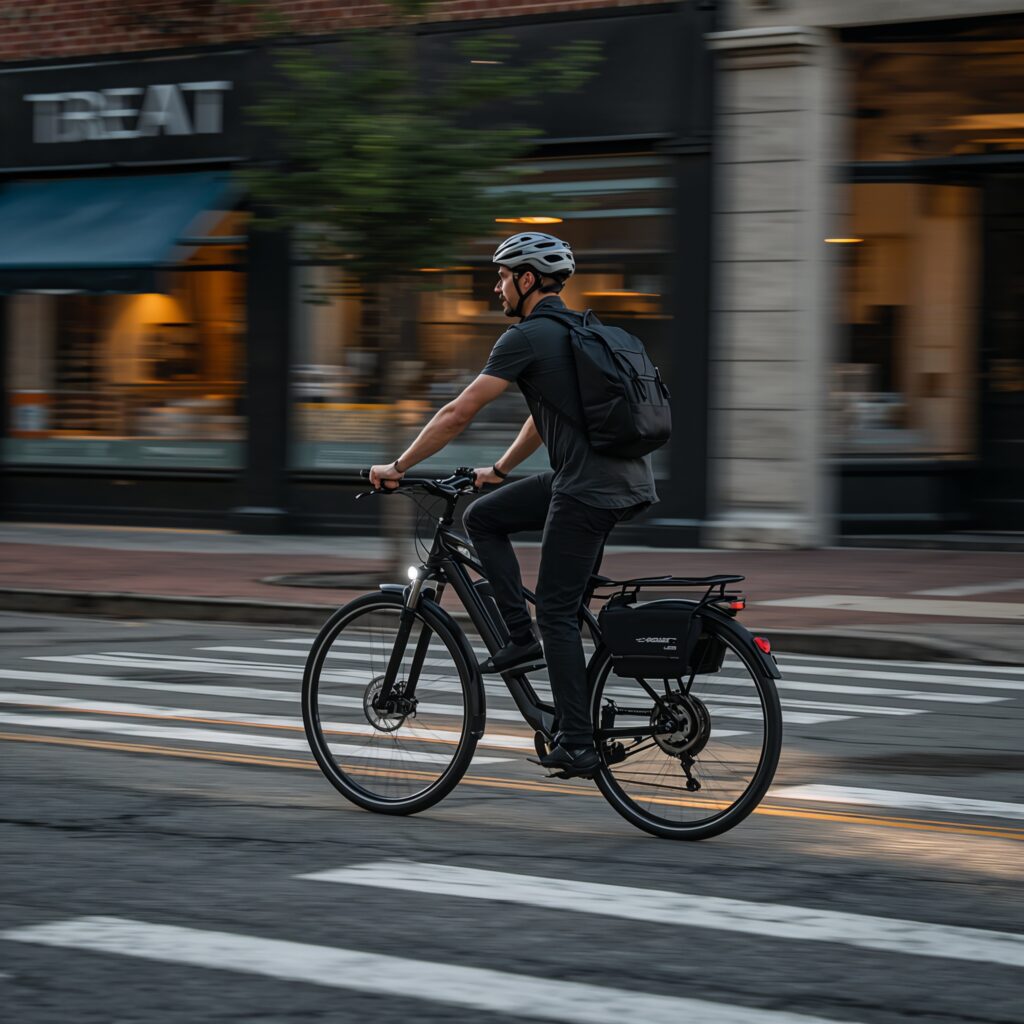
An electric commuter bike is an e-bike used for daily transportation, such as riding to work, school, transit stations, errands, or local appointments.
It has a motor and battery that assist your pedaling or, on some models, provide throttle support. The motor helps with starts, hills, headwind, and longer rides.
A commuter e-bike is not just about speed. The best commuter setup is usually about comfort, control, reliability, and carrying what you need.
Useful commuter features often include:
- Comfortable upright riding position
- Front and rear lights
- Fenders for wet roads
- Rear rack or panniers
- Strong brakes
- Puncture-resistant tires
- Stable kickstand
- Good battery range for your round trip
- Secure locking options
You do not need the most powerful e-bike for commuting. You need one that fits your route and daily habits.
Electric Bike vs Regular Bike vs Scooter vs Car Commute

An e-bike sits between several transportation options.
A regular bike is simple and low-cost, but it can be tiring on hills, longer routes, or hot days.
An electric scooter may be easier to carry, but many scooters are less comfortable on rough roads and less useful for cargo.
A car is weather-protected and comfortable, but it can be expensive, slow in traffic, and difficult to park in busy areas.
An e-bike gives you a middle path.
You still move your body, but the motor reduces the hardest parts of the ride. You can often travel farther than on a regular bike, carry more than on a scooter, and avoid some of the cost and parking problems of driving.
When an Electric Bike Makes Sense for Commuting

Short city commutes
E-bikes are very practical for short city trips.
A 2- to 6-mile city commute can be annoying by car because of traffic lights, parking, congestion, and short-distance driving stress.
On an e-bike, that same trip may feel smoother if you have bike lanes, slower streets, or a predictable route.
City commuting works best when you can avoid aggressive traffic and lock the bike securely near your destination.
Suburban commutes with safer route options
Suburban e-bike commuting can work well, but route quality matters more than distance.
A 7-mile ride through neighborhood streets and bike lanes may feel comfortable. A 4-mile ride on a high-speed road with no shoulder may feel unsafe.
Before deciding, look for:
- Slower side streets
- Bike lanes
- Wide shoulders
- Multi-use paths
- Safe crossings
- Lower-traffic alternatives
The best e-bike route is not always the shortest route. It is the route you can ride safely every day.
Hill-heavy commutes
Hills are one of the biggest reasons people choose e-bikes.
Pedal assist can make a steep or rolling commute more manageable, especially if you want to avoid arriving sweaty.
However, hills use more battery. If your route includes long climbs, plan your range more conservatively and avoid relying on the maximum advertised range.
Commutes with expensive parking or heavy traffic
If you drive only a few miles but spend too much time sitting in traffic or finding parking, an e-bike may solve a real daily problem.
This is common in:
- Downtown areas
- College towns
- Dense suburbs
- Beach cities
- Office districts
- Apartment-heavy neighborhoods
For these riders, the main benefit is often not top speed. It is convenience and predictability.
Common Electric Bike Commuting Scenarios

Home-to-office commute
This is the most common e-bike commuting setup.
You ride from home to work, lock or store the bike, then ride home later.
This works best if your workplace has a bike rack, garage, bike room, or secure indoor storage. If you need to bring the battery inside, check whether your workplace allows it.
College or campus commute
E-bikes can be useful for large campuses where walking takes too long and parking is limited.
They help riders move between dorms, classes, libraries, labs, and off-campus housing.
The main caution is pedestrian traffic. Campus areas are often crowded, so use lower assist, ride slowly, and follow campus rules.
Transit plus e-bike commute
This is one of the most useful electric bike commuting scenarios.
You may ride from home to the train station, take transit, then ride from the station to work.
Before relying on this setup, check:
- Whether your transit system allows bikes
- Whether there are peak-hour restrictions
- Whether you need a folding e-bike
- Whether you can safely lift or roll the bike
- Whether the station has secure bike parking
This type of commute works best when the e-bike solves the “last mile” problem without becoming difficult to carry or store.
Errands before or after work
An e-bike is useful when your commute includes groceries, pharmacy stops, coffee, gym, daycare, or other errands.
This is where a rear rack, pannier, or basket becomes valuable.
Avoid carrying heavy bags on the handlebars because it can affect steering. NHTSA recommends carrying items in a backpack or strapped to the back of the bike.
How to Commute on an Electric Bike Step by Step

Step 1: Plan your route like a cyclist, not a driver
Do not simply follow the same route you would drive.
A good e-bike route may be slightly longer but much safer and calmer.
Look for:
- Bike lanes
- Bike paths
- Slower roads
- Neighborhood streets
- Fewer dangerous intersections
- Better lighting
- Easier crossings
NHTSA advises bicyclists to choose routes with less traffic andfwhen riding on the road, and to use bike lanes or bike paths when available.
Step 2: Do a test ride before your first real commute
Do not make your first e-bike commute on a rushed work morning.
Do a practice ride on a weekend or day off.
During the test ride, check:
- How long the route really takes
- How stressful the traffic feels
- How much battery you use
- Where you will lock the bike
- Whether your bag setup works
- Whether you arrive sweaty
- Whether the route feels safe enough to repeat
This one step prevents many beginner mistakes.
Step 3: Start with a comfortable assist level
Many new riders use the highest assist level all the time.
That feels fun, but it drains the battery faster and can make the bike harder to control in busy areas.
Use higher assist when:
- Starting from a stop
- Climbing hills
- Riding into wind
- Carrying cargo
- Keeping up with traffic flow where safe
Use lower assist when:
- Riding on flat roads
- Moving through shared paths
- Passing pedestrians
- Saving battery
- Practicing control
A smart commuter uses the motor strategically instead of constantly riding at maximum power.
Step 4: Carry only what you need
Extra weight affects range, braking, balance, and comfort.
For daily commuting, carry the essentials:
- Lock
- Phone
- Wallet
- Keys
- Water
- Work bag
- Small repair kit
- Rain layer if needed
- Charger only if necessary
For heavier items, use a rack or pannier instead of overloading your backpack.
Step 5: Build an arrival routine
A good commute does not end when you reach the building.
Have a routine:
- Lock the frame and wheel
- Remove the battery if needed
- Take valuables with you
- Check battery level
- Wipe down if the road was wet
- Store helmet and lights
- Charge only if safe and allowed
This makes e-bike commuting feel normal instead of stressful.
How Far Can You Commute on an E-Bike?

Think round trip, not one way
The biggest beginner mistake with e-bike commuting distance is thinking only about the ride to work.
If your job is 8 miles away, your commute is not 8 miles. It is at least 16 miles round trip.
Then you need extra battery for hills, wind, cold weather, cargo, detours, and battery aging.
Use this simple formula:
One-way distance + return distance + 20–30% battery buffer = realistic commuter range
That buffer matters because real-world riding is rarely perfect.
What affects real-world e-bike range?
Your actual range depends on:
- Battery capacity
- Assist level
- Speed
- Hills
- Wind
- Rider weight
- Cargo
- Tire pressure
- Temperature
- Stop-and-go riding
- Battery age
- Road surface
That is why advertised range should be treated as an estimate, not a promise.
If your commute barely fits the advertised range, choose a stronger battery plan.
When long-distance e-bike commuting works
Long-distance e-bike commuting can work if the full route is safe, comfortable, and battery-realistic.
It works best when:
- The bike has enough range for the round trip
- You can charge safely at work if needed
- The route includes bike lanes, trails, or calmer roads
- You have a comfortable saddle and riding position
- You can handle weather changes
- You have secure parking
- You are comfortable spending that much time riding
Long-distance commuting is less about whether the bike can technically make it once. It is about whether you can repeat the ride several times per week without stress.
When the commute may be too far
An e-bike commute may be too far or inconvenient if:
- The battery is nearly empty after each round trip
- You must ride on fast roads with no safe space
- You cannot charge safely
- You cannot store the bike securely
- Bad weather would regularly make the ride unsafe
- The bike is too heavy for stairs or transit
- You arrive too tired or uncomfortable
A commute can be possible on paper but still not practical in real life.
Electric Bike Commuting Benefits for Daily Riders

Less effort than a regular bike
One of the biggest electric bike commuting benefits is reduced effort.
You still pedal, but the motor helps with the hard parts.
That means hills, starts, and longer distances feel more manageable.
For many riders, this is the difference between biking occasionally and actually commuting several days a week.
Less sweat on the way to work
An e-bike can help you arrive less sweaty than a regular bike because you can use more assist when needed.
You may still sweat in hot weather or on longer rides, but you have more control over your effort.
A practical strategy is:
Use more assist on the way to work and less assist on the way home.
Easier parking
Parking is a major benefit in busy U.S. cities, office areas, and campuses.
Instead of searching for a car space, you may be able to lock near your destination or use a bike room.
Just do not confuse easy parking with secure parking. E-bikes are valuable, so use a strong lock and choose visible, approved locations.
More predictable travel time
In traffic-heavy areas, an e-bike can make your commute more predictable.
You may still deal with lights and intersections, but you avoid many car-related delays like parking garages, traffic backups, and short-distance congestion.
Predictability is one reason commuters stick with e-bikes long term.
Light exercise without turning every ride into a workout
E-bike commuting can still support daily movement.
You pedal, steer, balance, and stay active. The motor simply reduces the parts that make regular bike commuting feel too hard.
This is useful for riders who want practical movement, not a full workout before work.
Safety Basics for E-Bike Commuting in the USA

Know your local e-bike rules
U.S. e-bike rules are not identical everywhere.
Many states and cities use a three-class system for low-speed electric bicycles, but access can still vary by road, city, park, trail, campus, and local ordinance. PeopleForBikes focuses its policy work on recognition of Class 1, Class 2, and Class 3 low-speed electric bicycles, while also noting that more powerful devices should not be placed into the same bicycle category.
A common class structure is:
- Class 1: Pedal assist only, assistance stops at 20 mph
- Class 2: Throttle-capable, assistance stops at 20 mph
- Class 3: Pedal assist only, assistance stops at 28 mph
California’s CHP page is one clear example of this structure and also notes that local use may be restricted or prohibited by ordinance.
The safe rule is simple:
Check your state, city, trail, campus, and workplace rules before assuming your e-bike is allowed everywhere.
Ride predictably around traffic
E-bike commuters should ride like drivers may not see them.
Be especially careful near:
- Intersections
- Driveways
- Parked cars
- Right-turning vehicles
- Parking lots
- Bus stops
- School zones
- Shopping centers
NHTSA advises bicyclists to ride with traffic, obey signs and signals, assume others may not see them, and avoid distractions while riding.
Predictability matters more than speed.
Use lights and visibility gear
For commuting, lights are not just for night riding.
A front white light and rear red light can help make you more visible in early morning, evening, rain, fog, and shaded streets.
Use:
- Front light
- Rear light
- Reflectors
- Bright or reflective clothing
- Helmet
- Side visibility if riding in low light
NHTSA emphasizes proper helmet fit and visibility as part of bicycle safety.
Be careful with sidewalk riding
Sidewalk riding may feel safer, but it can create hidden risks.
Drivers backing out of driveways or turning into parking lots may not expect a faster-moving bike on the sidewalk.
Some cities allow sidewalk riding in certain areas; others restrict it.
If you must ride on a sidewalk where allowed, go slowly and yield to pedestrians.
Use extra caution with Class 3 e-bikes
Class 3 e-bikes can assist up to higher speeds than Class 1 or Class 2 under the common class system.
That can help longer commutes, but it also increases stopping distance and reduces reaction time.
Be extra careful when passing, approaching intersections, riding near pedestrians, or sharing paths.
For commuting, control is more important than speed.
Charging and Battery Safety for Commuters

Use the correct charger only
Never use a random charger just because it fits the charging port.
CPSC warns that some “universal” chargers for micromobility products can create fire hazards. It recommends using the charger provided with the device or a replacement confirmed by the manufacturer as compatible.
This matters especially if:
- You bought a used e-bike
- You lost the original charger
- You bought a second charger for work
- Your battery or charger was replaced
- The charger looks damaged
If you are unsure, contact the manufacturer.
Do not charge while sleeping or away
Charging safety is part of commuting safety.
CPSC says to be present while charging micromobility products, never charge while sleeping, use the supplied charger, follow manufacturer instructions, unplug when done, and avoid modified or reworked battery packs.
A safe charging routine:
- Charge while awake and nearby
- Use the correct charger
- Keep the battery away from clutter
- Do not block exits
- Unplug when charging is complete
- Stop using damaged batteries or chargers
- Follow the owner’s manual
Do not treat battery safety as optional.
Keep enough battery for the ride home
For commuters, the return trip matters as much as the morning ride.
Before leaving home, ask:
- Do I have enough battery for the full round trip?
- Am I adding errands today?
- Is it windy or cold?
- Will I use high assist on hills?
- Can I safely charge at work if needed?
A good commuting plan avoids arriving home with a nearly dead battery every day.
Practical Electric Bike Commuting Tips

Use the right bag setup
A backpack is fine for short, light commutes.
For longer rides or heavier loads, use a rack, pannier, or basket.
This reduces back sweat, improves comfort, and keeps the bike more stable when loaded properly.
Add fenders if roads are wet
Fenders are one of the most useful commuter upgrades.
They protect your clothes, shoes, bag, and bike from road spray.
If you commute in rain, wet streets, or winter slush, fenders are not optional comfort. They are practical daily gear.
Keep a small emergency kit
You do not need to carry a full tool box.
A simple commuter kit can include:
- Spare tube or patch kit
- Tire levers
- Mini pump
- Multi-tool
- Zip ties
- Small flashlight
- Portable phone charger
- Emergency cash or card
Also learn how to fix a flat before you depend on the bike daily.
Check the bike before riding
Do a quick check before each commute:
- Tires feel firm
- Brakes respond well
- Battery is charged
- Lights work
- Wheels feel secure
- Chain sounds normal
- Nothing is loose
- Lock is packed
This takes less than a minute and can prevent a bad commute.
Dress for the ride and the destination
Commuting is easier when you plan your clothing.
Helpful options include:
- Breathable layers
- Rain jacket
- Gloves in cold weather
- Sunglasses or clear glasses
- Reflective outer layer
- Change of shirt if needed
- Waterproof bag for laptop or work clothes
The goal is not to dress like a racer. The goal is to arrive comfortable and ready for your day.
Common E-Bike Commuting Mistakes to Avoid

Buying based only on advertised range
Advertised range is often based on ideal conditions.
Your real range may be lower because of hills, wind, speed, cargo, cold weather, and assist level.
Always calculate your round trip and add a battery buffer.
Ignoring the route
A short unsafe route is worse than a slightly longer safe route.
Do not choose a commute only by distance.
Choose it by safety, stress level, traffic speed, road width, lighting, and crossing difficulty.
Riding too fast in shared spaces
E-bikes can move faster than pedestrians and regular bikes expect.
Slow down around:
- Sidewalks
- Campus paths
- Parks
- Families
- Dogs
- Narrow trails
- Blind corners
- Busy bike lanes
Good commuting is calm and predictable.
Forgetting theft protection
E-bikes are expensive and easy targets.
Use a strong lock, choose visible parking, lock the frame properly, and remove the battery if practical.
For high-value e-bikes, consider two locks.
Charging carelessly
Do not charge with the wrong charger, damaged cord, modified battery, or unknown replacement battery.
Do not charge while sleeping.
Do not leave the charger connected longer than needed.
Battery safety should be part of your daily commuting routine.
Is an Electric Bike Good for Your Commute? Use This Self-Check

Before buying or relying on an e-bike, answer these questions honestly.
Distance
- What is your one-way distance?
- What is your round-trip distance?
- Does the battery cover the full trip with a buffer?
- Will hills, wind, or cargo reduce range?
Route
- Can you avoid fast roads?
- Are there bike lanes or quieter streets?
- Are intersections manageable?
- Is the route safe in the dark or rain?
Storage
- Can you store the bike securely at home?
- Can you lock it safely at work or school?
- Is the bike too heavy for stairs?
- Can you bring the battery indoors if needed?
Charging
- Can you charge safely while awake and present?
- Do you have the correct charger?
- Does your building or workplace allow charging?
- Can you unplug when charging is complete?
Comfort
- Can you ride near traffic confidently?
- Can you carry your daily items safely?
- Do you have weather gear?
- Can you repeat this commute several days a week?
If most answers are yes, an e-bike may be a strong commuting option.
If several answers are no, fix those problems before depending on it daily.
FAQs About Electric Bike Commuting

Is an electric bike good for commuting?
Yes, an electric bike is good for commuting when the route is safe, the distance is realistic, and you have secure parking.
It is especially useful for short city rides, hilly routes, campus travel, suburban routes with bike lanes, and transit-plus-bike commutes.
How do you commute on an electric bike?
To learn how to commute on an electric bike, start with a practice ride.
Plan a safe route, check your battery, use a comfortable assist level, carry only what you need, lock the bike securely, and build a safe charging routine.
Do not make your first commute on a rushed morning.
How far can you commute on an electric bike?
It depends on the battery, assist level, terrain, wind, rider weight, cargo, speed, and temperature.
The best way to estimate range is to calculate your full round trip and add a 20–30% battery buffer.
Can I commute on an e-bike without sweating?
You can usually reduce sweat compared with a regular bike, but you may not avoid it completely.
Use more assist on the way to work, avoid heavy backpacks, dress in breathable layers, and give yourself a few minutes to cool down after arriving.
Do I need a license for an electric bike in the USA?
It depends on your state and the type of e-bike.
Many low-speed e-bikes are treated differently from mopeds or motorcycles, but rules vary by location and e-bike class. Check your state, city, and local riding rules before commuting.
Can I ride an electric bike in bike lanes?
Often, yes, but it depends on your local rules and e-bike class.
Some places allow Class 1 and Class 2 e-bikes in bike lanes or paths but may restrict Class 3 e-bikes in certain areas. Always check local laws and posted signs.
Is long-distance e-bike commuting practical?
Long-distance e-bike commuting is practical when the route is safe, the battery easily covers the round trip, the bike is comfortable, and you have secure parking and charging options.
It is not practical if the route is dangerous, the battery is barely enough, or the ride becomes too stressful to repeat regularly.
Quick Summary: E-Bike Commuting Checklist
An electric bike for commuting is a good fit if:
- Your route is safe enough to repeat
- Your round trip fits the battery with a buffer
- You can store or lock the bike securely
- You can charge safely
- You understand local e-bike rules
- You are comfortable riding near traffic
- You have lights, helmet, and visibility gear
- You can carry your work items safely
- You have a backup plan for weather or flats
The best e-bike commute is not the fastest one.
It is the one that feels safe, repeatable, affordable, and realistic for your daily life.
Pingback: Electric Bike Average Speed: Real MPH by Class, Terrain & Rider - electricscootercar.com
Pingback: What Is a Throttle on an Electric Bike? How It Works - electricscootercar.com
Pingback: Electric Bike Components: Every Major Part Explained - electricscootercar.com
Pingback: What Is an Electric Bike? How It Works, Classes & Range - electricscootercar.com
Pingback: SEO title: How E-Bikes Affect Urban Mobility: When They Cut Car Trips—and When They Don’t - electricscootercar.com
Pingback: Are Electric Bikes Eco-Friendly? When They Are—and What Changes the Answer - electricscootercar.com
Pingback: Electric Bike Frame Design: Fit, Strength & Compatibility - electricscootercar.com
Pingback: Smart Electric Bike Features: What’s Worth Paying For—and What to Skip - electricscootercar.com
Pingback: Electric Bike Carbon Footprint: CO₂ per Mile, Lifecycle & Savings - electricscootercar.com
Pingback: SEO title: AI Electric Bikes: What AI Really Does Before You Buy - electricscootercar.com
Pingback: SEO Title: Electric Bike Tire Types: Choose the Right Size, Tread & Fit - electricscootercar.com
Pingback: Electric Bike vs Scooter: Which Is Better for Your Commute? - electricscootercar.com
Pingback: E-Bike Suspension: Do You Need It? Types, Travel & Setup - electricscootercar.com
Pingback: SEO title: Electric Bike Laws in the USA: How to Check What Applies**** - electricscootercar.com
Comments are closed.