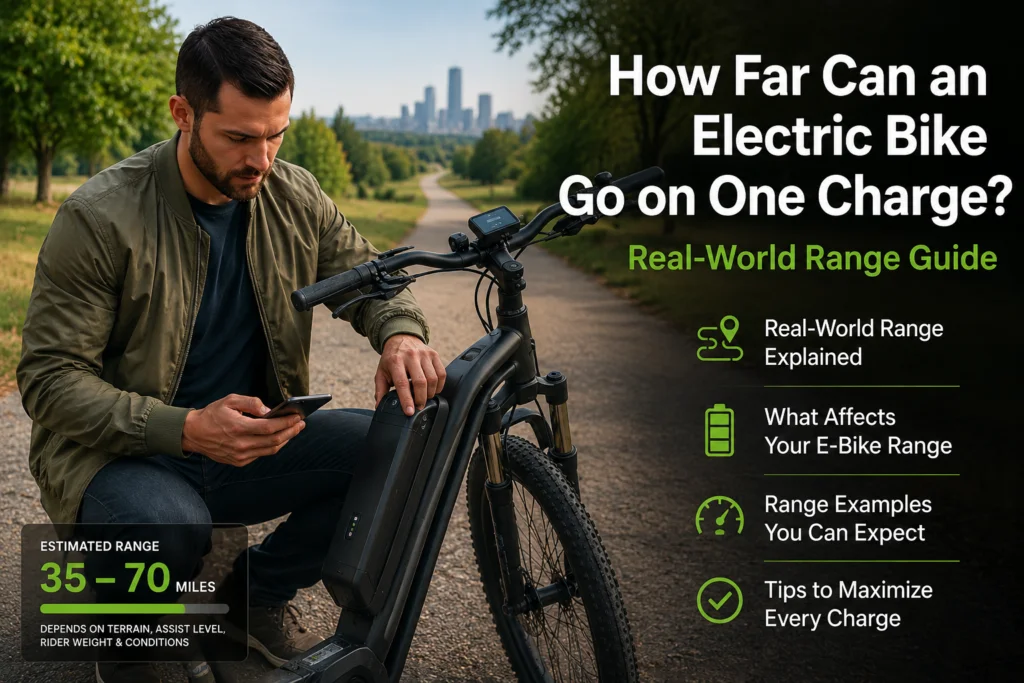
How far can an electric bike go on one charge? For most riders, a realistic answer is 20 to 60 miles per charge, depending on battery size, assist level, speed, terrain, rider weight, weather, and battery age.
Some e-bikes can go less than 20 miles if ridden fast, uphill, or mostly on throttle. Others can go 70 miles or more with a large battery, efficient pedal assist, flat roads, and a steady riding style.
The key is not to trust the biggest number on the product page without context. Real-world electric bike range is usually lower than advertised because lab-style range claims do not always reflect stop-and-go commuting, wind, hills, cargo, cold weather, or high-assist riding.
This guide gives you practical range estimates, commuter examples, battery-size tables, and a simple Wh-per-mile method so you can predict your own e-bike mileage with more confidence.
How Far Can an Electric Bike Really Go on One Charge?

Typical real-world e-bike range in miles and kilometers
Most electric bikes travel 20 to 60 miles on one charge in normal riding. That is roughly 32 to 97 kilometers.
Smaller city e-bikes may sit near the lower end. Long-range commuter, cargo, touring, or dual-battery e-bikes may go much farther when ridden efficiently.
| E-Bike Setup | Typical Real-World Range | Approx. KM Range | Best For |
|---|---|---|---|
| Small battery city e-bike | 15–30 miles | 24–48 km | Short errands, campus rides, light commuting |
| Standard commuter e-bike | 25–50 miles | 40–80 km | Daily commuting, leisure riding |
| Large-battery commuter e-bike | 40–70 miles | 64–113 km | Longer round trips, mixed terrain |
| Dual-battery or long-range setup | 60–100+ miles | 97–161+ km | Touring, delivery, long-distance commuting |
Best-case, realistic-case, and worst-case range
A better way to think about e-bike range is with three numbers:
| Range Type | What It Means | Example for a 500Wh Battery |
| Best-case range | Flat road, low assist, steady pedaling, light rider | 40–50 miles |
| Realistic range | Mixed assist, stops, some hills, normal commuting | 25–40 miles |
| Worst-case range | High speed, throttle-heavy riding, hills, cargo, wind | 15–25 miles |
The same e-bike can feel like a “50-mile bike” on one route and a “25-mile bike” on another.
Why your result may be different from the average
Your result may be different because the battery is only one part of the range equation.
A rider using low pedal assist on a flat route may use far less energy per mile than a rider using full throttle on hills. Extra body weight, cargo, cold weather, soft tires, rough roads, and repeated hard acceleration can all shorten the distance per charge.
A practical rule: treat advertised range as a best-case estimate, then plan your real commute with a safety buffer.
What Is a Good Real-World Range for an E-Bike?

Short-range, average-range, and long-range e-bike categories
A good e-bike range depends on what you need the bike to do.
| Range Category | Real-World Range | What It Usually Means |
| Short range | Under 25 miles | Fine for errands or short commutes, limited for long round trips |
| Average range | 25–50 miles | Good for most daily commuters and casual riders |
| Long range | 50–75 miles | Strong for longer commutes, hilly routes, or riders who want reserve |
| Extra-long range | 75+ miles | Best for touring, delivery use, or dual-battery setups |
A 30-mile range is not “bad” if your daily ride is 8 miles. It may be limiting if your round trip is 28 miles and you ride in winter, use high assist, or carry cargo.
Good range for commuting, leisure, delivery, and hills
For commuting, you should focus on your round-trip distance, not the one-way trip.
| Use Case | Good Practical Range |
| Short city commute | 20–30 miles |
| Average daily commute | 30–50 miles |
| Hilly commute | 40–60 miles |
| Delivery riding | 50–80+ miles |
| Weekend leisure rides | 30–60 miles |
| Long touring rides | 70+ miles |
If your route has hills or you ride at higher assist levels, choose more battery than the distance alone suggests.
When low range is normal vs when it may signal a problem
Low range can be normal if you are:
- Riding fast
- Using throttle only
- Climbing hills
- Carrying cargo or a passenger
- Riding into wind
- Using high assist most of the time
- Riding in cold weather
Low range may signal a problem if:
- Range suddenly drops by half on the same route
- The battery shuts off under load
- The charger stops too early
- The battery drains quickly while parked
- The bike feels weak even after a full charge
- The battery becomes hot, swollen, damaged, or smells unusual
Gradual range loss over years can be normal battery aging. Sudden range loss deserves troubleshooting.
Will Your E-Bike Complete Your Daily Commute? Real-World Scenarios

10-mile, 20-mile, 40-mile, and 60-mile commute examples
Use your daily round-trip mileage as the starting point.
| Daily Round Trip | Practical Range Needed | Battery Planning Advice |
| 10 miles | 20+ miles | Most e-bikes can handle this easily |
| 20 miles | 35+ miles | Choose a standard commuter battery with reserve |
| 40 miles | 60+ miles | Look for a larger battery or efficient mid-drive setup |
| 60 miles | 80+ miles | Consider dual batteries, workplace charging, or planned charging stops |
A 20-mile commute is comfortable on many e-bikes if the route is mostly flat and you pedal. The same commute can become tight if you use full throttle, ride fast, climb hills, or face winter temperatures.
Why round-trip range matters more than one-way range
A one-way commute can make range look safer than it really is.
If your office is 12 miles away, your daily ride is 24 miles before errands, detours, wind, hills, or battery aging. If the bike claims “up to 40 miles,” you may still be fine, but you should not plan as if every ride will deliver the full advertised number.
Think in round trips:
- Home to work
- Work to home
- Errands on the way
- Hills or headwind
- Battery reserve
- Range loss over time
That gives you a more reliable buying decision.
How much battery reserve you should keep
For commuting, keep a 15–25% range reserve whenever possible.
That means if your commute is 30 miles round trip, it is safer to choose an e-bike that can realistically handle about 40 miles in your conditions.
Reserve matters because batteries do not always discharge in a perfectly predictable way. Cold weather, wind, old tires, unexpected detours, or a heavier backpack can turn a comfortable ride into a low-battery ride.
Why Is Your Electric Bike Range Lower Than Advertised?

Manufacturer range tests vs real riding conditions
Advertised range is often based on ideal or controlled conditions. Real riding is messier.
Your ride may include:
- Traffic lights
- Stop-and-go starts
- Hills
- Rough pavement
- Wind
- Higher assist modes
- Throttle use
- Cargo
- Lower tire pressure
- Cold weather
- Battery age
That is why an e-bike advertised for “up to 60 miles” may realistically deliver 30 to 45 miles for many riders, and less under heavy use.
Why full throttle, hills, speed, and weight reduce distance
Your battery stores a fixed amount of energy. Anything that demands more power uses that energy faster.
Range drops when the motor works harder to:
- Push the bike at higher speed
- Carry more total weight
- Climb hills
- Fight headwind
- Accelerate repeatedly from stops
- Maintain speed on soft tires or rough surfaces
Full-throttle riding can drain the battery much faster than pedal assist because the motor is doing most of the work.
Why advertised range should be treated as a best-case estimate
The phrase “up to” is the clue.
“Up to 60 miles” usually means the bike may reach that range under favorable conditions. It does not mean every rider will get 60 miles every day.
A better buying method is to ask:
- What is the battery capacity in Wh?
- How hilly is my route?
- How fast will I ride?
- Will I pedal or use throttle often?
- How much reserve do I need?
- Will I ride in winter?
- How much range loss can I tolerate after battery aging?
This gives you a practical estimate instead of a marketing number.
What Determines E-Bike Range? The Main Factors That Matter Most

Battery capacity and usable watt-hours
Battery capacity is the foundation of range. It is usually measured in watt-hours, or Wh.
A larger Wh number usually means more stored energy. For example, a 750Wh battery generally has more range potential than a 500Wh battery, assuming similar riding conditions and bike efficiency.
But battery size is not the whole answer. A large battery can still drain quickly if the bike is ridden aggressively.
Motor efficiency, assist level, and riding speed
Motor type and riding behavior can change range significantly.
The biggest behavior-based range reducers are:
- High assist mode
- Full throttle
- Fast cruising
- Hard acceleration
- Poor gear choice on mid-drive bikes
- Riding a high-power motor aggressively
A 750W or 1000W e-bike does not automatically go farther than a 500W e-bike. Higher motor power can help with acceleration, hills, or heavy loads, but it can also use energy faster if ridden hard.
Rider weight, cargo, terrain, wind, tire pressure, and battery health
Range is affected by resistance. More resistance means more battery drain.
Common range reducers include:
- Heavier rider weight
- Child seats or passengers
- Delivery bags or panniers
- Trailers
- Steep hills
- Rough roads
- Headwind
- Low tire pressure
- Frequent stops
- Aging battery cells
- Cold temperatures
For real-world planning, assume your route and riding style matter as much as the battery label.
Battery Capacity Explained: 48V 20Ah, 400Wh, 500Wh, and Real Range

Why watt-hours matter more than voltage alone
Voltage alone does not tell you range. Amp-hours alone can also mislead you.
Use watt-hours:
Watt-hours = Volts × Amp-hours
A 48V 20Ah battery has about:
48 × 20 = 960Wh
That is a large battery for many commuter e-bikes. But the real range still depends on how many watt-hours you use per mile.
What range to expect from a 48V 20Ah e-bike battery
A 48V 20Ah battery is about 960Wh. In practical riding, that might deliver:
| Riding Style | Estimated Energy Use | Estimated Range |
| Efficient low assist | 10–15 Wh/mile | 64–96 miles |
| Normal commuter riding | 15–25 Wh/mile | 38–64 miles |
| Fast, hilly, throttle-heavy riding | 25–40 Wh/mile | 24–38 miles |
So, a 48V 20Ah battery can be a long-range setup, but it is not automatically a 90-mile battery for every rider.
How far 400Wh and 500Wh batteries usually go
Smaller and mid-size e-bike batteries are common on city and commuter bikes.
| Battery Size | Light Assist Estimate | Realistic Mixed Riding | Heavy Use Estimate |
| 400Wh | 27–40 miles | 18–30 miles | 10–18 miles |
| 500Wh | 33–50 miles | 22–40 miles | 13–25 miles |
A 500Wh e-bike can be excellent for a 10 to 20-mile daily round trip. It may feel limited for a 40-mile commute unless you ride efficiently or can charge during the day.
Why a 48V 25Ah battery may not always give huge range
A 48V 25Ah battery is about 1,200Wh, which is large. It can support long rides, but real range can still disappoint if the bike is heavy, the motor is powerful, the route is hilly, or the rider uses throttle often.
A big battery gives you more energy. It does not remove physics.
For long range, pair battery capacity with efficient habits:
- Use pedal assist instead of throttle-only riding
- Keep speed moderate
- Shift properly on hills
- Keep tires inflated
- Avoid unnecessary cargo
- Keep the battery healthy
How Speed, Assist Level, and Full-Throttle Riding Change E-Bike Range

Why faster riding drains the battery faster
Speed is one of the biggest range killers.
At higher speeds, wind resistance increases. The motor must work harder to maintain speed, especially on upright commuter bikes with bags, racks, or wide tires.
Riding at 15 mph may use far less energy than riding at 25 mph, even on the same road.
How pedal assist compares with throttle-only riding
Pedal assist usually extends range because the rider contributes part of the effort. Throttle-only riding makes the motor do most of the work.
| Riding Mode | Battery Use | Typical Range Impact |
| Low pedal assist | Lowest | Best range |
| Medium assist | Moderate | Balanced range and comfort |
| High assist | High | Shorter range |
| Throttle-only | Highest | Shortest range |
This is why two riders on the same e-bike can get completely different mileage.
How far an e-bike may go without pedaling
Throttle-only range is usually much lower than pedal-assist range.
A bike that can travel 40 miles with steady pedaling may only travel 15 to 25 miles if ridden mostly on throttle, especially with hills, high speeds, or heavy rider weight.
If you plan to ride without pedaling often, buy more battery than the advertised range suggests.
Why high-watt motors can reduce range when ridden aggressively
A 750W or 1000W motor can feel powerful, but power is not the same as range.
A stronger motor can drain the battery faster if you use that power for quick acceleration, hill climbing, or high-speed riding. The same motor can be reasonably efficient if you ride smoothly and use lower assist on flat roads.
Think of motor wattage as performance potential. Think of battery Wh and riding style as range control.
How Rider Weight, Cargo, Hills, Wind, and Road Conditions Reduce Range

How rider weight and passenger weight affect battery drain
More total weight requires more energy to accelerate and climb.
This includes:
- Rider weight
- Bike weight
- Passenger weight
- Backpack or work bag
- Groceries
- Child seat
- Trailer
- Delivery load
On flat roads, weight matters most during starts and stops. On hills, weight matters all the time.
How cargo, panniers, child seats, trailers, and delivery loads affect distance
Cargo affects range in two ways.
First, it adds weight. Second, it can add wind resistance, especially if bags or boxes sit wide or high on the bike.
Delivery riders and cargo-bike owners should plan more conservatively than casual riders. A 50-mile estimate for a light rider may become 30 to 40 miles with a loaded cargo setup, hills, traffic, and frequent starts.
Why hills, rough roads, headwinds, and low tire pressure reduce range
Hills force the motor to work harder. Headwinds do the same. Rough surfaces and soft tires increase rolling resistance.
Before blaming the battery, check:
- Tire pressure
- Brake rub
- Wheel alignment
- Chain lubrication
- Cargo load
- Route elevation
- Wind direction
- Assist level
A small maintenance issue can make a good battery feel weak.
Weather, Winter Riding, and Battery Age: Why Range Drops Over Time

How cold weather reduces usable battery range
Cold weather can reduce usable e-bike range because lithium-ion batteries do not deliver energy as efficiently in low temperatures.
In practical terms, your winter range may feel noticeably lower than your summer range. The drop is often worse if the battery starts cold, the ride is hilly, or you use high assist.
For winter commuting:
- Store the battery indoors when possible
- Start with a fully charged battery
- Expect shorter range
- Use lower assist where practical
- Keep extra reserve
- Avoid charging a freezing-cold battery until it has warmed to a safe indoor temperature
How heat, storage habits, and charging habits affect battery health
Battery range can also drop because of long-term stress.
Common stressors include:
- Storing the battery empty
- Leaving it fully charged for long periods
- Charging or storing in extreme heat
- Repeated deep discharges
- Using the wrong charger
- Heavy high-power riding all the time
Good habits do not make a battery last forever, but they can slow avoidable range loss.
How much range loss may appear after long-term use
Range loss over 1–2 years depends on battery quality, charge cycles, storage, temperature, and riding load.
A well-cared-for battery may only lose a modest amount of range. A battery exposed to heat, deep discharges, poor charging habits, or heavy use can lose range faster.
Avoid exact promises unless you have tested data for that specific battery and use case.
When reduced range is normal battery aging
Reduced range is often normal if it happens gradually.
It may be normal aging if:
- The bike still charges normally
- Power delivery feels smooth
- The range loss is gradual
- There are no warning signs
- The battery is several years old
- The same route now takes slightly more battery than before
It may be a problem if range drops suddenly, the bike shuts off under load, or the battery behaves unpredictably.
Hub Motor vs Mid-Drive: Does Motor Type Affect Real-World Range?

Why mid-drive motors can be more efficient on hills
Mid-drive motors power the bike through the drivetrain. This allows the motor to benefit from the bike’s gears.
On hilly routes, that can help the motor operate more efficiently if the rider shifts properly. A mid-drive bike in the right gear can climb more naturally than a hub motor forced to push hard at low speed.
Why hub motors may use more energy under heavy load
Hub motors can be simple, durable, and effective for city riding. But under heavy load, steep hills, or repeated starts, some hub motor setups may use more energy because they do not use the bike’s gears in the same way a mid-drive does.
That does not mean hub motors are bad. It means route and use case matter.
| Motor Type | Range Strength | Possible Range Weakness |
| Hub motor | Simple, strong for flat city riding | Can use more energy on hills or heavy loads |
| Mid-drive motor | Efficient climbing when shifted well | Depends on rider gear choice and drivetrain condition |
Why motor wattage alone does not determine range
A 500W, 750W, or 1000W label does not tell you how far the bike will go.
Range depends more on:
- Battery Wh
- Riding speed
- Assist level
- Terrain
- Total weight
- Motor efficiency
- Tire choice
- Weather
- Battery health
A 500W e-bike with a large battery and efficient rider can outlast a 1000W e-bike ridden fast on throttle.
How to Estimate Your E-Bike Range With a Chart, Calculator, or Wh-Per-Mile Method

Simple Wh-per-mile method for estimating range
Use this simple formula:
Estimated range = Battery Wh ÷ Wh per mile
Use these planning ranges:
| Riding Condition | Typical Planning Estimate |
| Light assist, flat road | 10–15 Wh/mile |
| Normal mixed commuting | 15–25 Wh/mile |
| Hills, cargo, high assist | 25–35 Wh/mile |
| Full throttle, fast riding, heavy load | 30–45+ Wh/mile |
Example:
A 500Wh battery used at 20 Wh/mile:
500 ÷ 20 = 25 miles
A 960Wh battery used at 24 Wh/mile:
960 ÷ 24 = 40 miles
This is not perfect, but it is more realistic than looking at voltage or motor watts alone.
How to use an e-bike range chart without overtrusting it
A range chart is helpful if you treat it as a planning tool, not a promise.
Before using a chart, ask:
- Is the range based on low assist?
- Does it assume a light rider?
- Does it include hills?
- Does it include throttle use?
- Does it account for cold weather?
- Does it include battery aging?
- Is the test speed close to how I ride?
If the chart does not explain conditions, use the lower end of the estimate.
Best-case, realistic-case, and worst-case range estimate
Create your own Range Confidence Score before buying or riding.
| Estimate Type | Use This For | How to Think About It |
| Best case | Marketing comparison | Flat road, low assist, light load |
| Realistic case | Daily planning | Mixed route, normal assist, some stops |
| Worst case | Safety reserve | Hills, cold, cargo, throttle, wind |
For commuting, plan around the realistic case. For longer rides, keep the worst case in mind.
Why e-bike range calculators are useful but not exact
E-bike range calculators can help because they ask for battery size, rider weight, route type, speed, assist level, and terrain.
But calculators cannot perfectly predict:
- Wind changes
- Traffic lights
- Battery age
- Tire condition
- Real rider behavior
- Stop-start frequency
- Surface quality
- Mechanical drag
Use calculators to estimate, then test your real route and adjust.
How to Increase the Range of Your Electric Bike

Ride slower and use lower assist when possible
The easiest way to increase range is to ride slightly slower and use less assist.
You do not need to ride uncomfortably slow. Even a small speed reduction can help, especially on windy roads or long commutes.
Try this:
- Use eco or low assist on flat sections
- Save high assist for hills
- Avoid full-throttle starts
- Pedal smoothly
- Shift early on mid-drive bikes
Keep tires inflated and reduce unnecessary cargo
Soft tires waste energy. Extra cargo also makes the motor work harder.
Before longer rides:
- Check tire pressure
- Remove unnecessary bags
- Make sure brakes are not rubbing
- Keep the chain clean and lubricated
- Avoid carrying a heavy lock or tools you do not need for that trip
Small improvements can add up.
Choose smoother routes and avoid repeated hard acceleration
The shortest route is not always the most efficient route.
A slightly longer route with fewer hills, fewer stops, smoother pavement, and less wind exposure may use less battery than a short route with traffic lights and steep climbs.
For commuting, test two routes and compare battery percentage used.
Care for the battery to protect long-term range
Good battery care helps protect future range.
Useful habits include:
- Use the manufacturer-approved charger
- Avoid storing the battery fully empty
- Avoid storing it at 100% for long periods
- Keep it away from extreme heat
- Store it indoors during cold weather
- Avoid repeated deep discharges
- Inspect it for damage
- Do not use a swollen, cracked, leaking, or overheating battery
If the battery acts unsafe, stop using it and get professional help.
Plan charging and reserve range before longer rides
For long rides, plan before the battery gets low.
Use this checklist:
- Know your round-trip distance
- Estimate realistic range, not advertised range
- Keep 15–25% reserve
- Account for hills and wind
- Check weather
- Charge before leaving
- Carry the charger if stopping somewhere practical
- Know whether the route has safe bailout options
Range anxiety usually comes from poor planning, not just small batteries.
When Low Range May Mean a Battery Problem

Battery aging vs sudden range loss
Gradual range loss is common as batteries age. Sudden range loss is different.
If your e-bike used to travel 35 miles and now only gets 28 miles after several years, that may be normal aging.
If it used to travel 35 miles last week and now struggles to reach 15 miles on the same route, investigate.
Electric bike battery cell imbalance symptoms that may affect range
Electric bike battery cell imbalance symptoms can include:
- Sudden power cut under load
- Battery percentage dropping quickly
- Charger stopping earlier than expected
- Reduced range after a full charge
- Voltage sag on hills
- Bike shutting off during acceleration
- Battery showing full charge but draining unusually fast
Cell imbalance is not the only possible cause. Low tire pressure, brake rub, charger faults, BMS issues, wiring problems, cold weather, or normal aging can create similar symptoms.
Charger, BMS, wiring, and tire issues that can mimic battery failure
Before replacing the battery, check simple causes first:
- Tire pressure is too low
- Brake pads are rubbing
- Charger is not completing charge
- Charging port is dirty or loose
- Battery is not locking into place
- Display percentage is inaccurate
- Controller or wiring has a fault
- Battery Management System is cutting power
- The route has changed without you noticing
A bike shop or qualified e-bike technician can test the battery and electrical system more safely than guessing.
When to stop riding and get the battery checked
Stop using the battery and get it checked if you notice:
- Swelling
- Burning smell
- Smoke
- Unusual heat
- Cracking
- Leaking
- Sizzling sounds
- Repeated sudden shutdowns
- Charger or battery behaving abnormally
Do not open an e-bike battery pack yourself unless you are qualified to work on lithium-ion battery systems. The safer choice is professional inspection.
FAQs About Electric Bike Range

How far can a 500W e-bike go on one charge?
A 500W e-bike can often travel about 20 to 50 miles on one charge, but battery size matters more than motor wattage. A 500W motor with a 500Wh battery may have much less range than a 500W motor with a 750Wh or 960Wh battery.
For a realistic estimate, check the battery Wh and your riding conditions.
How far can a 750W electric bike go?
A 750W electric bike may travel around 20 to 60 miles per charge in real use. The lower end is more likely with throttle, hills, high speed, cargo, or cold weather. The higher end is more likely with a large battery, pedal assist, flat roads, and moderate speed.
Do not assume 750W means longer range. It means the motor can deliver more power.
How far will a 48V 1000W e-bike go?
A 48V 1000W e-bike may go 20 to 60+ miles depending on the battery Ah rating and riding style. For example, a 48V 20Ah battery has about 960Wh, which can support strong range if ridden efficiently.
If the bike is ridden fast on throttle, that same battery can drain much sooner.
How many miles do e-bikes last on one charge?
Most e-bikes last about 20 to 60 miles on one charge in real-world riding. Some compact city bikes may get less. Long-range or dual-battery e-bikes may go 70 to 100+ miles under favorable conditions.
The real number depends on battery capacity, route, speed, assist level, rider weight, weather, and battery condition.
How many miles can an e-bike go at full throttle only?
An e-bike ridden at full throttle only may travel about 10 to 30 miles on many common battery setups, though larger batteries can go farther. Full throttle uses more energy because the motor does most of the work.
If you plan to ride throttle-only often, choose a larger battery and keep more reserve.
Does pedaling significantly extend e-bike range?
Yes, pedaling can significantly extend e-bike range. Pedal assist lets the rider share the work with the motor, which usually reduces energy use per mile.
The difference is most noticeable on flat roads, moderate speeds, and longer rides.
How accurate are e-bike range calculators?
E-bike range calculators are useful for planning, but they are not exact. They can estimate range using battery size, speed, rider weight, terrain, and assist level, but they cannot fully predict wind, traffic, battery age, tire pressure, or riding habits.
Use a calculator as a starting point, then test your real route.
How long does 20 miles take on an e-bike?
A 20-mile e-bike ride may take about 1 to 1.5 hours for many riders, depending on speed, traffic, stops, terrain, and local rules.
At 20 mph, 20 miles takes about 1 hour of moving time. At 15 mph, it takes about 1 hour and 20 minutes before stops.
What happens when an e-bike battery runs out during a ride?
When an e-bike battery runs out, you can usually still pedal the bike like a regular bicycle, but it may feel heavier because of the motor, battery, and frame weight.
To avoid this, plan your route with reserve range and avoid using high assist near the end of a ride.
Can electric bike battery cell imbalance reduce range?
Yes, battery cell imbalance can reduce usable range if one cell group reaches its limit earlier than the others. This can cause early cutoff, sudden voltage drop, or reduced usable capacity.
However, similar symptoms can also come from battery aging, charger issues, BMS faults, low tire pressure, brake rub, or cold weather. If range drops suddenly, get the battery checked by a qualified technician.
Pingback: 10 Types of Electric Bikes Compared: Which One Fits You? - electricscootercar.com
Pingback: What Is an Electric Bike? How It Works, Classes & Range - electricscootercar.com
Comments are closed.