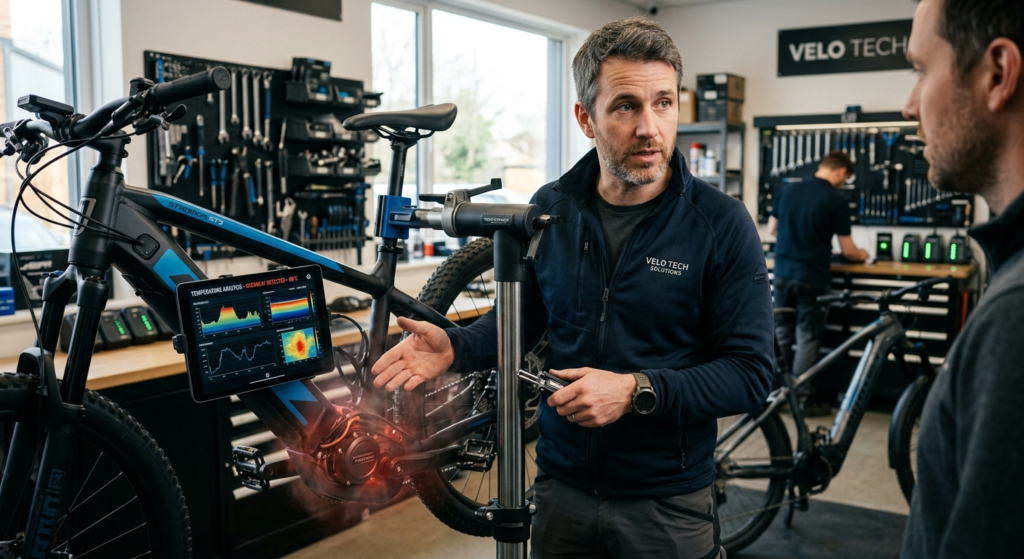
If your e-bike motor is overheating, the usual reason is simple: the motor is generating heat faster than it can get rid of it. Sustained high torque and current are major contributors, especially during slow, steep climbs, heavy-load riding, repeated hard starts, or near-stall operation.
If assistance suddenly drops, you get a temperature warning, or you notice a burning smell, stop pushing the motor and let the system cool. Then diagnose when the problem happens and what else the bike does. A complete power cut, for example, can also point to the battery, controller, wiring, or BMS rather than the motor itself.
The Main Causes of E-Bike Motor Overheating

The fastest way to narrow down the cause is to look at when the motor gets hot.
| When overheating happens | Start by checking |
|---|---|
| Slow, steep climbs | High motor load at low speed |
| Heavy cargo or towing | Excess torque demand |
| Repeated starts or very slow crawling | Near-stall/high-current operation |
| After a controller or power modification | Current limits and system compatibility |
| Only after long, hard rides | Heat accumulation and cooling conditions |
| Mainly on very hot days | Reduced thermal margin |
| During normal flat-road riding | Brake drag, tires, bearings, configuration, or faults |
These are diagnostic clues rather than proof. Several factors can contribute at the same time.
Slow Climbs, Heavy Loads and Near-Stall Riding Put the Motor Under High Thermal Stress
A motor produces more torque by drawing more current through its windings. Those windings have electrical resistance, so some of that electrical energy becomes heat.
Copper heating follows an I²R relationship. In practical terms, increasing current can increase winding heat much faster than many riders expect. Grin Technologies notes that current through the windings is responsible for much of a motor’s internal heating and that sustained thermal capability depends heavily on motor speed and operating conditions.
That explains a common real-world pattern: a motor may run comfortably while cruising but become much hotter while crawling up a steep hill at high assist.
A complete stall is an extreme condition. The motor can be drawing substantial current and producing torque while the wheel is barely moving or not moving at all. Avoid intentionally holding an e-bike motor at or near stall to test it.
Hub motors and mid-drives behave differently on hills
With a hub motor, motor RPM is closely tied to wheel speed. If the bike is crawling uphill, the hub motor is also turning slowly.
With a mid-drive, the bicycle’s gears change the relationship between road speed and motor speed. Shifting to a lower bicycle gear can let the motor spin at a more favorable cadence while the bike itself still climbs slowly.
That does not mean every hub motor overheats on hills or that every mid-drive is immune. Gradient, controller limits, combined rider-and-cargo weight, motor design, duration and cooling still matter.
High Current or Power Modifications Can Raise Motor Heat
A controller limits and regulates the electrical current supplied to the motor. Raising supported current limits can produce more torque, but it can also increase winding heat.
This matters if overheating began after:
- installing a different controller;
- increasing current-related settings;
- changing firmware parameters;
- increasing system voltage or power;
- combining components that were not designed to operate together.
Do not assume that the battery-current number you see on a display is identical to the current flowing through the motor windings. Depending on controller operation, particularly at lower speeds, motor or phase current can differ significantly from battery current. Grin’s motor simulator documentation specifically distinguishes those currents.
If the problem appeared after a modification, return to the manufacturer’s supported configuration before experimenting with additional settings.
Long Rides, Hot Weather and Mechanical Drag Can Tip a Motor Over Its Thermal Limit
Overheating does not require one dramatic event. Heat can accumulate gradually during sustained demanding use.
Hot weather makes that harder because the temperature difference between the motor and its surroundings is smaller, reducing the available thermal margin.
Mechanical resistance also matters. A rubbing brake, underinflated tire, damaged bearing, or binding drivetrain makes the motor do additional work on every mile.
If your motor overheats during otherwise ordinary riding, check those simple sources of resistance before assuming that the motor itself has failed.
Why the Watt Rating on the Motor Does Not Tell You Whether It Will Overheat

A label such as 250 W, 500 W, or 750 W does not by itself define every condition the motor can sustain without overheating.
Motor RPM, current, torque, duration, ambient temperature, cooling and controller behavior all affect the result.
Grin’s current technical guidance goes further: it notes that e-bike motor watt ratings are not standardized consistently across the industry and shows how the same motor’s sustainable output can vary greatly with speed.
So:
“My motor is rated for this power” is not enough information to conclude that overheating is impossible.
How to Tell If Your E-Bike Motor Is Actually Overheating

Motors naturally become warm during use. A hot casing after a demanding climb does not automatically mean something is wrong.
Look at the heat together with the bike’s behavior.
Probably Normal, Needs Investigation, or Stop Riding?
Probably normal
The motor is noticeably warm after a demanding climb or heavy load, but:
- assistance remains normal;
- there is no warning;
- there is no unusual smell or sound;
- the bike behaves normally once the workload decreases.
Monitor the pattern rather than assuming the motor is damaged.
Investigate further
Pay more attention if:
- the motor becomes unusually hot during ordinary riding;
- assistance repeatedly fades as the bike heats up;
- the same problem returns under similar conditions;
- performance returns only after the system cools;
- the bike displays a temperature-related warning.
Manufacturers do use thermal protection. Shimano, for example, documents a drive-unit temperature warning in which assistance can decrease and advises stopping use of the assist function until the drive unit cools.
Stop and inspect before continuing
Do not keep riding under heavy assist if you notice:
- smoke;
- a strong burnt-electrical smell;
- melted or badly discolored connectors;
- persistent abnormal motor noise or rough running;
- a temperature warning that remains after cooling;
- repeated thermal shutdown during ordinary use.
How Hot Is Too Hot for an E-Bike Motor?
There is no single casing temperature that can safely be applied to every e-bike motor.
The temperature you can measure on the outside of the motor is not necessarily the temperature of the windings inside it. An internal sensor may also be located somewhere different from the hottest part of the motor.
That means three numbers can differ:
- casing temperature;
- internal winding or component temperature;
- the temperature seen by the motor’s built-in sensor.
Do not use your hand as a precision thermometer, and avoid touching a motor that may be hot enough to cause a burn.
Where your system provides an internal temperature warning or protection limit, use the manufacturer’s information for that exact drive system.
For example, Bafang documents an overtemperature condition in which an internal motor sensor detects that the motor has reached its protection value, while Bosch documents drive-unit temperature warnings that can remove motor assistance until the system cools.
Those examples also show why copying a fixed temperature from a different motor is unreliable.
What to Do When an E-Bike Motor Overheats

If you are dealing with an overheating event right now, do not start troubleshooting it under full load.
What to Do Immediately
- Reduce or stop motor assistance.
Do not keep applying maximum power to see whether the problem clears. - Stop somewhere safe if assistance is fading or the bike is behaving abnormally.
- Switch off the e-bike according to its manual.
- Let the drive system cool naturally.
Do not use improvised rapid-cooling methods unless the manufacturer specifically approves them. - Check the display or app for an error or warning code.
Record the exact code before restarting. - After the system is cool, look for obvious problems.
Check for brake drag, a jammed wheel, damaged cables, loose accessible connectors, discoloration, melted plastic, or a burnt smell. - Do not repeatedly restart the bike and recreate the same severe overheating condition.
If the warning comes straight back, move to diagnosis or service.
Bosch’s current overtemperature guidance follows the same basic logic: switch off, let the drive unit cool, restart, and contact a specialist dealer if the problem persists.
Can You Ride Again After the Motor Cools?
A short, low-load check is more reasonable when:
- the overheating followed an obviously demanding climb or unusual load;
- the bike has cooled fully;
- no warning remains;
- there is no burnt smell or visible heat damage;
- the motor sounds and runs normally;
- assistance has returned normally.
Do not immediately repeat the same hill, payload, or maximum-assist condition.
If the motor repeatedly overheats during normal riding, cooling it down is no longer a solution. It is only resetting the symptom.
How to Troubleshoot an Overheating E-Bike Motor

Do not begin by replacing the motor.
First establish what triggers the problem, rule out avoidable mechanical load, and then determine whether the motor is actually the component entering protection.
Step 1: Record Exactly When the Problem Happens
Before changing settings or parts, record:
- whether you were climbing, accelerating, or cruising;
- how long you had been riding;
- road speed;
- assist or throttle level;
- rider and cargo load;
- weather conditions;
- recent modifications;
- any warning or error code;
- whether power faded gradually or disappeared instantly;
- whether the display stayed on;
- what happened after the bike cooled.
You do not need to deliberately recreate a severe overheating event.
The existing pattern may already tell you a lot.
Example: if the problem appears only after several minutes of crawling up a steep hill at maximum assist, workload-related heating is more plausible than if the whole bike randomly shuts down while cruising on level ground.
Step 2: Rule Out Extra Load Before Blaming the Motor
Start with the simple checks.
Brakes: Make sure a brake is not rubbing heavily.
Tires: Check that they are correctly inflated for the tire, bike and load.
Wheels and bearings: Look for unusual binding, roughness, or resistance.
Drivetrain: On a mid-drive, excessive drivetrain resistance adds directly to the work required from the motor.
Payload: Consider whether the problem appears only with unusually heavy cargo, towing, or combined rider weight.
Correcting a dragging brake can be more valuable than replacing an electrical component that was never faulty.
Step 3: Inspect Only Owner-Accessible Cables and Connectors
Switch the bike off and allow it to cool before inspection.
Look for:
- connectors that are visibly loose;
- corrosion;
- damaged or pinched cable insulation;
- discoloration;
- melted connector housings;
- cables rubbing against moving parts.
Do not open a battery pack, guess wire functions from colors, or begin phase/Hall rewiring from a generic internet diagram.
Use the exact manual or diagnostic information for your drive system when a warning code is present.
Step 4: Use the Shutdown Pattern to Identify the Right Diagnostic Branch
This is the part many generic overheating guides skip.
It overheats mainly during long, slow climbs or heavy loads
→ Start with motor workload, speed, gearing where applicable, payload and current demand.
The entire bike and display suddenly switch off
→ Do not assume the motor overheated. Battery/BMS protection, main connectors and the power path also need investigation.
The display stays on but assistance fades as the system heats up
→ Thermal derating or drive-unit protection becomes more plausible.
The controller is far hotter than the motor or reports its own temperature fault
→ Investigate the controller branch.
The motor stutters, runs roughly, or develops abnormal noise while heating
→ Stop repeated full-load tests. Motor phase, Hall/sensor, wiring or controller problems may need professional diagnosis.
The fault began immediately after a controller or current-setting change
→ Return to supported configuration and investigate the modification.
The warning remains after the bike has fully cooled
→ Follow the manufacturer’s diagnostic procedure or obtain service.
Bafang’s own fault system illustrates why this distinction matters. It lists separate conditions for motor overtemperature, motor temperature-sensor faults, motor overcurrent, controller overtemperature, battery-temperature problems and Hall/phase faults. A generic “the bike cut out, therefore the motor overheated” diagnosis can send you down the wrong path.
Can Overheating Damage an E-Bike Motor?

Yes, severe or repeated overheating can cause permanent damage. But a thermal-protection event does not automatically mean the motor has been damaged.
Protection systems exist precisely to reduce power or stop operation when temperatures become unacceptable.
If the bike cools and then performs normally, permanent damage is less obvious. If abnormal behavior remains, investigate further.
Sustained excessive internal heat can damage winding insulation. Depending on motor construction, very high temperatures can also affect magnets or polymer gears. Grin discusses all three as possible outcomes when excessive heat accumulates inside a motor.
Signs the Motor May Need Inspection After Overheating
Pay attention after the bike has fully cooled.
Professional diagnosis becomes more justified if you notice:
- persistent loss of power;
- new grinding, clicking, stuttering, or roughness;
- a burnt insulation or electrical smell;
- melted or badly discolored connectors;
- repeated temperature warnings;
- abnormal mechanical resistance;
- overheating that now occurs under ordinary loads.
The useful distinction is not simply:
“It cooled down, so everything is fine”
versus
“It overheated once, so the motor is ruined.”
There is a third and common-sense outcome:
The bike recovered, but the cause still needs diagnosis before you put it under the same load again.
When to Stop DIY Troubleshooting
Move to manufacturer or professional diagnosis when:
- warnings persist after cooling;
- the motor runs abnormally under low load;
- there is visible heat damage;
- a connector has melted;
- the motor repeatedly stutters or cuts out;
- the cause appears to require opening the motor, controller, or battery;
- simple brake, tire, load and connector checks have not explained the problem.
Do not buy a replacement motor solely because the existing one became hot.
Find the failure first.
How to Prevent E-Bike Motor Overheating

Prevention works best when it matches the cause.
| If the cause is… | The useful prevention is… |
|---|---|
| Slow, high-load climbing | Reduce prolonged near-stall operation and contribute more rider power |
| Mid-drive running in too high a gear | Shift down so the motor can operate at a healthier cadence |
| Hub motor repeatedly crawling under heavy torque | Reduce load or avoid sustained very-low-speed high-assist operation |
| Heavy cargo or towing | Reduce load or use a system designed for the regular duty |
| Brake or bearing drag | Repair the mechanical resistance |
| Underinflated tires | Maintain appropriate tire pressure |
| Unsupported current changes | Restore manufacturer-supported configuration |
| Long, hard riding in high ambient temperatures | Reduce sustained thermal load and allow recovery |
| Repeated overheating in normal intended use | Diagnose the system and reassess whether the drive setup suits the workload |
Do Not “Lug” the Motor Under Maximum Load
On steep terrain, riding more slowly is not automatically kinder to the motor.
If the motor is barely turning while being asked for maximum torque, heat generation can rise.
For a mid-drive, shift to a lower bicycle gear so the motor does not have to pull a tall gear at very low cadence.
For a hub motor, changing bicycle gears does not change hub-motor RPM. If the bike is crawling while the hub supplies heavy torque, reducing the load or changing the riding condition is more effective.
In both cases, pedaling more can reduce how much torque the motor must supply.
Remove Mechanical Resistance Before Looking for Cooling Modifications
Check the ordinary bike first:
- brakes;
- tire pressure;
- bearings;
- drivetrain condition.
Those fixes reduce the heat being generated rather than attempting to remove additional heat afterward.
Avoid drilling motors, adding fluids, altering housings, or attempting other cooling modifications unless you understand the specific design and consequences. For a stock e-bike, correcting the cause is usually the better first step.
Keep Controller Settings Within Supported Limits
There is no universal amp setting that is safe for every motor.
Motor winding, controller, battery, connectors, temperature sensing and manufacturer protection strategies differ.
If overheating started after increasing power or current, return to documented supported limits. Do not copy another rider’s current setting simply because their motor has a similar watt label.
The Most Useful Question Is Not “How Hot Is It?”

When an e-bike motor gets unusually hot, ask:
When does it happen, what load was the motor under, and what else does the bike do at the same time?
A motor that becomes hot only while crawling up a steep hill under maximum assist points toward a different problem than a bike that completely shuts off at random on flat ground.
Start with the operating pattern. Remove avoidable mechanical load. Check model-specific warnings. Then separate the motor from controller, battery/BMS and wiring faults before replacing anything.
If the bike keeps entering thermal protection during ordinary intended riding, remains weak after cooling, smells burnt, shows visible heat damage, or runs roughly, stop repeating the test and have the drive system properly diagnosed.
Pingback: SEO title: E-Bike Motor Efficiency Factors: Load, RPM, Heat & Gearing - electricscootercar.com
Pingback: SEO Title: Eco Mode vs Sport Mode on an E-Bike: Range, Speed & Which to Use - electricscootercar.com
Pingback: SEO title: E-Bike Watts vs Power: What Motor Ratings Really Mean - electricscootercar.com
Pingback: SEO title: Why Does My E-Bike Cut Out While Riding? Diagnose It Without Guessing - electricscootercar.com
Pingback: Does Rider Weight Affect E-Bike Performance? Range, Speed & Hills ( extenrla pending ) - electricscootercar.com
Pingback: E-Bike Uphill vs Downhill Battery Use: Elevation, Grade & Regen - electricscootercar.com
Pingback: Hub Motor vs Mid-Drive: Which E-Bike Setup Fits Your Ride? - electricscootercar.com
Pingback: What Is RPM on an E-Bike? Motor vs Wheel vs Cadence Explained - electricscootercar.com
Comments are closed.