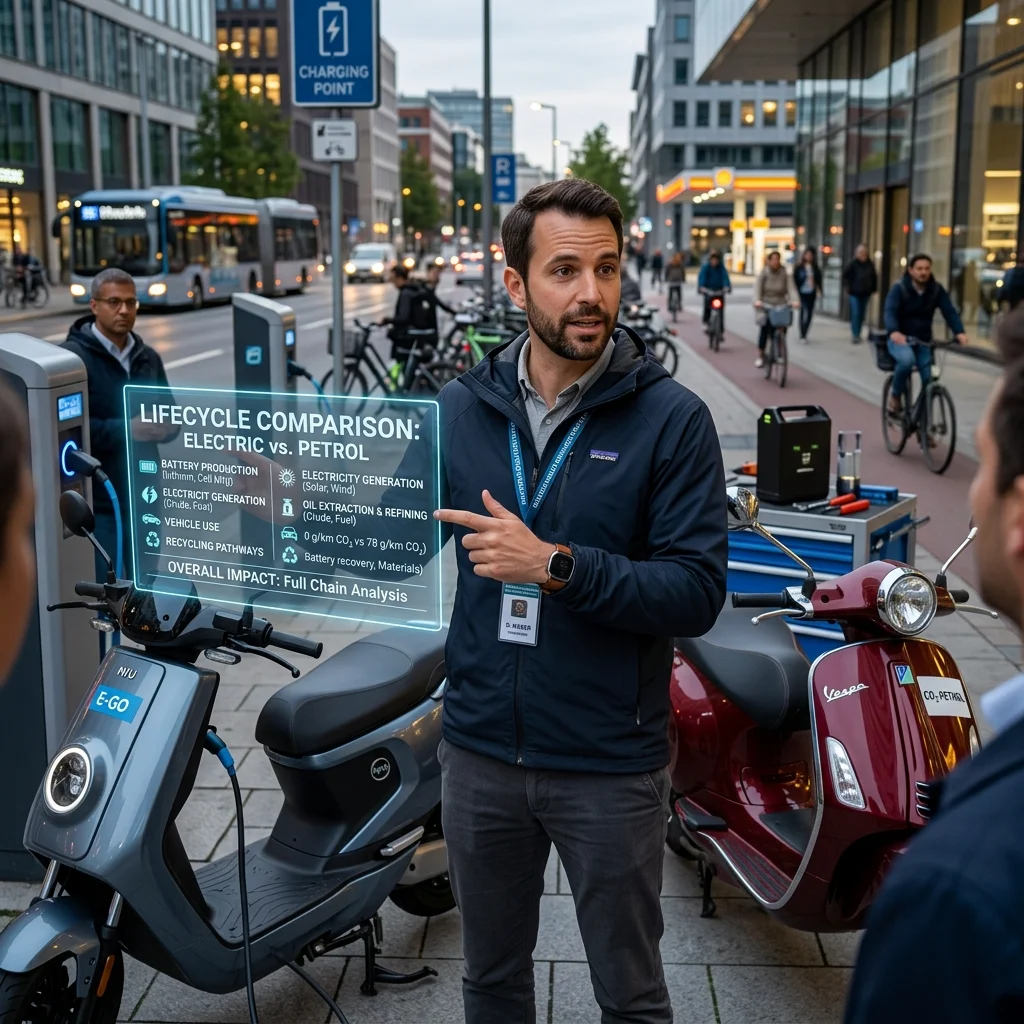
Usually, a comparable electric two-wheeler has the stronger environmental case for lifecycle climate impact and local exhaust pollution—but not under every set of assumptions.
The battery has an upfront manufacturing footprint. Electricity generation matters. So do vehicle lifespan, real energy use and battery replacement. Petrol vehicles, however, also have impacts before fuel reaches the tank: oil extraction, transport, refining and distribution all belong in the comparison.
For U.S. readers, petrol here means gasoline. The useful question is not simply “Is electric cleaner?” It is:
Which comparable vehicle causes less impact over the transport it actually provides?
That is the question this guide helps you answer.
Are Electric Two-Wheelers Actually Better for the Environment?

For many like-for-like comparisons, the evidence points in favor of electric two-wheelers on lifecycle greenhouse-gas emissions and local tailpipe pollution. But a trustworthy answer needs conditions attached.
The supplied research identifies a 2026 systematic review of motorcycle sustainability studies that found substantial variation among lifecycle results. Electricity mix, production assumptions, vehicle characteristics and methodology can materially change the outcome.
That means a percentage reported for one electric motorcycle should not automatically be reused for a scooter, e-bike or another country’s electricity system.
If you are comparing two actual vehicles, pay closest attention to:
- whether they perform roughly the same transport job;
- battery capacity;
- electricity use or petrol fuel economy;
- local electricity generation;
- expected lifetime mileage;
- whether a battery replacement is likely.
Those variables tell you more than a generic “electric versus petrol” claim.
There is also an important distinction between lower carbon impact and lower environmental impact in every category. Climate, resource use, local pollution, waste and noise are related questions, but they are not interchangeable.
Compare Like With Like Before Trusting Any Emissions Number

A pedal-assist e-bike, an electric commuter scooter and a high-performance electric motorcycle may all have two wheels, but they are not environmentally equivalent products.
They can differ sharply in mass, battery size, top speed, passenger capability and intended use. The petrol vehicle used as the comparison must therefore change with them.
| Electric class | Fair comparison |
|---|---|
| Pedal-assist e-bike | The motorized trip or transport mode it realistically replaces |
| Electric moped/commuter scooter | Similar-speed, similar-purpose petrol scooter or moped |
| Electric motorcycle | Petrol motorcycle with broadly similar performance and use |
| Shared electric kick scooter | Usually a separate shared-mobility lifecycle analysis |
The practical rule is simple:
Compare transport functions, not objects that merely share the same number of wheels.
An electric city scooter should not be made to look cleaner by comparing it with a much larger petrol motorcycle. The reverse can distort the result just as easily.
Per Mile Is Not Always the Right Comparison
Lifecycle studies need a common basis, usually called a functional unit.
That might be:
- impact per mile or kilometer;
- impact per passenger-mile;
- impact over the vehicle’s useful life.
Per-mile figures are easy to understand, but they can become misleading when the vehicles carry different loads, serve different trips or have very different useful lives.
There is no universally correct functional unit. What matters is that both vehicles use the same one and that it represents the transport task being compared.
A Fair Lifecycle Comparison Counts Both Supply Chains

Tailpipe emissions are only one part of the environmental picture.
The lifecycle framework identified in the supplied DOE research separates direct vehicle emissions from upstream energy or fuel effects and vehicle-cycle impacts such as manufacturing, battery production and end-of-life.
A fair cradle-to-grave comparison therefore needs to count both pathways consistently.
Electric pathway
Raw-material production
→ vehicle and battery manufacturing
→ electricity generation
→ charging and riding
→ maintenance or battery replacement where relevant
→ reuse, recycling or disposal
Petrol pathway
Raw-material production
→ vehicle and engine manufacturing
→ oil extraction
→ crude transport
→ refining
→ fuel distribution
→ combustion and riding
→ maintenance
→ recycling or disposal
This symmetry matters.
A comparison that examines lithium extraction, battery factories and recycling in detail but starts the petrol side only when fuel burns in the engine is not comparing equivalent system boundaries.
Why “Zero Tailpipe Emissions” Is the Better Phrase
An electric drivetrain produces no combustion exhaust from the vehicle itself.
That is a meaningful advantage, especially when local air pollution is the question.
It does not mean the complete vehicle has zero environmental impact. Electricity still has to be generated, the vehicle and battery have to be produced, and tires and other components still wear.
So these two statements answer different questions:
“No combustion tailpipe emissions” — describes what comes directly from the vehicle during operation.
“Zero lifecycle emissions” — would imply that manufacturing, electricity, maintenance and end-of-life produce no emissions, which is not the case.
Battery Mining Matters—but So Does the Petrol Supply Chain

Battery production is one of the strongest objections readers raise about electric vehicles, and it deserves serious treatment.
It can increase the electric vehicle’s upfront environmental burden before much riding has occurred. The importance of that burden depends on battery size, chemistry, manufacturing conditions, useful life and replacement.
What it does not justify is analyzing the battery in isolation while ignoring the fuel supply chain on the petrol side.
Why Battery Size Matters
A small e-bike battery and a large electric-motorcycle battery require very different quantities of material and stored energy.
That changes the manufacturing side of the lifecycle calculation.
The environmental case for electrification is therefore easier to assess when battery size is appropriate to the transport task rather than being treated as an irrelevant specification.
Minerals and Petroleum Need the Same Boundary
A useful comparison asks:
Electric: What resources and energy are required to make the battery and supply electricity throughout the vehicle’s life?
Petrol: What resources and energy are required to extract, transport, refine and distribute petroleum throughout the vehicle’s life?
The battery creates a substantial front-loaded production event. Petrol fuel production is a recurring process because more fuel must continue to be produced as the vehicle is ridden.
Neither pathway is impact-free.
The reader’s job is not to decide whether lithium mining is “good” or oil extraction is “bad” in isolation. It is to compare the environmental burdens that arise from providing the same transport service.
Does LFP vs NMC Change the Answer?
It can change the assumptions, but battery chemistry alone does not determine the final environmental verdict.
Different chemistries use different material combinations and can differ in manufacturing, performance, lifetime and recycling considerations.
That is why “LFP is greener than NMC” is too broad as a standalone rule. The supplied research specifically flags unconditional battery-chemistry claims as an accuracy risk.
Chemistry should be evaluated alongside battery capacity, production conditions, expected life and the environmental category being measured.
What If the Battery Needs Replacing?
A replacement battery adds another manufacturing burden.
In a carbon break-even calculation, that usually pushes the crossover farther out than a scenario where the original pack lasts for the vehicle’s full useful life.
It does not automatically mean the petrol vehicle becomes environmentally preferable. The result depends on how large the replacement burden is compared with the operating-impact difference over the rest of the vehicle’s life.
Any lifecycle study that assumes no replacement should state that assumption clearly.
Recycling Helps Only When the Model Justifies the Credit
Battery materials may be recoverable, and some batteries may have a useful second-life application.
But an environmental model should not award those benefits merely because recycling or reuse is theoretically possible.
The claimed credit depends on what actually happens to the pack, which materials are recovered, what those materials replace and how the lifecycle methodology allocates that benefit.
A modeled future benefit and an observed recycling outcome are not the same thing.
Where the Pollution Happens Changes the Answer

“Cleaner” can describe two different environmental questions:
- What pollution occurs around the road where the vehicle is used?
- What environmental impact occurs across the entire lifecycle?
Electric and petrol two-wheelers can perform differently on those two questions.
Local Air Pollution
Electric two-wheelers do not produce combustion exhaust at the vehicle.
Petrol engines burn fuel in the places where they are ridden, so their direct exhaust occurs in the street environment.
For dense urban areas, that difference matters independently of the wider climate calculation.
What About Tire and Brake Pollution?
Electrification does not eliminate every traffic-related particle.
The EPA material reviewed in the supplied research distinguishes electric vehicles’ lack of tailpipe and evaporative emissions from remaining brake and tire particulate emissions. It also warns against silently treating car-model outputs as motorcycle-specific data.
So the accurate claim is not “electric vehicles create no particulate pollution.”
It is that they remove combustion tailpipe pollution, while non-exhaust sources still remain.
The amount of tire or brake wear should be evaluated with evidence for the relevant vehicle rather than assumed to be identical across all two-wheelers.
A Fossil-Heavy Grid Does Not Turn an Electric Bike Into a Petrol Bike
If electricity comes from a carbon-intensive grid, the electric vehicle’s upstream climate impact rises.
Its local operating profile does not suddenly become identical to a combustion vehicle: it still has no combustion exhaust at the vehicle.
This is why two statements can both be true:
- electrification can reduce local tailpipe pollution;
- a carbon-intensive electricity supply can weaken its lifecycle greenhouse-gas advantage.
The first is a local-pollution question. The second is a lifecycle-climate question.
Lower CO₂ Does Not Mean Lower Impact in Every Category

Greenhouse-gas emissions are important, but they are not a complete environmental score.
Depending on the lifecycle assessment, other relevant issues can include:
| Impact area | Question to ask |
|---|---|
| Climate | What greenhouse-gas impact accumulates over the lifecycle? |
| Resources | What materials and extraction processes are required? |
| Local pollution | What pollutants occur near communities during use? |
| End of life | What happens to batteries, vehicles and components? |
| Noise | How does the vehicle affect the local acoustic environment? |
A lower carbon footprint does not mathematically prove lower impact in every other category.
This is also one reason apparently conflicting studies need careful reading. They may use different impact categories, system boundaries or functional units rather than genuinely answering the same question and reaching opposite conclusions.
Before deciding that two studies “disagree,” compare their assumptions.
Environmental Break-Even Depends on the Inputs, Not a Magic Mileage

A common question is:
How far does an electric two-wheeler have to travel before its lower operating impact offsets any higher manufacturing impact?
That is the environmental, or more specifically carbon, break-even point.
The idea is straightforward.
If the electric model begins with a higher manufacturing footprint but has a lower operating footprint per mile, its initial disadvantage becomes smaller as both vehicles are used.
A simplified calculation is:
Break-even distance = upfront impact difference ÷ operating-impact advantage per unit of distance
Or symbolically:
Break-even distance = Δ manufacturing impact / Δ operating impact
The formula is simple. Getting defensible inputs is the difficult part.
A credible calculation needs to state:
- vehicle class;
- functional unit;
- battery capacity and chemistry where known;
- manufacturing assumptions;
- electricity source;
- electricity consumption;
- petrol fuel economy;
- expected lifetime distance;
- battery replacements;
- end-of-life treatment;
- environmental metric being modeled.
The supplied research specifically requires quantitative break-even results to expose their vehicle class, geography, units and assumptions rather than presenting one universal crossover distance.
Three Scenarios Explain More Than One Headline Number
Consider three hypothetical situations:
Smaller battery + lower-carbon electricity + efficient riding + long useful life
The electric model’s operating advantage is likely to accumulate more quickly relative to its upfront burden.
Moderate battery + moderate grid + normal lifetime + no replacement
The crossover may move farther out, but the same basic calculation still applies.
Large battery + carbon-intensive electricity + short life + replacement battery
The electric advantage can shrink substantially. Under some assumptions, the relevant environmental break-even may fall beyond the vehicle’s useful life.
These are directional examples, not measured results for real models.
The useful lesson is not “electric becomes cleaner after X miles.”
It is which assumptions move X.
The Five Variables Most Likely to Change the Result

Once you understand break-even, most disagreements become easier to diagnose.
1. Electricity Mix
The higher the emissions associated with each unit of electricity, the larger the electric vehicle’s use-phase climate impact.
For a U.S.-focused comparison, state or regional electricity data can therefore be more useful than a single global assumption.
2. Real Energy Use and Petrol Fuel Economy
Grid carbon intensity alone is incomplete.
Two electric vehicles charging from the same grid can have different operating impacts if one consumes more electricity per mile.
The petrol side works the same way: fuel economy changes how much fuel must be produced and burned for every mile of travel.
The operational comparison therefore needs both:
energy source × energy consumed
3. Useful Life and Lifetime Mileage
A manufacturing impact is easier to spread over a vehicle that provides useful transport for a long time.
A short-lived vehicle may never reach the crossover predicted by a model that assumes much higher lifetime mileage.
This is why lifecycle results should not use ambitious mileage assumptions without explaining whether the vehicle is realistically expected to achieve them.
4. Battery Capacity
A larger battery generally means more battery material and manufacturing to account for.
That does not make large batteries inherently unjustified. A highway-capable motorcycle may genuinely need one.
It does mean battery size should match the comparison. An e-bike cannot donate its manufacturing assumptions to an electric motorcycle.
5. Battery Replacement
Replacement introduces another battery-production event.
The effect is most important when the replacement pack is large or when it occurs in a vehicle that does not then remain in service long enough to deliver substantial additional mileage.
If a study includes or excludes replacement, that choice should be visible.
What this means for you: an electric two-wheeler’s environmental case generally becomes stronger when the vehicle is efficient, appropriately sized, used for a long time and charged from lower-carbon electricity. The case becomes less favorable as electricity becomes more carbon-intensive, battery capacity rises relative to the transport task, useful life falls or extra battery production is required.
That is a sensitivity rule, not a guarantee for every model.
Electric Two-Wheelers Are Quieter at Low Speed—but They Are Not Silent

Electric drivetrains avoid combustion-engine and exhaust noise.
That can reduce powertrain noise, particularly in situations where engine sound is an important part of the total noise people hear.
But total traffic noise also includes:
- tire-road interaction;
- mechanical sounds;
- wind and aerodynamic noise.
As speed rises, those other sources can become more important relative to drivetrain noise.
So “electric vehicles are silent” is too absolute. The more defensible conclusion is that electrification removes a significant source of propulsion noise, while the size of the total noise benefit depends on speed, road conditions and vehicle type.
Any numerical decibel comparison should use measurements for the relevant two-wheeler and test conditions rather than borrowing passenger-car figures.
Before You Trust a “Greener” Claim, Check These 8 Assumptions

You do not need to be a lifecycle-assessment specialist to spot a weak comparison.
Before accepting a statement such as “electric scooters are zero-emission,” “battery mining makes EVs worse,” or “electric becomes cleaner after 5,000 miles,” check:
- Vehicle match: Are the two vehicles genuinely comparable in performance and use?
- Lifecycle boundary: Does the comparison count manufacturing and upstream energy on both sides?
- Functional unit: Is the result per mile, passenger-mile or useful vehicle life?
- Location: Which electricity grid and fuel-production assumptions are being used?
- Real consumption: What electricity use and petrol fuel economy are assumed?
- Useful life: How long and how far are the vehicles expected to remain in service?
- Battery assumptions: What capacity, chemistry and replacement schedule are included?
- Impact category: Is the claim about greenhouse gases, local pollution, resource use or something broader?
If a precise percentage or break-even mileage is presented without those assumptions, treat the number cautiously.
The strongest comparison is not the one with the most dramatic headline. It is the one that lets you see what was counted, what was assumed and what would change the answer.
If you are comparing two specific models, your next useful inputs are their real electricity or fuel consumption, battery capacity, likely battery life and realistic lifetime mileage. Those numbers turn a general environmental comparison into one that actually reflects how the vehicles will be used.
Pingback: Lithium Mining Impact: Water, Land & E-Bike Batteries - electricscootercar.com
Pingback: Does Electricity Source Affect E-Bike Emissions? Grid Mix, CO₂ & Charging - electricscootercar.com
Pingback: Are Electric Bikes Eco-Friendly? It Depends on the Bike—and the Trip It Replaces - electricscootercar.com
Comments are closed.