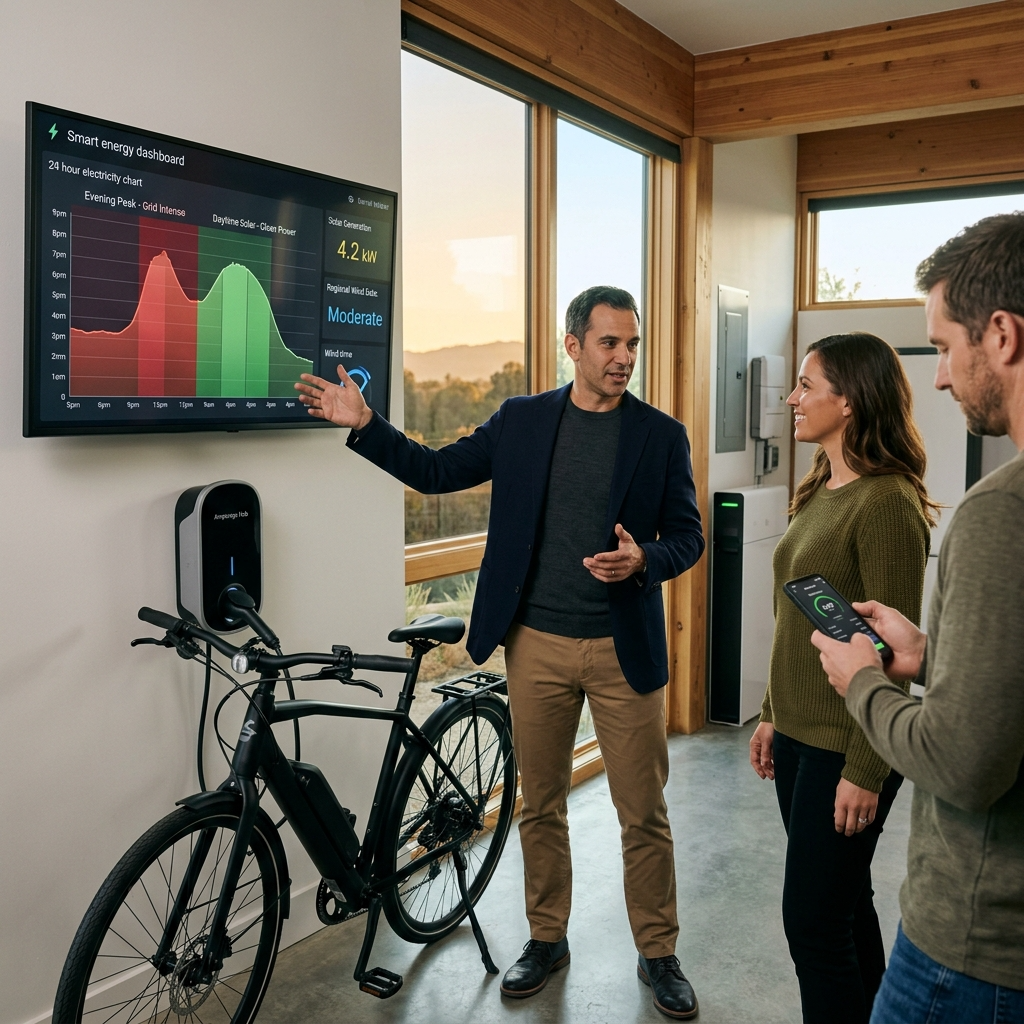
Yes. The electricity used to charge an e-bike affects its charging-related emissions. The same e-bike can produce different upstream CO₂ emissions in different places because electricity grids have different carbon intensities.
For a practical estimate, you need only two inputs:
Charging emissions = electricity consumed × electricity emission factor
A fossil-heavy grid raises the charging part of an e-bike’s footprint; a lower-carbon grid reduces it. But charging emissions are not the same as the bike’s complete lifecycle footprint, which can also include manufacturing, battery production, transport, maintenance, and end-of-life.
This guide shows how to separate those boundaries, find an appropriate U.S. electricity factor, calculate your own charging emissions, and avoid the mistakes that make many carbon estimates misleading.
Does Electricity Source Affect E-Bike Emissions?

Electricity source changes one side of the equation: the emissions associated with each unit of electricity your charger draws.
If two riders use the same e-bike, consume the same amount of electricity, and travel the same distance, the rider supplied by the more carbon-intensive electricity mix will have higher charging-related emissions.
That is why these two variables should be kept separate:
- E-bike energy demand: how much electricity the bike uses.
- Grid emission rate: how much CO₂ or other greenhouse-gas emissions are associated with producing that electricity.
For U.S. estimates, the EPA’s eGRID program provides electricity-generation, resource-mix, emissions, and emission-rate information. The EPA Power Profiler helps connect household electricity use with regional grid information.
Electricity price is not a carbon-intensity measure. Cheap electricity is not automatically cleaner, just as expensive electricity is not automatically more carbon-intensive.
Lower-carbon electricity therefore reduces charging-related emissions. It does not make the entire e-bike lifecycle automatically carbon-free.
Are Electric Bikes Truly Zero-Emission?

E-bikes produce no combustion exhaust from a fuel-burning engine while operating electrically. In that limited sense, they have no tailpipe combustion emissions.
That is different from saying an e-bike causes no emissions anywhere.
Tailpipe, Charging, and Lifecycle Emissions Measure Different Things
Direct or tailpipe emissions are released by the vehicle itself during operation. An electrically powered e-bike does not burn gasoline or diesel at the bike.
Charging or use-phase emissions arise upstream when electricity used to recharge the battery is generated.
Lifecycle emissions use a wider boundary that can include manufacturing the bike and battery, transporting components, electricity use, maintenance, and end-of-life.
The U.S. Department of Energy’s Alternative Fuels Data Center uses a similar direct/upstream/lifecycle distinction for electric road vehicles. Its figures are not e-bike measurements, but the boundary logic is useful for avoiding invalid comparisons.
A charging-only e-bike number should therefore not be compared directly with another vehicle’s full cradle-to-grave number.
There is a second terminology trap: CO₂ and CO₂e are not interchangeable labels. CO₂ means carbon dioxide. CO₂-equivalent combines multiple greenhouse gases using a common climate-impact unit. If your source reports only CO₂, label your result as CO₂.
Are E-Bikes Still Eco-Friendly on a Coal-Heavy Grid?

A coal-heavy or otherwise carbon-intensive grid increases an e-bike’s charging emissions. It does not automatically prove that the e-bike is environmentally worse overall than a car, motorcycle, bus, train, or conventional bicycle.
That broader question requires a clearly defined comparison and a wider lifecycle boundary.
The cleanest way to isolate the grid effect is to keep everything about the bike constant and change only the electricity emission factor.
Same E-Bike, Different Grid
The following figures are hypothetical examples for explaining the math. They are not current EPA values for named regions.
Assume the e-bike draws 15 Wh of wall electricity per mile.
| Lower-carbon gridCarbon-intensive grid | ||
|---|---|---|
| Electricity use | 15 Wh/mi | 15 Wh/mi |
| Example grid factor | 100 g CO₂/kWh | 700 g CO₂/kWh |
| Charging emissions | 1.5 g CO₂/mi | 10.5 g CO₂/mi |
Only the grid factor changed. The second result is seven times higher because its hypothetical electricity emission rate is seven times higher.
That demonstrates electricity-source dependence without introducing unrelated differences in battery size, rider behavior, terrain, or vehicle type.
It does not show that the bike’s complete lifecycle footprint is seven times larger. Manufacturing and other lifecycle stages are outside this calculation.
Why E-Bike Charging Emissions Vary by Location

The same e-bike can have different charging-emissions estimates in different locations because electricity systems use different mixes of generation.
One region may receive a large share of electricity from wind, solar, hydro, or nuclear generation. Another may depend more heavily on coal or natural gas. The resulting average emission rates can therefore differ substantially.
For a personal calculation, this makes a relevant regional factor more useful than blindly applying one national average.
Regional Grid Carbon Intensity
A U.S. grid region is not necessarily the same thing as a state.
Electricity moves across interconnected systems, and the nearest visible power plant is not necessarily the source that should define your calculation.
For a normal regional electricity-use estimate, EPA eGRID subregions provide a more defensible starting point than assumptions based only on state borders or a nearby generating station. The supplied research brief likewise identifies the EPA eGRID/Power Profiler workflow as the primary U.S. method for this article.
Whenever you publish or save a result, record:
- the grid region or subregion;
- the dataset year;
- the emission metric used;
- whether the figure includes an adjustment for electricity losses;
- whether your result is CO₂ or CO₂e.
A number such as “7 g CO₂ per mile” is much more useful when it is labeled:
Charging/use-phase CO₂ — [region], [dataset year], wall-electricity basis.
How to Find Your U.S. eGRID Region and Emission Factor
For a normal annual, location-based estimate:
- Open the EPA Power Profiler or current EPA eGRID resources.
- Use the location or utility information requested by the tool to identify the relevant regional electricity data.
- Record the eGRID subregion and the underlying dataset year.
- Select the emission rate appropriate to the pollutant and calculation you want to make.
- Convert the rate into units that match your e-bike electricity measurement.
- Check whether the source already incorporates transmission or distribution losses before adding any extra adjustment.
Do not call a regional factor “current” merely because the article itself was recently updated. Grid datasets usually refer to a specific historical reporting year.
Readers outside the United States should use an equivalent government, grid-operator, or other authoritative electricity-emissions source for their own country instead of applying U.S. eGRID values universally.
How to Calculate E-Bike Charging Carbon Emissions

Different websites often produce different e-bike carbon numbers because they use different energy-consumption assumptions, locations, grid factors, dataset years, and accounting boundaries.
A transparent calculation makes those differences visible.
The Formula and Units
If wall electricity is measured in kWh and your grid factor is expressed as grams CO₂ per kWh:
Charging CO₂ (g) = wall electricity (kWh) × grid factor (g CO₂/kWh)
For a per-mile estimate:
Charging CO₂ (g/mi) = [Wh/mi ÷ 1,000] × grid factor (g CO₂/kWh)
Keep the units beside each number while calculating. A correct formula with mismatched units can still produce a badly wrong answer.
For example:
1 lb/MWh = 0.453592 g/kWh
because one pound equals 453.592 grams and one megawatt-hour equals 1,000 kilowatt-hours.
Choose the Best Electricity-Use Input You Have
For a personal estimate, measured wall electricity is usually the most useful input because it records the electricity actually drawn by the charger.
Do not assume the following measurements are interchangeable:
- Battery rated Wh: nominal battery energy capacity.
- Energy delivered to the battery: energy reaching the battery rather than electricity drawn from the socket.
- Wall kWh: electricity drawn by the charger during the charging session.
- Wh/mi or Wh/km: electricity use normalized by distance.
Battery capacity alone does not tell you exactly how much electricity was drawn from the wall.
Energy use per mile can also change with terrain, assist level, speed, rider and cargo mass, tire pressure, wind, temperature, stops, and riding style. That is why an actual wall-meter reading or rider-specific consumption record is usually preferable to treating a single online Wh/mi number as universal.
If you only have nominal battery capacity, you can still estimate charging electricity, but any additional charging-efficiency assumption should be disclosed rather than hidden inside the result.
Choose the Grid Factor Based on the Question
There is no single emission factor that is correct for every purpose.
For an ordinary annual or location-based electricity footprint, a relevant regional average such as an appropriate eGRID output rate is a sensible starting point.
For describing grid conditions during a particular hour, hourly regional electricity information is more relevant.
For estimating how emissions change because electricity demand itself was added, removed, or shifted, a marginal-emissions methodology may be needed.
The EPA’s guidance on using eGRID to determine emissions is the appropriate U.S. starting point for selecting eGRID data for electricity-use calculations.
Warning: Do Not Count the Same Loss Twice
This is one of the easiest ways to inflate an emissions estimate.
Before adding a charger-efficiency adjustment, ask:
Was the electricity measured at the wall?
If yes, the wall measurement already reflects the electricity the charger needed to draw during that session. Do not add the same charging loss again.
Before adding a transmission or distribution adjustment, ask:
Does the grid tool or emission factor already account for that loss?
EPA’s Power Profiler methodology applies regional emission rates together with a region-specific line-loss adjustment. If the figure you use already contains that treatment, applying another generic grid-loss percentage would double-count it.
The same principle applies to power-plant efficiency. Do not add an extra plant-efficiency multiplier to an emission rate already expressed per unit of generated electricity unless the methodology explicitly calls for it.
The calculation brief specifically flags boundary matching and loss double-counting as major error risks.
Worked Example: From Wall Electricity to CO₂ per Mile
The grid factor below is hypothetical. It demonstrates the arithmetic without pretending to represent a current U.S. region.
Assume:
- wall electricity measured for the charge: 0.55 kWh;
- distance supported by that energy: 30 miles;
- hypothetical electricity factor: 400 g CO₂/kWh.
First calculate total charging emissions:
0.55 kWh × 400 g CO₂/kWh = 220 g CO₂
Then calculate electricity use per mile:
0.55 kWh ÷ 30 mi = 0.01833 kWh/mi
or:
18.33 Wh/mi
Finally:
220 g CO₂ ÷ 30 mi = 7.33 g CO₂/mi
The result is:
7.33 g CO₂ per mile of charging/use-phase emissions, based on measured wall electricity and the hypothetical 400 g CO₂/kWh factor.
For a real estimate, replace the hypothetical factor with an appropriate documented value for your location and calculation method.
Does Charging Time Affect E-Bike Emissions?

It can, because electricity generation changes over time.
Solar output rises and falls. Wind generation varies. Fossil generators can enter or leave service. Electricity demand changes during the day, and power may move between grid areas.
But that does not mean charging at night is always cleaner.
Is There a Cleanest Time to Charge an E-Bike?
There is no universal cleanest clock time.
The answer depends on your grid, the period being measured, and what kind of emissions question you are asking.
The U.S. Energy Information Administration provides hourly electricity information, including generation by energy source and CO₂ data, that can help describe changing grid conditions.
“Off-peak” should not be used as a synonym for “low carbon.” Off-peak usually describes demand or pricing conditions. A cheap overnight rate can coincide with relatively low emissions in one electricity system and more carbon-intensive generation in another.
Use this decision rule:
Estimating your ordinary electricity footprint?
Start with an appropriate regional average.
Interested in the grid’s average emissions during a specific charging period?
Use suitable hourly regional data.
Trying to estimate emissions caused or avoided by moving additional demand to another time?
A marginal-emissions method may be more appropriate.
Average and Marginal Emissions Answer Different Questions
An average emission rate distributes the emissions associated with a generation mix across electricity produced during a defined place and period.
A marginal emission rate estimates how system emissions change when electricity demand changes.
Knowing the average emissions of all generators operating at 9 p.m. does not necessarily reveal which generators respond to one additional unit of charging demand at 9 p.m.
NREL’s Cambium documentation provides useful technical context for modeled marginal emissions. Most riders do not need marginal modeling for a basic personal charging footprint, but the distinction matters before claiming that moving a charge from one hour to another reduces emissions.
The practical rule is simpler:
Do not call a charging time “greener” unless the local data and the calculation method support that conclusion.
Practical Ways to Lower E-Bike Charging Emissions
The highest-value actions follow directly from the equation: use less electricity where practical, use electricity with a lower emission rate where genuinely available, or both.
- Measure wall electricity if you want a better personal estimate. A plug-in electricity meter can replace several assumptions with a direct measurement.
- Use genuinely lower-carbon electricity when available. The lower the applicable electricity emission rate, the lower the charging-related emissions for the same amount of electricity.
- Treat home solar carefully. Charging from on-site solar can reduce reliance on grid electricity for that charging session, depending on timing, system configuration, and accounting. It does not make the e-bike, battery, or solar hardware lifecycle emission-free.
- Shift charging time only when local carbon data supports it. Do not assume that “night,” “off-peak,” and “low carbon” mean the same thing.
- Avoid unnecessary electricity consumption. Appropriate tire pressure, sensible assist settings, reasonable speeds, and sound mechanical condition can help limit energy demand without requiring major changes to how you use the bike.
- Put charging safety ahead of carbon optimization. Follow the battery and charger manufacturer’s approved charging instructions. For practical battery-care guidance, see our e-bike battery charging tips.
- Save the source and year with your calculation. That makes the result easier to verify and update.
- Recheck grid data when you update the estimate. Electricity mixes and published datasets change over time.
If you want to understand your own e-bike first, do not start with a generic claim that it is “zero emission” or “dirty-grid powered.”
Start with two numbers:
How much electricity does your charger actually draw?
What emission factor appropriately represents that electricity?
Once those are defined, the charging component becomes straightforward to calculate and much harder to misinterpret.