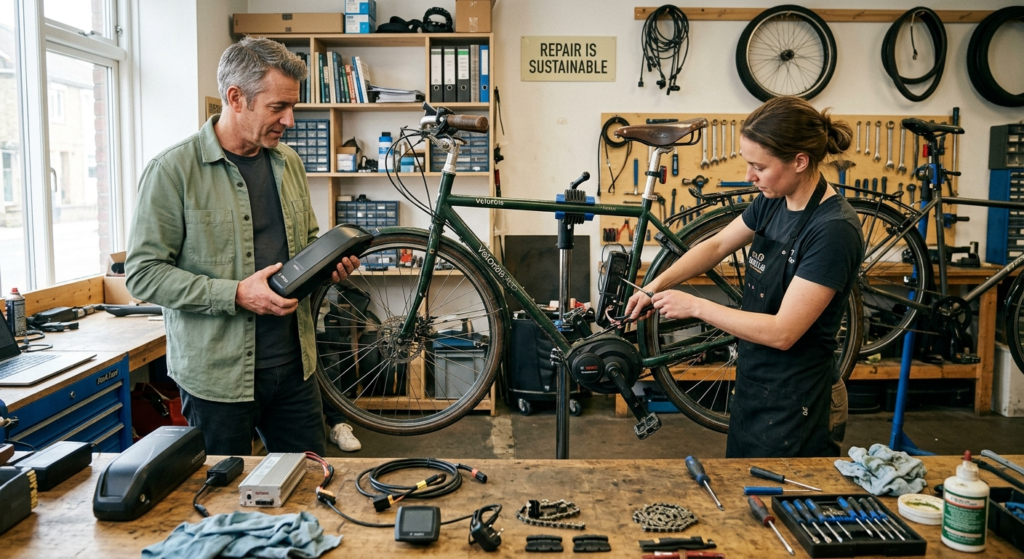
Short answer: usually, especially when an e-bike replaces car trips and stays useful for years. But an electric bike is not impact-free. Manufacturing the bike and battery uses materials and energy, charging uses electricity, parts eventually wear out, and the battery needs an appropriate end-of-life route.
The biggest variable is often not the bike itself. It is what you actually use it instead of.
A regularly ridden e-bike that replaces solo car journeys presents a much stronger sustainability case than the same bike bought for occasional use that mostly replaces walking or conventional cycling.
This guide shows how to judge that difference before you buy, and what to check if you already own an e-bike.
What Actually Makes an E-Bike a Lower-Impact Choice?

Six factors can materially change the answer:
- What the bike replaces. Replacing car travel generally creates a stronger environmental case than replacing walking or cycling.
- How much bike you buy. Battery capacity, motor capability and overall vehicle size should match the job rather than simply be maximized.
- How the bike is made. The frame, battery, motor and electronics all have manufacturing impacts.
- How much it is used. Frequent useful riding spreads those manufacturing impacts across more transportation.
- How long it remains serviceable. Replaceable batteries, available parts and practical repair support can prevent premature replacement.
- What happens at end-of-life. Lithium-ion batteries need a suitable collection or recycling route rather than ordinary household disposal.
That gives you a better test than asking whether an e-bike produces exhaust. E-bikes have zero tailpipe emissions while riding, but tailpipe emissions are only one part of their lifecycle impact.
How Sustainable Are Electric Bikes Over the Long Term?

A meaningful sustainability assessment starts before the first ride and ends after the bike is no longer in service.
A practical lifecycle looks like this:
Raw materials → component production → bike and battery manufacturing → distribution → charging and riding → maintenance and replacement → repair or reuse → end-of-life
Leaving out one of those stages can make a comparison look better or worse than it really is.
Manufacturing and Battery Production
An e-bike contains most of the components of a conventional bicycle plus an electrical system: typically a battery, motor, controller, charger, wiring and controls or a display.
Those additions create environmental impacts before the bike moves a mile. Battery cells require processed materials and manufacturing. Motors and electronics add more components and metals. The frame, wheels, brakes and other bicycle parts also require materials and energy.
That does not make an e-bike environmentally unattractive by definition. It means its manufacturing burden should be judged against the useful transportation it provides over its life.
A bike used frequently for years has a different lifecycle profile from one manufactured, shipped and then rarely ridden.
Charging Electricity Matters, but It Is Only One Variable
Charging moves part of the bike’s environmental impact to electricity generation.
The exact climate impact depends on factors such as:
- the electricity mix where charging occurs,
- how much electricity the bike consumes,
- charging losses,
- distance ridden,
- and how a particular study defines energy use.
A cleaner electricity supply strengthens the operating-phase result. A more carbon-intensive supply increases it.
But charging should not dominate the analysis simply because it is easy to measure. Manufacturing, useful life, replacement parts and trip substitution can be just as important to the overall decision.
For practical battery-care information, see the electric bike battery charging guide.
Maintenance Can Extend the Useful Life of the Whole Product
Tires, brake pads, chains, cassettes and other wear components need replacement over time. Batteries and electrical components may eventually need replacement too.
Routine maintenance therefore has a sustainability role beyond keeping the bike pleasant to ride: it can help the product remain useful instead of being replaced early.
The key question is not whether an e-bike will need maintenance. It is whether normal wear and component failures can be dealt with without making the entire bike economically or technically obsolete.
Why E-Bike Carbon-Footprint Numbers Often Disagree

There is no single defensible carbon number that represents every e-bike in every situation.
That does not make carbon accounting useless. It means you need to know what a number actually measures before comparing it with another one.
The supplied research specifically warns against universal emissions-per-mile claims because published estimates can use different lifecycle boundaries, electricity assumptions, service lives, battery-replacement assumptions, occupancy and comparison modes.
Check These Assumptions Before Trusting a Carbon Figure
| Check | Why it matters |
|---|---|
| Lifecycle boundary | Some estimates include manufacturing, charging and end-of-life; others include fewer stages |
| Lifetime distance | Manufacturing impact is spread across however many miles the study assumes |
| Battery replacement | A replacement battery adds another manufactured component |
| Electricity mix | Charging emissions vary by location and electricity source |
| Functional unit | A vehicle-mile and a passenger-mile are not the same measure |
| Vehicle occupancy | A solo car and a highly occupied car produce different per-passenger comparisons |
| Previous transport mode | Replacing a car is not the same as replacing a bicycle or transit journey |
| Data year and geography | Energy systems and production assumptions change across locations and time |
The practical rule is simple:
Do not compare two carbon figures until you know whether they are measuring roughly the same thing.
A Simple Example Shows Why Lifetime Use Matters
Consider a hypothetical example in which two studies assign the same manufacturing footprint to the same e-bike.
One assumes the bike will travel 2,000 miles during its useful life. The other assumes 10,000 miles.
Before charging is even included, the first study allocates five times as much manufacturing impact to each mile.
Neither calculation has to be mathematically wrong. They describe different usage assumptions.
That is why an unexplained “grams of CO₂e per mile” figure can create false precision.
When Are E-Bikes Sustainable Transportation?

The environmental case is generally strongest when an e-bike provides transportation that would otherwise require a larger motor vehicle.
The U.S. Department of Transportation’s FHWA e-bike resources identify reduced car travel as an important opportunity while also treating infrastructure, safety and environmental outcomes as areas requiring context and continued study. The supplied SERP research uses that material to support a conditional rather than universal transport claim.
E-Bike vs Gasoline Car
This is usually the easiest comparison to understand.
An e-bike produces no tailpipe exhaust while riding and requires a far smaller vehicle to move one rider. If it consistently replaces solo gasoline-car journeys, the sustainability case is generally much stronger than when it simply adds new recreational travel.
That does not mean an e-bike can replace every car journey. Distance, passengers, cargo, disability, weather, road conditions and safe infrastructure can all make car substitution more or less realistic.
E-Bike vs Electric Car
An electric car also eliminates tailpipe exhaust during driving, so the comparison shifts toward vehicle size, manufacturing, battery capacity, operating energy and the requirements of the trip.
For short trips that one person can realistically make by e-bike, using the much smaller vehicle can avoid moving a full-size passenger car for that journey.
For journeys involving several people, large cargo loads, long distances or unsuitable infrastructure, the practical answer may change.
E-Bike vs Conventional Bicycle
A conventional bicycle is mechanically simpler because it does not require the e-bike’s battery, motor and associated electronics.
If both options would genuinely serve the same journey, the conventional bicycle starts with that simplicity advantage.
But assistance can change behavior. An e-bike may enable someone to ride farther, handle hills, carry cargo or commute regularly when they would otherwise drive.
That is why “regular bike or e-bike?” cannot be answered from manufacturing alone. The relevant question is whether electric assistance changes the transportation mode the person actually uses.
For the broader ownership comparison, see Electric Bike vs Bicycle.
E-Bike vs Public Transit
Transit comparisons are highly route- and system-dependent.
A well-used train or bus system may already move many passengers efficiently. Replacing that journey with an e-bike does not create the same environmental gain as replacing a solo car trip.
On the other hand, an e-bike may provide a useful alternative where transit is unavailable, indirect or impractical.
The comparison baseline matters more than a universal ranking of transport modes.
Do E-Bikes Actually Replace Car Trips?
This is where a theoretically efficient product becomes a real environmental outcome.
Buying an e-bike does not automatically eliminate car travel. What matters is mode substitution: what you would have done if the e-bike were not available.
The supplied research highlights this as one of the clearest gaps in generic competitor content and recommends testing actual journeys rather than assuming that every e-bike mile equals one avoided car mile.
Use This Three-Step Test
For each journey you expect to make:
1. Would you have made this trip anyway?
If no, the e-bike enabled new travel rather than replacing an existing trip.
2. What would you have used instead?
- Solo gasoline car → potentially strong substitution benefit
- Electric car → potentially meaningful, but different comparison
- Transit → depends on the route and system
- Conventional bicycle → much smaller transport substitution benefit
- Walking → weak environmental justification on transport emissions alone
3. How often will this substitution actually happen?
A five-day-per-week commute affects lifetime use very differently from an occasional recreational ride.
Everyday Trips With Realistic Car-Replacement Potential
Depending on the rider and local conditions, useful candidates can include:
- commuting,
- shopping and errands,
- local appointments,
- school or family trips where the equipment and route are appropriate,
- short cargo trips,
- journeys where hills or distance make a conventional bicycle unrealistic.
Do not count a journey simply because it could be made by e-bike. Count the journeys you are likely to make that way in practice.
If commuting is the main goal, continue with the Electric Bike for Commuting guide.
Two Identical E-Bikes Can Have Different Environmental Outcomes
Consider two hypothetical owners.
Rider A uses an e-bike for a recurring commute that was previously made alone by car.
Rider B buys the same model but mainly uses it instead of an existing conventional bicycle.
The bikes have the same manufacturing footprint. Their transport effects are different.
That distinction between product efficiency and actual avoided travel is one of the most important ideas in evaluating e-bike sustainability.
What Makes One Electric Bike More Sustainable Than Another?

Once an e-bike makes sense for the journey, the next task is choosing a product likely to remain useful.
The most sustainable specification is not necessarily the largest battery, strongest motor or highest feature count.
Right-Size the Bike for the Job
Before comparing specifications, define the job:
- How far do you genuinely need to travel between charges?
- What hills will you ride?
- What load must the bike carry?
- Do you need cargo capacity?
- What level of assistance is necessary?
- What conditions will the bike be used in?
Then buy enough capability to perform that job reliably.
A larger battery can be justified when the required range demands it. A more capable motor may be appropriate for cargo, steep terrain or accessibility.
Right-sizing does not mean buying an underpowered bike. It means avoiding capacity and complexity that provide little useful benefit.
Check Support Before You Check Marketing Claims
Before buying, verify:
- Can you buy a replacement battery now?
- Is the charger available separately?
- Are displays and controllers replaceable?
- Does the bike use ordinary bicycle wear components where practical?
- Are manuals and parts diagrams available?
- Can a local shop work on it?
- Does the manufacturer publish clear warranty terms?
- Does essential functionality depend on an app or online account?
The supplied research identifies battery availability, proprietary connectors, diagnostics, software dependence, spare-parts support and local service as practical sustainability checks because they affect whether a bike can stay in use.
For ownership and replacement-cost questions, see the Electric Bike Cost guide.
Safety Certification Is Not a Sustainability Certification
Electrical-system safety deserves its own check.
The U.S. Consumer Product Safety Commission has called on micromobility manufacturers to comply with applicable safety standards, including relevant UL standards. That guidance concerns fire and electrical safety, not environmental performance.
A bike can have strong safety documentation and still be difficult to repair, poorly supported or unnecessarily over-specified.
Treat safety and sustainability as related purchasing considerations, not interchangeable labels.
Why Lifespan and Repairability Can Matter More Than a Claimed “X-Year Lifespan”

A single lifespan number hides several different failure points.
An e-bike really has at least four clocks running at once.
1. Mechanical Life
The frame and ordinary bicycle components may remain useful for years if they are maintained and not structurally damaged.
2. Battery Service Life
Battery capacity usually changes over time and use. Reduced capacity does not necessarily mean the battery is completely unusable; it may simply provide less range than when new.
Whether that becomes a practical problem depends on how much range you actually need and whether a suitable replacement battery remains available.
3. Electronics Life
The motor, controller, sensors, display, wiring and other electrical components can fail independently of the frame and mechanical parts.
4. Manufacturer and Parts-Support Life
This is the lifespan buyers often overlook.
A mechanically sound bike can become difficult to use if a proprietary battery, controller, display, connector or diagnostic system is discontinued.
That means product obsolescence can happen before the bicycle itself is physically worn out.
A Better Pre-Purchase Repairability Check
| Check | What you want to find |
|---|---|
| Replacement battery | Available separately with clear compatibility |
| Charger | Genuine replacement can be purchased |
| Display/controller | Parts or a documented replacement path exist |
| Wear components | Local shops can obtain and replace them |
| Manuals | User/service information is accessible |
| Diagnostics | A realistic service path exists |
| Dealer support | Someone can actually repair the system |
| Software | Core operation is not unnecessarily dependent on fragile online services |
Then ask one final question:
If one important component fails five years from now, what happens next?
If the only answer is “replace the whole bike,” that is a meaningful sustainability warning sign.
For battery-specific repair and replacement decisions, see Can an E-Bike Battery Be Repaired?.
How to Recycle an E-Bike Battery Safely in the U.S.
E-bike lithium-ion batteries should not go into household trash or ordinary curbside recycling.
The U.S. EPA recommends a separate recycling or household hazardous-waste collection route for used lithium-ion batteries and advises isolating terminals or otherwise keeping ordinary used batteries separated to reduce short-circuit risk. It also distinguishes damaged batteries from ordinary end-of-life batteries.
For a Normal End-of-Life Battery
Use this sequence:
- Check the battery or bike manufacturer’s take-back instructions.
- Ask the original retailer or an authorized dealer whether it accepts the battery.
- Check qualified battery or electronics recycling programs.
- Check local household hazardous-waste services where applicable.
- Confirm that the facility accepts your specific type and size of e-bike battery before taking it there.
- Follow the battery manufacturer’s and receiving facility’s handling instructions.
A facility advertising “battery recycling” does not automatically accept large e-bike packs.
Damaged or Abnormal Batteries Need Different Handling
Do not treat a battery as an ordinary recycling case if it is:
- swollen,
- leaking,
- unusually hot,
- smoking,
- visibly damaged,
- damaged in a crash,
- significantly water-damaged,
- defective,
- or recalled.
Get condition-specific guidance from the manufacturer, retailer, appropriate local authority or qualified battery professional.
Do not casually dismantle, rebuild, ship or transport a damaged lithium-ion pack based on generic internet instructions.
For more detailed safety information, see Electric Bike Battery Safety and Electric Bike Battery Problems.
The source research treats this normal-versus-damaged battery distinction as a critical safety requirement rather than a generic “just recycle it” recommendation.
E-Bike Sustainability Checklist Before You Buy

Mark each item Yes, No, or Need to verify.
Will It Replace Higher-Impact Travel?
- I know which journeys I expect to make by e-bike.
- I know what transport I currently use for those journeys.
- A meaningful share of those trips would otherwise involve a car or another higher-impact option.
- I expect to ride frequently enough for the bike to receive substantial useful use.
Is the Bike Right-Sized?
- The battery range matches my real requirement.
- The motor capability matches my terrain, load and accessibility needs.
- I am not paying for unnecessary size, weight or capability.
Can It Stay in Service?
- A replacement battery is currently available.
- I know its approximate replacement cost.
- Important electrical components have a documented support path.
- Ordinary wear parts can be serviced locally.
- Manuals and support information are available.
- I know who can diagnose or repair the bike.
- Warranty terms are clear.
- Essential functionality is not unnecessarily dependent on unsupported software.
Can I Own It Safely and Responsibly?
- I have checked relevant battery/electrical safety documentation.
- I can provide appropriate charging and storage conditions.
- I have identified a realistic local battery take-back or recycling route.
Does Buying a New Bike Make Sense at All?
- I considered whether a suitable used or refurbished bike could meet the same need.
- The transportation value I expect from the bike justifies adding another manufactured product.
If most answers are Yes, especially around car-trip replacement, frequent use, right-sizing and long-term service support, the sustainability case is relatively strong.
If several important answers are Need to verify, investigate them before buying.
If the bike is unlikely to replace higher-impact travel and its battery, electronics or replacement parts have poor long-term support, a “green” marketing label should not outweigh those weaknesses.
Your next step depends on the journey you are trying to change. If you are deciding between pedal-only and electric assistance, compare the practical trade-offs in Electric Bike vs Bicycle. If the goal is specifically to replace driving, move next to the Electric Bike for Commuting guide.