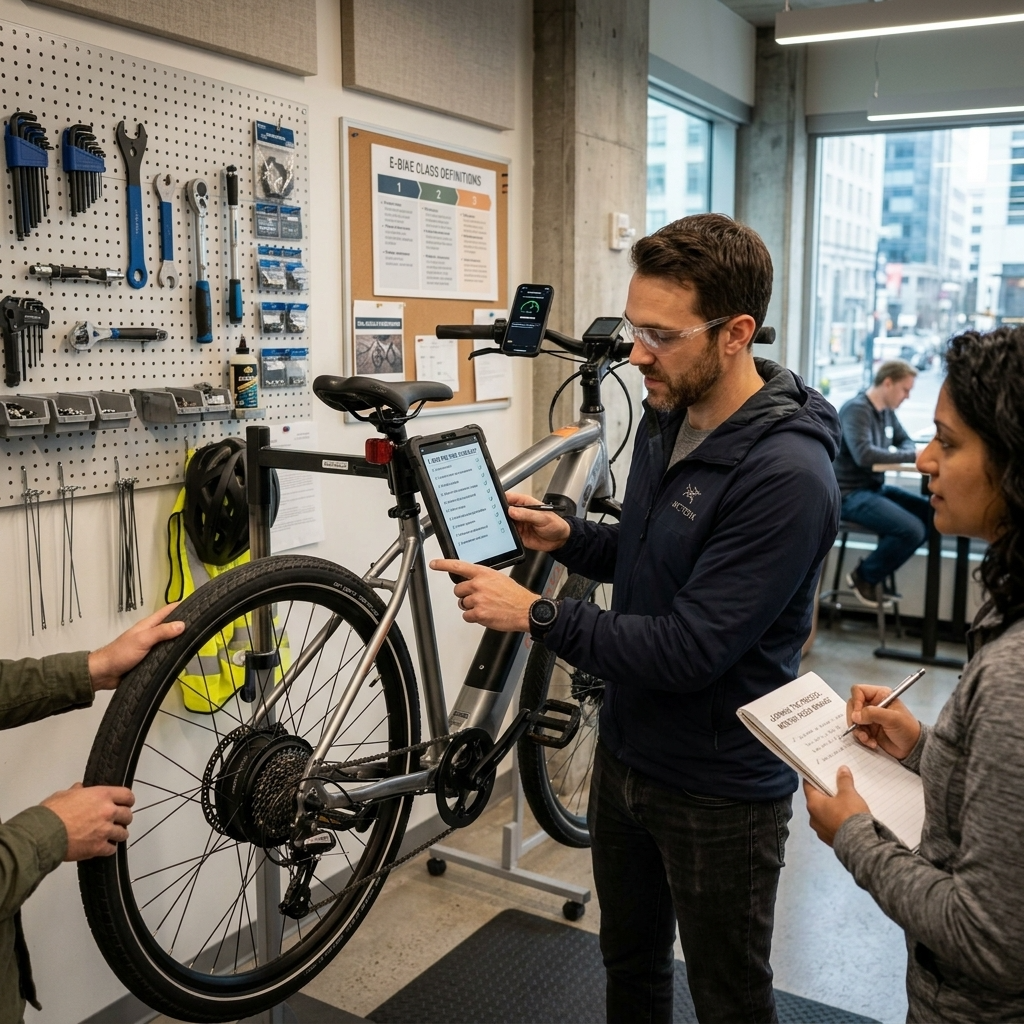
Quick answer: Usually no—but only if the bike fits the legal e-bike definition where you ride.
New Jersey is a major 2026 exception: riders generally need a valid driver’s license or e-bike license, and covered e-bikes must be registered. Hawaii requires registration for qualifying e-bikes but not a driver’s license.
For every state, the final answer depends on the state’s definition and your bike’s current configuration, not simply the word “e-bike” on the product page.
Use this guide in two steps:
- Find your state.
- Check whether your exact bike fits that state’s e-bike definition.
A Class 1, 2 or 3 sticker is useful evidence, but it is not conclusive if the bike is faster than the state permits, has a different throttle setup, lacks functional pedals, or has been unlocked or modified.
Legal research checked: September 9, 2026. State and local rules can change, so confirm the current official source for the place where you intend to ride.
When You Need a License—and When You Usually Don’t

For a qualifying electric bike, the practical answer usually falls into three situations. What matters is the legal category your bike fits—not what the manufacturer calls it.
| SituationWhat it means for you | |
|---|---|
| Your bike clearly fits your state’s e-bike definition | A driver’s or motorcycle license is usually not required at the state level. |
| Your state has an exception or atypical framework | Licensing, registration, age restrictions or other paperwork may apply. New Jersey is the clearest current licensing exception. |
| Your bike falls outside the state’s e-bike definition | Stop relying on the “e-bike” label. It may instead fall under moped, motorized bicycle, motor-driven cycle, motorcycle or another vehicle category. |
The word license also needs some precision.
An operator license can mean a standard driver’s license, an e-bike or moped credential, or another type of license depending on the jurisdiction.
Registration is different: it records the vehicle with a government agency.
Insurance is another separate requirement.
A state saying that you do not need a driver’s license does not automatically mean that no registration, insurance or other compliance requirement applies.
Federal vs. State E-Bike Rules: Which One Decides Licensing?

The Federal Definition Answers a Product-Classification Question
Federal law defines a “low-speed electric bicycle” for consumer-product purposes as a two- or three-wheeled vehicle with fully operable pedals, an electric motor of less than 750 watts, and a motor-only top speed below 20 mph under a specified level-surface test with a 170-pound rider.[1]
That definition matters, but it does not create a nationwide driver-license exemption.
It is also not the source of a universal federal Class 1, Class 2 and Class 3 licensing system.
State law still determines much of the analysis involving:
- Operator licensing
- Registration
- Road use
- Vehicle classification
- Age restrictions
- Trail or path access
- Equipment requirements
State Law Decides the Category You Actually Ride Under
Many states use some version of the familiar three-class framework:
- Class 1: Pedal assist up to 20 mph
- Class 2: Throttle-capable motor assistance up to 20 mph
- Class 3: Pedal assist up to 28 mph
But this system is not universal.
For example, Massachusetts currently defines Class 1 and Class 2 but not Class 3. New Jersey uses a different licensing framework. North Carolina’s new three-class system does not take effect until December 1, 2026.[2]
That means a 28-mph pedal-assist bike might be recognized as a normal Class 3 e-bike in one state while requiring a different classification analysis in another.
How to Check Whether Your Exact E-Bike Needs a License

Check the bike in the same order every time.
This avoids two of the most common mistakes: assuming that “750W means legal” or treating a class sticker as definitive proof.
| CheckWhat to recordWhy it matters | ||
|---|---|---|
| 1. State definition | Current statute or DMV/MVC/DOT guidance | This is the legal framework your bike must fit. |
| 2. Class label | Class, assisted-speed limit and manufacturer label | Useful evidence, but not final proof. |
| 3. Motor assistance | Motor-only and pedal-assist cutoffs | A 20-mph throttle and 28-mph pedal assist can be treated differently. |
| 4. Motor rating | Nameplate/rated output and manufacturer specifications | Some laws use power limits; advertised peak output may not be the relevant figure. |
| 5. Throttle and pedals | What the throttle can do and whether the pedals work | These characteristics may determine the legal category. |
| 6. Current configuration | Firmware, speed limiter, controller, motor, modes and modifications | A used or modified bike may no longer fit its original legal category. |
A Used-Bike Example
Imagine that you buy a used bike labeled:
“Class 2 — 750W.”
The previous owner has enabled a throttle mode that can propel the bike to 28 mph.
The sticker still says Class 2, but the bike’s current behavior may no longer satisfy your state’s Class 2 definition.
That is why you should verify the settings and components on the bike you own today—not rely only on its factory label.
E-Bike License Requirements by State in 2026

The table below is a licensing snapshot for a bike that otherwise qualifies as an e-bike under that jurisdiction’s rules.
“No statewide license identified” does not mean every electric bike is automatically license-exempt. A faster, higher-power, no-pedal or modified bike may fall into another vehicle category.
“VERIFY” means the current source set was not strong enough to provide a confident yes-or-no answer without additional official verification.[3]
| State / D.C.Operator-License StatusWhat to Check | ||
|---|---|---|
| Alabama | No statewide license identified | Three-class framework; qualifying e-bikes are generally treated as bicycles. |
| Alaska | VERIFY | A dedicated e-bike definition was not resolved cleanly in the current audit. Confirm DMV/local treatment. |
| Arizona | No statewide license identified | Three-class framework. |
| Arkansas | No statewide license identified | Three-class framework. |
| California | No statewide license identified | Three-class framework. Modified or out-of-definition devices require separate analysis. |
| Colorado | No statewide license identified | Local governments may impose additional registration or access rules. |
| Connecticut | No statewide license identified | Three-class framework; separate helmet and access rules may apply. |
| Delaware | No statewide license identified | Qualifying e-bikes are generally exempt from ordinary motor-vehicle licensing. |
| Florida | No statewide license identified | Qualifying e-bikes are treated separately from motor vehicles. |
| Georgia | No statewide license identified | Class 3 age and helmet rules are separate from licensing. |
| Hawaii | No driver’s license for qualifying e-bike | Registration is required.[4] |
| Idaho | No statewide license identified | Three-class framework. |
| Illinois | No statewide license identified | Local authority remains relevant until a 2026 preemption change takes effect in 2027. |
| Indiana | No statewide license identified | Three-class framework. |
| Iowa | No statewide license identified | Three-class framework. |
| Kansas | No statewide license identified | Qualifying e-bike treatment generally does not require a driver’s license. |
| Kentucky | VERIFY | Current statewide classification needs a stronger final cross-check. |
| Louisiana | VERIFY | Bicycle treatment appears applicable, but a final licensing cross-check is recommended. |
| Maine | No statewide license identified | Qualifying e-bike treatment. |
| Maryland | VERIFY | Current sources need a final licensing cross-check. |
| Massachusetts | No for Class 1 / Class 2 | The state currently defines Classes 1 and 2, not Class 3. A 28-mph bike requires separate classification.[5] |
| Michigan | No statewide license identified | Qualifying e-bikes are treated within the bicycle framework. |
| Minnesota | No statewide license identified | Separate age and equipment requirements may apply. |
| Mississippi | No statewide license identified | Qualifying e-bike treatment. |
| Missouri | No statewide license identified | Qualifying e-bike treatment. |
| Montana | No for defined e-bike | Single-tier definition; a 28-mph pedal-assist bike may fall outside it. |
| Nebraska | VERIFY | Bicycle treatment is indicated, but final administrative/licensing confirmation is recommended. |
| Nevada | VERIFY | Bicycle treatment is indicated, but final licensing verification is recommended. |
| New Hampshire | No statewide license identified | Qualifying e-bike treatment. |
| New Jersey | YES | Rider must generally be at least 15 and hold a valid driver’s license or e-bike license. Registration is also required.[6] |
| New Mexico | No statewide license identified | Three-class framework; qualifying e-bikes fall outside ordinary OHV registration treatment. |
| New York | No statewide license identified | Minimum age rules apply; New York City uses a special Class 3 / 25-mph framework. |
| North Carolina | No for current qualifying e-bike | Current single-tier framework changes to a three-class system on December 1, 2026.[7] |
| North Dakota | No statewide license identified | Qualifying e-bikes are treated separately from ordinary motor-vehicle licensing categories. |
| Ohio | VERIFY | Bicycle treatment is indicated, but a final licensing cross-check is recommended. |
| Oklahoma | No statewide license identified | Three-class framework. |
| Oregon | No statewide license identified | Qualifying e-bikes do not generally require a driver’s license; state age and definition rules still apply. |
| Pennsylvania | No for defined e-bike | Single-tier 20-mph definition; a 28-mph bike falls outside that definition. |
| Rhode Island | VERIFY | Current sources need a final licensing cross-check. |
| South Carolina | No statewide license identified | Single-tier e-bike framework; qualifying e-bikes are distinct from mopeds. |
| South Dakota | VERIFY | Bicycle treatment is indicated, but a final licensing check is recommended. |
| Tennessee | No statewide license identified | Qualifying e-bikes are generally exempt from driver-license, titling and registration treatment. |
| Texas | No statewide license identified | Three-class framework. |
| Utah | VERIFY | Bicycle provisions apply, but programmable or out-of-definition riding modes require closer review. |
| Vermont | No statewide license identified | Qualifying e-bike treatment. |
| Virginia | No statewide license identified | Qualifying e-bike treatment. |
| Washington | No statewide license identified | Qualifying e-bikes generally do not require state licensing or registration. |
| West Virginia | No statewide license identified | Qualifying e-bike treatment. |
| Wisconsin | No statewide license identified | Qualifying e-bike treatment. |
| Wyoming | No statewide license identified | Qualifying e-bike treatment. |
| District of Columbia | VERIFY | Motorized-bicycle classification is atypical. Confirm current D.C. licensing and registration requirements. |
Why New Jersey Changes the National Answer

New Jersey is one reason you should be cautious with articles that simply say:
“E-bikes never require a license.”
Current New Jersey MVC guidance says an e-bike rider must generally be at least 15 and hold either an e-bike license or a valid driver’s license.
Covered e-bikes must also be registered.
Insurance treatment depends on the category. New Jersey requires insurance for motorized bicycles, while low-speed electric bicycles do not require insurance.[8]
That creates a very different compliance picture from most states.
No Driver’s License? Choose a Bike That Is Easy to Classify

If you do not have a driver’s license, shop according to the bike’s legal configuration, not its model name or marketing description.
The simplest option is usually a bike that clearly fits a recognized e-bike category in the state where you intend to ride.
| CharacteristicLower-Complexity ProfileStop and Verify | ||
|---|---|---|
| State status | Qualifying e-bike is license-exempt | State requires a credential or classification is unclear |
| Pedals | Fully operable where required | Missing, disabled or decorative |
| Assisted speed | Within state/class cutoff | Assistance exceeds the legal cutoff |
| Power | Within applicable definition | Above the limit or rating is unclear |
| Throttle | Fits recognized class/category | Behavior exceeds the permitted category |
| Configuration | Stock, documented, no hidden modes | Used, modified, unlocked or unknown history |
Before You Buy
Ask the seller or manufacturer for:
- A clear photo of the class label
- A photo of the motor plate
- The exact manufacturer specification sheet
- Motor-assistance limits for every riding mode
- Throttle behavior
- Confirmation that the pedals are functional
- Details of any firmware, controller, limiter, motor or throttle modifications
Then compare those facts with the current official rules where you intend to ride.
License, Registration and Insurance Are Three Separate Questions

A “no driver’s license required” answer does not necessarily mean “no paperwork.”
| RequirementWhat It AnswersExample | ||
|---|---|---|
| Operator license | Does the rider need a driver, e-bike, moped or another credential? | New Jersey requires an appropriate licensed rider for covered e-bikes. |
| Registration | Must the bike itself be recorded with a government agency? | New Jersey registers covered e-bikes; Hawaii also requires e-bike registration. |
| Insurance | Must the vehicle category carry required liability or other coverage? | New Jersey requires insurance for motorized bicycles, but not low-speed electric bicycles. |
Hawaii is a useful example because a qualifying e-bike may require registration without requiring the rider to have a driver’s license.
New Jersey demonstrates another combination: licensing and registration apply to covered e-bikes, while insurance depends on the legal category.[9]
When a Fast or Modified “E-Bike” May Fall Under Moped or Motorcycle Rules

Avoid universal shortcuts such as:
“Anything over 750W is a motorcycle.”
That is not how state vehicle classification works.
Falling outside an e-bike definition tells you only that the normal e-bike rules may no longer apply.
The replacement category depends on the jurisdiction. Depending on state law, the bike might instead be classified as a:
- Moped
- Motorized bicycle
- Motor-driven cycle
- Motorcycle
- Another motor-vehicle category
In some cases, the classification may need clarification from the relevant state agency.
The Stop-and-Classify Rule
Ask one question first:
Does the bike fit your state’s e-bike definition in its current configuration?
If yes, apply the state’s e-bike framework.
If no, identify the replacement vehicle category before deciding whether licensing, registration, insurance, equipment or other motor-vehicle rules apply.
This is especially important for:
- 28-mph bikes in states without a Class 3 category
- Bikes with speed limiters removed
- Modified firmware
- Controller upgrades
- Motor replacements
- Altered throttles
- Used bikes with an unknown modification history
11 Checks to Verify Your E-Bike Before Riding
Before relying on any national summary, run through these checks:
- Identify the exact jurisdiction. Check the state and any applicable local rules where you will actually ride.
- Open the current official e-bike definition. Prefer your state legislature, DMV, MVC, DOT or other responsible government agency.
- Photograph the labels. Record the class label, motor plate, serial/VIN information and any compliance label.
- Get the manufacturer documentation. Use the manual and specification sheet for your exact model and version.
- Check the pedals. Confirm that they are fully functional where the applicable e-bike definition requires operable pedals.
- Record assistance-speed limits. Check motor-only and pedal-assist cutoffs for every selectable riding mode.
- Check the motor rating. Record the relevant rated or nominal output rather than relying only on advertised peak power.
- Test what the throttle is designed to do. Determine whether it can propel the bike without pedaling and up to what speed.
- Check for modifications. Review app settings, firmware, controller, limiter, off-road mode, motor, throttle, pedals and previous-owner changes.
- Compare the current bike with current law. Do not compare only the original factory specifications.
- Save the source and date. Keep the official source you relied on and when you checked it.
If official sources conflict or your bike’s configuration is uncertain, contact the responsible state agency or seek qualified local legal guidance before relying on an assumption.
Buying Used? Check More Than the Sticker
“Factory Class 2” means very little if the bike no longer behaves like the factory version.
Previous-owner changes to firmware, controllers, motors, throttles or speed limiters can turn an otherwise straightforward e-bike classification into a stop-and-verify situation.
Frequently Asked Questions About E-Bike Licenses

Can I Buy an E-Bike Without a Driver’s License?
Usually, buying or owning an e-bike is a different legal question from operating it on a public road or other regulated location.
Successfully purchasing a bike does not prove that its exact configuration is legal to operate where you live.
Do Class 3 E-Bikes Require a Driver’s License?
Not automatically.
In states that recognize Class 3 e-bikes, a driver’s license is often not required merely because the bike is Class 3.
However, states without a Class 3 category—or states with unusual licensing systems—require a different analysis.
Can I Ride an E-Bike With a Learner’s Permit?
It depends on whether the legal category you are riding requires an operator credential.
If your state does not require a license for a qualifying e-bike, your learner’s permit may not be relevant.
If the jurisdiction requires a credential, check exactly which type of license or permit satisfies the rule.
Do I Need a License to Ride an E-Bike on Private Property?
Public-road rules may apply differently on genuinely private property, but “private property” is not a universal exemption.
The answer can still depend on:
- State law
- Local ordinances
- Landowner rules
- Whether the area is open to public traffic
Do Tourists or Out-of-State Riders Need a Local License?
Follow the law where the bike is being operated.
New Jersey, for example, requires out-of-state riders bringing their own e-bike to comply with its licensing and registration framework, while separate provisions exist for certain rental situations.[10]
Do Rental E-Bike Riders Need a License?
Rental rules can differ from the rules for personally owned bikes.
New Jersey currently provides an exemption for operators of certain commercially rented low-speed e-bikes from possessing a driver’s license or e-bike license, subject to its stated conditions.[11]
What Should You Do Before Riding?

Do not rely on the sentence “most e-bikes don’t require a license” by itself.
Verify two things together:
1. The official rule where you will ride.
2. The current configuration of your exact bike.
If either is uncertain, do not let a class sticker, retailer FAQ, product listing or nationwide summary replace the official answer.
That extra check matters most when the bike is fast, high-powered, used, modified, unlocked or difficult to fit cleanly into your state’s e-bike definition.
Legal note: This article provides general U.S. legal information and is not legal advice. Laws, regulations and agency guidance can change. Re-check primary government sources before relying on the information for a specific bike or jurisdiction.
Sources & Update Notes
- U.S. Code, 15 U.S.C. § 2085 — federal low-speed electric bicycle definition.
- Massachusetts General Laws ch. 90 §1; New Jersey MVC e-bike requirements; North Carolina Session Law 2026-46.
- State snapshot based on the August/September 2026 legal research and supporting state-law review.
- Hawaii 2026 Act 259 / HB2021 and Hawaii DOT e-bike guidance.
- Massachusetts General Laws ch. 90 §1.
- New Jersey MVC — New E-Bike Requirements Effective July 2026.
- North Carolina Session Law 2026-46.
- New Jersey MVC licensing, registration and insurance requirements.
- Hawaii e-bike registration framework and New Jersey MVC requirements.
- New Jersey MVC out-of-state resident guidance.
- New Jersey MVC commercial-rental low-speed e-bike exception.
Pingback: SEO title: Electric Bike Import Rules USA (2026): CPSC, Customs & Duties - electricscootercar.com
Pingback: E-Bike Laws by Country: Check Power, Speed & Road Legality ( ex ped) - electricscootercar.com
Pingback: Electric Bike Speed Limits in the USA: 20 vs 28 MPH, Classes & Local Rules - electricscootercar.com
Comments are closed.