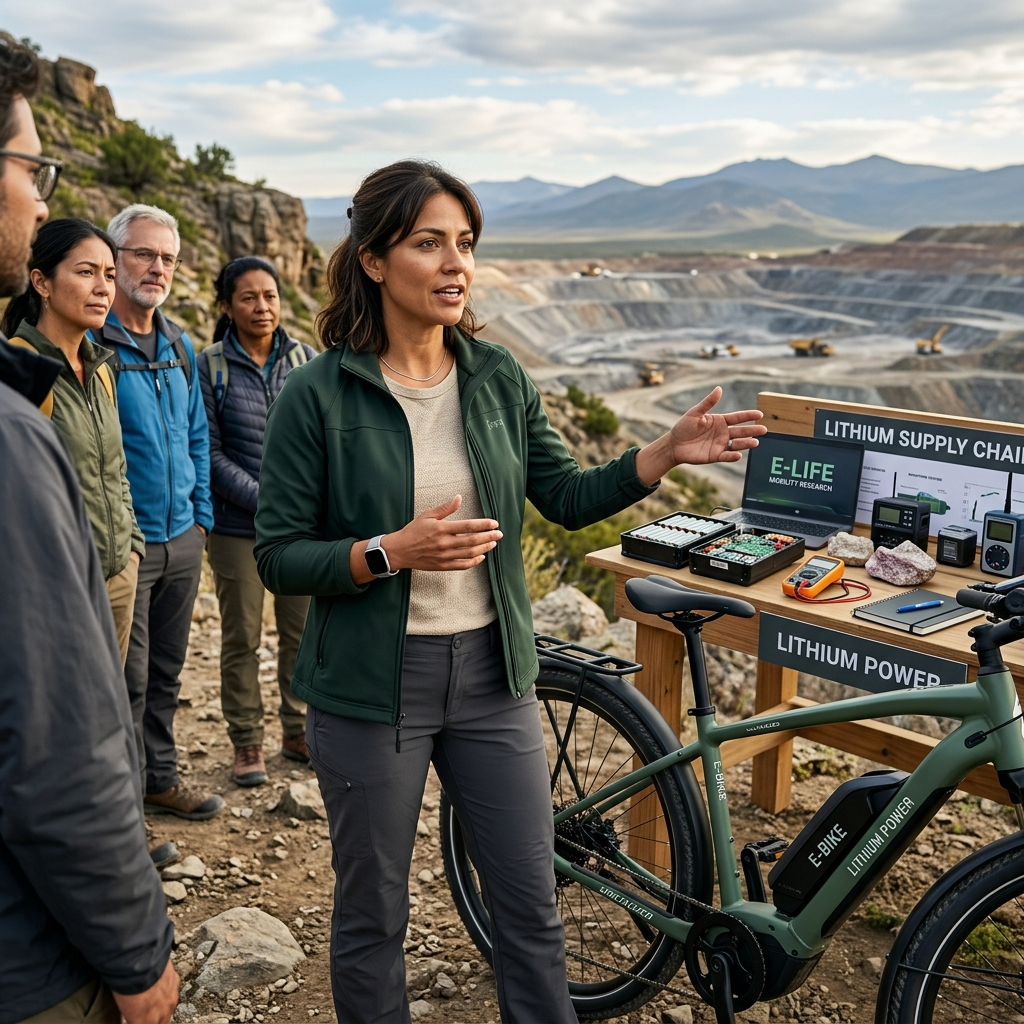
Short answer: lithium extraction creates real environmental costs, but there is no single footprint that applies to every lithium source.
Brine evaporation, hard-rock mining and direct lithium extraction (DLE) put different pressures on water, land, habitats, waste management, chemicals, energy use and emissions. Local geology and water availability can change the result further.
For an e-bike, that distinction matters. Lithium mining is one upstream part of the battery lifecycle, and the battery is only one part of the environmental footprint of the complete bike.
The most useful way to judge a lithium-impact claim is therefore to ask what extraction method, location and lifecycle stage it actually describes.
Six variables explain much of the disagreement between lithium-impact studies:
- extraction method;
- deposit characteristics;
- local water conditions;
- processing route;
- energy source;
- the lifecycle boundary being measured.
Once those differences are separated, apparently contradictory claims become much easier to interpret.
Why the Lithium Extraction Method Changes the Environmental Impact

“Lithium mining” is often used as if it describes one industrial process. It does not.
Lithium can come from lithium-rich underground brines or from hard-rock deposits containing minerals such as spodumene. DLE adds another group of processes designed to recover lithium from brine without relying on the same long evaporation cycle.
Current research supports treating these routes separately. A 2026 Journal of Cleaner Production study cited in the supplied research found distinct land, water and emissions profiles across hard-rock, evaporation and DLE pathways.
Brine Evaporation: The Main Trade-Off Is More Than “Water Use”
Conventional brine production pumps lithium-bearing brine from underground and concentrates it in evaporation ponds before further processing.
Its environmental questions include:
- how much brine is removed from the underground system;
- whether nearby freshwater systems are connected to that system;
- how much freshwater later processing requires;
- the land occupied by ponds, wells, roads and processing infrastructure;
- how the operation affects the specific basin in which it is located.
The distinction between brine and freshwater is important. Lithium-bearing brine may not be suitable for drinking, but that does not make its removal environmentally irrelevant. Its significance depends on local hydrogeology and ecosystem connections.
Two salt-flat systems should therefore not be assumed to respond identically simply because both produce lithium from brine.
Hard-Rock Lithium Mining: More Conventional Mining, Different Pressures
Hard-rock lithium usually follows a more recognizable mining route.
Lithium-bearing rock is extracted, crushed and concentrated. Producing a usable lithium compound then requires additional thermal and chemical processing.
That shifts the environmental profile.
Hard-rock operations can involve substantial physical land disturbance, waste rock and tailings. Processing can also require considerable energy. These are different problems from the brine-removal and evaporation issues that dominate many discussions of salar-based lithium production.
A water or land statistic from a brine project should therefore not be presented as a universal lithium-mining figure.
Why Tailings and Waste Rock Need Separate Attention
Waste rock is material removed while accessing the economically useful ore. Tailings are finer residual materials left after mineral processing.
Their environmental significance depends on factors such as:
- material composition;
- storage design;
- physical stability;
- drainage and water movement;
- long-term monitoring.
The existence of tailings does not prove that a mine is contaminating nearby water. It creates a waste-management pathway that has to be assessed and controlled.
Direct Lithium Extraction: Potentially Better in Some Areas, Not Automatically “Clean”
DLE is a family of processes that selectively recover lithium from brine rather than depending on the same long evaporation-pond sequence.
That can create important advantages. Some DLE configurations may reduce evaporation-pond requirements or improve particular land, water or emissions outcomes.
But the environmental assessment cannot stop there.
The Nature Reviews research examined in the supplied evidence warns that freshwater demand, energy use, chemical inputs, spent brine and deposit-specific hydrogeology can still matter. DLE performance therefore needs to be assessed across the complete process, not inferred from the technology label alone.
A process can reduce one environmental burden while leaving another unchanged.
That is the central point: there is no defensible red-yellow-green environmental score for an extraction method without knowing how and where it is being used.
E-bike takeaway: if you see a dramatic mining statistic attached to an e-bike battery, first check whether the battery’s lithium actually comes from the type of production studied. One extraction-route average cannot describe every battery supply chain.
Beyond Water: How Lithium Extraction Affects Land, Habitats and Emissions

Water attracts much of the attention around lithium, but it is only part of the environmental picture.
Land disturbance, habitat change, biodiversity effects, mining waste, processing energy and greenhouse-gas emissions can all matter. Their importance varies by extraction route and site.
Land Disturbance Depends on What Is Being Built
Hard-rock mines can require pits or other extraction areas, processing facilities, roads, waste-rock storage and tailings infrastructure.
Conventional brine projects use a different physical layout, including wells, pipelines, processing facilities and evaporation ponds.
DLE may reduce some surface requirements compared with evaporation ponds, but it still requires industrial infrastructure.
The number of hectares affected is only part of the question. What occupies those hectares before development can matter just as much.
Disturbing already modified land is not environmentally equivalent to disturbing scarce or highly connected habitat.
Biodiversity Impact Is a Pathway, Not Just a Headline
Statements such as “lithium mining causes biodiversity loss” are too broad to explain what actually happens.
A more useful assessment follows the mechanism.
Land conversion may remove habitat directly. Roads and infrastructure can fragment connected habitat. Changes in hydrology can alter ecosystem conditions. Dust, noise or process-related risks may create additional pressures where relevant.
These effects should not all be treated the same way.
Some are direct consequences of developing land. Others depend heavily on the site, extraction route and project design. Some are potential risks that require monitoring rather than impacts that should be assumed in advance.
Energy Use and Emissions Also Vary by Process
Lithium production requires energy, but the amount and associated emissions are not fixed.
Hard-rock lithium can carry substantial processing requirements because ore must be mined, concentrated and converted into lithium compounds. Brine evaporation and DLE follow different processing routes and therefore have different energy profiles.
The resulting greenhouse-gas footprint can be influenced by:
- ore or brine characteristics;
- process efficiency;
- downstream processing;
- the energy source serving the operation.
A global production average may be useful for a broad lifecycle model. It should not automatically be described as the emissions footprint of one specific mine.
Lithium Mining and Water: Four Things “Water Use” Can Mean

Water claims are where lithium discussions become especially easy to misread.
A sentence such as “producing lithium uses X amount of water” is incomplete unless the source explains what kind of water, which measurement, which extraction process and which location.
Four separate questions are commonly compressed into the phrase “water use”:
Freshwater withdrawal
Water taken from a freshwater source. Withdrawal does not necessarily mean every unit is permanently consumed.
Freshwater consumption
Water that is not readily returned to or reusable within the same local system after use.
Brine withdrawal
Removal of lithium-bearing saline fluid from an underground deposit. Brine is not the same as freshwater, but changes to subsurface fluid systems can still matter environmentally.
Water quality
Whether mining or processing changes the physical or chemical condition of water.
These measures should not be added together or compared without explaining what each number represents.
When Water Scarcity Becomes the Bigger Issue
The same level of freshwater demand can have very different consequences in different locations.
Using a given amount of water in a relatively water-abundant basin is not equivalent to using it in an arid area where communities, ecosystems, agriculture or other industries depend on limited supplies.
That is why site-specific evidence matters.
A May 2026 USGS-associated study reviewed in the supplied research evaluated water availability around one existing and 22 proposed U.S. lithium mines under several mid-century scenarios. The modeling indicated that water availability could constrain development at a number of locations depending on climate scenario, deposit type and local conditions.
The study does not show that every proposed U.S. lithium mine will face the same water shortage.
It shows why a single national water-use number is a poor substitute for local water analysis.
Water-Quality Risk Is Not the Same as Proven Contamination
Water quantity and water quality answer different questions.
In hard-rock mining, potential water-quality pathways can involve exposed rock, waste material, tailings or process residues. Whether those pathways produce harmful contamination depends on site conditions and management.
A useful example comes from legacy hard-rock lithium mining in North Carolina.
The study reviewed in the supplied research found elevated dissolved solids and some lithium-associated elements in affected streams, while the regulated contaminants examined were not reported above applicable standards.
The Word research blueprint also corrects an earlier source-ledger date: the publisher record places the study’s online publication in December 2025, rather than 2024.
That example is useful because it separates three statements that are often blurred together:
- water chemistry changed;
- a contamination pathway exists;
- regulatory contamination limits were exceeded.
Those statements are not interchangeable.
Nor should a legacy North Carolina case be generalized to every hard-rock lithium project.
Five Questions to Ask Before Believing a Lithium-Water Statistic
Before accepting a water claim, check:
- Freshwater or brine?
- Withdrawal or consumption?
- Extraction only, or downstream processing too?
- Which deposit and location?
- Measured result, modeled scenario or literature estimate?
If a source cannot answer those questions, its headline number may be far less informative than it first appears.
Local Impacts: Why Global Averages Can Miss What Matters

Environmental footprints are often reported as global or industry averages.
Communities experience impacts locally.
A change that appears modest within a global lifecycle calculation can be important in a particular place if it affects scarce water, livelihoods, access to land or a culturally significant ecosystem.
The useful chain is:
Mining or extraction change → environmental resource change → locally important use or value → possible community effect
That sequence connects environmental measurements to what people living near a project may actually experience.
Water and Land Can Have Different Meanings in Different Places
Water pressure can affect domestic supply, agriculture, grazing or ecosystems depending on local conditions.
Land change can affect physical access, livelihoods or places with cultural importance.
None of those consequences should be assumed to occur everywhere. Nor should local communities be treated as having a single position on lithium development.
Economic opportunities, environmental risks and community priorities can differ substantially between locations.
Local and Indigenous Knowledge Can Reveal What Global Metrics Miss
Scientific measurements and lifecycle indicators are valuable, but they do not capture every locally important relationship.
The supplied research cites a 2025 Environmental Science & Policy study in the Argentinian Puna in which local and Indigenous knowledge identified locally relevant impacts and priorities that were not fully represented in broader global policy frameworks.
That result should not be generalized into a universal claim about Indigenous communities.
Its practical lesson is narrower and more useful: environmental assessment can improve when local knowledge is considered alongside hydrological, ecological and lifecycle measurements.
What Lithium Mining Actually Means for an E-Bike Battery

This is where the boundaries of the claim matter most.
An e-bike battery does not go directly from a lithium mine to the bike.
A simplified lifecycle looks like this:
raw-material extraction → refining and material processing → cell manufacturing → battery-pack manufacturing → e-bike manufacturing → use and maintenance → end-of-life or recycling
Lithium extraction sits near the beginning.
That creates three different environmental questions:
- Lithium mining impact: what happens during upstream extraction and associated processing.
- Battery lifecycle impact: extraction plus other materials, cell and pack production and the end-of-life boundary used by the study.
- Whole e-bike impact: the battery plus frame, components, manufacturing, use, maintenance, lifespan and disposal or recycling.
Treating those three as interchangeable can lead to the wrong conclusion.
Why There Is No Universal “Mining Share” of an E-Bike’s Footprint
The contribution of lithium extraction changes with the assumptions used in a lifecycle assessment.
Relevant variables include:
- battery capacity and mass;
- battery chemistry;
- material sourcing;
- manufacturing location;
- battery lifespan;
- whether the battery is replaced;
- electricity source;
- total distance ridden;
- the study’s system boundary.
The supplied research identifies e-bike-specific lifecycle studies from 2021 and 2023 that separate extraction and material processing from later battery or whole-bike stages. It also cautions that important available studies use China-specific assumptions and should not be treated as universal results.
That evidence is useful for understanding where mining fits.
It does not support one universal percentage for how much of every e-bike’s environmental footprint comes from lithium extraction.
Why Electric-Car Battery Figures Cannot Simply Be Shrunk to E-Bike Size
Passenger electric vehicles have a much larger research base than e-bikes, so car-battery figures are frequently used as a shortcut.
The problem is that battery capacity is not the only variable that changes.
Car and e-bike studies may differ in:
- chemistry;
- pack design;
- manufacturing assumptions;
- lifespan;
- use pattern;
- geographic scope;
- system boundary.
Taking an electric-car battery result and scaling it down solely according to battery capacity can therefore create false precision.
Passenger-EV research can provide context. It should not be presented as an e-bike result unless the methodology supports that transfer.
Which Mitigation Measures Help—and What They Don’t Solve

Lithium extraction cannot be made impact-free by one technology or management practice.
A better approach is to match each measure to the environmental problem it can actually address.
Better Siting and Baseline Assessment
Helps with: identifying sensitive water systems, habitats and local resource conflicts before development.
Doesn’t eliminate: the physical impacts inherent to extraction and processing.
Good baseline data also makes later monitoring more meaningful because changes can be compared with conditions that existed before operations began.
Water Management and Hydrological Monitoring
Helps with: detecting pressure on freshwater or brine systems and evaluating whether operating assumptions remain valid.
Doesn’t solve: land disturbance, processing emissions or every community concern.
The correct water strategy depends on whether the problem is freshwater consumption, brine removal, water quality or a combination of those issues.
Tailings and Waste Management
Helps with: reducing hard-rock waste-management and water-quality risks.
Doesn’t solve: the mine footprint or energy required for processing.
The relevant evidence includes material characteristics, facility design, drainage controls and monitoring rather than a generic claim that tailings are “safe” or “unsafe.”
Lower-Carbon Energy and More Efficient Processing
Helps with: reducing greenhouse-gas emissions associated with energy use.
Doesn’t solve: water, habitat or local land-use impacts.
A lower-carbon electricity supply improves one part of the environmental profile; it does not make the complete extraction system low impact.
DLE Where the Technology and Deposit Are Suitable
Can help with: reducing some evaporation-pond, land, water or emissions impacts in appropriate configurations.
Still requires evaluation of: freshwater, energy, chemicals, spent brine and site hydrogeology.
“Uses DLE” is therefore not sufficient evidence for an environmental claim.
Can Recycling Reduce New Lithium Mining?
Yes. Recycling can reduce future demand for newly extracted lithium.
That does not mean it can eliminate primary extraction immediately.
Recycled lithium only becomes available after batteries and other products reach the end of their useful lives, enter collection systems and are successfully processed. Meanwhile, total demand for lithium can continue to grow.
The supplied research cites June 2026 European modeling showing that the near-term contribution of recycled material is constrained by battery lifetimes and the availability of end-of-life material. It specifically warns against transplanting those European supply percentages directly to the United States.
The distinction is simple but important:
Recycling can reduce primary lithium demand. It does not currently justify assuming that new mining becomes unnecessary.
So, Does Lithium Mining Undermine E-Bike Sustainability?

Lithium extraction should affect how an e-bike’s environmental footprint is judged.
It can create meaningful pressures on water, land, habitats, local communities, waste management and emissions. Those impacts should not be dismissed simply because lithium supports electrified transport.
But lithium mining alone cannot answer whether an e-bike is environmentally preferable overall.
Its environmental burden varies with the extraction method, deposit, water regime, processing system and energy source. Mining also represents only one part of the battery lifecycle, which is itself only one part of the e-bike lifecycle.
When you encounter a claim about lithium and e-bikes, use this five-question check:
- Which extraction method is being discussed?
- Which location, deposit and water system does the evidence describe?
- What impact is actually being measured?
- Does the claim cover mining, the battery lifecycle or the whole e-bike?
- Which uncertainties or mitigation measures are missing from the claim?
That framework avoids two equally weak conclusions: that lithium extraction is automatically “clean,” or that the existence of mining impacts automatically makes an e-bike environmentally harmful.
Lithium mining is a real part of the sustainability calculation. It is not the entire calculation.
For the vehicle-level question—including manufacturing, charging, lifespan, maintenance and end-of-life—the natural next step is the broader guide to whether electric bikes are eco-friendly.
Pingback: Does Electricity Source Affect E-Bike Emissions? Grid Mix, CO₂ & Charging - electricscootercar.com
Pingback: Battery Recycling Process: How E-Bike & EV Batteries Become New Materials - electricscootercar.com
Pingback: Are Electric Bikes Eco-Friendly? It Depends on the Bike—and the Trip It Replaces - electricscootercar.com
Comments are closed.