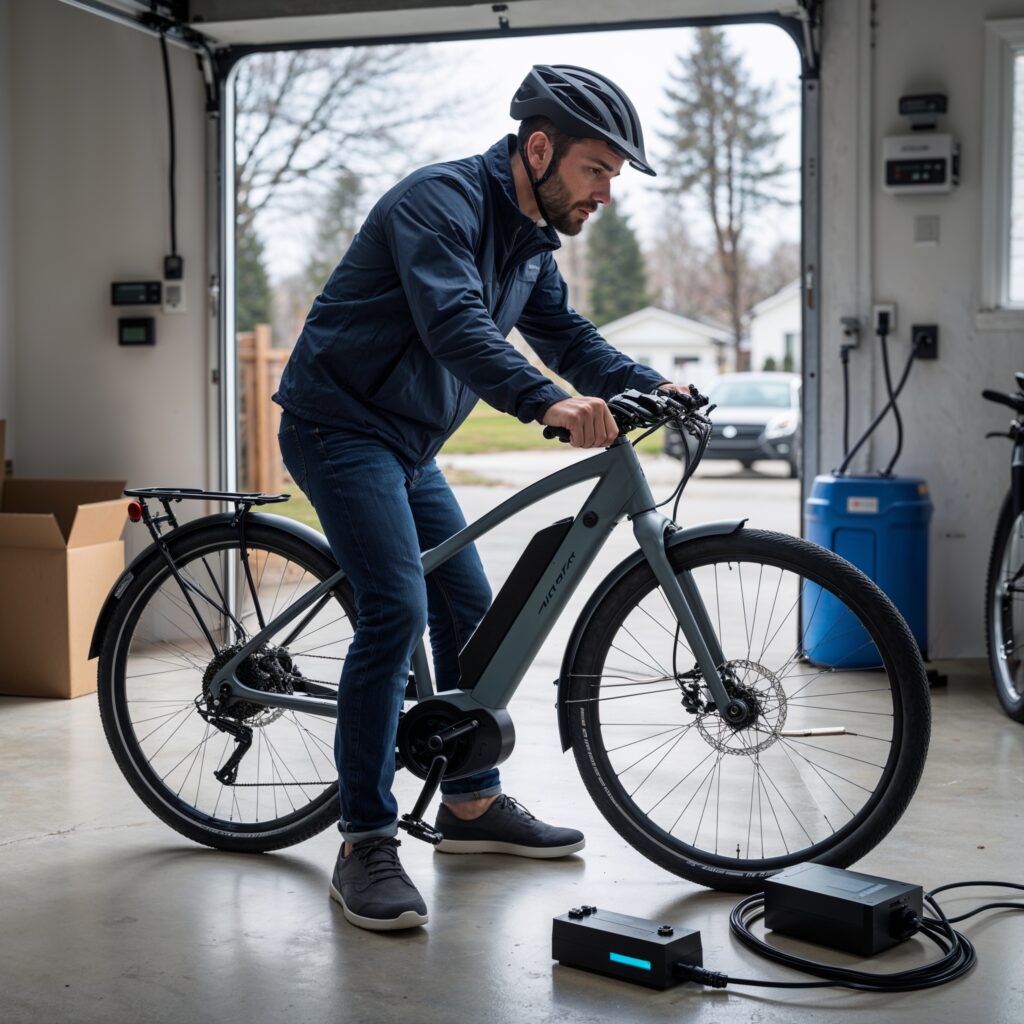
Electric bike battery problems usually show up as charging failure, sudden power loss, fast range drop, a battery that shows full but does not power the bike, or a charger that behaves strangely.
Start with safety. If the battery is swollen, cracked, leaking, smoking, sparking, unusually hot, wet inside, or giving off a chemical smell, stop using it and do not charge it again. Contact the bike brand, a qualified e-bike shop, or your local hazardous-waste service.
If there are no warning signs, you can safely check the charger, wall outlet, battery seating, terminals, display, brake sensors, and basic reset steps before deciding whether the problem is the charger, the battery, or another part of the bike.
Common Signs Your E-Bike Battery Has a Problem

Most electric bike battery problems show up in a few obvious ways.
The Battery Will Not Hold a Charge
You charge the battery fully, but the range drops much faster than it used to. A bike that once handled a 20-mile commute may now struggle after 8–10 miles.
This usually points to battery age, cell wear, cold weather, heavy load, or long-term charging habits.
The Bike Suddenly Losves Power
A sudden shutoff while riding can happen when the battery voltage drops too low under load. This is more common when climbing hills, carrying cargo, riding in cold weather, or using high pedal assist for long periods.
It can also happen if the battery is not seated properly in the mount.
The Battery Charges Slowly or Not at All
Electric bike battery charging problems may come from the battery, charger, outlet, charge port, fuse, or battery management system.
Before assuming the battery is dead, check the simple things first:
- Wall outlet
- Charger light
- Charge cable
- Battery charge port
- Battery terminals
- Whether the battery is fully locked into place
The Battery Says Full but the Bike Does Not Work
An e-bike battery fully charged but not working can be confusing. The battery indicator may show full, but the bike still refuses to power on.
Common causes include:
- Loose battery connection
- Dirty or bent terminals
- Blown fuse
- Display or controller issue
- Battery management system protection mode
- Internal battery fault
- Wrong or incompatible battery
| Battery problem | Most likely cause | Safe first check | Next step |
|---|---|---|---|
| Battery will not charge | Bad charger, loose port, BMS sleep mode, deep discharge | Check outlet, charger light, charge cable, and charge port | Try only the approved charger. Stop if the charger or port is hot, burnt, or damaged. |
| Battery drains fast | Old cells, cold weather, high assist use, low tyre pressure, heavy load | Compare current range with normal range in similar weather | Check riding conditions first. If range is less than half, test battery health or plan replacement. |
| Bike cuts out under load | Weak cells, loose battery mount, BMS protection, controller issue | Reseat battery and check terminals | If it happens on hills or acceleration, the battery may be weak under load. |
| Battery shows full but bike will not turn on | Dirty terminals, display fault, controller fault, BMS lockout | Check display, power button, terminals, and battery seating | If lights work but motor assist does not, check error codes and brake sensors. |
| Charger light stays green | Battery already full, charger not detecting battery, bad charge port, bad charger | Confirm battery charge level and inspect the port | Test with manufacturer-approved charger only. |
| Battery gets hot or smells strange | Internal fault, wrong charger, damage, water entry | Do not continue testing | Stop using the battery and contact a qualified professional. |
Why Your E-Bike Battery Might Fail

Most e-bike batteries fail for one of five reasons: age, temperature stress, charging mistakes, physical damage, or connection problems.
Age and Cycle Wear
Lithium-ion batteries slowly lose capacity over time. Even with careful use, the cells age each time they charge and discharge.
For many everyday riders, noticeable range loss after a few years is normal. The battery may still work, but it may no longer deliver enough power for longer rides, steep hills, or daily commuting.
Extreme Heat or Cold
Cold weather can make a healthy battery feel weak.
For example, a winter ride in Michigan, Minnesota, Colorado, or upstate New York may show a sudden range drop compared with summer riding. That does not always mean the battery is permanently damaged. Cold temperatures can reduce battery performance temporarily.
Heat is more concerning. Leaving a battery in a hot garage, car trunk, or direct summer sun can speed up long-term wear and increase safety risks.
Overcharging, Deep Discharging, and Poor Storage
Most modern e-bike batteries include a battery management system, but charging habits still matter.
Leaving a battery empty for weeks or months can push cells into deep discharge. Storing it fully charged in heat can also shorten battery life.
For longer storage, many e-bike battery makers recommend storing around a partial charge rather than completely full or completely empty. Bosch, for example, recommends storing e-bike batteries around 30–60% charge in a dry, moderate-temperature space.
Connector and Wiring Problems
Sometimes the battery itself is fine, but power is not reaching the bike.
Look for:
- Loose battery mount
- Corroded contacts
- Bent pins
- Damaged wiring near the battery cradle
- Dirt or moisture inside the charge port
- A battery that clicks in but does not fully lock
This is especially important after rain, winter road salt, rough trail riding, or transporting the bike on a car rack.
Brand-Specific Battery Issues
Searches like “giant e-bike battery problems” often come from riders trying to figure out whether the issue is brand-specific or just a normal e-bike battery fault.
Start with the same basic checks no matter the brand:
- Correct charger
- Battery seating
- Clean terminals
- Display error codes
- Battery reset procedure
- Dealer or manufacturer diagnostic steps
Then check the owner’s manual or authorized dealer guidance for brand-specific instructions.
Battery Management System Protection
Most modern e-bike batteries have a Battery Management System, often called a BMS. Its job is to help protect the battery from unsafe conditions such as overcharging, deep discharge, overheating, short circuits, and cell imbalance.
Sometimes the BMS may shut the battery down even when the pack is not completely dead. This can make the bike look like it has no power, the charger may not behave normally, or the battery may cut out under load.
A basic reset may help if the battery has no damage or warning signs. But if the battery keeps shutting off, gets hot, smells strange, or will not wake up with the approved charger, stop testing and get professional help.
Safety First: When to Stop Using the Battery Immediately

Do not keep testing or charging an e-bike battery if you notice warning signs.
Stop using the battery if you see:
- Swelling or bulging
- Cracked battery case
- Burn marks
- Melted plastic
- Chemical smell
- Hissing, popping, or smoke
- Battery gets unusually hot while charging
- Water inside the battery case
- Sparking at the charge port or terminals
If it is safe to do so, move the battery away from living areas and flammable materials. Then contact a qualified e-bike shop, the manufacturer, or your local hazardous waste authority.
The U.S. Consumer Product Safety Commission warns riders to follow manufacturer charging instructions, avoid unattended charging, and use only the charger supplied or recommended by the manufacturer.
Avoid “universal” chargers unless your e-bike manufacturer specifically approves them. A plug that fits does not automatically mean the charger is safe.
Stop Before Troubleshooting: Unsafe Battery Warning Signs
Do not keep testing or charging the battery if you notice any of these signs:
| Warning sign | What to do |
|---|---|
| Swelling or bulging case | Stop using the battery and keep it away from flammable items. |
| Cracked, burned, melted, or leaking case | Do not charge it. Contact the manufacturer or a qualified e-bike shop. |
| Chemical smell, smoke, hissing, or popping | Move away from the battery if safe and follow local emergency guidance. |
| Battery gets unusually hot while charging | Unplug only if safe. Do not continue charging. |
| Water inside the battery case or charge port | Do not test the battery. Moisture can create short-circuit risk. |
| Sparking at the charge port or terminals | Stop using the battery and get professional help. |
Only continue with the checks below if the battery has no visible damage, no strange smell, no unusual heat, and no signs of water, smoke, swelling, or sparking.
Troubleshooting Electric Bike Battery Problems at Home

If the battery has no visible damage and no warning signs, work through these checks in order.
Step 1: Check the Wall Outlet and Charger
In the U.S., most household outlets supply about 110–120V AC power. Your e-bike charger plugs into that outlet and converts the power into the correct DC output for your battery.
Check:
- Does the outlet work with another device?
- Does the charger light turn on?
- Is the charger damaged, cracked, buzzing, or unusually hot?
- Does the charger label match your battery voltage?
- Are you using the original or manufacturer-approved charger?
A 36V battery, 48V battery, and 52V battery usually require different charger outputs. Do not mix chargers unless the manufacturer confirms compatibility.
Step 2: Inspect the Battery Terminals
Remove the battery and look at the contact points.
Check for:
- Dirt
- Moisture
- Rust or corrosion
- Bent pins
- Black marks
- Loose battery cradle
- Debris inside the connector
Use a dry cloth to clean visible dirt. Do not spray liquid cleaner into the battery port.
Step 3: Make Sure the Battery Is Fully Seated
Many electric bike battery problems happen because the battery looks installed but is not fully locked into place.
Reinstall the battery and listen for the lock or click. Gently check for movement. If the battery shifts while riding, the connection can cut out under vibration.
Step 4: Check the Display and Power Button
If the battery lights turn on but the bike does not, the issue may be outside the battery.
Check:
- Display cable
- Power button
- Controller wiring
- Brake sensor cutoff
- Motor cable connection
- Error code on the display
Some e-bikes will not provide motor assist if a brake sensor is stuck or if the controller detects a fault.
Step 5: Try a System Reset
Some batteries enter protection mode after a voltage drop, overload, or charging error.
A reset may involve:
- Turning the battery off and on
- Holding the battery power button for several seconds
- Removing and reinstalling the battery
- Charging for a short period with the approved charger
- Following the reset steps in the owner’s manual
Do not force repeated resets if the battery smells hot, looks damaged, or keeps shutting off.
Step 6: Test Voltage Only If You Know How to Do It Safely
A multimeter can show whether the battery has voltage, but it does not prove the battery is healthy.
A weak battery may show voltage with no load and still fail when the motor demands power.
Do not open the battery case to test individual cells unless you are trained to work with lithium-ion packs. Opening the pack can create shock, short-circuit, fire, and warranty risks.
Electric Bike Battery Charging Problems and How to Prevent Them

Charging habits have a major effect on battery life and safety.
Use the Manufacturer-Approved Charger
This is one of the most important rules. The charger must match the battery’s voltage, chemistry, connector, charging current, and safety system.
For safer buying, look for e-bike systems tested as a complete electrical system. UL 2849 evaluates the electrical drive train system, battery system, and charger system together.
Do Not Charge Unattended
Charge where you can monitor the battery. Avoid charging while asleep, away from home, or near exits.
A safer charging area is:
- Dry
- Open and visible
- Away from beds, couches, curtains, and paper
- Near a working smoke alarm
- Not blocking a doorway or escape path
Avoid Charging in Extreme Heat or Cold
Let the battery return closer to room temperature before charging.
After a hot summer ride, let the battery cool down before plugging it in. After a freezing winter ride, bring the battery indoors and let it warm up before charging.
Partial Charges Are Usually Fine
You do not need to drain most modern lithium-ion e-bike batteries to zero before charging.
For daily commuting, charging to full before a long ride is normal. For short trips, partial charging is fine. For long storage, partial charge is usually better than storing completely full or completely empty.
When the Battery Cannot Be Fixed

Some batteries are not worth repairing. Others should not be repaired at all.
Replace or Recycle the Battery If It Has Physical Damage
A cracked, swollen, burned, water-damaged, or leaking battery should not be treated as a normal repair job.
Physical damage can affect internal cells, wiring, insulation, and the battery management system. Even if the battery still powers on, it may no longer be safe.
The Cells May Be Too Worn Out
If the battery charges fully but range is extremely low, the cells may be near the end of their useful life.
Signs include:
- Range is less than half of what it used to be
- Battery shuts off under hill climbing
- Charging completes unusually fast
- Battery percentage drops suddenly
- Bike works only on low assist
At this point, replacement is often more practical than troubleshooting.
The Battery Management System May Be Locked or Failed
The battery management system protects the cells from unsafe conditions. If it detects deep discharge, imbalance, overheating, or short-circuit risk, it may shut the pack down.
A qualified technician may be able to diagnose this. Most riders should not open the pack at home.
Replacement Options in the USA

Battery replacement is not just about finding a pack that fits. It must be electrically compatible, physically secure, and safe to charge.
OEM Battery Replacement
The safest route is usually an original equipment manufacturer battery from the bike brand or authorized dealer.
This helps ensure the battery matches:
- Voltage
- Mounting rail
- Connector shape
- Communication system
- Charger
- Controller
- Battery management system
Raleigh Electric Bike Battery Replacement
For Raleigh electric bike battery replacement, start by identifying the exact bike model, model year, battery part number, voltage, amp-hour rating, connector, and charger model.
Then contact an authorized Raleigh dealer, Raleigh support channel, or a reputable e-bike shop that can confirm compatibility.
Avoid buying a random battery only because it looks similar. Two batteries can share the same shape but use different wiring, output, or communication protocols.
Third-Party Batteries
Before buying a third-party e-bike battery, check every point below:
- Exact voltage match, such as 36V, 48V, or 52V.
- Correct amp-hour rating for your bike and controller.
- Correct connector shape and wiring layout.
- Correct mounting rail or battery case shape.
- Charger included or confirmed compatible by the bike/battery maker.
- Clear brand name, seller name, warranty, and return policy.
- Safety certification information from a recognised testing lab.
- Compatibility with the bike controller and display system.
- Local e-bike shop is willing to inspect or install it.
- No unrealistic range claims or vague product specifications.
Avoid any battery that only “looks similar” to your old battery. Two packs can have the same shape but different wiring, communication systems, charger requirements, or safety protections.
Preventive Maintenance for Long-Term Battery Life

Good battery care is simple. It mostly comes down to temperature, charging habits, clean connections, and avoiding long inactivity.
Store the Battery Correctly
For long storage:
- Store around 30–60% charge unless your manual says otherwise
- Keep it indoors in a dry, moderate-temperature space
- Avoid freezing garages and hot sheds
- Keep away from flammable items
- Store near a working smoke alarm when practical
- Check charge every month or two
- Do not leave it plugged into the charger for storage
Keep Terminals Clean and Dry
Inspect the battery contacts every few weeks, especially if you ride in rain, snow, dust, or coastal air.
Do not pressure-wash the battery area. High-pressure water can push moisture into connectors.
Avoid Prolonged Inactivity
Leaving an e-bike unused for months can drain the battery too low.
If you store your bike for winter, set a reminder to check the battery. A battery sitting empty for a long time may become impossible to recover.
Ride in Ways That Reduce Battery Stress
Your riding style affects battery load.
To protect the battery:
- Use moderate pedal assist when possible
- Avoid repeated full-throttle starts
- Shift to an easier gear before hills
- Reduce heavy cargo loads when range matters
- Keep tires properly inflated
- Avoid storing the bike in direct sun
Small habits add up, especially for commuters who ride every day.
FAQs on Electric Bike Battery Problems

How to Dispose of a Dead E-Bike Battery in the USA
Do not place a lithium-ion e-bike battery in household trash or normal curbside recycling. Even a battery that looks dead can still hold enough energy to create a fire risk if it is crushed, punctured, or shorted.
For safer disposal:
- Tape the battery terminals if they are exposed.
- Keep the battery away from heat, water, and flammable items.
- Do not open the battery case.
- Contact the manufacturer, local bike shop, city recycling programme, or household hazardous-waste centre.
- Use a proper lithium-ion battery recycling or hazardous-waste drop-off point.
If the battery is swollen, leaking, burned, smoking, or unusually hot, ask your local hazardous-waste authority or fire department for handling advice before transporting it.
Why is my e-bike battery not charging?
The most common causes are a faulty charger, loose charge port, dirty terminals, BMS protection mode, deep discharge, or using the wrong charger. Start with the wall outlet, charger light, charge cable, and charge port before assuming the battery is dead.
Why does my e-bike battery show full but not work?
The battery indicator may show charge, but power may not be reaching the controller or motor. Check the battery seating, terminals, display cable, brake sensor, controller connection, and error codes.
Why does my e-bike battery cut out when I accelerate?
This often happens when the battery voltage drops under load. Common causes include weak cells, cold weather, high pedal assist, loose battery contacts, a poor mount connection, or BMS protection.
Is it safe to reset an e-bike battery?
A basic external reset is usually safe only if the battery has no damage, no heat, no smell, no swelling, and no water entry. Do not open the battery case or force repeated resets if the battery keeps shutting down.
Can I repair an electric bike battery at home?
Most riders should not open or repair an e-bike battery at home. External issues like a loose mount, dirty terminals, or a bad charger may be simple to solve, but internal cell, wiring, and BMS repairs should be handled by a qualified professional.
When should I replace my e-bike battery?
Replace the battery if it is physically damaged, swollen, leaking, burned, water-damaged, or no longer holds enough charge for normal riding. Replacement is also safer when repair cost is close to the price of a compatible new battery.
Can I use a different charger for my e-bike battery?
Use only the original charger or a charger approved by the bike or battery manufacturer. A plug that fits does not mean the voltage, current, chemistry, or safety system is compatible.
Why is my e-bike battery fully charged but not working?
The battery may be charged, but power may not be reaching the bike. Check whether the battery is fully seated, terminals are clean, the display turns on, the charger is correct, and there are no error codes.
If the battery lights show full but the bike cuts out under load, the cells may be weak or the battery management system may be limiting output.
How long should a typical e-bike battery last?
Many e-bike batteries last several years with normal use, but lifespan depends on charging habits, temperature, storage, rider weight, terrain, and assist level.
A commuter using high assist every day may wear out a battery faster than a casual weekend rider.
Can extreme weather permanently damage my battery?
Yes, especially heat. Cold weather usually reduces range temporarily, but charging a very cold battery or storing a battery in extreme heat can shorten battery life.
In winter, bring the battery indoors before charging. In summer, avoid leaving it in a hot car, shed, or direct sun.
How do I safely dispose of a dead lithium e-bike battery in the USA?
Do not putlithium-ion batteries in household trash or curbside recycling. EPA guidance says lithium-ion batteries should go to separate recycling or household hazardous waste collection points. It also recommends taping battery terminals or placing batteries in separate plastic bags to reduce fire risk.
Many U.S. riders can also ask local bike shops, city recycling programs, or household hazardous waste centers about e-bike battery recycling options.
Quick Summary / Checklist

Daily Battery Care Routine
Before riding:
- Make sure the battery is locked into place
- Check the charge level
- Look for loose cables or warning lights
- Avoid riding with a cracked or swollen battery
After riding:
- Let the battery cool before charging
- Charge with the approved charger only
- Do not charge while asleep or away from home
- Keep the battery away from heat, water, and flammable items
For storage:
- Store around 30–60% charge
- Keep it indoors, dry, and climate-controlled
- Check charge every month or two
- Recycle dead batteries properly
Diagram Idea
A simple labeled diagram titled “Common E-Bike Battery Failure Points” showing:
- Battery cells
- Battery management system
- Charge port
- Output terminals
- Mounting rail
- Charger
- Controller connection
- Display connection
Add red callouts for dirty terminals, loose mount, wrong charger, water damage, and worn cells.
4. Improvement Summary
What was improved
- Safety warnings were made more prominent before troubleshooting.
- Charger compatibility guidance was clarified for beginner readers.
- U.S.-specific disposal guidance was strengthened.
- Replacement advice became more practical and safer.
- Brand-related keywords were preserved naturally without unsupported claims.
- Storage guidance was aligned more closely with common manufacturer battery-care recommendations.
Pingback: Electric Bike Battery Range: Real Miles by Battery Size, Speed & 48V - electricscootercar.com
Pingback: Electric Bike Battery Charging Guide: Safe Steps, Time, Cost & Battery Care - electricscootercar.com
Pingback: Electric Bike Battery Cost in the USA: $300–$1,500 Replacement Guide - electricscootercar.com
Pingback: Electric Bike Range: Real Miles Per Charge by Battery Size - electricscootercar.com
Pingback: How to Improve E-Bike Range: 15 Ways to Ride Farther - electricscootercar.com
Pingback: What Is a BMS on an E-Bike? How It Works, Protects the Battery, and Troubleshoots Problems - electricscootercar.com
Pingback: SEO Title: E-Bike Display System: Compatibility, Settings & Fixes - electricscootercar.com
Pingback: E-Bike Sensor Troubleshooting: Find the Fault Before Replacing Parts - electricscootercar.com
Pingback: Are Electric Bikes Eco-Friendly? When They Are—and What Changes the Answer - electricscootercar.com
Pingback: Electric Bike Battery Safety: Charging, Warning Signs & UL Checks - electricscootercar.com
Pingback: Battery Recycling Process: How E-Bike & EV Batteries Become New Materials - electricscootercar.com
Comments are closed.