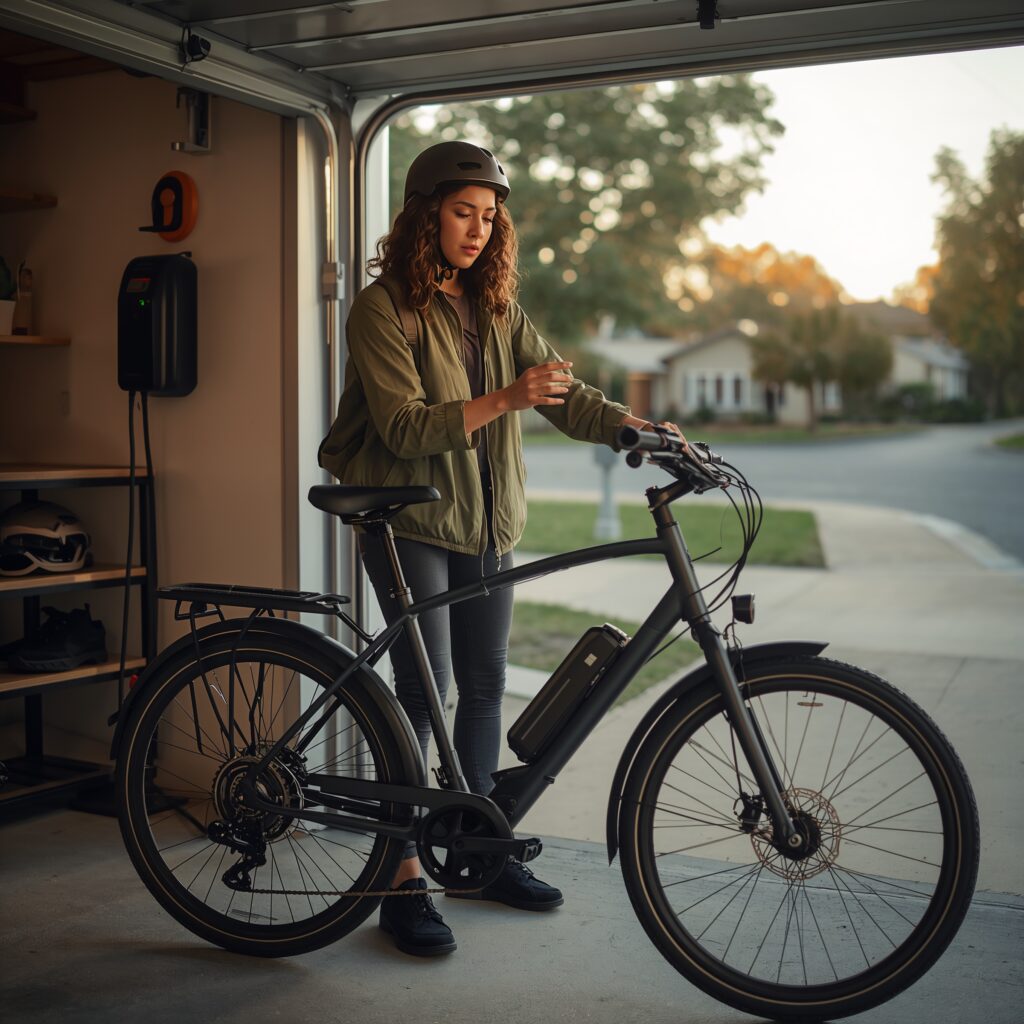
Most lithium-ion electric bike batteries remain useful for several years. A common estimate is 3–5 years or roughly 500–1,000 equivalent full-charge cycles, although a well-maintained battery may last considerably longer.
Those numbers are guidelines, not expiration dates. Your battery’s actual lifespan depends on its construction, charging habits, riding frequency, temperature exposure, and storage conditions.
There is another important distinction: a battery can lose some capacity without becoming unusable. If your e-bike once traveled 40 miles on a charge and now manages 32 miles under comparable conditions, the battery may still be suitable for your everyday rides.
This guide explains how long e-bike batteries last, what charge cycles actually mean, how to recognize normal aging, and when it makes sense to repair or replace a battery.
Electric Bike Battery Life: Range vs. Lifespan

Before comparing battery-life estimates, it helps to understand two measurements that are often confused.
| Measurement | What it means | Example |
|---|---|---|
| Battery range | Distance traveled on one full charge | 35 miles |
| Battery lifespan | Length of time the battery remains useful | Several years |
| Charge-cycle life | Cumulative battery use before a specified amount of degradation | 500–1,000 equivalent full cycles as a broad reference |
| Battery health | Remaining usable capacity compared with the original capacity | 80% of original capacity |
A battery with a long lifespan does not necessarily provide a long range per charge. A smaller, well-made battery may remain useful for years while providing fewer miles than a larger battery.
Similarly, an e-bike with an impressive advertised range may lose capacity relatively quickly if its battery is poorly maintained or regularly exposed to excessive heat.
For anyone shopping for a new e-bike, this distinction matters. Battery capacity helps you understand how far you might ride today. Battery lifespan helps you estimate how long the battery might serve you before you need a replacement.
How Many Years Does an E-Bike Battery Last?

For many modern lithium-ion e-bikes, three to five years is a reasonable starting estimate, but the actual usable life varies considerably.
According to REI’s electric bike charging guidance, many batteries can undergo approximately 500–1,000 equivalent full-charge cycles before experiencing meaningful capacity loss. How long those cycles take to accumulate depends on how often the bike is ridden and how much battery energy each ride consumes.
For example:
- A daily commuter riding long distances may accumulate battery cycles relatively quickly.
- A weekend rider may use far fewer cycles each year.
- A battery stored for months can still age even when it is not being ridden.
Battery design also makes a difference.
Bosch reports that certain smart-system batteries can retain approximately 80% of their original capacity after 1,000 charging cycles under specified laboratory conditions. Those results apply to the manufacturer’s stated battery systems and testing conditions; they do not predict the exact lifespan of every battery or account for all calendar aging.
You can review the details in Bosch’s official battery information.
Does a Battery Die After 500 or 1,000 Cycles?

No. Reaching a particular cycle count does not automatically make an e-bike battery defective or unsafe.
Lithium-ion batteries generally lose capacity gradually. A battery might retain 90%, 85%, or 80% of its original energy capacity as it ages, depending on its design and history.
Consider a battery that originally stored 500Wh of usable energy. If a reliable diagnostic test later indicates that it retains 80% of that original capacity, its usable energy would be approximately 400Wh.
That does not necessarily mean it must be replaced. If 400Wh still provides enough range for your normal journeys and the battery operates safely, continued use may be practical.
A significant capacity reduction is a reason to evaluate performance. Physical damage, abnormal heat, swelling, or repeated electrical faults are separate safety concerns that should never be ignored.
What Counts as an E-Bike Battery Charge Cycle?

A charge cycle is commonly misunderstood.
Plugging your battery into a charger does not automatically use one full cycle.
Instead, an equivalent full-charge cycle represents cumulative battery use totaling approximately 100% of its capacity.
Here is a simple example:
| Battery energy used | Approximate equivalent cycles |
|---|---|
| 20% | 0.2 |
| 50% | 0.5 |
| 80% | 0.8 |
| 100% total across multiple rides | 1.0 |
Suppose you ride your e-bike on Monday and use 40% of the battery. You recharge it before Tuesday.
On Tuesday, you use another 30%. On Wednesday, you use 30% again.
You have consumed energy equivalent to approximately one full battery cycle across three rides.
The exact cycle-counting method can vary between manufacturers, but the general principle remains useful: several partial discharges can add up to one equivalent full cycle.
For a more detailed explanation, see our e-bike battery charging cycles guide.
How to Estimate Your Annual Battery Cycle Usage

You can make a rough estimate using your actual riding distance.
Imagine that:
- Your e-bike travels approximately 30 miles on a full charge.
- You ride 15 miles per day.
- You use the bike four days per week.
- Your weekly distance is 60 miles.
At a consistent 30-mile full-charge range, that represents approximately two equivalent full cycles per week, or about 104 per year.
This does not mean your battery will last a mathematically exact number of years. Battery capacity changes over time, and calendar aging, temperatures, charging conditions, and battery quality also affect longevity.
However, estimating your cycle usage helps you understand why two people with similar e-bikes may experience different battery lifespans.
What Causes Electric Bike Batteries to Lose Capacity?

Lithium-ion battery aging happens through gradual changes inside the battery cells.
Over time, those changes reduce how much energy the battery can store or how effectively it delivers energy under load.
Some aging is unavoidable. Other forms of wear are influenced by how the battery is used and stored.
1. Excessive Heat
Prolonged exposure to high temperatures can accelerate battery degradation.
For example, leaving an e-bike battery inside a hot vehicle or in direct summer sunlight may expose it to temperatures substantially higher than the surrounding air.
Battery heat can also build up during demanding riding or charging.
The practical approach is to keep the battery out of unnecessary heat, use the charging conditions specified by its manufacturer, and allow a hot battery to return to a permitted charging temperature before connecting it.
2. Frequent Deep Discharges
Regularly using nearly all available battery capacity can contribute to wear, depending on the battery system.
Modern e-bikes often have a Battery Management System (BMS) that protects against certain electrical conditions, including excessive discharge. However, those protections do not eliminate battery aging.
There is usually no need to drain a lithium-ion e-bike battery completely before recharging it.
If you want to understand how the protection electronics operate, read our guide to e-bike battery management systems.
3. Poor Long-Term Storage
A battery can deteriorate even while sitting unused.
Leaving it at an extremely low charge for a prolonged period may allow it to become deeply discharged. Keeping it fully charged for extended periods, especially in a hot environment, can also accelerate aging.
Manufacturers may specify different storage charge levels for their battery systems.
The correct storage procedure is therefore more useful than following one universal percentage recommendation found online.
4. Frequent High-Energy Riding
Steep hills, high speeds, strong headwinds, heavy loads, and extensive throttle use can increase the amount of energy consumed during a ride.
These conditions do not automatically mean the battery is defective or permanently damaged.
However, consuming more energy per mile generally means you will need to recharge more frequently, increasing your accumulated cycle usage over the same distance.
5. Battery Cell Quality and Construction
Not all lithium-ion battery packs are built to the same standards.
Cell quality, pack assembly, temperature management, protective electronics, charger compatibility, and overall system design all influence reliability and service life.
A larger battery is not automatically a longer-lasting battery in calendar years. Capacity and durability are related but different characteristics.
For a closer explanation of the underlying aging process, see our article on e-bike battery degradation.
How Far Does an Electric Bike Battery Last on One Charge?

Battery lifespan and per-charge range are different questions, but they influence each other.
Range depends partly on the energy your battery can store and partly on how efficiently your bike uses that energy.
Battery energy is usually measured in watt-hours (Wh).
A basic calculation is:
Voltage (V) × Amp-hours (Ah) = Watt-hours (Wh)
For example:
48V × 14Ah = 672Wh
That is the battery’s nominal energy capacity. Actual usable energy can differ because of the battery system’s operating limits and condition.
When comparing batteries with different voltages, watt-hours are generally more informative than amp-hours alone. Our battery capacity Ah versus Wh guide explains why.
Example: Range From a 500Wh E-Bike Battery
A simple range estimate divides battery energy by energy consumption per mile.
Estimated range = Battery energy (Wh) ÷ Energy used per mile (Wh/mi)
| Illustrative energy consumption | Estimated range with 500Wh |
|---|---|
| 10Wh per mile | 50 miles |
| 15Wh per mile | 33 miles |
| 20Wh per mile | 25 miles |
| 25Wh per mile | 20 miles |
These figures are calculations, not measured performance results or guaranteed distances.
A rider pedaling steadily on flat ground with low assistance may consume much less energy than a rider using heavy assistance on steep hills.
As a battery ages and loses usable capacity, its potential range generally decreases under otherwise similar riding conditions.
For a more complete discussion of riding conditions and range calculations, see our electric bike range guide.
Why Your Range Can Drop Without Permanent Battery Damage

A shorter ride on one charge does not automatically prove that your battery has degraded.
Before assuming the battery is worn out, consider changes in your riding environment.
| Condition | Common effect |
|---|---|
| Cold weather | Temporarily reduces available battery performance |
| Higher assist mode | Increases energy consumption |
| Steep hills | Requires more motor energy |
| Low tire pressure | Increases rolling resistance |
| Strong headwind | Increases energy required to maintain speed |
| Heavy cargo | Increases energy demand, especially during acceleration and climbing |
| Rubbing brakes | Wastes energy through mechanical resistance |
Cold weather deserves particular attention. An e-bike may deliver less range during winter even when the battery has not suffered an equivalent permanent loss of capacity.
Battery performance can improve again as operating temperatures return to normal.
For safe riding and charging in different weather conditions, consult our e-bike battery temperature guide.
How to Extend Electric Bike Battery Life Safely

Good battery care is less about complicated routines and more about avoiding conditions that unnecessarily accelerate wear.
The following habits can help protect battery longevity while keeping safety first.
1. Use the Manufacturer-Approved Charger
Always use the charger supplied with your e-bike or one explicitly approved for your battery and electrical system.
A charger that has the same connector shape is not necessarily electrically compatible.
Incorrect voltage, charging characteristics, or protective functions can damage the battery and create a fire risk.
If your original charger is lost or defective, contact the manufacturer or authorized dealer before choosing a replacement.
2. Avoid Unnecessary Deep Discharging
You generally do not need to run the battery to zero before recharging.
If a shorter trip uses only part of your available capacity, you can normally recharge when convenient, following the manufacturer’s instructions.
This is one reason partial charging is practical for everyday commuting.
3. Charge to 100% When You Need the Range
Advice about always keeping a battery between 20% and 80% is often presented as a universal rule. It is not.
A partial-charge routine may reduce certain forms of battery stress, but the appropriate charging strategy depends on the manufacturer, battery chemistry, BMS, available charge-limit controls, and your actual riding needs.
Charging a properly functioning, compatible battery to 100% is not inherently improper when the manufacturer permits it.
If your next journey requires the full available range, charge accordingly. Avoid leaving a fully charged battery exposed to prolonged heat or storing it at full charge contrary to manufacturer guidance.
4. Charge Under Safe Conditions
The U.S. Consumer Product Safety Commission recommends that micromobility owners remain present while charging, avoid charging while asleep or away from home, use the approved charger, and disconnect charging equipment when charging is complete.
Follow these precautions:
- Charge in a suitable dry, ventilated location.
- Keep the battery and charger away from flammable materials and escape routes.
- Do not charge a visibly damaged or overheating battery.
- Do not charge while sleeping or away from home.
- Allow the battery to reach a manufacturer-permitted charging temperature if it is unusually hot or cold.
- Disconnect the charger when charging is complete.
Read the CPSC micromobility battery charging guidance for the official safety recommendations.
5. Keep the Bicycle Mechanically Efficient
Battery health is not the only factor affecting energy consumption.
Correct tire pressure, freely rotating wheels, properly adjusted brakes, and a clean drivetrain can make the bike more efficient.
A dragging brake or underinflated tire may reduce range even when the battery itself is healthy.
If you need detailed charging procedures, our electric bike battery charging guide covers the process and common charging concerns.
6. Protect the Battery From Extreme Temperatures
Do not leave a removable battery in a hot parked car or exposed to direct sunlight for unnecessarily long periods.
In winter, follow the battery manufacturer’s recommendations for bringing the battery to a suitable temperature before charging or riding.
Cold-weather charging restrictions are particularly important. Never attempt to override a battery or charger temperature protection system.
For additional longevity recommendations, see how to increase e-bike battery life safely.
How to Store an E-Bike Battery for Weeks or Months

If you use your e-bike only during certain seasons, storage habits may affect battery life as much as everyday charging.
The main priorities are appropriate temperature, a suitable partial charge, a dry location, and protection from physical damage.
For Bosch e-bike batteries, the manufacturer recommends approximately 30–60% charge for extended storage.
That is a Bosch recommendation, not a universal rule for every battery. Always check the instructions for your own model.
See Bosch’s official battery storage guidance.
For longer breaks from riding:
- Consult the manufacturer’s recommended storage charge level and temperature.
- Remove the battery if the bike is designed to allow it and the manufacturer recommends doing so.
- Store it in a dry, appropriate location away from heat sources and combustible materials.
- Keep the battery protected from accidental impacts and contact with conductive objects.
- Check its charge periodically as recommended by the manufacturer.
- Recharge safely before riding again if necessary.
- Do not leave the charger connected continuously during storage.
If a battery has become deeply discharged and refuses to charge, do not attempt to force it back into operation using improvised chargers, direct wiring, or battery-pack modifications.
Contact the manufacturer or a qualified service provider instead.
How to Check Whether Your E-Bike Battery Is Still Healthy

You do not need to open a battery pack to evaluate its everyday performance.
Begin with observations that are safe for an ordinary rider.
Step 1: Inspect for Warning Signs
Check the battery case, connections, and charging area for visible damage.
Stop using or charging the battery if you notice swelling, cracks, leaking material, a burning smell, smoke, hissing, or unusual heat.
Do not proceed with a range test on a suspicious battery.
Step 2: Compare Similar Rides
If the battery appears physically normal, compare its range under reasonably similar conditions.
Try to keep the following consistent:
- Route and distance
- Assist level
- Tire pressure
- Rider and cargo weight
- Average speed
- Weather and temperature
For example, suppose your battery previously traveled about 35 miles under a particular set of conditions.
If similar journeys now consistently deliver only 24–26 miles, that may justify a battery-health inspection.
However, differences in terrain, wind, temperature, brake condition, or rider behavior can still influence the result.
Step 3: Look at the Battery Information Available on Your E-Bike
Some e-bikes provide useful diagnostic information through their displays, mobile applications, or dealer software.
Depending on the system, available information may include:
- Remaining charge percentage
- Estimated remaining range
- Charge-cycle count
- Battery-health or capacity estimates
- Error messages or diagnostic codes
A display reading 100% charge does not necessarily mean the battery retains 100% of its original capacity.
State of charge indicates how full the battery currently is relative to its available capacity.
State of health indicates how much of its original capability remains.
The two measurements should not be confused.
Step 4: Get a Professional Capacity Test When Needed
If you suspect meaningful degradation, an authorized dealer may be able to measure remaining capacity or review battery diagnostics.
This is particularly helpful when considering an expensive replacement.
A battery that has gradually lost capacity may simply be aging. A battery that unexpectedly shuts down under light or normal use could have a different electrical problem.
Do not open the battery case, probe internal cells, bypass protection circuits, or attempt cell balancing without appropriate professional training.
Our safe e-bike battery health-check guide explains how to distinguish common symptoms and choose the next step.
When Should You Replace an Electric Bike Battery?

There is no single age or battery-health percentage that automatically requires every e-bike battery to be replaced.
A replacement decision should consider safety, reliability, remaining range, compatibility, repair options, and cost.
| Battery condition | Recommended response |
|---|---|
| Gradual range reduction, but still adequate for your trips | Continue using and monitoring if the battery operates safely |
| Consistently insufficient range | Consider professional capacity testing and replacement options |
| Sudden shutdowns or unreliable charging | Arrange professional diagnosis |
| Physical swelling, leakage, burning smell or abnormal heat | Stop using and charging; seek qualified assistance |
| Battery physically damaged after a crash or serious water exposure | Avoid further use or charging until professionally assessed |
| Battery no longer supported or compatible replacements unavailable | Consult the manufacturer about safe options |
Is 80% Battery Health a Reason to Replace?
Not automatically.
If a battery retains approximately 80% of its original usable capacity, it may still provide enough energy for shorter commutes and recreational rides.
For example, if your usual round trip is 12 miles and the battery still provides a reliable 25-mile range under those conditions, replacement may not be necessary purely because of its age.
But if your required journey is 30 miles without a charging opportunity, the same battery may no longer meet your needs.
The important question is whether the battery remains safe, reliable, and useful for its intended purpose.
Should You Repair or Replace an Aging Battery?
Battery repair is not equivalent to repairing a tire or adjusting a brake.
Lithium-ion packs contain cells and electrical protection systems that can create serious hazards when incorrectly modified.
The CPSC advises against using battery packs modified or rebuilt by unqualified personnel.
If the problem involves the charger, external connections, or other replaceable components, a qualified service provider may be able to correct it without replacing the entire battery.
If the cells or pack have deteriorated or been physically damaged, a manufacturer-approved replacement may be the safer solution.
Our electric bike battery repair guide discusses professional assessment and repair-versus-replacement decisions in more detail.
Electric Bike Battery Warranty and Replacement Cost
Battery lifespan and battery warranty coverage are not the same thing.
A manufacturer warranty generally sets out specific rights and coverage conditions for eligible defects or capacity-related claims. It does not necessarily promise that the battery will retain its original range throughout the warranty period.
For example, Specialized’s published Turbo battery warranty describes coverage of two years or 300 charge cycles, whichever comes first, subject to the applicable warranty terms.
You can verify the details in the Specialized warranty policy.
Your own coverage may differ based on brand, model, purchase date, location, and warranty conditions.
What Affects Replacement Cost?
Replacement battery prices vary substantially depending on capacity, manufacturer, compatibility, and availability.
Common price drivers include:
- Battery energy capacity in watt-hours
- Original equipment manufacturer versus compatible replacement
- Integrated or removable battery design
- Battery Management System compatibility
- Connector and mounting design
- Manufacturer support and availability
- Installation or diagnostic labor
A cheap battery that resembles the original is not necessarily compatible or safe.
Always confirm the replacement part with the manufacturer or an authorized dealer. Match the exact model requirements, including electrical compatibility, mounting arrangement, approved charger, and protective electronics.
For more detailed pricing considerations, see our electric bike battery replacement cost guide.
What Battery Safety Certification Should You Look For?
In the United States, recognized electrical safety standards provide useful guidance when choosing an e-bike or replacement battery.
UL 2849 addresses the electrical system of an e-bike, including the drive system, battery system, and charger as an integrated system.
UL 2271 addresses batteries for light electric vehicle applications.
These standards are not interchangeable, and a claim that a product was merely tested to a standard should not automatically be treated as proof of independent certification.
You can learn about their scope through UL Solutions’ e-bike certification information.
Check the manufacturer’s certification documentation and verify relevant claims rather than relying solely on product listing language.
Frequently Asked Questions About Electric Bike Battery Life
Can an E-Bike Battery Last 10 Years?
It is possible for some batteries to remain useful for 10 years or longer, particularly with limited cycling, careful storage, and favorable operating conditions. However, that is not a guaranteed lifespan. Battery chemistry, design, calendar aging, and individual usage determine the actual outcome. Inspect and evaluate older batteries rather than assuming age alone proves they are safe or unusable.
Is It Bad to Charge an Electric Bike Battery Every Day?
Not necessarily. Daily charging does not automatically mean one full cycle is consumed every day. Several partial charges may add up to one equivalent full cycle. The more important considerations are energy throughput, heat exposure, charging conditions, and manufacturer instructions. Use the approved charger and follow safe charging practices.
Does an E-Bike Battery Need Replacing After Five Years?
No fixed five-year replacement rule applies to all e-bikes. Some batteries may require earlier replacement because of damage, faults, or substantial loss of usable range. Others may continue operating satisfactorily beyond five years. Base the decision on the battery’s condition, professional diagnostics where necessary, and whether it still meets your riding needs.
Why Is My E-Bike Battery Draining Faster Than Before?
An aging battery is one possibility, but higher assist settings, low tire pressure, cold weather, headwinds, steep hills, added cargo, and brake drag can also reduce range. Compare similar journeys and look for consistent changes before assuming the battery needs replacement. For a diagnostic walkthrough, read why an e-bike battery drains so fast.
Where Should I Dispose of an Old E-Bike Battery in the USA?
Do not put an e-bike lithium-ion battery in household trash or ordinary recycling bins. Use an authorized battery recycling or hazardous-waste collection service. The Battery Network drop-off locator can help identify participating sites, but you must confirm that the location accepts your specific e-bike battery. Damaged or defective batteries require special handling.
Final Takeaway: Getting More Useful Years From Your E-Bike Battery
Electric bike battery life is best understood through three things: remaining capacity, accumulated use, and overall battery condition.
Many lithium-ion e-bike batteries provide several years of service, and 500–1,000 equivalent full-charge cycles is a useful broad reference. But the number of years a battery remains useful varies, and reaching a particular cycle count does not automatically mean the battery has failed.
For everyday riders, the most effective approach is straightforward: use the correct charger, avoid unnecessary heat, follow safe charging practices, store the battery properly during long breaks, and maintain the bicycle so it does not waste energy.
If your range gradually decreases, compare rides under similar conditions and consider a professional battery-health check before purchasing a replacement.
If your battery is damaged, swollen, unusually hot, or behaving unpredictably, prioritize safety rather than trying to extend its life.
A well-cared-for battery will not last forever. Understanding how it ages helps you preserve its useful life, avoid unnecessary replacement costs, and make better decisions about your electric bike.
Pingback: SEO title: How Temperature Affects E-Bike Batteries: Ride, Charge or Wait? - electricscootercar.com
Pingback: Solid-State E-Bike Batteries in 2026: What’s Real and Should You Wait? - electricscootercar.com
Pingback: SEO title: Wireless Charging for Electric Bikes: Is It Practical in 2026? - electricscootercar.com
Pingback: SEO title: AI Electric Bikes: What AI Really Does Before You Buy - electricscootercar.com
Comments are closed.