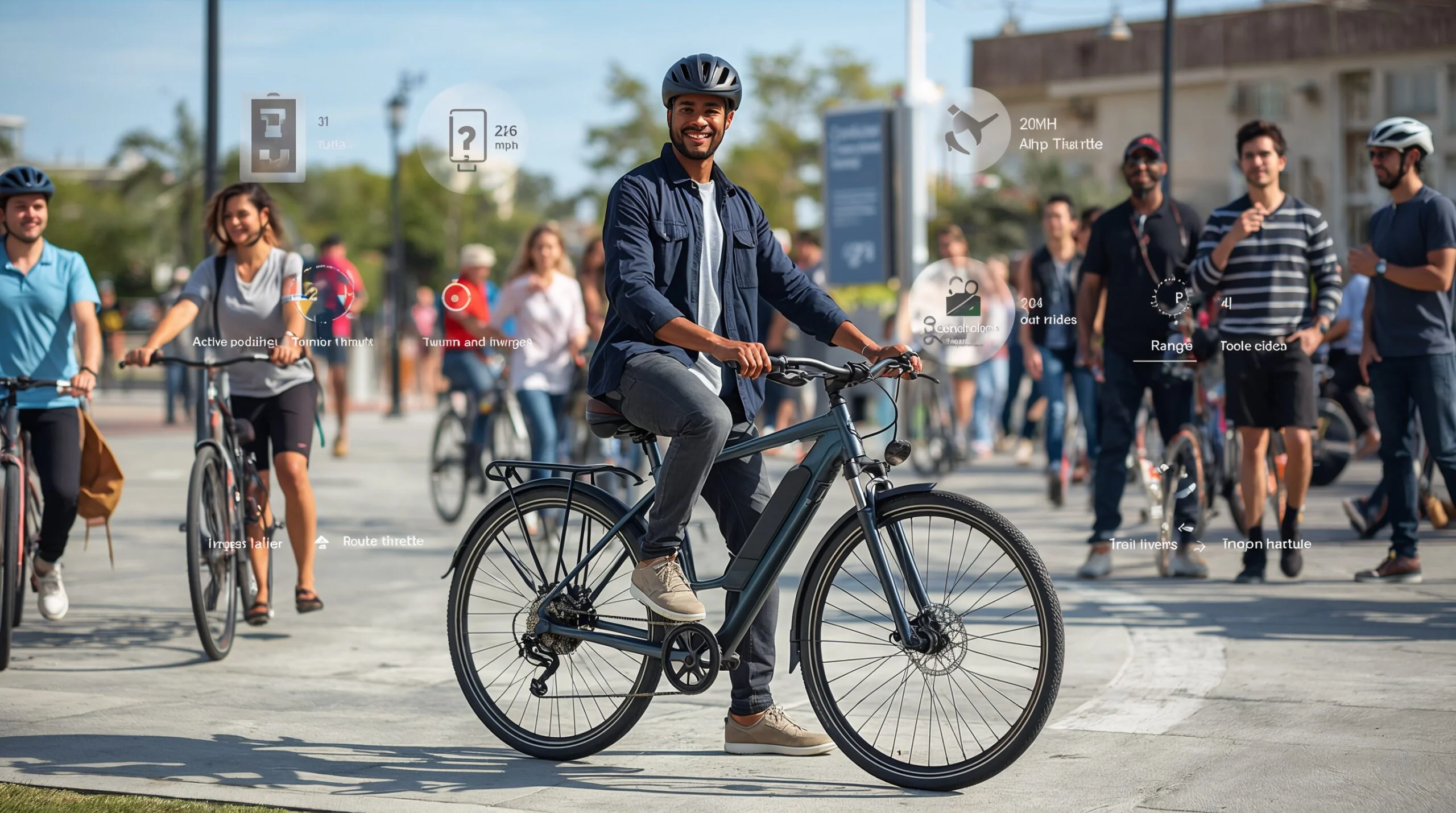
An electric bike, or e-bike, is a bicycle with operable pedals, a rechargeable battery, and an electric motor that assists the rider. Most e-bikes provide assistance when you pedal, while some also have a throttle. You can usually continue riding without motor assistance, although the additional weight may make pedaling harder.
Electric Bikes: Quick Answers
| Question | Answer |
|---|---|
| Do you have to pedal? | On a pedal-assist bike, yes. A throttle-equipped bike may move without active pedaling. |
| Can you ride with a dead battery? | Usually, but it will feel like a heavier bicycle. |
| How fast is an e-bike? | Common U.S. assistance cutoffs are 20 or 28 mph, depending on the class. |
| How far can it travel? | Range varies with battery capacity, assistance, terrain, weather, weight, and speed. |
| Is it legally a bicycle? | Sometimes, but federal, state, and local rules answer different legal questions. |
| Does every e-bike have a throttle? | No. Many e-bikes use pedal assistance only. |
The simplest explanation is:
An e-bike is still a bicycle, but a battery-powered system helps the rider do part of the work.
What Makes a Bicycle an E-Bike?

An e-bike combines normal bicycle parts with an electrical assistance system.
Its three defining features are:
- Operable pedals
- A rechargeable battery
- An electric motor
The pedals let you propel the bicycle through human power. The battery stores electrical energy, and the motor converts that energy into assistance.
Sensors and controls tell the system when assistance is needed. A controller regulates how power moves from the battery to the motor.
Is every powered two-wheeler with pedals an e-bike?
No.
Some powered devices have pedals but are designed and operated more like mopeds, dirt bikes, or motorcycles. Pedals alone do not prove that a product qualifies as an e-bike under federal or state rules.
Under the federal consumer-product definition, a low-speed electric bicycle has two or three wheels, fully operable pedals, a motor of less than 750 watts, and a motor-only maximum speed below 20 mph under a specified test condition.
State and local definitions may differ, particularly for more powerful or faster devices.
Can you ride an e-bike like a normal bicycle?
Most e-bikes can be pedaled with the motor switched off or after the battery runs out.
The experience may not feel identical to riding a comparable conventional bicycle because an e-bike normally carries additional battery, motor, wiring, and frame weight.
How manageable it feels without assistance depends on:
- Total weight
- Available gears
- Tire width and pressure
- Terrain
- Cargo
- Motor-system resistance
- Rider strength
A lighter commuter e-bike may remain manageable on level ground. A heavy cargo or fat-tire model can be difficult to pedal uphill without assistance.
How Does an Electric Bike Work?

An e-bike responds to rider input and delivers controlled assistance.
The system works in six basic steps:
- You begin pedaling or use a throttle.
- A sensor or throttle sends an input.
- The controller interprets that input.
- The battery supplies electrical energy.
- The motor converts the energy into mechanical assistance.
- The motor helps turn the wheel or drivetrain.
Recommended original visual: Place a labeled diagram here showing:
Rider input → sensor or throttle → controller → battery → motor → wheel or drivetrain
Battery
The battery stores the energy used by the motor.
Battery capacity is commonly measured in watt-hours, abbreviated as Wh. A higher watt-hour figure means the battery can store more energy, but it does not guarantee a specific riding distance.
Energy use changes with:
- Assistance level
- Rider effort
- Speed
- Hills
- Wind
- Temperature
- Rider and cargo weight
- Tire pressure
- Stops and acceleration
- Battery age
A large battery used at maximum assistance can provide less range than a smaller battery used carefully on a flatter route.
Controller
The controller manages the relationship among the battery, sensors, controls, and motor.
It influences:
- When assistance begins
- How quickly it responds
- How strongly the motor assists
- When assistance decreases or stops
- How the system reacts to speed and brake signals
Controller programming is one reason two bikes with similar motor specifications can feel different.
Hub motor vs mid-drive motor
A hub motor sits inside the front or rear wheel hub. Rear-hub motors are common on commuter, folding, and lower-cost e-bikes.
A mid-drive motor sits near the crank and sends assistance through the bicycle’s drivetrain.
Hub motors can provide relatively straightforward and affordable assistance. Mid-drive systems can use the bicycle’s gears and may perform well on hills, but they can cost more and place additional load on the drivetrain.
Neither design is automatically best for every rider.
Sensors
A cadence sensor detects whether or how quickly the pedals are turning.
A torque sensor measures how much force the rider applies to the pedals.
A speed sensor tracks bicycle speed and helps the system manage assistance around its programmed cutoff.
Some bikes also use brake sensors that stop motor power when a brake lever is activated.
Do You Have to Pedal an Electric Bike?

It depends on whether the bike uses pedal assistance, a throttle, or both.
| Feature | Pedal assist | Throttle |
|---|---|---|
| Activation | You pedal | You operate a hand control |
| Pedaling required for activation | Yes | Not necessarily |
| Typical behavior | Motor adds to your effort | Motor supplies direct propulsion |
| Useful for | Bicycle-like riding and adjustable effort | Starts, cargo, and direct short-term control |
| Legal treatment | Depends on class and location | May face additional restrictions |
How pedal assist works
A pedal-assist system activates while you pedal.
Most systems provide several assistance settings. Lower modes generally require more rider effort and consume battery energy more slowly. Higher modes provide stronger assistance but usually use energy faster.
The selected level does not control the bike independently. Motor behavior also depends on the sensor, controller, gear, terrain, speed, and rider input.
What a throttle does
A throttle is usually operated with a thumb lever or twist control. It can request motor assistance while the rider is not actively pedaling.
A throttle may help when:
- Starting from a stop
- Restarting on a hill
- Moving a loaded cargo bike
- Establishing balance before steady pedaling
- Using a short burst of assistance
Throttle-equipped bikes may be classified differently or restricted on particular routes.
Cadence sensor vs torque sensor
| Question | Cadence sensor | Torque sensor |
|---|---|---|
| What does it measure? | Pedal rotation | Pedal force |
| Typical response | Programmed assistance after rotation is detected | Assistance that changes with rider pressure |
| Starting behavior | May have a short delay or noticeable push | Often feels more immediate |
| Riding feel | Can feel like selecting a boost level | Can feel more connected to rider effort |
| Typical cost | Often lower | Often higher |
These are general tendencies. Controller programming can make two systems in the same sensor category behave differently.
A cadence system may suit a rider seeking a lower price and obvious assistance. A torque system may suit someone who values smooth low-speed control and a more bicycle-like response.
What Do Class 1, Class 2, and Class 3 Mean?

Many U.S. states use a three-class framework.
| Common class | Assistance | Common cutoff |
|---|---|---|
| Class 1 | Motor assists while the rider pedals | 20 mph |
| Class 2 | Motor may propel the bike without pedaling | 20 mph |
| Class 3 | Motor assists while the rider pedals | 28 mph |
This framework is widely used, but it is not universal. State e-bike laws differ and continue to change.
Federal definition and state riding rules are different
Two legal questions matter:
What is the product?
Federal law provides a consumer-product definition for certain low-speed electric bicycles. A qualifying low-speed e-bike is not treated as a motor vehicle for federal motor-vehicle safety standards.
Where and how may it be ridden?
State and local rules can determine:
- Road and bike-lane access
- Trail access
- Helmet requirements
- Minimum rider age
- Passenger rules
- Equipment requirements
- Licensing or registration
- Restrictions on throttle-equipped bikes
A class sticker does not automatically prove that the bike is allowed on every road, path, park, or trail.
Before riding, check:
- The bike’s class and specifications
- Current state law
- City or county rules
- Rules for the specific trail, park, or land manager
How Fast and How Far Can an E-Bike Go?

Assisted speed
Under the common three-class framework:
- Class 1 assistance normally stops at 20 mph.
- Class 2 motor assistance normally stops at 20 mph.
- Class 3 assistance normally stops at 28 mph.
An assistance cutoff is not necessarily the bicycle’s absolute maximum speed.
A rider may travel faster by pedaling or descending a hill. Local speed limits and safe riding conditions still apply.
What determines e-bike range?
Range depends on how much usable energy the battery stores and how quickly the bike consumes it.
The main factors are:
- Battery watt-hours
- Assistance level
- Rider effort
- Speed
- Hills
- Wind
- Temperature
- Rider and cargo weight
- Tire pressure
- Stops and acceleration
- Mechanical condition
- Battery age
Two riders using the same bike may receive very different results.
Advertised range vs realistic range
A maximum advertised range may assume favorable conditions such as:
- A light rider
- Flat terrain
- Low assistance
- Moderate speed
- Mild weather
- Correct tire pressure
- A new battery
- Few stops
Do not plan an essential journey around the most optimistic number unless the stated test conditions resemble your route.
A practical method is:
- Read the manufacturer’s test conditions.
- Account for hills, wind, temperature, and cargo.
- Avoid assuming the highest advertised figure.
- Keep a reserve for detours and the return trip.
- Record your results over repeated rides.
Your own route history will eventually be more useful than a universal range estimate.
What happens when the battery runs out?
Motor assistance stops, but you can usually continue pedaling.
The bike may become difficult to ride when:
- It is particularly heavy
- The route is hilly
- You are carrying cargo
- The tires are wide or underinflated
- It lacks suitable low gears
- The drive system creates noticeable resistance
During a test ride, switch the assistance off and pedal on level ground and a gentle incline. That reveals whether you could reasonably finish a journey without power.
How long does charging take?
Charging time depends on battery capacity, charger output, starting charge, temperature, and battery-management programming.
Use the charging guidance for the exact battery and charger combination. Do not substitute a “universal” or higher-output charger merely to reduce charging time. CPSC advises using the charger supplied or recommended by the manufacturer.
Which Type of E-Bike Fits Your Needs?

Start with the task you need the bike to perform.
| Main need | Type to explore | Main trade-off |
|---|---|---|
| Daily paved commute | Commuter e-bike | Security and storage |
| Groceries, children, or equipment | Cargo e-bike | Size, weight, and handling |
| Limited storage | Folding e-bike | Carrying weight and ride comfort |
| Off-road riding | Electric mountain bike | Trail access and maintenance |
| Fitness-oriented paved rides | Road or lightweight e-bike | Less cargo capacity |
| Relaxed riding | Cruiser e-bike | Weight and hill performance |
| Loose or uneven surfaces | Fat-tire e-bike | Bulk and rolling resistance |
| Three-wheel format | Electric tricycle | Width and turning behavior |
Commuter e-bike
A commuter model is intended primarily for transportation on paved routes.
Useful features may include:
- Lights
- Fenders
- Rear rack
- Kickstand
- Puncture-resistant tires
- A comfortable riding position
For frequent transportation, reliability, fit, security, and local repair support may matter more than maximum motor output.
Cargo e-bike
Cargo e-bikes are designed to carry larger loads.
They may be useful for:
- Groceries
- Work equipment
- Children
- Deliveries
- Household errands
Check the frame, rack, passenger equipment, and total load ratings. A motor’s ability to move a load does not prove that the frame or brakes are designed to carry it safely.
Folding e-bike
A folding frame reduces storage dimensions, but it does not necessarily make the bike light.
Before buying one for stairs or public transportation, check:
- Complete weight with the battery
- Folded dimensions
- Whether it rolls while folded
- Whether you can lift it safely
- How easily the folding mechanism operates
Electric mountain bike
An electric mountain bike is designed for off-road riding, but trail access may depend on class and land-management policy.
Confirm access before buying a bike for a particular trail system.
E-Bike vs Regular Bicycle, Scooter, and Motorcycle

E-bike vs regular bicycle
An e-bike is heavier and more complex, but it can reduce the effort needed for hills, longer routes, headwinds, and cargo.
A regular bicycle is generally lighter, less expensive, easier to carry, and simpler to maintain.
E-bike vs electric scooter
An e-bike normally has pedals, a seated bicycle position, and larger wheels. An electric scooter commonly uses a standing platform and smaller wheels.
An e-bike may be better for longer rides, uneven surfaces, and carrying loads. A scooter may be more compact for short urban trips.
Legal rules differ by location for both categories.
E-bike vs motorcycle
A motorcycle uses its motor as its primary propulsion system and is generally subject to motor-vehicle requirements.
A qualifying e-bike retains bicycle pedals and fits a lower-speed legal category. Faster or more powerful products may fall outside ordinary e-bike definitions.
What Does an E-Bike Feel Like to Ride?

The exact experience depends on the sensor, controller, motor location, bike weight, tires, and gearing.
Starting
A cadence-sensor bike may require part of a pedal turn before assistance begins. The response can feel like a noticeable push.
A torque-sensor bike responds to pedal pressure and may feel more connected to the rider’s effort.
A throttle can provide assistance before steady pedaling begins.
Climbing
Hill performance depends on more than motor wattage.
Important factors include:
- Motor design
- Torque delivery
- Available gears
- Rider cadence
- Hill steepness
- Bike and cargo weight
- Battery condition
- Controller programming
Correct gear selection can matter as much as selecting a high assistance mode.
Braking and turning
Additional weight affects:
- Stopping distance
- Low-speed balance
- Tight turns
- Parking
- Lifting
- Pushing the bike
Practice starting, stopping, signaling, and turning in a low-risk area before riding in traffic or carrying a passenger.
Is it still exercise?
On a pedal-assist bike, the rider continues to pedal. Assistance changes the effort needed for a route, hill, or speed.
The amount of physical effort depends on the assistance level, rider contribution, terrain, ride duration, and riding frequency. An e-bike does not guarantee a particular fitness or medical outcome.
Benefits and Ownership Trade-Offs

An e-bike may make these tasks easier:
- Climbing hills
- Riding into headwinds
- Traveling farther
- Restarting repeatedly
- Carrying suitable cargo
- Adjusting rider effort
- Completing longer commutes
Potential disadvantages include:
- Higher purchase price
- Additional weight
- Battery replacement expense
- Charging requirements
- More complex repairs
- Theft risk
- Storage difficulty
- Transportation difficulty
- Local access restrictions
- Limited replacement parts or service
A bike with impressive specifications can still be a poor purchase when replacement batteries, software support, or qualified repairs are unavailable.
A conventional bicycle may be a better choice when low weight, low cost, easy carrying, simple maintenance, and widely available parts matter most.
E-Bike Battery and Charging Safety

Use only the charger supplied or recommended by the manufacturer and an approved replacement battery. CPSC warns against incompatible batteries, modified packs, and universal chargers because a connector that fits may still be electrically unsuitable.
Four charging rules
- Be present while charging. Do not charge while sleeping or away from home.
- Keep exits clear. Do not charge where the bike blocks an escape route.
- Stop using damaged equipment. Watch for swelling, leakage, cracks, unusual heat, odor, smoke, or hissing sounds.
- Dispose of batteries correctly. Do not put lithium-ion batteries in household trash or ordinary recycling.
These recommendations reflect current CPSC micromobility guidance.
What does UL 2849 cover?
UL 2849 evaluates electrical and fire-safety aspects of the electrical drivetrain, battery, and charger system combination.
It does not prove that:
- Every mechanical part is safe
- The bike is correctly assembled
- The rider can control it
- It is legal on every route
- It fits a particular rider
- Every certification claim made by a seller is genuine
UL-certified products can be checked through UL’s certification database.
Is an E-Bike Right for You?

An e-bike may suit you when:
- Your route includes hills or headwinds
- You want to travel farther
- You need to carry suitable cargo
- You want adjustable effort
- You have secure storage
- You have a safe charging location
- Your intended route allows the bike
- Replacement batteries and repairs are available
Another option may be more practical when:
- You regularly carry the bike upstairs
- Secure storage is unavailable
- Charging is difficult
- Your route prohibits the bike
- Low weight is your main priority
- Qualified service is unavailable
- The complete ownership cost exceeds your budget
Check these before comparing motor power
Use this order:
- Route: Where will you ride?
- Rules: Is the bike permitted there?
- Storage: Where will you keep it?
- Weight: Can you lift or move it?
- Service: Who will repair it?
- Battery support: Can you buy a genuine replacement?
- Use: Will you commute, carry cargo, or ride recreationally?
- Fit: Is the bike comfortable and controllable?
- Assistance: Does the motor response feel right?
- Range: Does realistic range cover the route with a reserve?
Motor wattage and battery capacity matter, but only after the bike passes these practical checks.
Five-minute test-ride checklist
During a test ride:
- Start without using the throttle.
- Try the lowest assistance level.
- Increase assistance gradually.
- Ride up a gentle hill.
- Brake firmly in a safe area.
- Make a slow, tight turn.
- Switch the motor off and pedal.
- Push the bike by hand.
- Test whether you can lift or reposition it.
- Check whether the controls are understandable without distraction.
A bike that feels unpredictable, uncomfortable, or excessively heavy during a controlled test is unlikely to become more practical after purchase.
Common Questions About Electric Bikes

Do e-bikes charge while you pedal?
Most consumer e-bikes do not meaningfully recharge through normal pedaling. Some specialized systems use regenerative braking, but it is not a standard feature and does not replace plug-in charging.
Can you ride an e-bike in the rain?
Many e-bikes are designed for ordinary outdoor conditions, but water resistance varies. Follow the manufacturer’s instructions, avoid submerging electrical components, and do not use high-pressure washing on the electrical system.
Do you need a license?
Requirements depend on the bike and jurisdiction. Many conventional low-speed e-bikes do not require a driver’s license under commonly used state frameworks, but rules differ and can change. Check current state and local requirements before riding.
Can a regular bicycle be converted into an e-bike?
A conversion kit can add a motor, battery, controls, and sensors to a conventional bicycle.
The original bicycle must be suitable for the added weight, speed, braking demands, and electrical system. The completed conversion must also meet applicable product and operating rules.
How much does an e-bike weigh?
There is no useful universal weight. Lightweight road-style bikes, folding models, fat-tire bikes, and cargo bikes differ substantially.
Check the complete ready-to-ride weight, including the battery and necessary accessories.
What to Do Next

Before choosing a model:
- Check current e-bike rules for your state and intended route.
- Measure the distance, hills, and storage constraints involved in your real trips.
- Decide whether you need a commuter, cargo, folding, mountain, or other type.
- Test the bike with assistance on and off.
- Confirm local repair support and genuine replacement-battery availability.
Then continue with the most relevant specialist guide:
- Electric bike motor types
- Electric bike range and range calculator
- U.S. electric bike speed rules
- Electric bike cost
- Electric bike maintenance
- Electric bike versus electric scooter
- Beginner e-bike buying guide
The Bottom Line
An electric bike is a bicycle with pedals and a battery-powered motor that assists the rider. Assistance may activate through pedaling, a throttle, or both.
The right e-bike can make hills, longer routes, commuting, and suitable cargo easier. It also introduces additional weight, charging, battery care, service needs, cost, and legal considerations.
The best e-bike is not the one with the largest specifications. It is the one you can legally ride, safely control, securely store, properly maintain, and reliably use for the journeys you actually make.
Research note: Legal and safety information was reviewed on July 24, 2026 using current U.S. federal law, CPSC guidance, UL documentation, and a current state-law reference. No specific e-bike was physically tested for this article. Model-specific ride claims should be added only after documented testing or review by a named qualified contributor.
Pingback: Electric Bike vs Scooter: Which Is Better for Your Commute? - electricscootercar.com
Pingback: What Is Pedal Assist? How It Works and What It Feels Like - electricscootercar.com
Pingback: 10 Types of Electric Bikes Compared: Which One Fits You? - electricscootercar.com
Pingback: SEO title: Electric Bike Lifecycle Impact: What Actually Changes the Result - electricscootercar.com
Pingback: Electric Bike Import Rules USA (2026): CPSC, Customs & Duties - electricscootercar.com
Pingback: Electric Bike Helmet Laws by State (2026): Age & Class Rules - electricscootercar.com
Pingback: Do Electric Bikes Need a License? 2026 U.S. Rules by State - electricscootercar.com
Pingback: SEO title: Electric Bike Laws in the USA: How to Check What Applies**** - electricscootercar.com
Comments are closed.