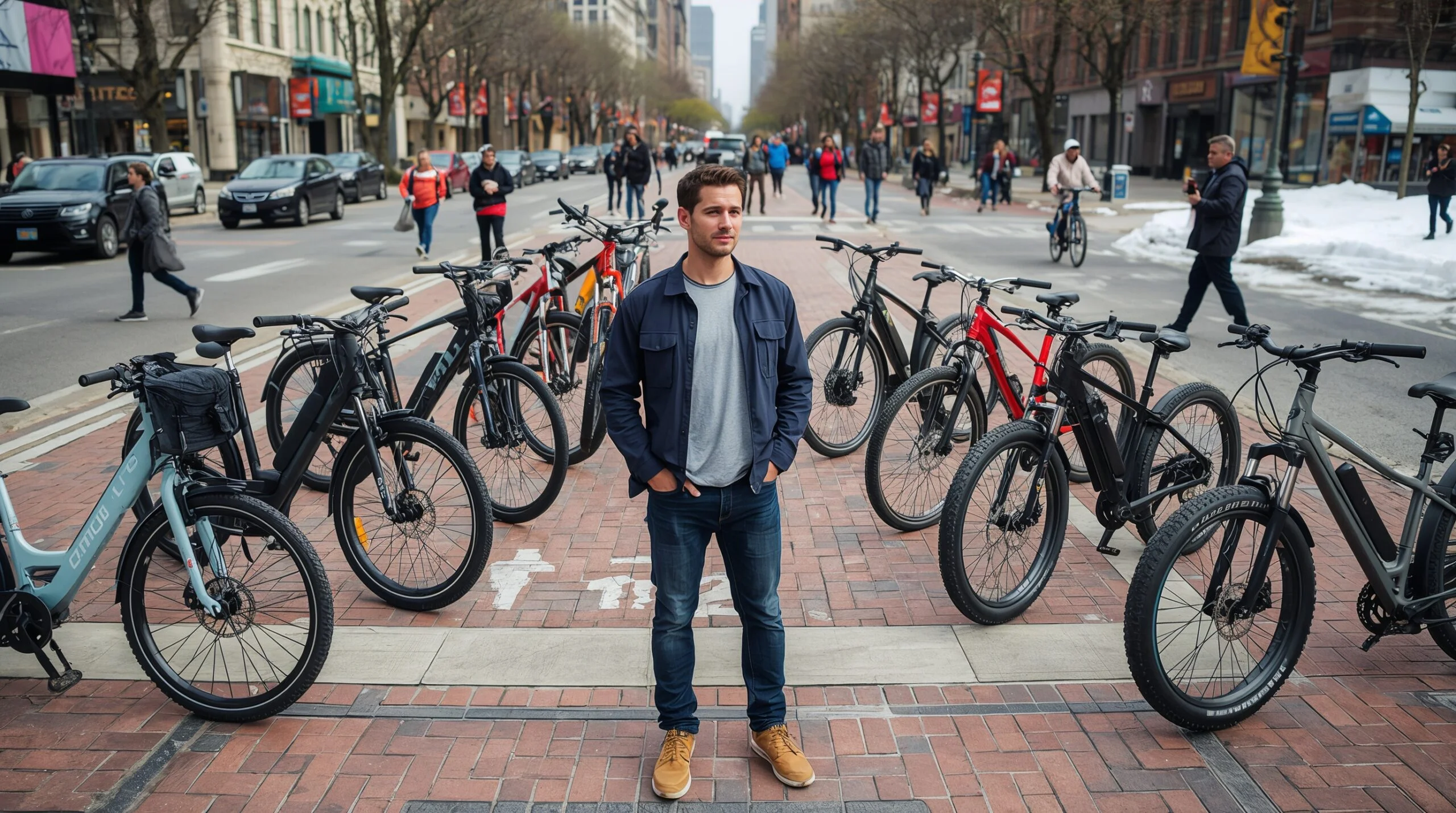
The 10 main types of electric bikes are commuter, hybrid, road, gravel, mountain, folding, cargo, cruiser, touring, and fat-tire e-bikes. The right one depends on your route, hills, cargo, storage space, and preferred riding feel.
These are riding-purpose categories. Other labels describe different features: step-through describes the frame, Class 2 describes motor assistance, and mid-drive describes motor position. One bike can belong to several categories at the same time.
Electric bike types at a glance

| Type | Best for | Main advantage | Main trade-off |
|---|---|---|---|
| Commuter | Work, school, and errands | Practical everyday equipment | Weight and theft risk |
| Hybrid | Roads, paths, and mixed everyday use | Versatility | Less specialized |
| Road | Fitness and efficient paved riding | Lightweight, responsive feel | Sportier position and limited cargo |
| Gravel | Pavement, gravel, and light trails | Mixed-surface efficiency | Not intended for technical trails |
| Mountain | Steep, rough off-road terrain | Suspension, grip, and control | Cost and maintenance |
| Folding | Apartments, cars, and transit | Compact storage | May still be heavy |
| Cargo | Children, groceries, and equipment | High carrying capacity | Size, handling, and parking |
| Cruiser | Relaxed recreational rides | Upright comfort | Weight and lower efficiency |
| Touring | Long rides with luggage | Distance comfort | Charging and range planning |
| Fat-tire | Sand, snow, and loose ground | Flotation and traction | Weight and rolling resistance |
The quickest way to choose

Answer these five questions before comparing individual models.
1. Where will you ride most often?
Choose for your normal route—not an occasional trip you might take someday.
Consider:
- Paved streets
- Protected bike paths
- Gravel roads
- Smooth trails
- Technical mountain-bike trails
- Sand or snow
2. How steep is the route?
Flat streets place different demands on a motor than repeated steep climbs with a child or heavy groceries.
Think about:
- The length of each climb
- How often you stop and restart
- Rider and cargo weight
- Available gearing
- Brake quality
3. What will you carry?
A laptop bag may require only a rack. Children, tools, or large grocery loads may require a cargo frame, approved passenger equipment, stronger brakes, and a higher total load rating.
4. Where will you store the bike?
Measure the actual space.
Include:
- Doorways
- Elevators
- Stairs
- Hallways
- Car storage
- Workplace parking
- The final storage area
A bike marketed as compact or folding may still be difficult to lift.
5. How should the assistance feel?
Some riders want support that increases naturally with pedaling effort. Others prefer consistent assistance or a throttle for starting from a stop.
A realistic test ride is more useful than comparing specifications alone.
Why one e-bike can have several labels

Electric bikes are classified in four separate ways.
Riding purpose
This explains what the bike is designed to do.
Examples include commuter, mountain, cargo, folding, and touring.
Frame design
This explains the bike’s physical layout.
Examples include step-through, step-over, long-tail, front-loader, folding, and tricycle.
Assistance type and class
This explains how the motor activates and when its assistance stops.
Examples include pedal assist, throttle assist, Class 1, Class 2, and Class 3.
Motor and sensor system
This explains where the motor is positioned and how it reacts to pedaling.
Examples include front-hub, rear-hub, and mid-drive motors, plus cadence and torque sensors.
A single model could therefore be a:
Step-through, Class 2, rear-hub, torque-sensor commuter e-bike.
Each label describes a different feature.
The most useful buying formula is:
Riding purpose + frame + assistance class + motor system
Commuter or hybrid: which is better for daily use?

Choose a commuter e-bike when practicality comes first
A commuter e-bike is designed around transportation.
Common features include:
- Integrated lights
- Fenders
- Rear rack or rack mounts
- Kickstand
- Comfortable street-oriented position
- Tires suited to paved routes
It is a logical choice when you regularly ride to work, school, stores, or appointments.
Check:
- Whether you can lock the frame and wheels securely
- Whether the battery is removable
- Where you will charge it
- Whether the rack supports your intended load
- Whether the bike fits at home and work
- Whether local shops can service it
Choose a hybrid when versatility matters more
A hybrid e-bike balances comfort and efficiency across paved streets, bike paths, canal paths, and smoother unpaved routes.
It may be a better fit when you want one bike for:
- Commuting
- Weekend recreation
- Paved bike paths
- Light gravel
- General fitness riding
The categories can overlap:
Commuter describes the job. Hybrid describes versatility and geometry.
A single bike can be both.
Road, gravel, or touring: which fits longer rides?

Road e-bikes
Road e-bikes prioritize efficient paved riding and an active cycling experience.
They may include:
- Drop handlebars
- Narrower tires
- A sportier riding position
- Lower overall weight
- Assistance tuned to complement active pedaling
Choose one for fitness rides, group rides, and longer paved routes when responsive handling matters more than upright comfort or large cargo capacity.
A road e-bike may be a poor fit when you need:
- An upright position
- Large panniers
- Frequent stop-and-go convenience
- Rough-surface capability
Gravel e-bikes
Gravel e-bikes bridge the gap between road efficiency and light off-road use.
They are commonly suited to:
- Paved roads
- Gravel roads
- Hard-packed paths
- Canal routes
- Bikepacking
- Light trails
Choose gravel rather than mountain when mixed-surface efficiency matters and your routes do not include repeated rocks, drops, roots, or major impacts.
Touring e-bikes
Touring e-bikes prioritize long-distance comfort, stable handling, and luggage.
Before choosing one, evaluate:
- Realistic battery range
- Charging opportunities
- Rack and pannier compatibility
- Riding position
- Replacement-tire availability
- Repair support along the route
Advertised maximum range is not a guaranteed result. Terrain, wind, temperature, speed, assistance level, tire pressure, rider weight, and cargo can all affect actual distance.
Mountain or fat-tire: what does your terrain require?

Electric mountain bikes
An electric mountain bike, or e-MTB, is designed for off-road terrain that requires suspension, traction, braking, and component durability.
It may include:
- Front or full suspension
- Wide, knobby tires
- Strong hydraulic brakes
- Trail-oriented geometry
- Reinforced wheels
- A mid-drive motor
Choose an e-MTB when you regularly ride genuine mountain-bike terrain.
Do not choose one only because your local streets have potholes. The added suspension, tires, weight, and maintenance may solve problems you do not have.
Check:
- Trail difficulty
- Local access rules
- Suspension type
- Tire suitability
- Brake specifications
- Motor and suspension service
- Ongoing maintenance requirements
Electric-bike access differs among states, cities, parks, land managers, and individual trails.
Fat-tire e-bikes
Fat tires can add flotation and traction on:
- Sand
- Snow
- Loose ground
- Rough recreational paths
They may also soften smaller bumps when used at an appropriate tire pressure.
Common trade-offs include:
- More weight
- Greater rolling resistance
- Larger storage requirements
- Higher replacement-tire cost
- Reduced efficiency on ordinary paved roads
Fat tires alone do not make a bike suitable for technical mountain-bike trails. Geometry, brakes, suspension, wheels, handling, and component strength also matter.
Folding or compact: which solves your storage problem?

Folding e-bikes
A folding e-bike reduces its stored size. It does not necessarily reduce its weight.
Before buying, check:
- Complete weight with the battery
- Weight after removing the battery
- Exact folded dimensions
- Whether it rolls while folded
- How securely the hinge locks
- How long folding takes
- Whether it fits your elevator, car, train, or closet
- Whether you can lift it safely
A folding model is best when compact storage matters more than minimum weight.
Compact non-folding e-bikes
A compact bike may use smaller wheels, a short frame, folding pedals, or a rotating handlebar without folding through the main frame.
This may be a better option when:
- You need a shorter bike for an apartment or car
- You do not need to carry it as luggage
- You want to avoid a frame hinge
- You prefer a simpler daily setup
The real decision is not always “folding or standard.” It may be “small enough to store or small enough to carry.”
Cargo e-bikes: choose by what you carry

Cargo bikes differ mainly in load position, capacity, length, and handling.
Long-tail cargo bikes
A long-tail extends the rear section of a familiar bicycle layout.
It may work well for:
- Children using approved passenger equipment
- Large panniers
- Groceries
- Work gear
- Riders who prefer conventional steering
Front-loader cargo bikes
A front-loader places a box or platform between the rider and front wheel.
It may work well for:
- Large grocery loads
- Boxes
- Work equipment
- Carrying children in front
- Keeping cargo low and visible
Its longer wheelbase and steering behavior can require practice.
Compact utility bikes
A compact utility bike provides more carrying ability than a standard commuter without taking up as much space as many full-length cargo bikes.
It can suit:
- Urban errands
- Moderate grocery loads
- Limited garage space
- One passenger using approved equipment
- Riders who want a more manageable bike length
Cargo-bike checks that matter
Verify:
- Maximum total permitted weight
- Rider limit
- Rack and passenger limits
- Approved child seats
- Approved passenger accessories
- Brake specifications
- Kickstand stability
- Low-speed handling
- Parking space
- Local passenger rules
A large rack is not proof that the bike is approved to carry a person.
Cruiser e-bikes: when comfort matters most

Cruiser e-bikes commonly use:
- Upright seating
- Swept-back handlebars
- Wide saddles
- Relaxed steering
They can be comfortable on flat or gently rolling recreational routes.
They may be a poor fit when you need:
- Easy lifting
- Compact storage
- Efficient pedaling
- Sustained steep climbing
- Technical trail handling
A cruiser is not automatically the easiest beginner option. A lighter commuter or hybrid may be easier to maneuver and store.
Choose a frame you can control comfortably

Step-through frames
A step-through frame has a low or absent upper frame tube.
It can help riders who:
- Make frequent stops
- Carry cargo
- Have limited hip mobility
- Find a high top tube uncomfortable
- Want easier mounting and dismounting
Step-through is a frame design—not an age or gender category. It appears on commuter, cruiser, folding, cargo, and other e-bikes.
Step-over frames
A step-over frame uses a higher top tube and resembles a traditional diamond-frame bicycle.
It may suit riders who:
- Prefer traditional geometry
- Can comfortably swing a leg over the bike
- Want a performance-oriented design
- Are considering road, gravel, or mountain models
Choose based on clearance and comfort rather than appearance.
Electric trikes
Electric trikes do not require the rider to balance while stopped and may provide useful low-speed stability.
However, they:
- Are wider than bicycles
- Respond differently to sloped roads
- Require more storage
- Can be difficult to transport
- May tip during sharp or fast turns
Test-riding the actual trike is especially important.
Choose how the motor responds

Pedal assist
Pedal assist activates while you turn the pedals.
It suits riders who want:
- A bicycle-like experience
- Adjustable support
- Exercise with assistance
- More control over battery use
Throttle assist
A throttle provides motor assistance through a handlebar control without requiring continuous pedaling, subject to the bike’s design and applicable rules.
It can be helpful for:
- Starting from a stop
- Brief low-speed movement
- Stop-and-go traffic
- Riders who find initial acceleration difficult
Check local rules before choosing a throttle-equipped bike.
Cadence sensing
A cadence sensor detects pedal rotation and supplies assistance according to the selected mode and system programming.
It may suit riders who prioritize:
- Simpler operation
- Consistent assistance
- Easier cruising
- Lower purchase price
Torque sensing
A torque sensor measures pedaling force and changes support in response to rider effort.
It may suit riders who prioritize:
- A more natural response
- Fine low-speed control
- Assistance proportional to effort
- Better modulation on changing terrain
Neither sensor is universally better. Motor tuning, controller software, assistance modes, and rider preference also affect the result.
Understand Class 1, Class 2, and Class 3

The commonly used US three-class model describes how motor assistance operates.
| Class | Assistance | Common cutoff |
|---|---|---|
| Class 1 | Pedal assist | 20 mph |
| Class 2 | Throttle-capable assistance | 20 mph |
| Class 3 | Pedal assist | 28 mph |
These are assistance classes—not frame or riding categories.
The federal CPSC product definition is separate. It covers certain two- or three-wheeled bicycles with fully operable pedals, a motor of less than 750 watts, and a motor-only speed below 20 mph under specified test conditions.
That federal product definition does not create one operating rule for every road, path, park, or trail. State rules vary, and local authorities or land managers may add restrictions.
Action: Check the rules for the exact roads, bike paths, parks, and trails you expect to use.
US legal information checked July 24, 2026.
Match the motor to your terrain

| Motor | Strong starting point for | Main consideration |
|---|---|---|
| Rear hub | Everyday riding and value-focused bikes | Rear-wheel weight and servicing |
| Mid-drive | Steep hills, cargo, and demanding trails | Cost and drivetrain wear |
| Front hub | Simple or specialized systems | Steering feel and front-wheel traction |
Rear-hub motors
A rear-hub motor powers the rear wheel directly.
It is commonly used on:
- Commuter bikes
- Folding models
- Cruisers
- More affordable e-bikes
It can provide straightforward assistance but adds weight and servicing complexity to the rear wheel.
Mid-drive motors
A mid-drive sits near the crank and transfers power through the bicycle drivetrain.
Because it works with the bike’s gearing, it is often worth considering for:
- Steep climbs
- Heavy cargo
- Mountain biking
- Routes with frequent changes in gradient
Trade-offs can include higher cost, greater drivetrain wear, and more specialized repair requirements.
Front-hub motors
A front-hub motor powers the front wheel.
It may appear in conversion systems and some simple city bikes. The pulling sensation and added front-wheel weight can affect steering, while traction deserves attention on loose or slippery climbs.
Motor position is only one factor. Gearing, software tuning, battery output, total weight, tires, and rider input also affect performance.
Best starting points for common situations

| Situation | Sensible starting point | Prioritize |
|---|---|---|
| Flat city commute | Commuter or hybrid with rear-hub assistance | Security, storage, rack, and battery removal |
| Steep commute | Commuter or hybrid with mid-drive assistance | Gearing, brakes, total weight, and service |
| Apartment and train | Folding or compact e-bike | Measured size, lifting weight, and transit rules |
| Children and groceries | Long-tail, front-loader, or compact cargo bike | Load ratings, passenger equipment, and stability |
| Mixed roads and light trails | Hybrid or gravel e-bike | Tires, comfort, and realistic range |
| Technical trails | Purpose-built e-MTB | Access, suspension, brakes, and maintenance |
| Long-distance trips | Touring, road, gravel, or efficient hybrid | Range, charging, luggage, and parts |
| Sand or snow | Fat-tire e-bike | Weight, storage, tire cost, and surface need |
These are starting points rather than universal prescriptions. Fit, local law, component quality, and test-ride results may change the final choice.
Avoid these expensive mistakes

| Mistake | Better question |
|---|---|
| Treating Class 3 as a bike style | What is the bike designed to do? |
| Treating mid-drive as a complete category | Which use, frame, class, and motor combination fits me? |
| Assuming folding means lightweight | Can I lift it, and does it fit my measured space? |
| Assuming fat tires create mountain-bike capability | Are the frame, brakes, suspension, and components trail-ready? |
| Choosing only by motor wattage | How does the complete system perform on my route? |
| Ignoring total bike weight | Can I move it safely when the motor is off? |
| Treating maximum range as guaranteed | What range is realistic for my terrain and load? |
| Judging cargo capacity by rack size | What are the approved load and passenger ratings? |
| Ignoring replacement batteries | Is a compatible replacement available and affordable? |
| Assuming every e-bike is legally a bicycle | Do its power, speed, and equipment comply locally? |
| Buying before measuring storage | Does it fit every doorway and storage area? |
| Choosing price over service support | Can parts and qualified repairs be obtained locally? |
Complete this pre-purchase check

Fit and control
Confirm that you can:
- Mount and dismount comfortably
- Reach every control
- Place a foot down confidently
- Turn at low speed
- Push the bike without motor assistance
- Lift or move it when necessary
- Control it with the intended cargo
Whenever possible, test the bike under conditions similar to your real route.
Battery and charging
Use only the charger provided or recommended by the manufacturer. CPSC advises riders to follow manufacturer charging instructions, remain present while charging, and avoid charging while asleep or away from home.
Check:
- Battery and charger compatibility
- Replacement-battery availability
- Warranty terms
- Visible battery damage
- Charging and storage instructions
- Current recalls or safety warnings
Brakes, tires, and load limits
Verify:
- Total permitted system weight
- Rider limit
- Passenger limit
- Rack and cargo limit
- Brake specifications
- Tire suitability
- Replacement-part availability
The total load must account for the rider, accessories, cargo, and passengers—not only what sits on the rack.
Electrical-system certification
UL 2849 evaluates an e-bike’s electrical drive train, battery, and charger combination for electrical and fire-safety risks.
It should not be presented as certification of every aspect of the bike.
A precise interpretation is:
UL 2849 provides evidence that the defined electrical system was evaluated against the standard’s requirements. It does not guarantee braking performance, handling, maintenance quality, or safe rider behavior.
Parts and repair support
Confirm that you can obtain:
- Replacement battery
- Correct charger
- Controller
- Display
- Sensors
- Motor service
- Brake parts
- Tires and tubes
- Diagnostic support
- Warranty repairs
A lower purchase price may become poor value when proprietary parts cannot be sourced.
Make your shortlist in five minutes

Before comparing brands or prices, write down:
- Your normal route and surface
- The steepest regular hill
- Your rider, passenger, and cargo needs
- Your measured storage space
- Your preferred assistance feel
- The classes allowed on your routes
- The nearest shop that can service the system
Then shortlist no more than three configurations.
For example:
- Flat city commute: commuter or hybrid, rear hub, rack and fenders
- Hilly family transport: cargo frame, mid-drive, torque sensor, strong brakes
- Apartment and train: folding or compact frame, removable battery, verified carrying weight
- Mixed roads and gravel: hybrid or gravel frame, suitable tires, comfortable position
Compare individual models only after the configuration is clear.
The best electric bike is not the one with the longest specification list. It is the one you can comfortably ride, safely store, legally use, and realistically maintain.
Frequently asked questions

What is the best type of electric bike for a beginner?
A commuter or hybrid with predictable assistance, comfortable geometry, manageable weight, and local repair support is often a sensible starting point. Fit and control matter more than a “beginner” label.
Which electric bike is best for steep hills?
A mid-drive bike with suitable gearing is often worth considering for repeated steep climbs. Total weight, hill length, braking, tires, and service support also matter.
Are folding electric bikes easy to carry?
Not always. Some become compact but remain heavy. Check complete weight, battery-removal weight, folded dimensions, lifting points, and whether the bike rolls while folded.
Is step-through a separate type of electric bike?
Step-through is a frame design. A step-through model can also be a commuter, cruiser, cargo, folding, or hybrid e-bike.
Are Class 1, Class 2, and Class 3 different bike styles?
No. They describe how motor assistance operates within the commonly used three-class model. They do not describe the frame or intended use.
Can one bike belong to several categories?
Yes. A bike can simultaneously be a step-through, Class 2, rear-hub, torque-sensor commuter e-bike.
Research and review note

This guide synthesizes the supplied electric-bike content strategy with current CPSC guidance, PeopleForBikes policy resources, and UL documentation. It does not claim that every bike category or motor system was personally tested.
Before publication, the legal and safety passages should be reviewed by an appropriately qualified US policy or safety professional. Mechanical guidance should be reviewed by an experienced bicycle mechanic.
Pingback: Electric Bike vs Bicycle: Which One Is Right for You? - electricscootercar.com
Pingback: Are Electric Bikes Vehicles or Bicycles? U.S. Laws Explained - electricscootercar.com
Pingback: Electric Bike Frame Design: Fit, Strength & Compatibility - electricscootercar.com
Pingback: SEO Title: Electric Bike Tire Types: Choose the Right Size, Tread & Fit - electricscootercar.com
Pingback: E-Bike Suspension: Do You Need It? Types, Travel & Setup - electricscootercar.com
Comments are closed.