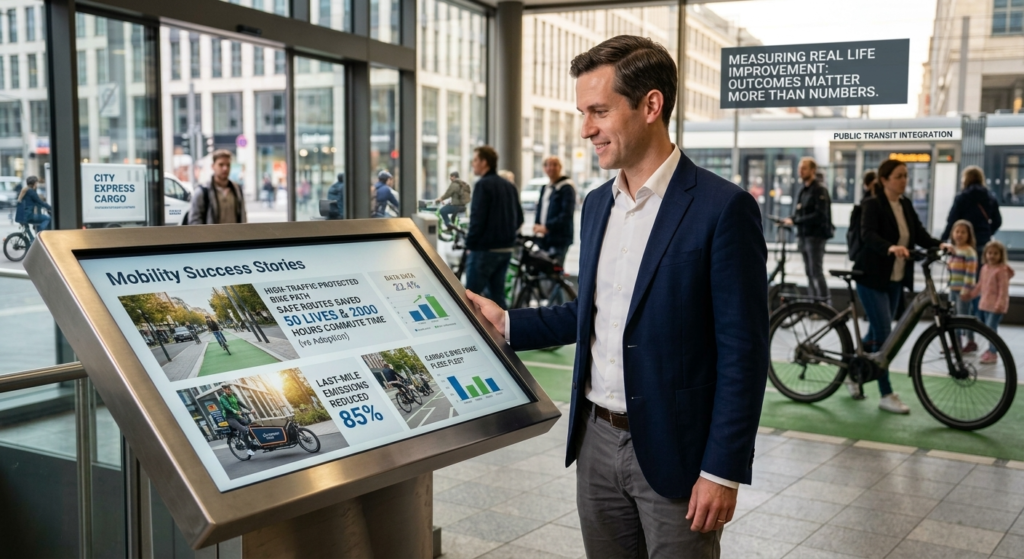
E-bikes can improve urban mobility, but not simply because more people ride them. The strongest city-level gains occur when e-bike trips replace meaningful car travel and when safe routes, secure parking and useful destinations make that switch practical enough to repeat.
When e-bikes replace walking, conventional cycling or public transport instead, the effects on congestion and parking are smaller or different. Some e-bike journeys are also entirely new trips, which can increase access without replacing another mode.
So if you want to judge whether e-bikes are helping a city, start with one question:
What did the e-bike trip replace?
From there, four factors matter most: how many trips change, where they happen, whether infrastructure supports them and who can realistically use the system.
How E-Bikes Change Travel: Start With What They Replace

Transport researchers call a switch from one form of travel to another modal shift.
For e-bikes, that shift might be from a car, train, bus, conventional bicycle or walking. It can also involve a journey that would not otherwise have happened.
Those cases should not be treated as equivalent.
| What the e-bike replacesLikely urban effect | |
|---|---|
| Car trip | Can reduce motor-vehicle traffic and destination parking demand |
| Public transport trip | Changes transit demand but usually provides less direct congestion relief than replacing a car |
| Walking trip | May increase range or reduce travel time, with little direct effect on car traffic |
| Conventional bicycle trip | Can make longer or hillier journeys easier, but changes street-space demand relatively little |
| No previous trip | Creates additional mobility or access rather than directly removing another trip |
The practical takeaway is simple: one additional e-bike trip does not automatically equal one fewer car trip.
U.S. transportation research has examined e-bike use in relation to car substitution, infrastructure, access and safety, while studies from other countries show that substitution patterns vary by location and user group. The Federal Highway Administration’s e-bike research material is a useful U.S. starting point.
A 2026 study examining private and shared e-bike use in Lisbon and Madrid also found that the two ownership models showed different substitution patterns. That distinction matters later when considering shared-bike programs.
Car, Transit, Walking—or a Trip That Wouldn’t Happen Otherwise?
Car replacement generally offers the largest direct opportunity to change urban road and parking demand.
But replacing another low-space mode can still benefit the individual rider. Someone who previously walked may reach a farther destination. A person who used a conventional bicycle may find a difficult hill or longer commute manageable. Someone poorly served by transit may gain access to a job or service that previously required an impractical journey.
New trips deserve the same nuance.
If an e-bike enables someone to reach employment, healthcare or social activities they previously could not reach conveniently, additional travel can represent an accessibility gain rather than a transport failure.
The system effect therefore depends on both what disappeared and what became possible.
Why People Switch Modes
Electric assistance changes the practical effort required for a bicycle journey.
That can make e-bikes attractive where riders face:
- longer urban distances;
- hills;
- physical-effort concerns;
- slow or indirect transit;
- traffic delays;
- difficulty finding car parking;
- or the need to carry modest loads.
The switch still has to feel practical.
A rider may be physically capable of making a five-mile e-bike journey but continue driving because one intersection feels dangerous or because there is nowhere secure to leave the bike.
That is why mode choice and infrastructure cannot be evaluated separately.
Fewer Car Trips Do Not Always Mean Fewer Cars
Several different outcomes are often compressed into the phrase “reducing car dependence.”
They should be separated.
A household could:
replace one car trip → drive fewer annual miles → reduce its share of trips made by car → rely less heavily on the car → eventually decide it does not need a second vehicle
Evidence for an earlier step does not prove the later ones.
Studies from places including Lausanne, Shanghai and Germany have produced context-dependent findings on car use and ownership.
The safest conclusion is that e-bikes can reduce car travel without assuming that households will necessarily give up their cars.
When E-Bikes Can Actually Reduce Traffic and Parking

E-bikes can reduce traffic pressure when they replace enough motor-vehicle journeys in the places and at the times where road capacity is constrained.
That means e-bike sales alone are a poor measure of congestion impact.
Consider two hypothetical cities.
In City A, 1,000 additional daily e-bike journeys mostly replace cars traveling into a congested employment district during busy periods.
In City B, the same number of new e-bike journeys mostly replace walking, cycling and transit.
Both cities gain 1,000 e-bike trips. City A has much greater potential for direct traffic relief.
The size of the effect therefore depends on four things:
- Previous mode: Were cars actually displaced?
- Scale: Is the change large enough relative to motor traffic?
- Location and timing: Are the affected streets congested when the substitution occurs?
- Network conditions: Can riders make those journeys safely and consistently?
Without those conditions, “more e-bikes means less congestion” is too broad a claim.
Why Vehicle Size Matters in Dense Streets
Urban congestion is partly a problem of physical space.
An e-bike occupies far less street and storage space than a passenger car. That gives it an important advantage for suitable trips in dense areas where road and curb space are scarce.
Exact capacity comparisons should be treated cautiously because street performance depends on intersections, vehicle speeds, lane design and traffic mix.
The broad distinction is more useful:
Electrifying a car changes how the vehicle is powered. Replacing a car trip with an e-bike also changes how much physical space the trip requires.
Parking Benefits Require Real Car-Trip Replacement
Traffic flow and vehicle storage are separate problems.
If a commuter switches from driving to an e-bike, that journey may remove both a car from the road and the need to park it at the destination.
If the rider previously walked or used a train, the same parking benefit does not occur.
Cities evaluating e-bike programs should therefore look beyond ownership figures and ask how many car journeys—and particularly journeys requiring destination parking—actually disappeared.
Why an E-Bike and an Electric Car Solve Different Urban Problems
Electric cars can reduce problems associated with combustion engines, but they remain car-sized vehicles.
They still occupy road space and require parking.
For short and medium urban trips that can reasonably be made by bicycle, an e-bike can address a different constraint: the amount of physical city space required to move one person.
That does not make e-bikes universal car replacements. Passenger needs, disability requirements, long distances, weather, large loads and other circumstances can make a car the practical choice.
The useful comparison is therefore not “Which vehicle is always better?” It is which journeys genuinely require a car-sized vehicle?
Why Infrastructure Decides Whether the Benefits Scale

Electric assistance can make a journey physically easier without making the route feel safe or usable.
That creates a simple chain:
possible e-bike trip → feasible route → repeatable journey → meaningful mode shift
If the route fails at the second step, the city may never receive the later mobility benefit.
A 2025 transport study focused on Wuppertal illustrates why infrastructure and substitution should be considered together rather than as unrelated topics.
A Network Is Only as Useful as Its Weakest Link
Imagine a route with a quiet residential street, a protected cycling corridor and a convenient destination.
Then place one high-speed, difficult intersection in the middle.
For many potential riders, that single gap can determine whether the entire journey feels usable.
That is why connected routes generally matter more than isolated pieces of cycling infrastructure. The relevant question is not only how much infrastructure exists, but whether it connects homes with employment, shops, schools, services and transit.
As e-bikes allow people to contemplate longer journeys, network continuity becomes even more important because a longer route creates more opportunities to encounter a weak link.
Secure Parking Is Part of the Trip
A journey is not complete when the rider reaches the destination.
An e-bike also needs somewhere reasonably secure to stay.
Theft risk can discourage commuting, shopping and transit connections even when the riding route itself works well. That makes destination parking part of the mobility system rather than merely a convenience.
For transit integration, secure parking at stations is particularly important because the bicycle may remain unattended for hours.
A usable network therefore needs both:
a route people are willing to ride + a destination where they are willing to leave the bike
Do E-Bikes Strengthen Transit—or Replace It?

They can do both.
E-bikes can help people reach a train or bus stop from farther away, expanding the practical catchment area of public transport.
They can also replace an entire transit journey when riding directly is faster or simpler.
Research on e-bike and public-transport integration supports treating the relationship as context dependent rather than automatically complementary.
Where E-Bikes Solve First- and Last-Mile Problems
Public transport can move large numbers of people efficiently along major corridors, but reaching the station may still be inconvenient.
An e-bike can bridge that gap.
A typical multimodal trip could be:
Home → e-bike → station → train or bus → destination
This becomes more practical when the route to the station is safe and secure parking is available.
Shared e-bikes can play a similar role at the destination end of a transit journey without requiring travelers to own or transport a bicycle.
When the E-Bike Becomes the Whole Journey
An e-bike may replace transit entirely when:
- the destination is within a practical riding distance;
- transit requires a transfer;
- service is infrequent;
- access or waiting time is substantial;
- or the bicycle provides a much more direct route.
That substitution is not inherently good or bad.
For the traveler, it may mean a faster or more flexible journey. For the wider transport system, however, replacing a car and replacing a train passenger have different implications.
A city therefore needs to know which mode lost the trip, not merely that e-bike use increased.
Who Gains Better Access, and Who Can Still Be Left Out?

E-bikes can make certain journeys possible for people who find conventional cycling too far, too hilly or too physically demanding.
But easier movement does not automatically produce equitable mobility.
Three questions should be kept separate:
Can I physically make the trip?
Can I reach the job, school, shop or service I need?
Do people across different neighborhoods and circumstances have a reasonable opportunity to do the same?
Those are questions about physical mobility, accessibility and equity respectively.
Electric Assistance Can Expand the Practical Travel Area
Motor assistance can reduce the effort associated with hills and distance.
That may make cycling practical for some older adults and for some people whose physical circumstances make conventional cycling difficult.
It should not be interpreted as evidence that a standard e-bike meets every disability or mobility need. Accessible public transport and other options remain essential.
The important urban effect is that electric assistance can expand the set of destinations some people can reasonably reach by bicycle.
Better Mobility Matters Most When It Reaches Useful Destinations
Traveling farther is not automatically valuable.
Reaching work, healthcare, education, shops or essential services is.
A 2026 study examining job accessibility in São Paulo reported improved accessibility from e-bikes relative to conventional bicycles under the study’s conditions, while important peripheral inequalities remained.
That illustrates the more useful causal chain:
electric assistance → larger practical travel area → more reachable opportunities → remaining structural barriers
Who Can Still Be Excluded?
Common barriers include:
- e-bike purchase cost;
- lack of secure home or destination storage;
- safe infrastructure concentrated in selected neighborhoods;
- very long distances created by urban sprawl;
- smartphone, account or payment requirements for shared systems;
- weak shared-bike availability outside central areas;
- and mobility needs that ordinary e-bikes cannot accommodate.
Research examining electric-micromobility policies across 16 U.S. cities reinforces why distribution and access need to be considered alongside total system use.
A city can therefore make cycling easier without making urban mobility fully equitable.
Shared E-Bikes Behave Differently From Private Ones

A privately owned e-bike and a shared e-bike may use the same street, but the systems around them are very different.
Private ownership gives the rider control over availability. Shared systems depend on fleet distribution, pricing, operating zones, payment access and vehicle availability.
That changes behavior.
A private owner may build a regular commute around the bicycle. A shared user may use an e-bike occasionally for a station connection or a one-way journey.
Research from Lisbon and Madrid found differences between private and shared e-bike substitution patterns, which is why evidence from one model should not automatically be generalized to the other.
Shared Systems Remove One Barrier but Add Others
Shared e-bikes can provide access without requiring someone to buy a bicycle.
That can lower the upfront barrier to occasional use.
But shared access can introduce different constraints:
- per-trip or subscription costs;
- payment requirements;
- smartphone or account access;
- service-area limits;
- uneven neighborhood coverage;
- and bicycles being unavailable when needed.
A fleet can therefore perform well in total ride numbers while still providing poor access in particular neighborhoods.
Public-Space Management Matters Too
Shared fleets introduce operational issues private owners largely handle themselves.
Operators must maintain, charge and redistribute vehicles. Dockless systems also need parking rules that prevent bicycles from blocking sidewalks, curb ramps and other public space.
Poorly managed parking can weaken public acceptance even when the mobility service itself is useful.
For shared e-bikes, success therefore involves both transport performance and public-space management.
Where Cargo E-Bikes Fit Into Urban Freight

Cargo e-bikes can replace some delivery-van movements, particularly in dense areas with short routes, frequent stops and relatively compact loads.
They are not universal freight substitutes.
The International Transport Forum’s work on light cargo vehicles supports a conditional approach: smaller freight vehicles can reduce some urban street-space pressures, but their viability depends on infrastructure, land use and logistics design.
Good Fits and Poor Fits
Better candidates for cargo e-bikes include:
- small parcels;
- local food or service deliveries;
- dense delivery rounds with many short stops;
- and some local business deliveries.
Poorer candidates include:
- very heavy freight;
- unusually bulky loads;
- long-distance routes;
- and logistics operations that require high capacity in a single vehicle.
The measurement principle is the same as for passenger travel.
A cargo e-bike that genuinely replaces a van movement has a different system effect from a cargo bike added on top of the existing van fleet.
Why Micro-Hubs and Loading Space Matter
The final mile is only part of the freight journey.
Goods may still arrive in a larger vehicle before being transferred to cargo bikes near the delivery area. That makes consolidation points or micro-hubs important in some systems.
This does not negate the benefit. It simply means the claim should be precise.
A cargo e-bike may replace urban final-mile van movements without eliminating upstream freight transport.
Cities also need workable loading and parking arrangements. If cargo bikes compete chaotically for curb or sidewalk space, some operational benefits can be undermined.
Safety and Public Trust Can Limit Adoption

E-bike mobility benefits depend on people being willing to ride.
Safety therefore influences both individual risk and whether mode shift can occur at scale.
Urban conflicts can involve motorists, pedestrians and conventional cyclists. They are shaped by street design, intersections, speed differences, rider behavior and where each user is expected to travel.
The U.S. Consumer Product Safety Commission’s Micromobility Information Center provides current U.S. safety information.
Any numerical injury comparison needs careful interpretation because datasets can combine different device types or use different populations and denominators.
Where Conflicts Tend to Arise
Common problem areas include:
- intersections where vehicles cross cycling routes;
- facilities shared by riders traveling at noticeably different speeds;
- constrained pedestrian areas;
- and gaps where protected routes suddenly place riders back into mixed traffic.
Infrastructure can therefore act as a risk modifier rather than safety being purely a matter of rider behavior.
Clearer separation and more predictable movement can reduce some conflicts, while poor design can create situations in which different users compete for the same space.
Modified Devices Can Distort the Debate
Public discussion becomes less useful when every electrically powered two-wheel vehicle is treated as equivalent.
Higher-speed or modified devices may behave differently from ordinary compliant e-bikes, yet visible misuse can influence perceptions of the entire category.
A more useful safety analysis separates:
- Vehicle characteristics
- Street and network design
- Rider behavior or modification
Rules are more likely to address the real problem when cities identify which of those factors is producing the conflict.
What Cities Should Fix—and What They Should Measure

A city should not judge success simply by the number of e-bikes sold, registered or available for rent.
Those figures measure adoption.
They do not tell policymakers whether car travel fell, access improved or safety problems changed.
A better approach is to identify the mobility bottleneck first.
If Unsafe Network Gaps Stop Trips
Action: connect lower-stress routes and address major intersections or missing links.
Measure: repeated use, route coverage and what modes users previously relied on.
If Theft Makes Useful Trips Impractical
Action: improve secure parking at employment centers, shopping areas and transit stations.
Measure: parking use, reported barriers and repeat-trip behavior.
If Transit Has a First- or Last-Mile Problem
Action: improve cycling access to stations, secure parking and mobility-hub connections.
Measure: multimodal journeys and whether the e-bike replaces car access to transit.
If Cost or Access Excludes Potential Riders
Action: design incentives or shared programs around the populations and neighborhoods facing the barrier.
Measure: who participates, where they live and what journeys change after adoption.
Simply counting subsidized bicycles is not enough.
If Shared Bikes Are Unevenly Distributed
Action: evaluate service areas, vehicle availability and payment barriers.
Measure: reliable availability by neighborhood, not only citywide ride totals.
If Cargo E-Bikes Are Intended to Replace Vans
Action: identify suitable delivery zones, routes, loading areas and consolidation needs.
Measure: actual van movements replaced rather than cargo-bike trips alone.
If Safety or Public-Space Conflict Is Growing
Action: use understandable, proportionate rules that address the specific source of conflict.
Measure: collisions, reported conflicts, obstruction and compliance using clearly defined device categories.
The Best Test Is Whether the Transport System Actually Changed
E-bikes are most likely to improve urban mobility when several conditions line up:
- they replace a meaningful amount of car travel;
- safe, connected routes make those trips repeatable;
- riders have secure places to park;
- transit integration fills useful network gaps;
- access extends beyond a small set of advantaged neighborhoods;
- cargo-bike use matches suitable freight tasks;
- and cities measure outcomes rather than ownership alone.
When those conditions are absent, high e-bike adoption may produce much smaller congestion, parking or equity benefits than advocates expect.
The most useful question remains the simplest one:
What changed because this trip was made by e-bike?
Answer that well, and the effects on traffic, parking, transit, access and city space become much easier to understand.
Evidence note: E-bike research varies substantially by geography, ownership model, infrastructure and study design. Findings from one city or shared system should not be treated as universal.
If you’re evaluating whether an e-bike makes sense for your own daily journey rather than its citywide effect, continue with our electric-bike commuting guide.
Pingback: Electric Bike Carbon Footprint: CO₂ per Mile, Lifecycle & Savings - electricscootercar.com
Pingback: Are Electric Bikes Eco-Friendly? It Depends on the Bike—and the Trip It Replaces *** - electricscootercar.com
Pingback: Future of Electric Bikes: What’s Real, Emerging & Worth Waiting For - electricscootercar.com
Comments are closed.