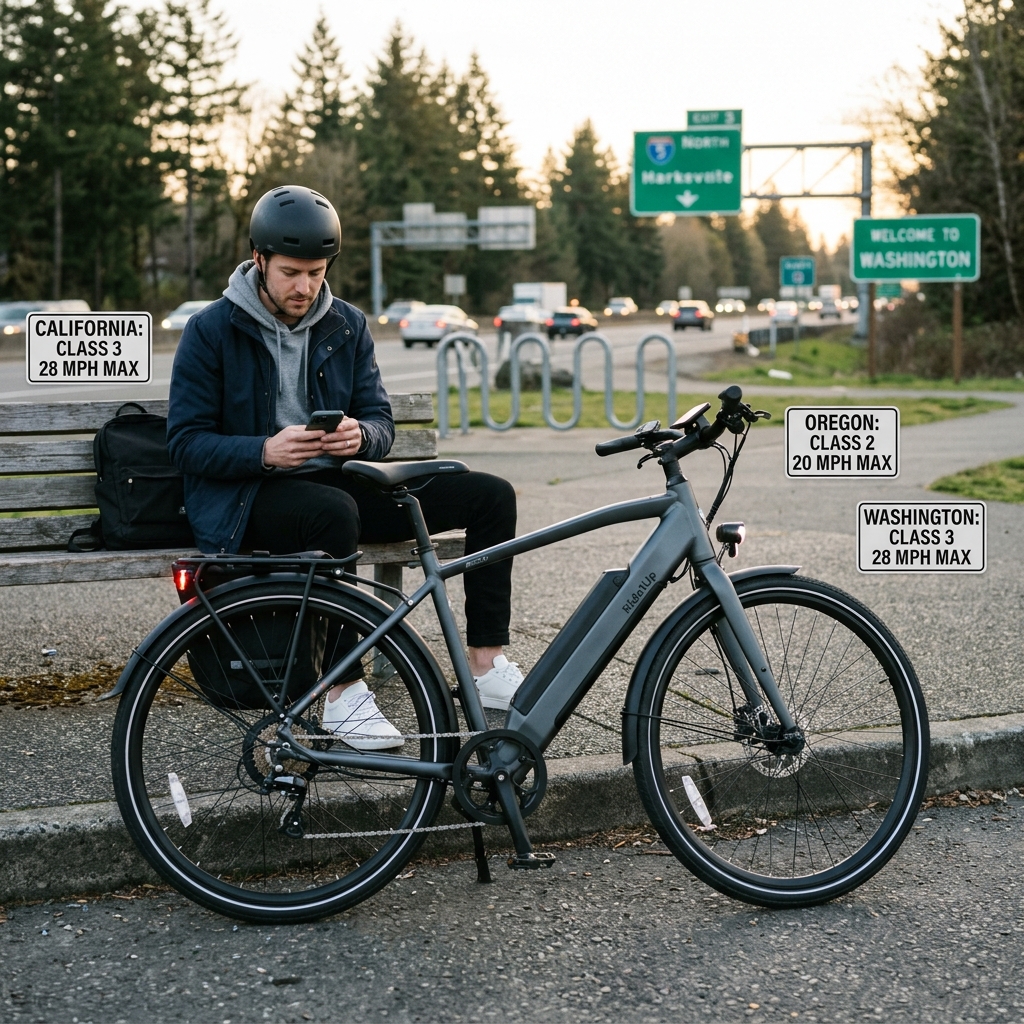
Electric bike speed limits in the USA depend on the bicycle’s classification, state law, and where you ride. Under the widely used three-class system, Class 1 and Class 2 e-bikes generally stop providing motor assistance at 20 mph, while Class 3 e-bikes can provide pedal assistance up to 28 mph in many states.
However, these figures do not mean you can legally ride at those speeds everywhere. Some states use different classifications, and cities, parks, and trail authorities may impose additional restrictions. New York and New Jersey are particularly important examples of why riders should check their local requirements.
This guide explains the common e-bike speed limits in the United States, the difference between motor-assisted speed and actual riding speed, important state-specific rules, and how to check which regulations apply to your bicycle.
What Is the Legal Speed Limit for an Electric Bike in the USA?

There is no single nationwide road-speed limit that answers every question about every electric bicycle. The three-class system is a useful starting point, but state and local laws determine how those classifications apply to actual riding. If you are comparing bicycle designs and riding categories, our guide to types of electric bikes provides additional context.
Class 1, Class 2, and Class 3 E-Bike Speed Limits
| E-bike class | Motor operation | Common assisted-speed cutoff |
|---|---|---|
| Class 1 | Pedal assistance only | 20 mph |
| Class 2 | Throttle-capable; motor can propel the bicycle without pedaling | 20 mph |
| Class 3 | Pedal assistance only | 28 mph in the common framework |
These are the commonly used class definitions. Always check the law in your state before relying on them for a particular bicycle or route. For a broader explanation of how fast electric bikes can go, see our guide to real-world speed and common e-bike classes.
Class 1 electric bikes
A Class 1 e-bike provides motor assistance while you pedal. Under the common classification, assistance stops when the bicycle reaches 20 mph.
These bikes are often used for commuting, recreational cycling, and fitness riding. However, the classification does not automatically guarantee access to every bike path or trail.
Class 2 electric bikes
A Class 2 e-bike can use a throttle to propel the bicycle without pedaling. Under the common framework, motor assistance stops at 20 mph.
Throttle operation and access restrictions can vary by jurisdiction, so check the applicable state and local rules before riding. For more detail on how an e-bike throttle works, see our guide.
Class 3 electric bikes
A Class 3 e-bike generally provides pedal assistance up to 28 mph. These bicycles are often chosen for longer commutes and riders who want additional assistance at higher speeds. Our electric bike commuting guide explains what to consider when choosing an e-bike for a daily route.
Class 3 bikes can face stricter age, helmet, and path-access requirements. Some jurisdictions also define Class 3 differently.
Does Federal Law Set a Nationwide E-Bike Speed Limit?

No. Federal consumer-product law and state or local riding regulations address different legal questions.
Under 15 U.S.C. § 2085, the federal definition of a low-speed electric bicycle for consumer-product purposes includes fully operable pedals, an electric motor of less than 750 watts, and a motor-only maximum speed of less than 20 mph on a paved, level surface under specified test conditions. The CPSC bicycle requirements guidance also summarizes the federal bicycle definition and associated product requirements.
This federal definition should not be confused with the common state-level Class 1, Class 2, and Class 3 framework. If you are unsure whether electric bikes are vehicles or bicycles under the applicable law, check the relevant federal and state definitions.
The federal definition does not establish one universal riding-speed limit for every e-bike in every state. State laws determine how electric bicycles are classified and regulated for road use, while local authorities and facility managers may impose additional restrictions. You should not automatically apply e-bike rules to every other powered two-wheeler; our guide explains how electric bikes compare with scooters.
When checking the legality of an electric bike, distinguish between:
- Federal product rules: The federal definition and applicable consumer-product requirements.
- State laws: E-bike classifications, operating rules, age restrictions, and licensing or registration requirements.
- Local regulations: City speed limits and other applicable restrictions.
- Facility rules: Specific conditions for bike paths, recreational trails, parks, and other managed areas.
Understanding these distinctions helps prevent confusion when buying an e-bike or planning a ride across state lines.
Can You Ride an Electric Bike Faster Than 20 or 28 MPH?

An electric bike can physically travel faster than its motor-assistance cutoff. The cutoff generally determines when the motor stops providing assistance; it does not necessarily prevent the bicycle from moving faster.
For example, a Class 1 e-bike may stop receiving motor assistance at 20 mph while the rider continues pedaling. A bicycle may also travel faster downhill because of gravity and momentum.
However, physical capability and legal permission are two different things.
Consider these examples:
- A Class 1 e-bike reaches 22 mph through pedaling after its motor assistance ends.
- A Class 3 e-bike exceeds 28 mph while descending a hill.
- A bicycle capable of 28 mph enters a shared-use path with a lower posted speed limit.
The legal answer depends on the applicable law and location. The fact that the motor has stopped assisting does not give a rider permission to ignore an otherwise applicable speed limit.
Similarly, a manufacturer’s advertised top speed does not establish that a bicycle qualifies as a legally compliant e-bike. Motor power, throttle operation, labeling, and modifications may also affect its classification.
For more information about real-world performance, read our Electric Bike Top Speed Guide. For realistic average riding speeds, see our Electric Bike Average Speed Guide.
How Do E-Bike Speed Limits Differ by State?

State laws can differ in their classification systems, operating requirements, and restrictions on where electric bikes may be ridden. The following examples illustrate important differences.
California E-Bike Speed Limits
California uses the three-class e-bike framework. Its law also establishes specific requirements for Class 3 riders.
Under California Vehicle Code Section 21213, a person under 16 may not operate a Class 3 electric bicycle. Class 3 riders and passengers must wear a properly fitted and fastened bicycle helmet as required by the statute.
Class 3 riders should also verify whether their bicycle is permitted on the intended route. Compliance with the class definition does not automatically establish access to every path or trail.
Official reference: California Vehicle Code Section 21213.
Texas E-Bike Speed Limits
Texas uses electric bicycle classifications that distinguish lower-speed pedal-assist and throttle-capable bicycles from Class 3 bicycles.
Class 1 and Class 2 e-bikes generally have an assisted-speed cutoff of 20 mph. Class 3 e-bikes can provide pedal assistance above 20 mph, up to the applicable 28 mph limit.
Texas also has requirements concerning Class 3 equipment and rider age. A Class 3 electric bicycle must have a speedometer, and state law generally requires an operator to be at least 15 years old, subject to the statute’s provisions.
Before riding, check the applicable state rules and any restrictions imposed by the city, campus, park, or trail authority.
Official references: Texas Transportation Code, Chapter 664 and Texas Transportation Code, Chapter 551 (PDF).
New York and New York City E-Bike Speed Limits
New York is an important exception to the common 20/20/28 mph framework.
Under New York Vehicle and Traffic Law Section 1242, Class 1 and Class 2 electric bicycles are limited to 20 mph, while Class 3 electric bicycles are limited to 25 mph. The state law also restricts Class 3 operation to a city with a population of one million or more.
New York City has an additional operating-speed rule. The NYC DOT e-bike guidance states that e-bike, e-scooter, and pedal-assist bicycle riders must not exceed 15 mph on city streets.
This means a bicycle’s classification and assisted-speed capability do not automatically determine the speed permitted on a particular route.
If you ride in New York, check both state law and the local requirements for your destination.
Florida E-Bike Speed and Access Rules
Florida generally gives qualifying electric bicycles the rights and duties of bicycles, subject to applicable statutory exceptions.
However, local governments and authorities responsible for bicycle paths, multi-use paths, trails, beaches, and dunes may regulate or restrict e-bike operation in the circumstances covered by state law.
Consequently, an e-bike that complies with its class definition may still be prohibited from a particular recreational route.
Before riding on a beach path, trail, or multi-use route, check the rules published by the responsible local authority.
Official reference: Florida Statutes, Section 316.20655.
New Jersey E-Bike Laws in 2026
New Jersey requires particular attention because its e-bike requirements changed in 2026.
The New Jersey Motor Vehicle Commission distinguishes low-speed electric bicycles from motorized bicycles and other vehicle categories. Its current guidance describes applicable licensing, registration, age, and helmet requirements.
These rules differ from the general assumption that every qualifying electric bicycle can be ridden without licensing or registration. The MVC documented the updated requirements in its June 2026 licensing and registration announcement.
If you live in New Jersey or plan to ride there, check the current New Jersey Motor Vehicle Commission e-bike requirements for your bicycle’s specific category rather than relying solely on a generic Class 1, Class 2, or Class 3 description.
Are Electric Bikes Allowed on Bike Paths and Trails?

Not automatically. Permission to ride depends on the relevant state and local laws and, in managed facilities, the rules of the authority responsible for the route. Our electric bike safety guide provides additional context for riding responsibly.
Roads and Bike Lanes
Check your state’s e-bike classification and road-use requirements. Then verify any applicable posted speed limit, age restriction, equipment requirement, or local rule. Our guide to electric bikes versus traditional bicycles explains some of the practical differences between the two types of transportation.
Shared-Use Paths and Recreational Trails
Some routes permit certain e-bike classes but restrict others. A facility may also impose a lower operating-speed limit than the bicycle’s motor-assistance cutoff.
Before entering a route, check:
- Whether electric bikes are permitted.
- Whether your specific class is allowed.
- Whether a posted or local speed limit applies.
- Whether age, helmet, or other requirements apply.
Electric Bikes in National Parks
The National Park Service — Electric Bicycles in National Parks guidance permits e-bikes where traditional bicycles are allowed, subject to applicable federal regulations and park-specific rules. Park superintendents may impose additional conditions or restrictions, and e-bikes are not permitted in designated wilderness areas under the applicable NPS rules.
Check the official website of the park you intend to visit rather than assuming that state-level permission applies throughout the park.
Do You Need a License, Registration, or Helmet to Ride an E-Bike?
The answer depends on your state and the type of electric bicycle you ride.
Many states do not require a driver’s license for a qualifying e-bike, but this is not a universal rule. New Jersey’s current requirements, for example, include licensing and registration provisions. Other states have age or helmet requirements that vary by class.
A bicycle that falls outside the applicable state’s e-bike definition may also be regulated differently from a conventional bicycle.
Before riding, verify:
- Whether your state requires a license or registration.
- Whether your e-bike class has a minimum rider age.
- Whether a helmet is legally required.
- Whether insurance requirements apply to your vehicle category.
- Whether local authorities impose additional restrictions.
For further information, read our guides to electric bike licensing requirements and Electric Bike Helmet Laws by State.
What Happens If You Modify an E-Bike or Install a Higher-Power Motor?

Modifying an electric bicycle can affect its legal classification.
Motor wattage alone does not answer every question about whether an e-bike is legal. Depending on the applicable law, classification may depend on operable pedals, motor power, motor-assisted speed, throttle operation, labeling, and other characteristics. Our electric bike components guide explains the hardware involved in these systems.
For example, the federal low-speed electric bicycle definition uses a motor rating of less than 750 watts and a specified motor-only speed test. State definitions and requirements may differ.
If you unlock a speed limiter, change the controller, increase the motor’s assisted-speed capability, or install a higher-power motor, check whether the resulting configuration remains compliant with the relevant state law.
Do not assume that selecting a lower speed setting automatically makes a modified bicycle legally equivalent to a conventional Class 1, Class 2, or Class 3 e-bike.
How to Check the Legal Speed Limit for Your E-Bike
Use these steps before buying an electric bicycle, modifying its settings, or riding in an unfamiliar location.
Step 1: Identify Your E-Bike’s Classification
Check the manufacturer’s label and documentation. Confirm the stated class, motor wattage, assisted-speed cutoff, and whether the bicycle has a throttle.
If the label, owner’s manual, and product listing conflict, ask the manufacturer to confirm the exact model and configuration.
Step 2: Check Your State’s Current Law
Look for the official state definition of an electric bicycle and the requirements concerning speed, age, helmet use, licensing, registration, and road access.
Use the actual statute or responsible government agency wherever possible. A retailer’s product description or an online summary is not a substitute for the applicable law.
You can begin with the PeopleForBikes state-by-state e-bike law resource, then verify important details against primary legal sources.
For additional official examples of state-specific rules, consult Washington’s e-bike classification statute, RCW 46.04.169, Colorado’s official electric bicycle classification guide, and Oregon Revised Statutes, Chapter 814. These examples reinforce why you should check the laws and guidance that apply in the jurisdiction where you intend to ride.
Step 3: Check the Specific Route
Identify who manages the road, bike path, trail, or facility. Check whether your e-bike class is permitted and whether a lower operating-speed limit applies.
This is particularly important for shared-use paths, parks, national parks, and recreational trails.
Step 4: Recheck After Modifications or When Traveling
A change in bicycle configuration can affect its legal status. Traveling to another state or using a different managed trail can also change which requirements apply.
Save the relevant official source and record when you checked it, especially if you regularly ride across jurisdictions.
Frequently Asked Questions About E-Bike Speed Limits
Is 28 mph legal for an electric bike in the USA?
Class 3 e-bikes can provide pedal assistance up to 28 mph in the common three-class framework. However, not every state uses the same definition, and local operating-speed or access restrictions may be lower. New York, for example, defines Class 3 at 25 mph, and New York City has a 15 mph operating-speed limit for e-bike riders on city streets.
Can an electric bike go faster than 20 mph?
Yes. An e-bike can physically exceed 20 mph through pedaling or downhill momentum after motor assistance ends. Whether that speed is legal depends on the applicable law and route.
Is a 750W e-bike legal in the USA?
Not automatically everywhere. The federal low-speed electric bicycle definition uses a motor of less than 750 watts, but state definitions and vehicle classifications must also be checked. Motor wattage alone does not establish that a bicycle is legal on every public road or trail.
Do you need a license to ride an electric bike?
Requirements vary by state and bicycle category. Many states do not require a driver’s license for a qualifying e-bike, but New Jersey has specific licensing and registration requirements under its current rules. Always verify the requirements for your state.
Are Class 3 e-bikes allowed on bike paths?
Sometimes, but not everywhere. State or local authorities may restrict Class 3 bikes on particular paths and trails. National parks can also impose class-specific restrictions. Check the rules for the actual route before riding.
What happens if you unlock an e-bike’s speed limiter?
Unlocking a speed limiter can change the bicycle’s assisted-speed capability and may affect its legal classification. The outcome depends on the jurisdiction and the bike’s actual configuration. Verify the manufacturer’s specifications and applicable state law before using a modified e-bike on public roads.
Conclusion
For the common U.S. three-class e-bike framework, Class 1 and Class 2 motor assistance typically ends at 20 mph, while Class 3 pedal assistance typically ends at 28 mph. These are assisted-speed cutoffs, not universal permission to ride at those speeds everywhere.
The applicable legal requirements depend on your bicycle, the state where you ride, and the route you intend to use. Check official sources, especially when riding in jurisdictions with different class definitions or additional licensing, helmet, trail, or local speed requirements.
For a broader overview, continue with our Electric Bike Laws in the USA guide. For practical advice on riding safely in traffic, read our E-Bike Road Safety Tips.
Pingback: How Fast Do Electric Bikes Go? 20 vs 28 MPH - electricscootercar.com
Pingback: Electric Bike vs Bicycle: Which One Is Right for You? - electricscootercar.com
Pingback: How Do Electric Bikes Work? A Simple 6-Step Guide - electricscootercar.com
Pingback: What Is a Throttle on an Electric Bike? How It Works - electricscootercar.com
Pingback: Are Electric Bikes Vehicles or Bicycles? U.S. Laws Explained - electricscootercar.com
Comments are closed.